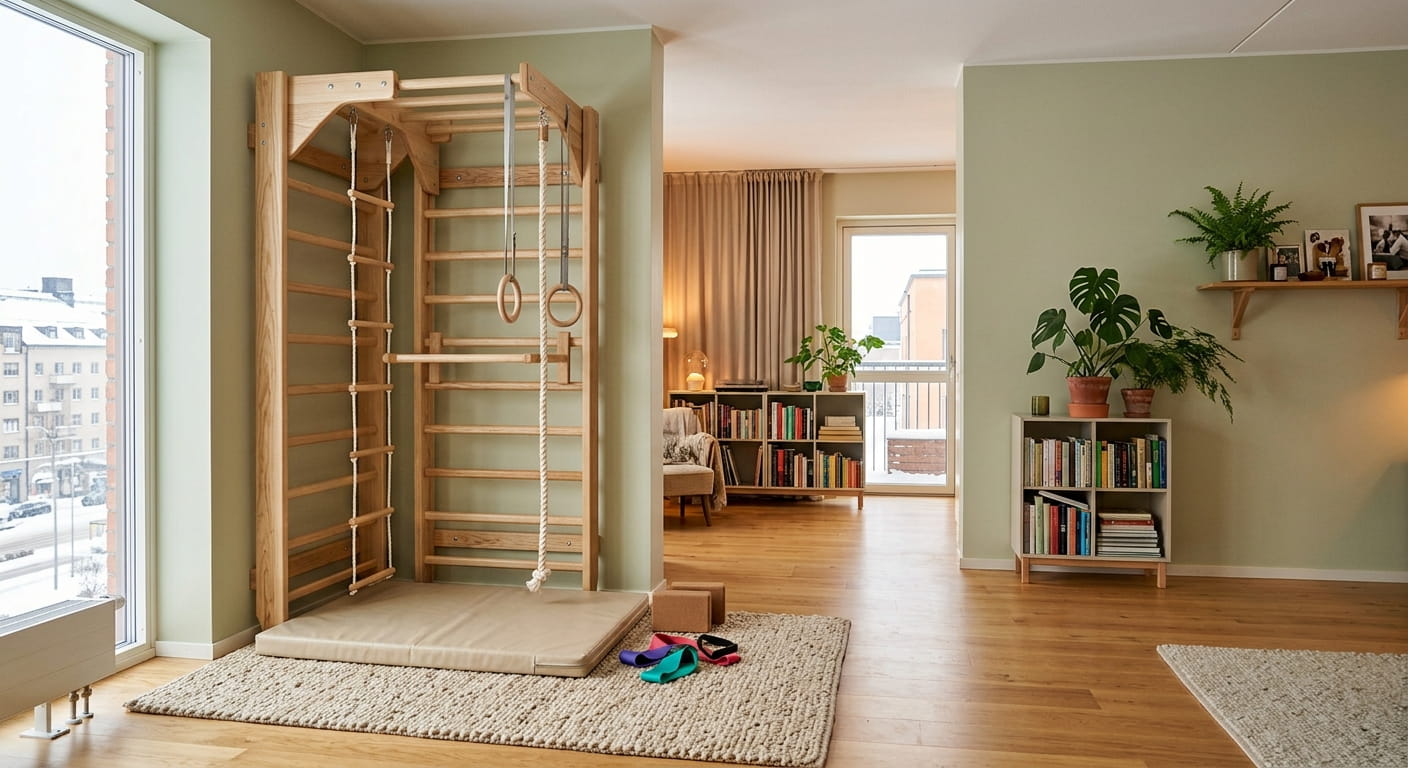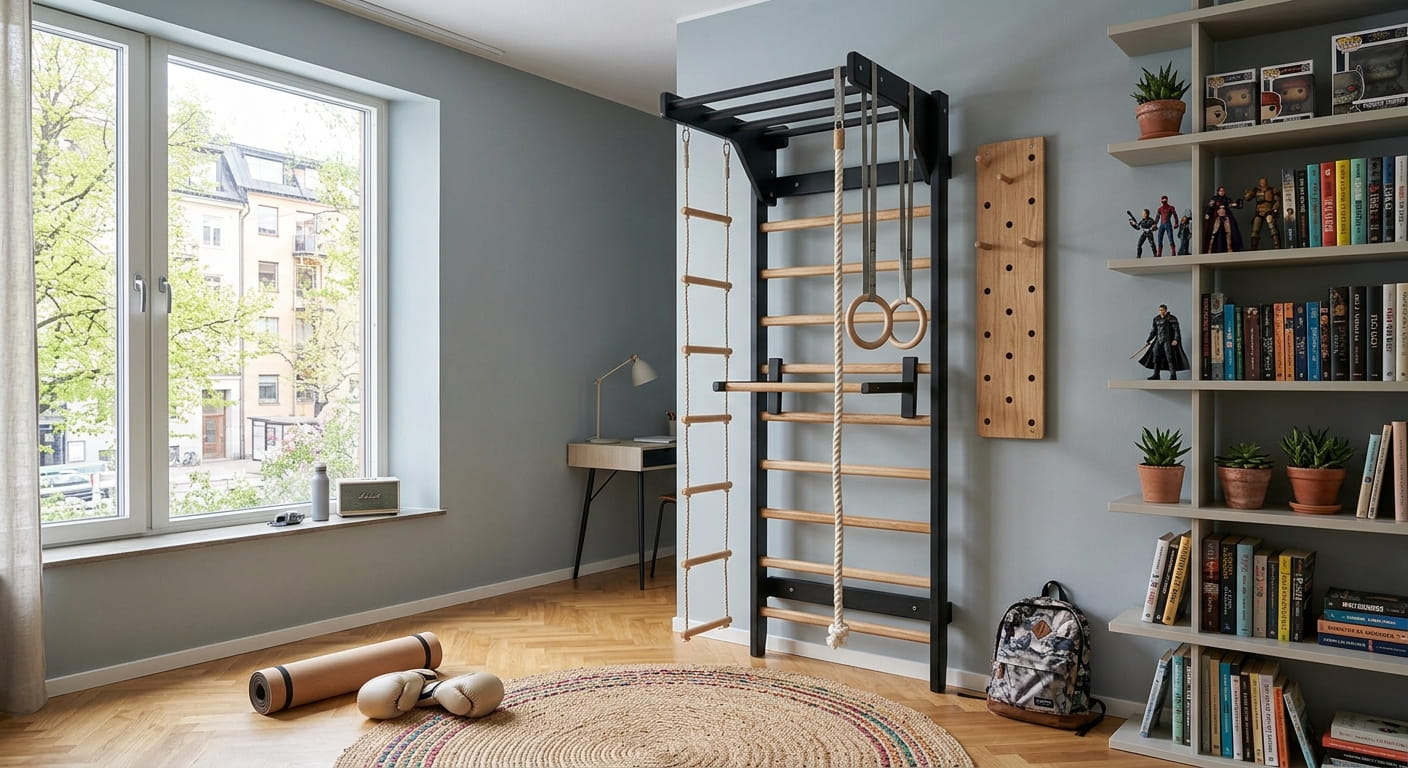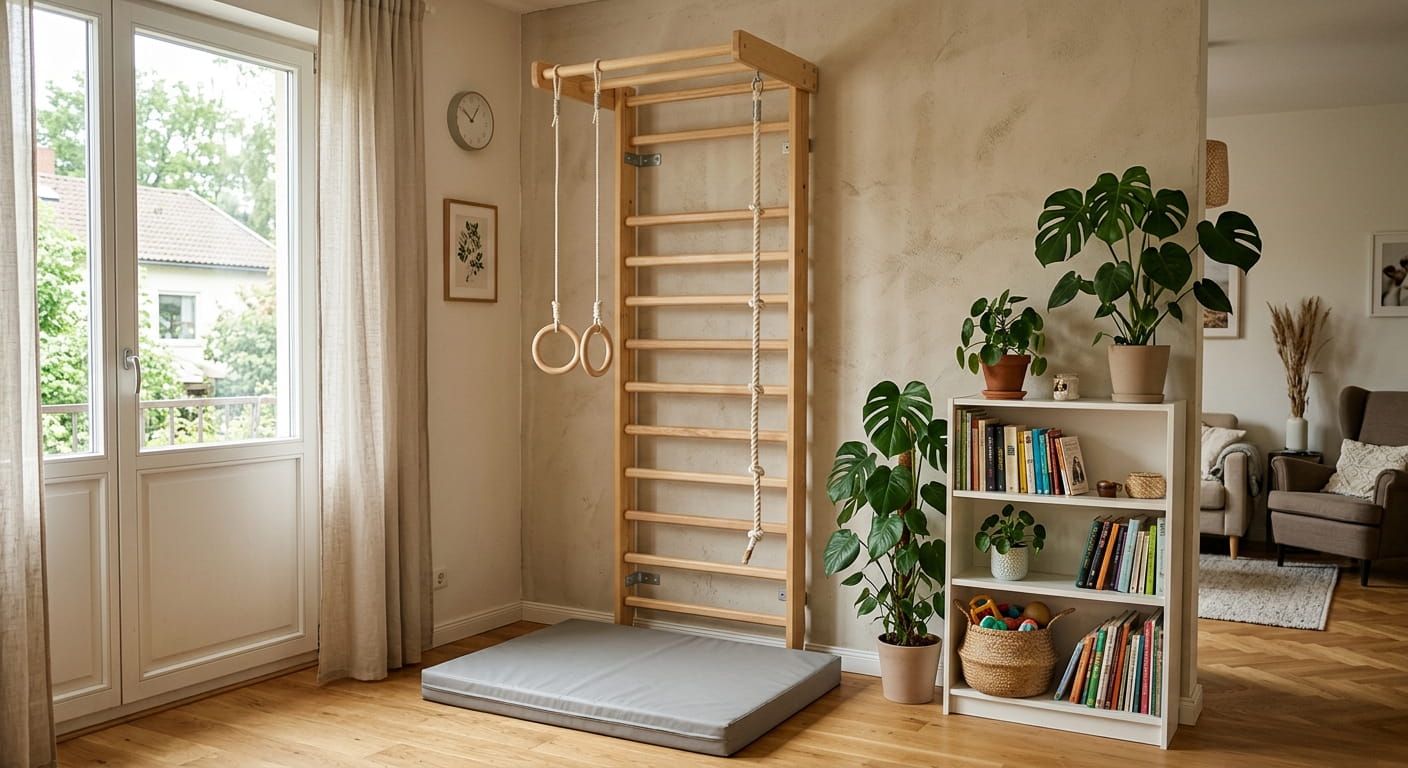
A five-year-old swings on the rings, hangs upside down — and a month later holds a plank twice as long as before. Wall bars with rings are simply a wooden ladder with a removable set suspended from the top bar: gymnastic rings, a climbing rope and a rope ladder on adjustable straps. Below you'll find what this gear is for, how to fix it and adjust the height, and how much the children's "Maugli" model with such a set costs.
Customers often ask the same thing: must you buy the rings straight away, or can you take basic wall bars and add the accessories later? The answer is simple — the maker builds almost every model so that the top bar or a separate beam will hold both pull-ups and swinging, which is why the rings, rope and ladder are easily bought separately a year or two after the main structure is installed.
Wall bars with rings: what the rings change in training
An ordinary ladder against the wall is first and foremost a pull-up bar and a foot brace: pull-ups, hanging, a back stretch. Hang the rings and you add movement in several planes at once. The body doesn't just hang from a fixed bar — it swings, turns and searches for its point of balance. That is a completely different load on the wrists, the shoulders and the stabiliser muscles of the core, which on a regular pull-up bar barely switch on at all.
The first thing the rings train is grip. A ring is thicker than a bar, it moves, and the fingers have to constantly adjust to the shifting weight. In children, a couple of months of regular practice noticeably strengthens the hand — you can see it in how a child holds a bike handlebar, a rope on the playground or an ordinary door handle. Adults use the rings to work the grip separately from the overall strength load: pull-ups on an unstable support tax the forearms more than on a straight bar.
The second is the vestibular system. Swinging, spinning, hanging upside down by the knees — a classic load on the organs of balance that you simply have no other way to train in an ordinary apartment. Physiotherapy instructors often recommend exactly this kind of swinging and spinning for children with less confident coordination: a swing, a spin, a jump down onto the mat — the vestibular system works without a trampoline or a swing in the yard.
The third is coordination and core work. To stay on the rings even in a simple static hold, the abdominal and back muscles that stabilise the torso switch on. On a fixed bar that doesn't happen — there the body just hangs. With rings every movement calls for a slight adjustment, and that is closer to functional gymnastics than to a regular strength machine.
Grip strength
A moving ring is thicker than a bar — the hand and forearm work harder than on a straight pull-up bar.
Vestibular system
Swinging and spinning on the rings loads the organs of balance in a way a static apparatus can't.
Coordination
An unstable support forces the core stabiliser muscles to engage with every movement.
For the whole family
The rings adjust for height: suitable for a five-year-old and for an adult weighing up to 150 kg.

Stretching deserves a separate mention. Hanging on wall bars with rings lengthens the spine more gently than hanging from a rigid bar, because the hands aren't locked in one position and the body finds its own comfortable angle. For children this is posture-problem prevention; for adults it's a simple way to release the tightness of a sedentary day without even leaving the room.
The rope apparatus set: rings, climbing rope, rope ladder
Rings are rarely sold on their own — the usual thing is to hang a whole set on the wall bars: a pair of gymnastic rings, a climbing rope and a rope ladder. All three elements attach to a single top bar or to a dedicated beam and come off in a minute if the apparatus is needed free for another exercise.
The rope handles the strength load — climbing up engages the arms, back and legs at once; it's one of the most energy-intensive pieces on wall bars of any kind. The rope ladder is gentler: you can clamber up it or simply swing while holding on — an easier task than the rope, which is why the ladder is usually mastered first.
The rings are the most versatile of the three. On them you can simply hang, swing, do a flip, train the abs by raising the legs. The range of movement is wider than with the rope or the ladder, which is why the rings are the first thing people ask to add to children's or adult wall bars beyond the basic package.
| Apparatus | What it trains | Age guide | Difficulty to master |
|---|---|---|---|
| Gymnastic rings | Grip, coordination, vestibular system, core muscles | from age 3 (with support), no limit for adults | medium |
| Climbing rope | Arm, back and leg strength, endurance | from age 5–6 | high |
| Rope ladder | Coordination of movement, agility, climbing | from age 3 | low |
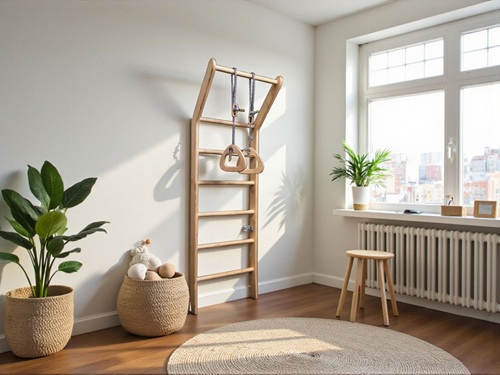
What gymnastic rings for the home are made of
For home wall bars, rings are made of wood or durable plastic. Wooden ones — from hard species, beech or birch — feel nicer in the hand, don't slip when the palms sweat and don't feel cold in winter on an unheated balcony. Plastic ones are lighter in weight and cheaper, but with heavy use they lose their look faster — scratches appear and collect dirt.
The straps the rings hang from are usually textile webbing or a strong cord with metal carabiners or buckles for adjusting the length. Safety depends directly on the quality of the straps: a cheap thin cord chafes where it touches the bar, which is why a decent set has the attachment point reinforced or protected by a guard.
Rings or pull-up bar: which is better for a child to start with
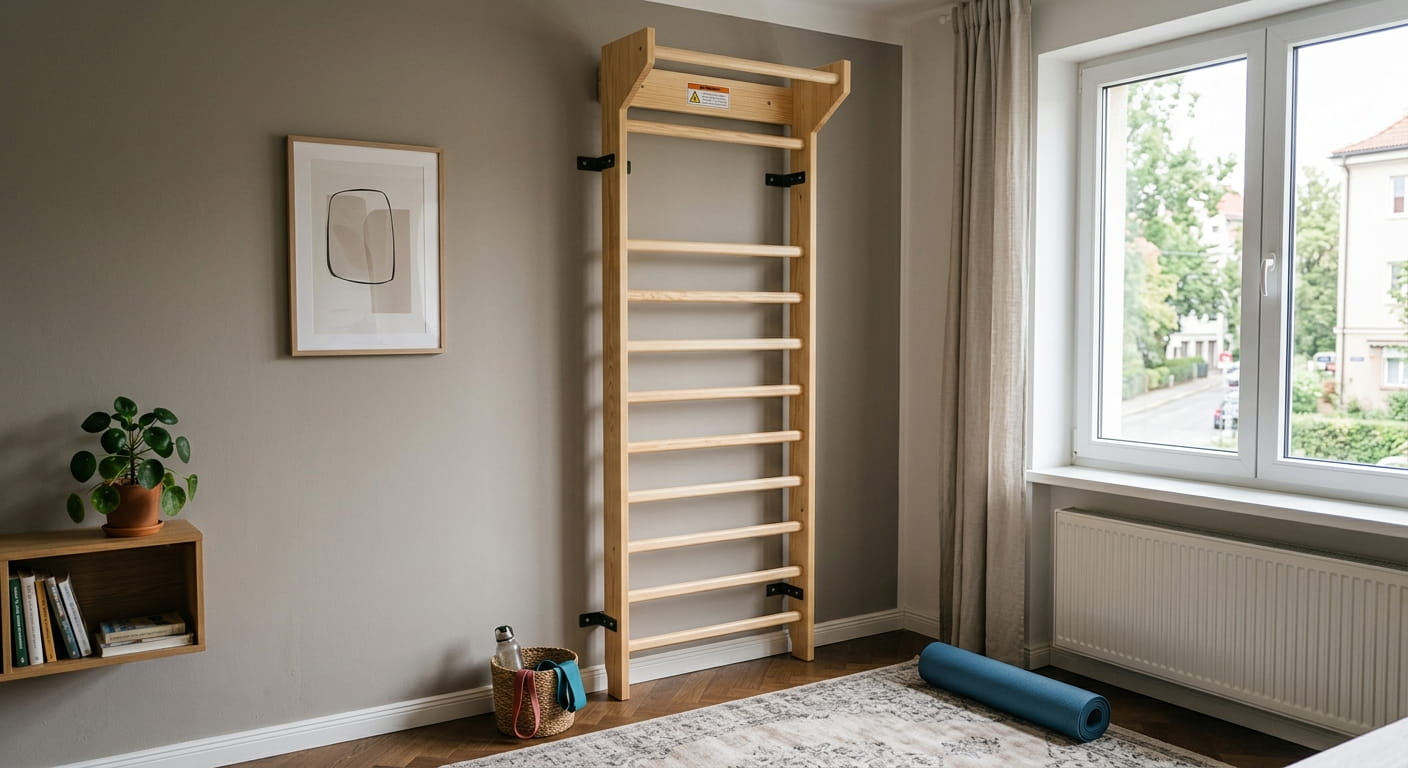
Parents often compare the two directly: a pull-up bar is already part of the basic package of almost any wall bars, while rings are add-on equipment bought separately. In practice they aren't rivals but two stages of one programme. The bar teaches you to hold your body weight on straight arms in a static position; the rings add instability to that — the same hang, but with constant adjustment of grip and torso to the shifting apparatus.
For a very young child who can't yet do pull-ups, the rings are often even more intuitive than the bar: you can just hang, swing, put your feet in the rings and spin — there are more movement options, and far less arm strength is needed than for a full pull-up on a straight bar. That's why in children's models like "Maugli" the rings come not as an addition to the bar but as the main piece of apparatus for activity.
For a schoolchild the situation is reversed: they can already do pull-ups on a regular bar, and the rings become a progression — the same movement, but on an unstable support where you also have to keep your balance. Here it makes sense to keep both pieces at once: the bar for basic strength work, the rings for developing grip and coordination on top.
For an adult the choice is more often pragmatic: if the main goal is pull-ups for size and strength, a regular bar is enough. If you want to vary the programme, take the load off the elbow joints with a moving grip, or add static elements like the cross and the support hold — the rings become a logical addition to the wall bars already in place, rather than a replacement for the bar.
Children's wall bars with rings "Maugli"
"Maugli" is a dedicated model built for exactly the "rings plus rope plus ladder" task, not an adult sports complex with an add-on. It has lightweight bays scaled to a child's height, the add-on equipment set comes in the basic package, and these wall bars start from $92 — cheaper than most adult models, because they're designed for a lighter load and use less material.
The model is made of glued timber — pine or birch — with bars of beech or ash, finished with water-based lacquer or oil free of harsh odour, hypoallergenic and certified. In terms of strength, the frame holds the standard household load of 120–150 kg, so an adult can calmly hang on the rings too, helping the child fix the apparatus higher or spotting them on a rotation.
"Maugli" is assembled the same way as the other models — 1.5–3 hours by yourself following the instructions, with all the hardware already in the box. The warranty on the structure and the add-on equipment is 12 months, but the ropes and textiles are consumables — natural wear of the rope from active use isn't covered by the warranty, much like shoes or sportswear.
A detailed look at children's models specifically, sizes and age recommendations is on the wall bars for kids page, which also has a table by the child's height and weight for different configurations.
Height adjustment: for a child's and an adult's height
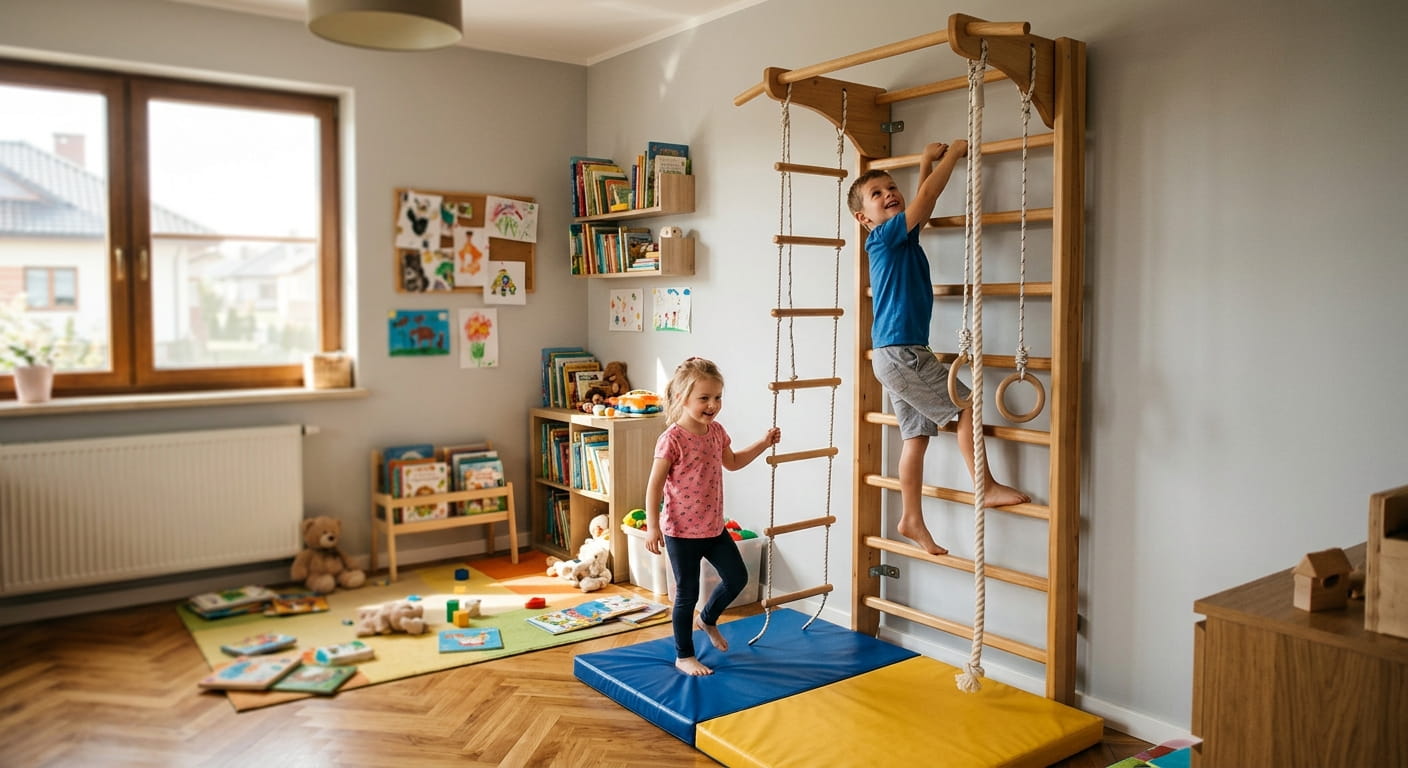
The rings aren't hung permanently — the straps adjust for length with a carabiner, a side-release buckle or a knot, depending on the set. The point is that the same pair of rings should reach the floor for a five-year-old standing up and at the same time give a full hang to an adult using the same apparatus in the evening after work.
The practice is simple: for a preschooler the rings are lowered so the toes barely leave the floor or touch it — that's safer for the first attempts, because if the grip fails the child simply stands up rather than falling from a height. For a schoolchild the rings are raised higher for a full hang with straight arms. For an adult they go to their own height, with some margin, so the feet don't reach the floor when the arms are extended.
Models with an integrated top pull-up bar — "Vershina" or "Moy Turnik" with a removable adjustable bar — have an extra plus: the attachment point itself can be raised or lowered along with the bar's height, not just by adjusting the length of the ring straps. That's handy if the wall bars stand in a room with a low ceiling and there isn't enough spare length in the rope or cable.
An everyday rule: once the child has grown and the rings no longer reach the floor with their toes, the strap length must be reset from scratch — don't leave it "by eye", or the hang will be too high for their current agility.
By the same logic, a single set of wall bars with rings usually serves a family not for one season but for several years in a row: at first the rings are set at the minimum for a preschooler, then raised for a schoolchild, and by the teenage years the apparatus is adjusted for a full adult hang. There's no need to remount the structure itself or buy a new one as the child ages — adjusting the strap length fully covers this.
Safety: mats, knots, regular checks
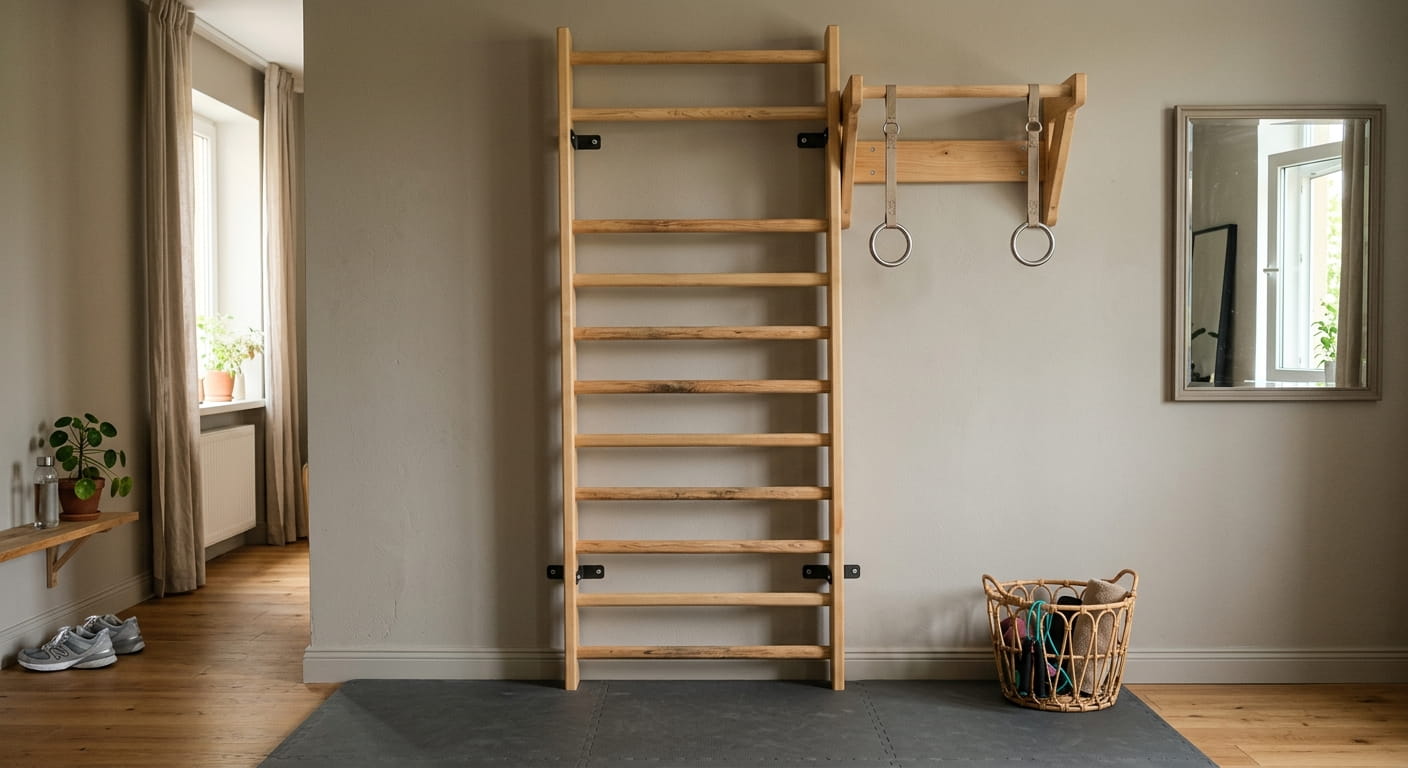
Rings and rope are fall-risk apparatus, unlike a static ladder you hold with both hands and feet at once. That's why three things here are mandatory, not merely advisable: a mat under the apparatus, a reliable knot or carabiner at the attachment point, and a periodic check of the whole set of wall bars for tightness.
The mat should cover the entire area of a possible fall, not just the patch directly under the rings — when swinging, the landing point shifts a metre or more in each direction. A mat thickness of 3–5 cm is usual for home use, enough at a sensible hanging height, but it won't save you from an attempt to jump off rings raised to the ceiling with arms fully extended.
Fixing the straps to the bar or beam must be taken out of the "just loop it over and tie a bow" category. A proper set uses a carabiner with a locking sleeve against accidental opening, or a friction knot designed specifically for a dynamic load — swinging and jerks, not static weight.
- The mat is laid under the whole swing zone, not just under the attachment point
- Carabiners are closed with the locking sleeve; knots are tight and not frayed
- Straps and rope are inspected for chafing where they contact the bar
- The anchor or pressure-mounted fixings of the wall bars themselves are tightened (check every 3–6 months)
- The rings are not positioned right above a furniture corner or a threshold
A separate point is footwear and clothing during ring sessions. Socks slip on a smooth floor when jumping off the mat; loose laces and hoods catch on carabiners and straps during rotation. A simple rule — train on the rings barefoot or in non-slip socks, and tuck the hood away before the child starts spinning — removes a good half of the minor everyday injuries around wall bars.
Pressure-mounted fixing of the wall bars (floor-to-ceiling, no drilling) holds a static load worse than an anchor into concrete or solid brick. If the main load on the apparatus is active swinging on the rings and jerking on the rope rather than just pull-ups, pressure-mounted wall bars need a strength reserve: it's worth checking the tightness of the screw pair more often, every 2–3 months rather than every six.
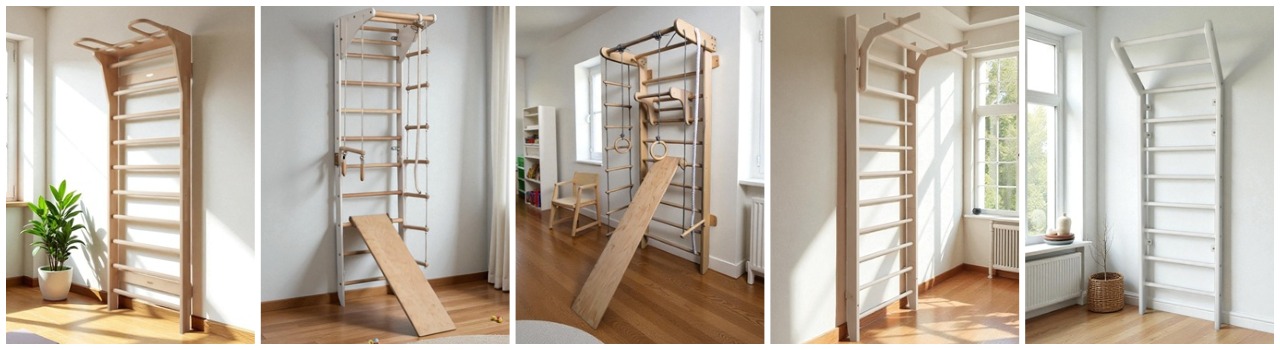
Fixing the rings to the top pull-up bar and the load-bearing beam
Rings, rope and ladder hang from one of two points: the top bar of the ladder section, where pull-ups are usually done, or a separate load-bearing beam if the wall bars provide one. Models with a built-in pull-up bar — "Vershina", "Moy Turnik" — have reinforced fixing of the top bar built in, because it's already designed for the dynamic load of pull-ups and so will take ring-swinging too.
On models without a dedicated pull-up bar, the rings are usually hung from the very top rung of the ladder or from a horizontal bar under the ceiling. Here it matters to check the diameter and material of that particular bar — it's beech or ash, the same dense wood as the rest of the rungs, and rated not just to "step on" but to "hang your full weight on and swing".
For active climbing with swinging and pull-ups on the apparatus, monkey bars also come in handy — a horizontal ladder for moving hand over hand, which often comes paired with a pull-up bar. There's more on such combinations on the wall bars with pull-up bar and monkey bars page.
The type of fixing of the wall bars to the wall and ceiling also affects the choice of apparatus. Wall-mounted anchor fixing into concrete or solid brick is the sturdiest — it holds any dynamic load from the rings and rope without question, but it requires drilling and isn't suitable for a plasterboard partition. Pressure-mounted fixing with floor-to-ceiling screw posts needs no drilling at all, suits rented housing, but requires a ceiling height of 2.40–3.10 metres, and you absolutely must not install such wall bars under a stretch or suspended ceiling — the brace presses against a rigid surface, not a decorative film. Combined fixing, where a pressure-mounted element is added to the anchor, is used in top models such as "Atlet" — there both rigidity is at its maximum and the load rating reaches up to 250 kg.
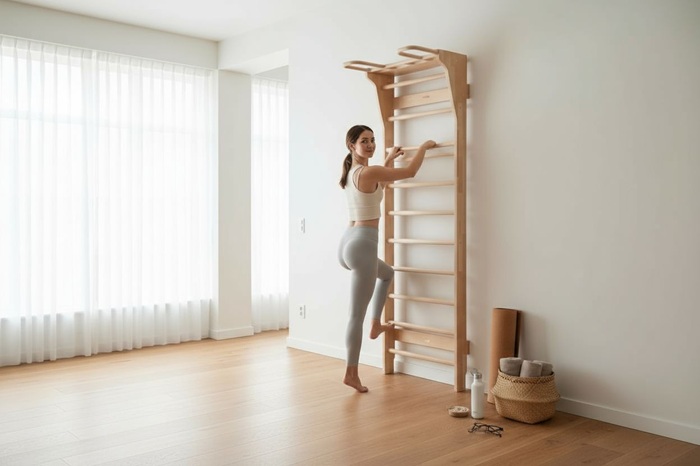
Ring material and care for the rope gear
Wooden rings are more practical day to day: they don't build up static, don't stick to the palms in the heat and cope with temperature swings better than plastic — relevant for a balcony or an unheated veranda. Plastic rings are lighter and usually cheaper, but they become more brittle in the cold, and under direct sun the plastic yellows and goes cloudy over time.
Caring for the wall bars structure itself is easy: wipe it with a dry or slightly damp cloth, without abrasives or aggressive chemicals that eat into a lacquer or oil finish. It's better not to place the bars right next to a radiator or keep them in direct sun all day — that dries out the wood and the finish loses its look faster.
The textile elements — ring straps, rope, rope ladder — need separate attention because they wear out faster than the whole frame. Every few months it's worth inspecting where the rope contacts metal — carabiner, hook, bar — as the fibres chafe there first. A rope that's wet after an outdoor or damp-room session is better dried without being coiled into a tight bundle, otherwise moisture lingers inside the weave longer and the fibre rots.
The warranty on the wall bars structure and the add-on equipment is 12 months. Natural wear of the ropes and textiles is not a warranty case — it's the expected consumption of material under active use, like the wearing of a shoe sole. If the family trains almost every day, it's sensible to budget the rope-and-rings set for replacement roughly every couple of years, rather than expect the rope to last forever.
The wall bars themselves, meanwhile, make almost no demands for special care: glued timber and the hard wood of the bars tolerate ordinary household humidity fine, and the water-based finish isn't afraid of a wipe with a damp cloth. The only thing to avoid is direct contact with a heating radiator and constant sun through the window: that dries the wood out faster and the lacquer or oil finish dulls noticeably sooner than it should.
When to replace the rope and ring straps on wall bars
There's no exact service life for textile apparatus — it all depends on how often they're used and the conditions the wall bars stand in. In a family where the rings and rope are used almost every day, replacement is worth planning every year and a half to two years. If the wall bars stand on a glazed balcony or in a room with humidity swings, the rope's service life is usually shorter — damp and temperature changes speed up fibre wear from the inside, even when the rope looks fine on the outside.
- Fuzzy, frayed sections have appeared on the straps or rope
- Where it contacts the carabiner or bar, the fibre is noticeably thinner than the rest
- The weave of the rope ladder has loosened and the rungs rotate
- After getting wet, the rope stays damp to the touch for a long time
- The rings or carabiner stick when adjusting the height
Replacing the set with a new one is a normal operating matter, not a reason to consider the wall bars defective: the wooden structure itself serves for years with careful maintenance, while the add-on textile equipment is consumed faster because it takes the full dynamic jerk of swinging and climbing.
Exercises on the rings: for children and for adults
For a preschooler the set is simple: hang on straight arms, swing from side to side, carefully spin around their own axis, try hooking the knees and hanging upside down with an adult's support. At this stage the task isn't strength but getting used to an unstable support and working the vestibular system.
A schoolchild can add pull-ups on the rings with a narrow and wide grip, raising the bent legs to the chest for the abs, simple strength elements like the muscle-up. The rings work harder here than a bar: keeping the torso level while the support swings is objectively harder, so progress on the rings is more visible than on the pull-up bar.
For an adult the range of exercises is wider: pull-ups with different grips, dips in the support hold on the rings, crunches with leg raises, static holds — a simple hang to stretch the back and shoulder girdle after sedentary work. The rings are also used as a substitute for ordinary pull-ups when the load on the elbow and shoulder joints needs reducing: a moving ring lets the hand turn into a natural position rather than locking the arm at one angle, as a rigid bar does.
The "wall bars plus rings plus rope" combination effectively replaces several separate machines: a bar for pull-ups, rings for gymnastics and grip, a rope for strength endurance — and all of it on about 0.2 square metres of wall.

Group games and family workouts on the rings
If several children gather at the apparatus — your own and the neighbours' at a kids' birthday party, say — the rings easily turn into a play area without any special method. A simple relay: run to the wall bars, hang on the rings for a count, jump onto the mat, make way for the next one. Who hung the longest or landed most neatly — the competitive element appeals to children more than simply "hang and get down".
Another option is a combined obstacle course from the equipment you already have: crawl between the ladder rungs, cross along the rope ladder, grab the rings and swing, slide down the rope. For this you don't need to buy anything beyond the standard "Maugli" set or a similar model — all the add-on equipment is already rated for such a load.
The family format works differently: while the child trains on the height-adjustable pair of rings, an adult beside them uses the pull-up bar or dip bars of the same wall bars. This way the apparatus is used by two or three family members at once rather than standing idle most of the day — given a footprint of 0.2 square metres of wall, that's a tangible saving of space compared with a separate kids' corner and a separate adult machine.
Rings, rope and ladder for an apartment and for a private house
In an apartment with low ceilings and thin internal partitions, wall-mounted anchor fixing is often impossible — plasterboard won't hold the load from swinging on the rings, however strong the anchor. This is where wall bars with floor-to-ceiling pressure-mounted fixing help out: they brace against the slabs rather than the partition, and the swinging on the rings is distributed across the whole pressure-mount assembly rather than a single point in the wall.
For rented housing this same pressure-mounted fixing is a practical choice: wall bars with no drilling, that dismantle and move to a new place without leaving anchor marks in the wall. The ceiling limit is the standard one — from 2.40 to 3.10 metres — and, as already noted, a stretch or suspended ceiling rules out this kind of installation entirely.
In a private house, where the ceilings are often higher and the walls are structural, any fixing option is available, including combined — the sturdiest for active dynamic loads from rope and rings. It's also easier here to fit a larger model — for example "Lider" with sections, a climbing net and monkey bars, where the rings become one of several pieces of apparatus rather than the only add-on element.
A separate option for those who want to combine rings with full climbing is a pairing with climbing-wall holds. Such wall bars are covered on the wall bars with a climbing wall page: there the rings and rope work in tandem with holds of various profiles.
| Model | Construction | Load rating | Price from |
|---|---|---|---|
| "Maugli" | children's, lightweight, with a ready-made rings, rope and ladder set | 120–150 kg | $92 |
| "Minsk Sport" | modular, removable adjustable add-ons | 120–150 kg | $174 |
| "Vertikal" | I-shaped, rigid combined fixing | 120–150 kg | $183 |
| "Vershina" | I-shaped with a built-in top pull-up bar | 120–150 kg | $187 |
| "Lider" | U/T-shaped, sections, net, monkey bars | 120–150 kg | $195 |
| "Krepysh" | basic I-shaped, narrow wall sections | 120–150 kg | $198 |
| "Atlet" | reinforced, thick uprights, dip bars and bench | up to 250 kg | $202 |
| "Moy Turnik" | removable adjustable pull-up bar with grips | 120–150 kg | $218 |
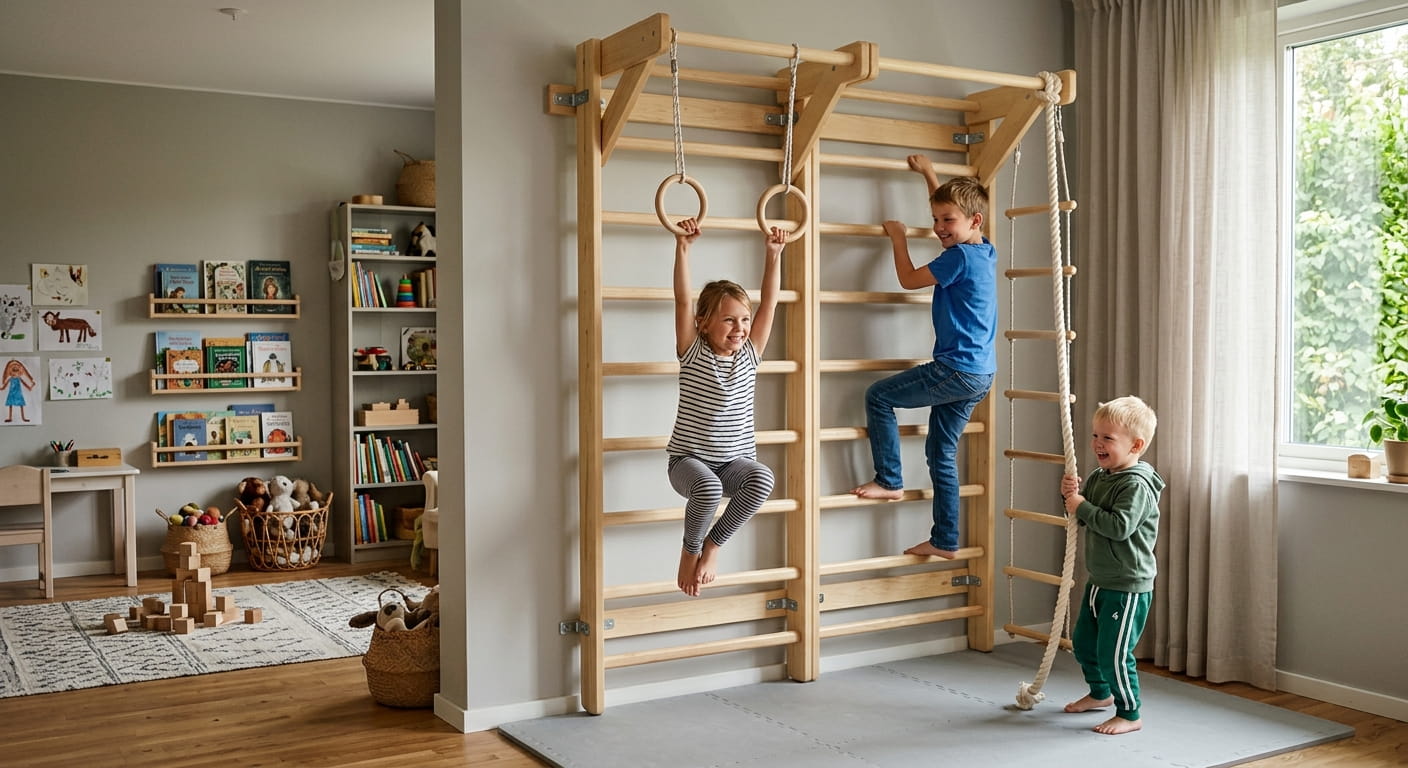
How to choose wall bars with rings and place an order
If the apparatus is needed first of all for a child, it's more logical to look at "Maugli": it's designed from the start for a lighter load and already comes with rings, rope and ladder, so there's nothing extra to buy. If adults will use the bars in parallel, it's worth considering models with a more serious strength reserve such as "Vertikal" or "Atlet", where the rings are just one of several add-on pieces of apparatus on reinforced-fixing wall bars.
For those who need the most sports-oriented configuration — with a pull-up bar, dip bars, rings and monkey bars all at once — there are gymnastic options assembled for a full functional workout, not just for climbing. Such solutions are covered on the gymnastic wall bars page.
Before ordering, it's worth settling two things: the fixing type — anchor for a structural wall, pressure-mounted for rented housing or plasterboard, combined for maximum load — and the ceiling height in the room where the wall bars will stand. During the consultation a manager helps choose both the model and the fixing option for your specific room — you don't have to guess from catalogue photos.
Our own production in Zaslavl, Minsk District, Stroitelnaya ulitsa, 7, gives leeway on timing and price: manufacturing takes 15–35 days, shipping after completion is 3–5 business days, and delivery is available across the whole of Belarus. For wholesale buyers from 10 units, there are private-label and own-brand terms, with TR CU conformity certificates and free delivery to the carrier's terminal.
A short checklist before placing an order helps you not to miss anything important:
- The age and weight of those who will use the rings most often — a child, an adult or both
- The wall and ceiling material in the room — concrete, brick, plasterboard; the floor-to-ceiling height
- Whether you need the full set at once (rings, rope, ladder) or want to start with just the rings
- Whether a separate mat will be needed for the swing zone
- Rented or owned housing — this determines the choice between anchor and pressure-mounted fixing
A manager asks clarifying questions on each point at the consultation stage, so even without any building experience you don't have to work out on your own whether a particular wall will hold anchor fixing or whether it's better to plan for pressure-mounted wall bars from the start.
Assembly takes from one and a half to three hours — all the hardware is already included, no separate trip to the hardware store needed. The warranty on the frame and the add-on equipment is 12 months, except for natural wear of the ropes and textiles discussed above. A mat for the wall bars is usually not part of the package and is chosen separately to match the fall area — this point is worth discussing with a manager straight away rather than buying after the fact.
The bottom line is simple: wall bars with rings aren't a separate product category but ordinary wall bars plus an add-on set that you can take down, move higher or lower, or replace the rope on after a couple of years of active use. The main choice isn't between "with rings" and "without rings" but between models by load rating, fixing type and budget — and the rings, rope and ladder can almost always be added or completed on wall bars already in place — whether in an apartment or a private house, whether in a nursery or the shared living room.
Expert opinion
From a manufacturer's point of view, the rings are the quickest way to test how well the wall bars format resonates with a family at all: even if the child isn't ready for serious pull-ups yet, almost anyone wants to swing and hang on the rings. From there the structure grows with them — the height is adjusted, a rope is added, the worn rope is replaced, and the bars themselves stay the same for years.
The main mistake we see during consultations is trying to save on the fixing type for a specific wall instead of choosing anchor, pressure-mounted or combined fixing right away to match the room's actual conditions. Rings and rope deliver a dynamic load with jerks, and saving on the fixing usually shows up not immediately but in the next six months to a year as a loosened structure.
— Veronika Tarasevich, digital marketer, specialist in semantics and content for product niches.