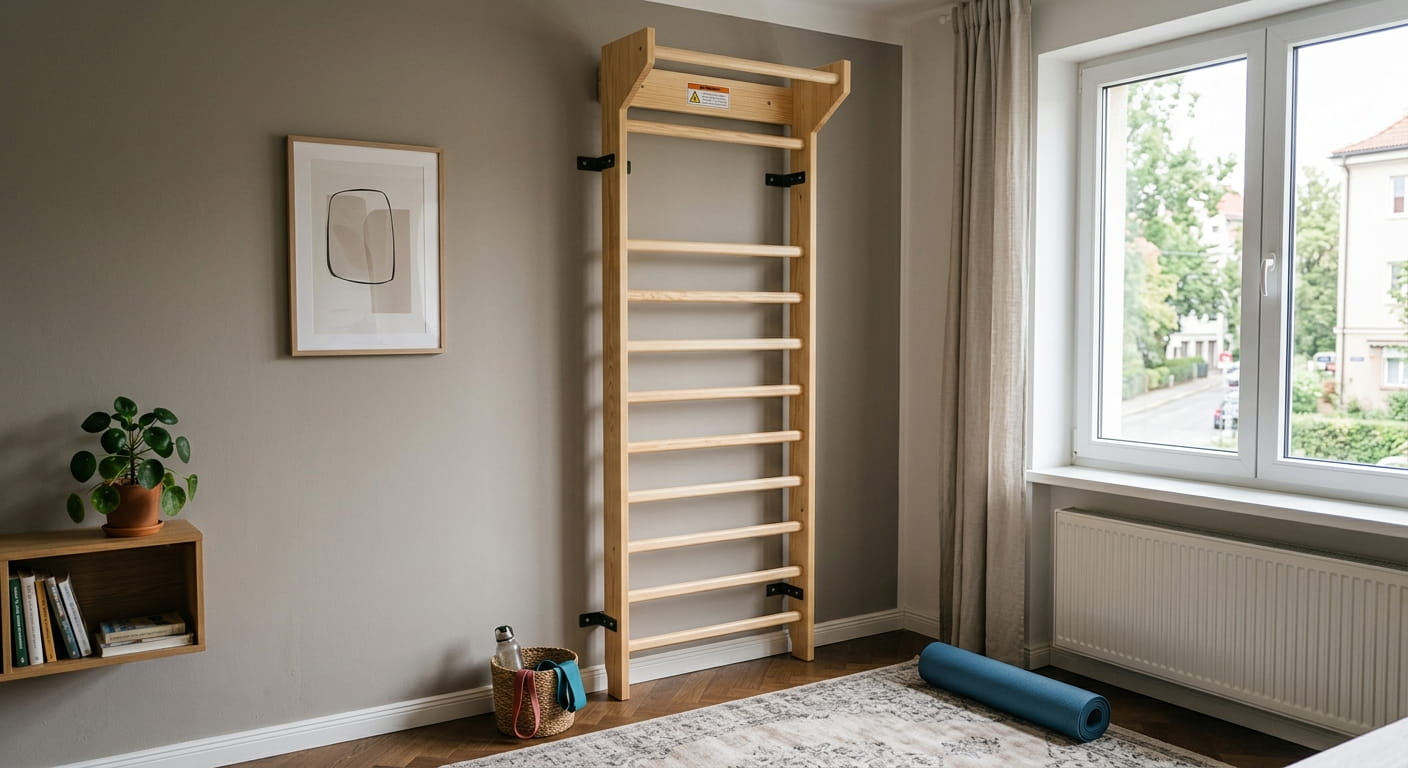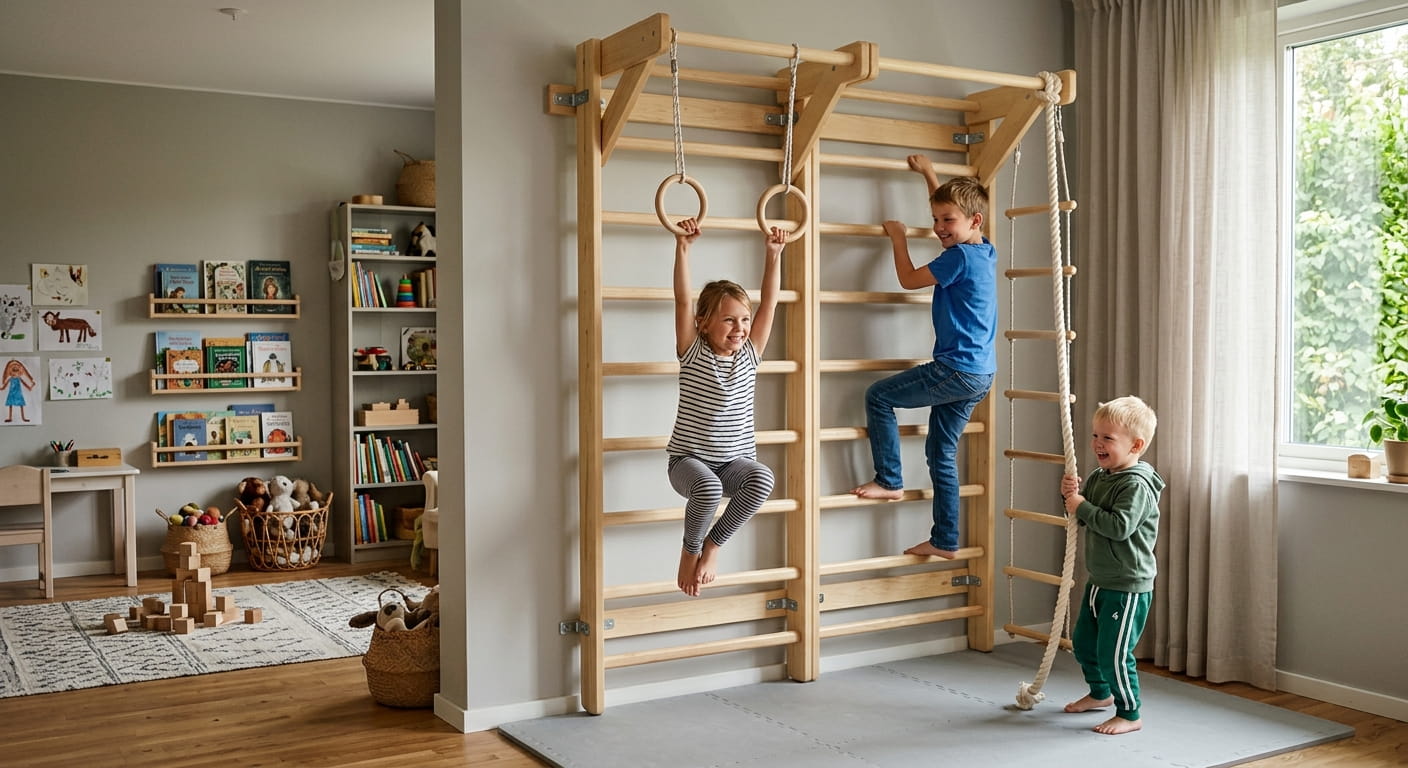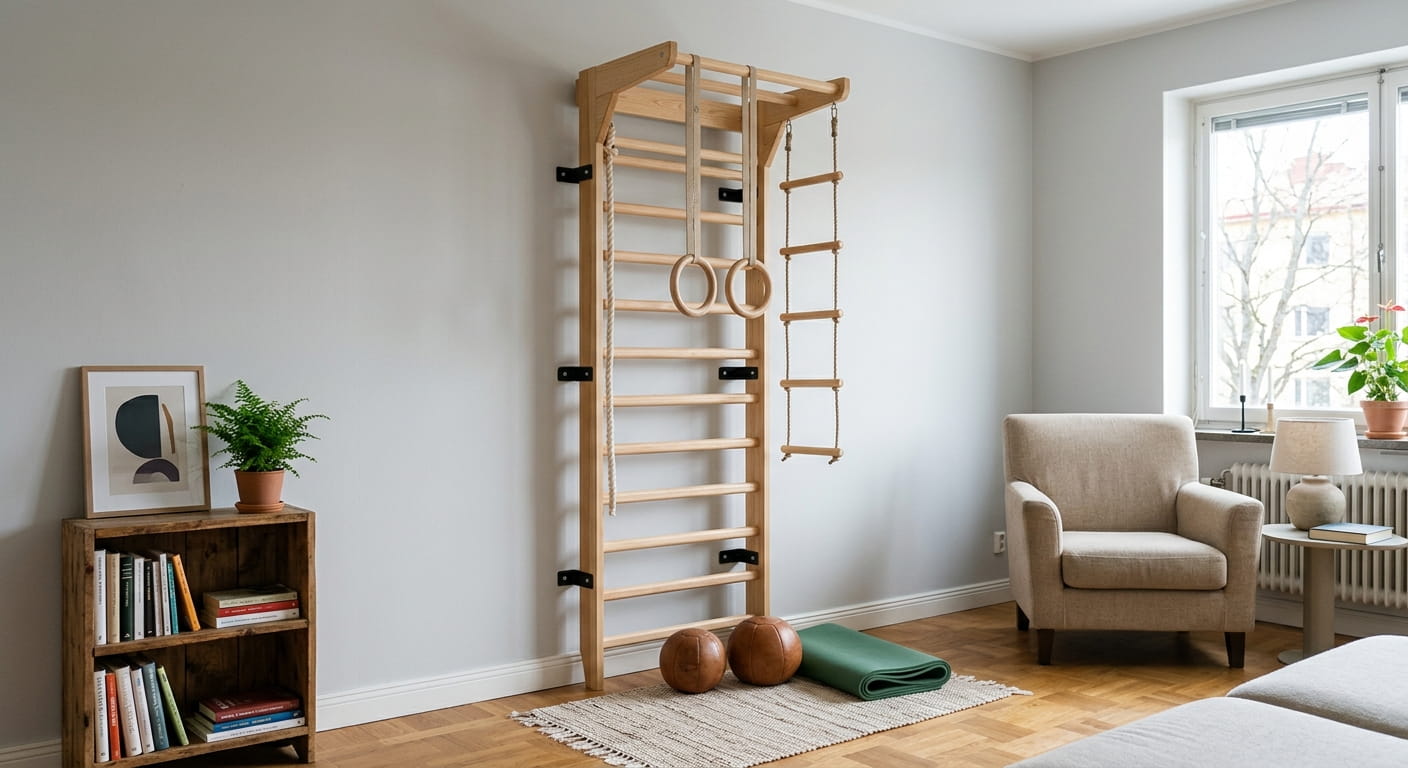
Wall bars for home solve a very specific problem: they give the whole family a piece of equipment for pull-ups, push-ups and stretching exactly where you physically have one free wall section rather than a dedicated gym room. They take up about 0.2 sq.m of floor and fix either to the wall or with a screw brace between floor and ceiling without drilling — and in the rest of this article we'll work out what to go for, wood or metal, which mounting suits your particular flat or house, which models to pick for different tasks and how to look after the frame afterwards.
Wall bars for home: how much space they really claim
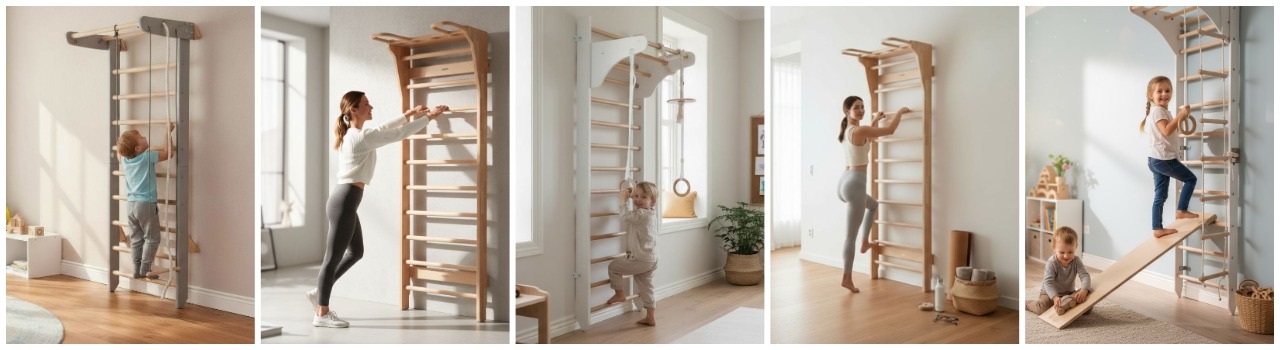
The first question almost every buyer asks is whether the unit will fit in the room. The answer is mundane: wooden wall bars for home take up around 0.2 square metres of floor. That's less than an ironing board in its open position and noticeably less than a treadmill or a power rack. The frame mounts vertically along the wall, so it only "eats" the depth of the uprights — usually a narrow strip by the wall that used to sit empty or was cluttered with a chair.
In a flat such a wall section turns up in the nursery, in the hallway by the room entrance, sometimes at the head of the bed in the parents' bedroom. A house offers more options: a free wall under the stairs, a corner in the boiler room or workshop, a stretch of wall in the attic. A house usually gives you more ceiling height and thicker load-bearing walls, so the choice of mounting is wider — more on that just below.
- Nursery — the wall bars stand by the window or against a free, furniture-less wall
- Hallway — the narrow wall section between doorways often sits empty
- Bedroom — the corner by the wardrobe, if ceiling height allows
- Detached house — the space under the staircase to the first floor
- Garage, boiler room, workshop — wherever you don't mind giving a wall over to a fitness corner
A telling real-world example: a family with two children in a three-room flat put the purchase off for a long time, convinced the unit needed a room of its own. In the end they set the wall bars for home into the narrow wall section between the kitchen door and the window — where previously there was only a floor lamp. By size the frame slotted into a strip barely wider than a stool, and the lamp simply moved to another corner. The same logic works in almost any flat: a free stretch of wall is usually already there, it just wasn't seen as usable.
For comparison: a treadmill or a weight bench needs its own patch of floor plus clearance for the body to move back and forth, and you can't tuck such equipment away for a day to free the room for guests. Wall bars for home stand against the wall permanently, don't block the walkway and take up no floor when stored, so they feel more like a piece of furniture than a gym machine.
Wall section width and ceiling height for wall bars
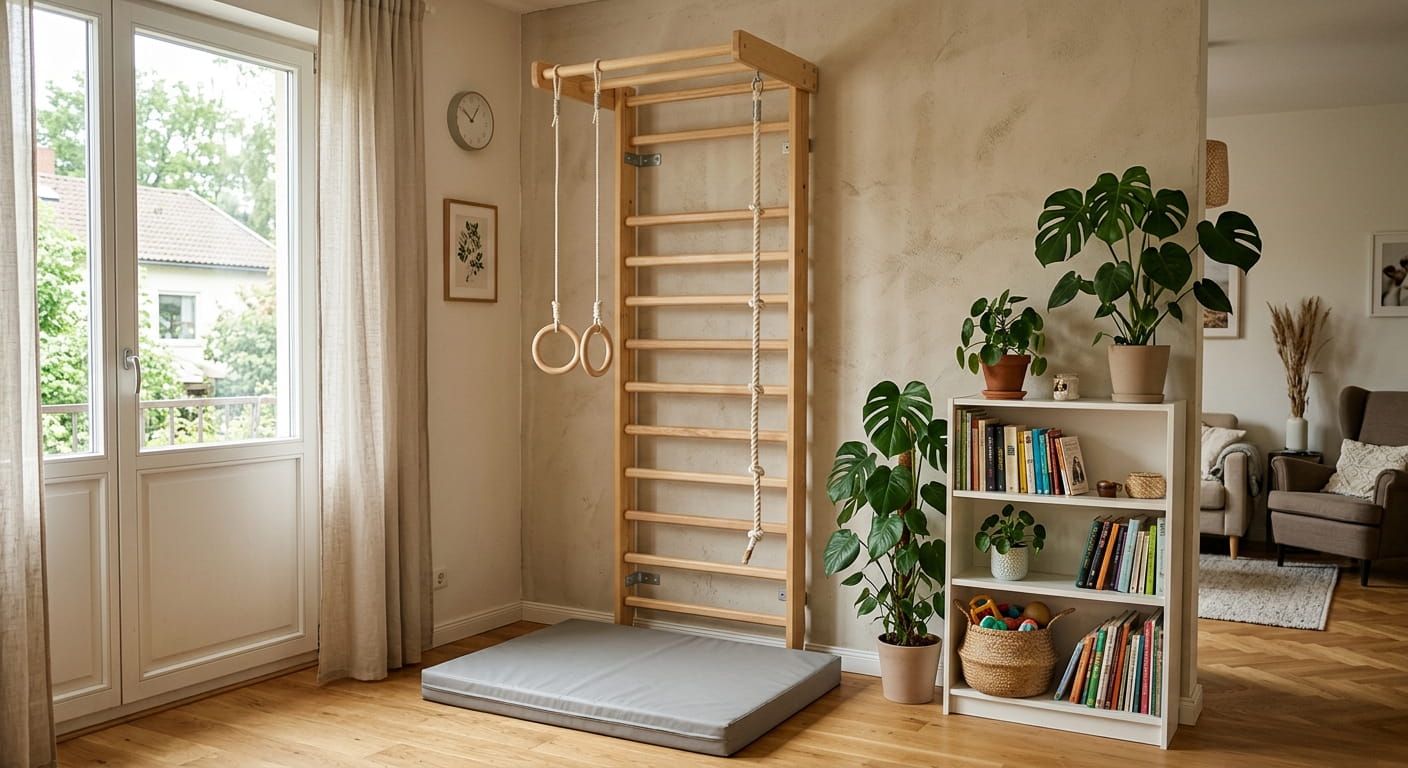
The width you need is small — about that of a narrow bookcase — so even wall bars with dip bars or a pull-up bar fit into a wall section many people write off as "useless". Ceiling height, on the other hand, becomes a significant parameter for just one type of mounting — the pressure-mounted one, covered separately below. For the wall-fixed anchor version the ceiling height is irrelevant: the frame fixes to the wall rather than pushing against the slab.
A practical tip: before ordering, simply measure the floor-to-ceiling height with a tape where you plan to put the unit, and photograph the wall — the wall material (concrete, brick, plasterboard) determines which mounting will suit you, and a manager will help match a model to your exact dimensions.
Some people still call this kind of frame, out of old habit, a "wooden ladder wall" — in essence it's the same thing: vertical uprights with rungs, a home fitness corner that doesn't take a room of its own. The name doesn't change the function: "wall bars", "fitness corner" and "unit" all mean the same product in conversation, just in different words.
Wall bars for home are not a separate gym room but a single wall section of about 0.2 sq.m. Even in a one-room flat there's room for them without any remodelling.
Wood or metal: what to choose for the home
Metal frames are more often installed outdoors or in commercial gyms — there, resistance to weather and intense round-the-clock use matters most. For a living room the priorities are different: warmth to the touch, quiet operation without the creak and clang of metal on metal, safety for a child's bare feet and blending into the interior. Wood wins on every one of these points at once, which is why makers of home units have historically bet on solid and glued timber.
The uprights of wall bars for home are made of glued timber — pine or birch. Glued timber is stronger than solid wood thanks to its layered structure: it doesn't warp with the swings in humidity and temperature that are inevitable in a living space heated through the winter. The rungs are made of denser, harder wood — beech or ash — because they take the impact and gripping load every day.
Warm timber
Uprights and rungs don't chill the hands and feet in winter, unlike a metal profile.
Hypoallergenic coating
Water-based lacquers and oils are certified and give off no solvent smell after assembly.
Concealed fasteners
Metal furniture connectors are hidden inside the timber — no sharp bolt heads or burrs.
Fits the interior
Light or tinted wood doesn't clash with a living room, unlike factory metal.
The coating is a separate topic people often forget to ask about when choosing wall bars for home. Water-based lacquers and oils release no volatile substances as they dry and are certified for contact with a child's skin. That's crucial for a nursery, where the unit may be used every day for several hours in total.
There's also a practical everyday argument in favour of wood that sellers of metal frames usually stay quiet about: sound. A metal frame rings during active workouts and passes vibration through the wall to the neighbours below in a panel building — after ten at night that's awkward for the family and the neighbours alike. A wooden frame dampens impacts naturally, thanks to the fibrous structure of the timber, and works noticeably more quietly even during vigorous jumps or a sharp grab of the crossbar.
At a country house or in an unheated space the difference is felt even more strongly: metal freezes through in winter and holds the cold all day, while wood warms up with the air in the room and doesn't burn your palms with cold on the first morning grip. By price, ready-made wooden wall bars for home from the maker often come out on a par with a metal equivalent of comparable spec, yet in everyday feel the difference in wood's favour is noticeable from the very first day of use.
| Model | Frame type | Mounting | Load | Price, from |
|---|---|---|---|---|
| Krepysh | Basic, I-shaped, for narrow wall sections | Wall-fixed / pressure-mounted | 120–150 kg | from $198 |
| Vershina | I-shaped, with an integrated top pull-up bar | Wall-fixed / pressure-mounted | 120–150 kg | from $187 |
| Vertikal | I-shaped, rigid combined mounting | Combined | 120–150 kg | from $183 |
| Atlet | Reinforced, thick uprights, dip bars and bench | Combined | up to 250 kg | from $202 |
| Minsk Sport | Modular, removable adjustable add-ons | Wall-fixed / pressure-mounted | 120–150 kg | from $174 |
| Lider | U/T-shaped, sections, net, monkey bars | Wall-fixed / pressure-mounted | 120–150 kg | from $195 |
| Moy Turnik | Removable adjustable pull-up bar with grips | Wall-fixed / pressure-mounted | 120–150 kg | from $218 |
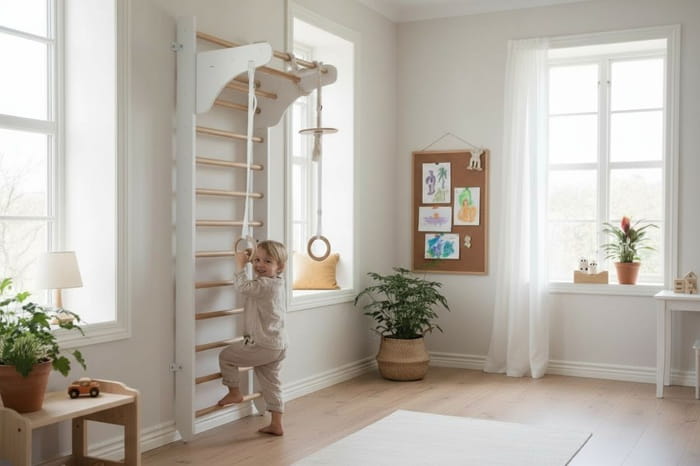
| Maugli | Children's, rope, rings, rope ladder | Wall-fixed / pressure-mounted | 120–150 kg | from $92 |
Mounting wall bars for home: wall-fixed, pressure-mounted or combined
The choice of mounting depends not on preference but on the wall material and ceiling type — here the maker doesn't advise "by eye" but asks for specifics: panel, brick, aerated block, stretch or ordinary ceiling. Let's look at the three options used in the models above.
Wall-fixed anchor mounting is the most rigid option of all. The frame is pulled tight to the wall with heavy anchors, so it suits concrete and solid brick — that is, most load-bearing walls in panel and brick flats, as well as solid walls in a detached house. An important limitation: anchor mounting must not go on plasterboard, as the sheet simply won't take the pull-out load during active use of the pull-up bar or dip bars.
A plasterboard partition won't hold the anchor mounting of wall bars for home. If the wall in the flat is clad in plasterboard with no concrete or brick base behind it, you need pressure mounting or a different wall section.
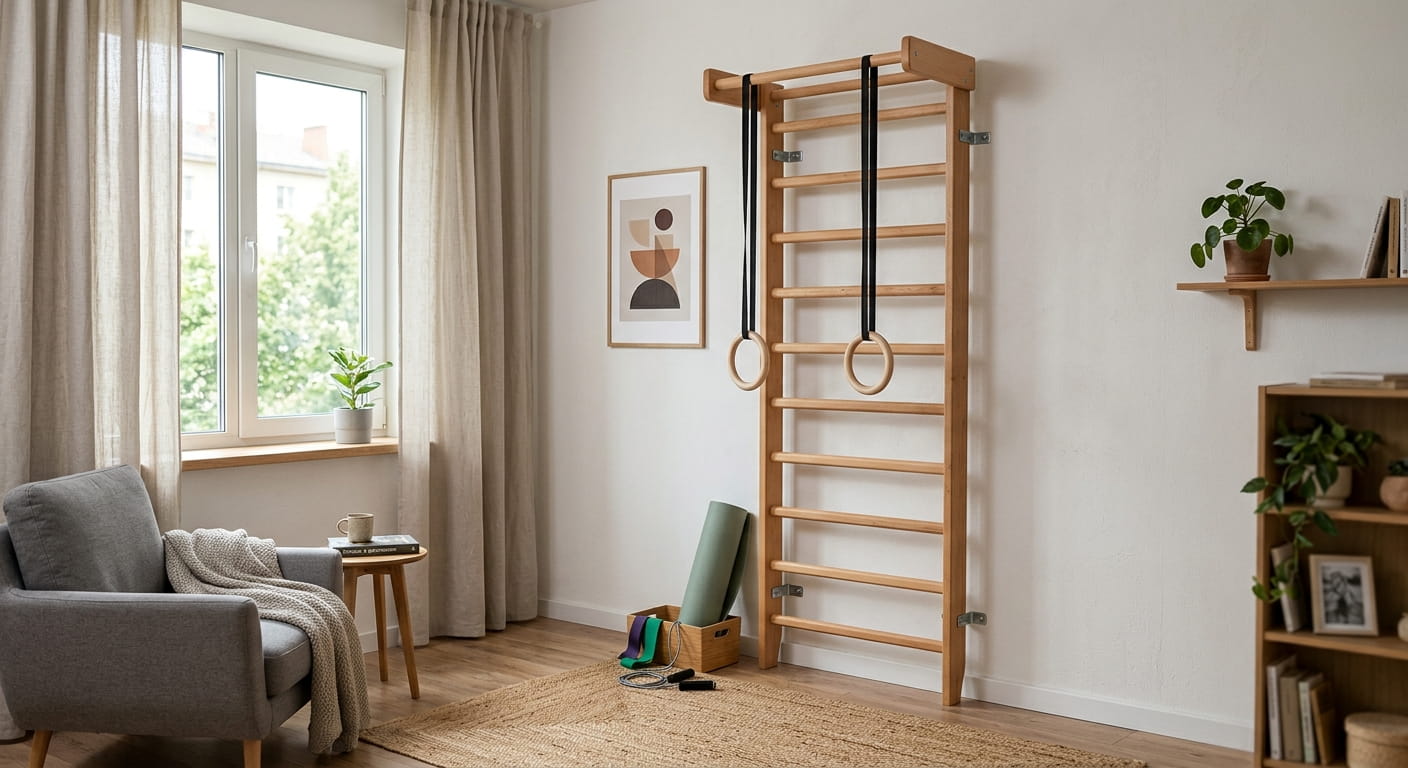
Pressure mounting works on a different principle: the frame braces with screw jacks against the floor and the ceiling at once, without a single hole in the wall. This method is indispensable for rented homes, where drilling load-bearing walls is forbidden by the lease, and for thin partitions that physically won't hold an anchor. The price of that versatility is a ceiling-height requirement: it must be in the 2.40 to 3.10 metre range, otherwise the screw brace either won't reach or, conversely, ends up too short even at maximum extension.
What ceiling you need for pressure-mounted wall bars for home
There's a hard rule here worth spelling out on its own: a pressure-mounted frame must not be installed under a stretch or suspended ceiling. The membrane and the frame of a suspended ceiling aren't designed for the point load of a bracing pad, and during active use of the pull-up bar the ceiling will push through or tear. If a stretch ceiling is already fitted in the flat and you can't drill the solid wall, pressure mounting won't do — you need either anchor mounting into a concrete base or removal of the membrane at the bracing point. More on how to choose exactly this type of installation for your conditions is covered on the page about pressure-mounted wall bars.
Combined mounting is used in the top reinforced models — for example, in "Atlet". It unites anchor points at the wall and a pressure brace into the ceiling at the same time, which lets the frame hold a load up to 250 kg and not "play" even under sharp jerks on the pull-up bar or pushes from the dip bars.
A frequent question from buyers: can you work out the mounting type yourself before calling a manager. The cue is simple — if, when you try to drive an ordinary plug into the wall, the drill goes straight through with no resistance and no dust of the characteristic concrete colour, you're most likely facing plasterboard or a thin partition, and pressure mounting is needed. If the wall is solid, with concrete or brick dust as you drill, wall-fixed anchor mounting will almost certainly do. The precise answer, of course, comes from a measurement and consultation, but this rough check helps you get your bearings in advance, before ordering wall bars for home.
| Mounting type | Where it suits | Requirements | Limitations |
|---|---|---|---|
| Wall-fixed (anchor) | Concrete, solid brick | A strong load-bearing base | Not on plasterboard |
| Pressure-mounted (floor-to-ceiling) | Rented homes, thin walls | Ceiling 2.40–3.10 m | Not under a stretch/suspended ceiling |
| Combined | Reinforced models, maximum load | Wall + ceiling at once | Used in the top models |
Models for the home: "Krepysh", "Minsk Sport", "Vershina"
Of the eight models in the range for home use, three are chosen most often — they cover the majority of scenarios: a tight wall section, a growing family, and the wish to get a pull-up bar without a separate add-on module.
"Krepysh" is the basic I-shaped model designed specifically for narrow wall sections. If the free stretch of wall in the flat is smaller than you'd like, this is the first candidate: the frame doesn't need a wide wall section, yet in strength it's no weaker than bulkier models. The retail price starts from $198.
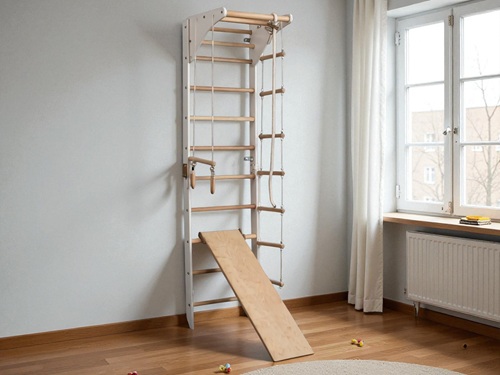
"Minsk Sport" is a modular frame with removable, adjustable add-on equipment. It's a sound choice for a home where the children are growing: the pull-up bar, dip bars and other modules move up and down the uprights, and some of the add-ons can be taken off and swapped around as the child gets older and more grown-up equipment takes over. The price from $174 makes it one of the most affordable options in the range while still being fully modular.
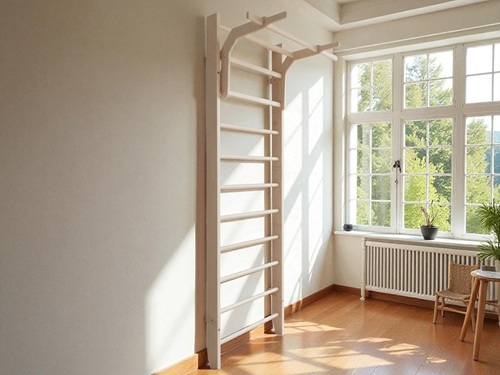
"Vershina" is also an I-shaped model, but with an integrated top pull-up bar: the crossbar for pull-ups is already built into the upper part of the frame, with no need to buy and fit it separately. This solution saves both money and assembly time for those who mainly want a pull-up bar rather than a full set of add-ons. More on the options with a ready-built bar is on the page wall bars with a pull-up bar. The price of "Vershina" starts from $187.
All three models hold the standard 120–150 kg load, which is enough for an adult and a child of any age in everyday use. If there's someone in the home closer to the upper weight limit, or strength training with added weight is planned, it's worth looking at "Atlet" — a reinforced model with thick uprights, dip bars and a bench, rated for a load up to 250 kg.
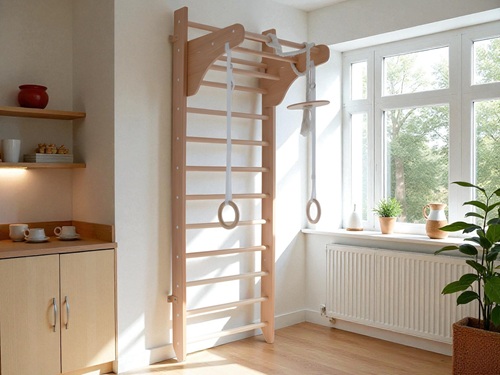
The materials and fasteners are the same across all models — glued pine or birch timber for the uprights, beech or ash for the rungs, a hypoallergenic water-based coating and concealed metal fasteners on furniture connectors. The difference between models is in geometry, the set of add-ons and the mounting type, not in the quality of the timber.
If the budget allows and you want to settle the question for years ahead, it's worth considering "Lider" — a U- or T-shaped model with sections, a net and monkey bars from $195: it's wider than the basic I-shaped versions and suits a wall section that can accommodate a larger frame. "Vertikal" with its rigid combined mounting from $183 is a compromise between the simplicity of "Krepysh" and the strength reserve of "Atlet" — a good option if one family member trains more actively than the rest.
Add-on equipment for home wall bars
Uprights with rungs are the base, while the character of your workouts is set by the add-on equipment. The maker offers a removable pull-up bar, hook-on dip bars, a folding sit-up bench, gymnastic rings, a climbing rope, a rope ladder and resistance bands — all of it bought as needed and moved along the uprights without drilling new holes.
- Removable pull-up bar — for pull-ups and hanging, adjustable in height to suit your stature
- Hook-on dip bars — for push-ups and strengthening the shoulder girdle
- Folding sit-up bench — folds away when not in use
- Gymnastic rings — for stretching and strength elements
- Rope and rope ladder — for children and overall coordination
- Resistance bands — for extra strength load without increasing the footprint
For a family with children of different ages, exactly the logic built into "Minsk Sport" is handy: the add-ons come off and move around, so the same wall bars for home first work as a unit with a rope and rings for a preschooler, and a few years later turn into a pull-up bar and dip bars for a teenager. Children's add-on options and separate models for the youngest are covered on the page wall bars for kids.
It makes sense to get the sit-up bench straight away if you plan not just the pull-up bar and dip bars but also lying ab and back exercises. The folding design takes no room when unused — it tucks right up to the uprights, and opening it back out takes a few seconds without tools.
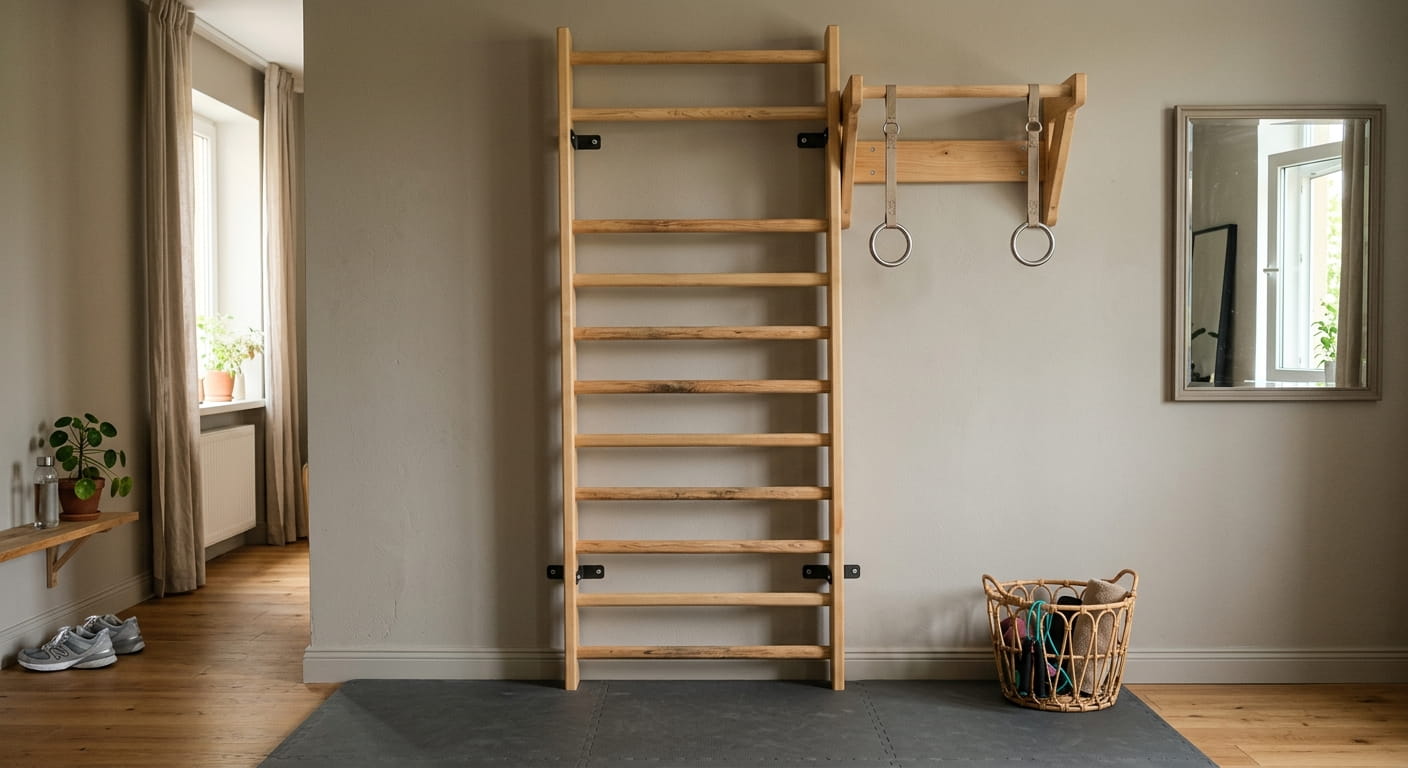
The warranty on the add-on equipment is 12 months — the same as on the frame itself. The exception is the natural wear of rope and textile elements: the climbing rope and rope ladder abrade over time with active use, and that's normal wear of a consumable part, not a manufacturing defect.
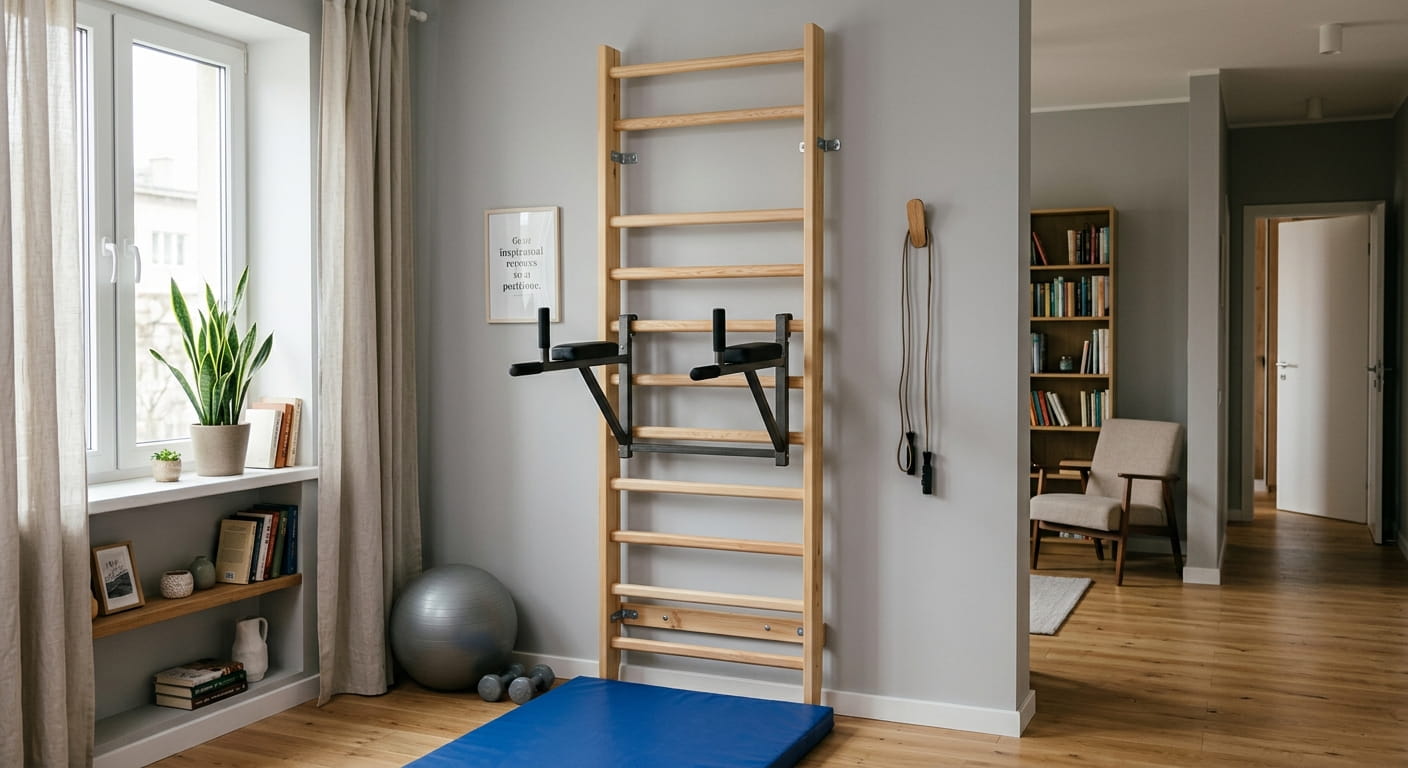
Good for the back and posture: how wall bars for home benefit the whole family
A schoolchild's posture with a backpack on one shoulder, an adult's sedentary work at a laptop, a low-activity evening after nursery — each family member has their own reason to warm up, and a single unit covers several tasks at once. Hanging on the pull-up bar unloads the intervertebral discs after a long sit, while regular pull-ups and dip-bar exercises strengthen the muscular corset that holds the back in the right position through the day.
Unloading the spine
Hanging on the bar relieves compression on the intervertebral discs after a sedentary day.
Shaping children's posture
Regular exercises on wall bars for home strengthen the back muscles during the period of active skeletal growth.
A unit for the whole family
Height adjustment and varied add-ons let both a child and an adult train in turn.
A warm-up without heading to the gym
Five minutes on the pull-up bar and dip bars at home replaces part of a cardio and strength warm-up.
It's important to understand the limits: wall bars for home don't replace treatment for already diagnosed spinal problems, and in such cases the load programme is better agreed with a doctor or a physiotherapy instructor. But as a tool for prevention and general physical activity for the whole family, the unit works effectively precisely because it stands at home rather than as a membership booked across town.
In practice the scenario is usually this: in the morning, five minutes of hanging and stretching before school for the child, in the evening ten minutes of pull-ups and dip bars for the adult after work. Neither needs getting ready, a journey or time to change — the unit stands a couple of steps from the bed or the kitchen, and it's this closeness that settles the question of regularity better than any membership. Wall bars for home win in this sense not on technical specs but on availability: they're always nearby whenever there's a free five minutes.
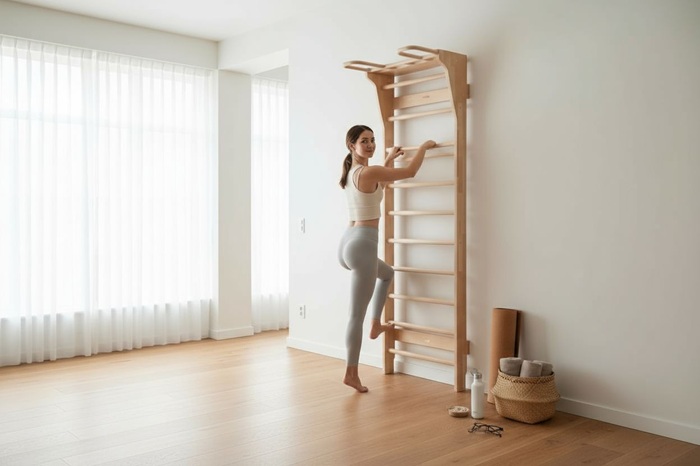
Assembly, warranty and care of wall bars at home
Assembly takes from 1.5 to 3 hours — the spread depends on the model and the set of add-on equipment. The kit comes with full instructions and all the fasteners, so nothing extra needs buying. For pressure mounting, after installation it's important to check that the screw jacks brace evenly against the ceiling without skew — the stability of the whole frame depends on it.
The warranty on wall bars for home is 12 months, and that covers not only the load-bearing uprights and rungs but also the add-on equipment: the pull-up bar, dip bars, bench and rings. The only exception is the natural wear of rope and textile elements such as the climbing rope or rope ladder, because that wear is directly tied to the intensity and frequency of use, not to the quality of the material.
| What to do | How often | Why |
|---|---|---|
| Wipe with a dry or slightly damp cloth | As it gets dirty | Abrasives damage the water-based coating |
| Check the tension of bolts and fasteners | Every 3–6 months | Active use loosens the joints |
| Lay a mat under the wall bars for home | Permanently | Softens the dismount and protects the floor from scratches |
| Don't place near radiators or in direct sun | When choosing the spot | Over-drying of the timber and fading of the coating |
A separate placement tip: don't set the wooden frame flush against a radiator and don't pick a wall section that direct sun hits all day from the window. Constant overheating dries the timber faster than its natural cycle, and UV light gradually changes the tone of the coating unevenly — where furniture casts a shadow on the unit, the wood stays darker than the exposed areas.
If there are several children in the home and the unit is used every day by several people in a row, it's worth checking the bolt tension more often than the lower end of the interval — not every six months but every quarter. That's five minutes with the hex key from the kit, yet it rules out the chance of a fastener loosening unnoticed during active play. The same logic applies to the mat under the frame: if both an adult and a child train on wall bars for home, it's better to get a mat that's thicker and wider than standard, so it covers the dismount zone with room to spare.
Common mistakes when choosing wall bars for home
Most returns and reinstalls are linked not to defects but to the buyer skipping one of the preparatory steps. Below is a list of what's worth checking before you place the order.
- Didn't measure the ceiling height before ordering a pressure-mounted model — result: the jacks don't reach or brace at the limit of their travel
- Chose anchor mounting for a plasterboard partition — the wall won't hold the load from active workouts
- Bought a basic 120–150 kg model for an athlete who needs a load up to 250 kg — overpaying to replace the frame
- Forgot about the mat under the wall bars for home — the floor covering gets scratched on dismount
- Placed the frame by a radiator or on the sunny side — the timber dries and the coating fades faster
- Didn't check the wall-section dimensions with a manager — the model has to be swapped after delivery
Each of these points is settled with a single call or message to a manager before placing the order: they'll ask three or four clarifying questions about the wall, ceiling and family make-up and immediately weed out the models that won't suit. Judging by buyer feedback, it's exactly this pre-order consultation that saves more time and money than choosing on your own from pictures on a website.
The situation with rented housing deserves spelling out separately: if the flat is rented and the landlord is against drilling walls, the only workable option is floor-to-ceiling pressure mounting, provided the ceiling is ordinary rather than a stretch one and the height falls within the 2.40–3.10 metre range. When you move, such a frame can be taken down and transported to a new place without marks on the wall, which for tenants is often the deciding argument in favour of this particular mounting type.
Wall bars for home in a flat and in a detached house: how the choice differs
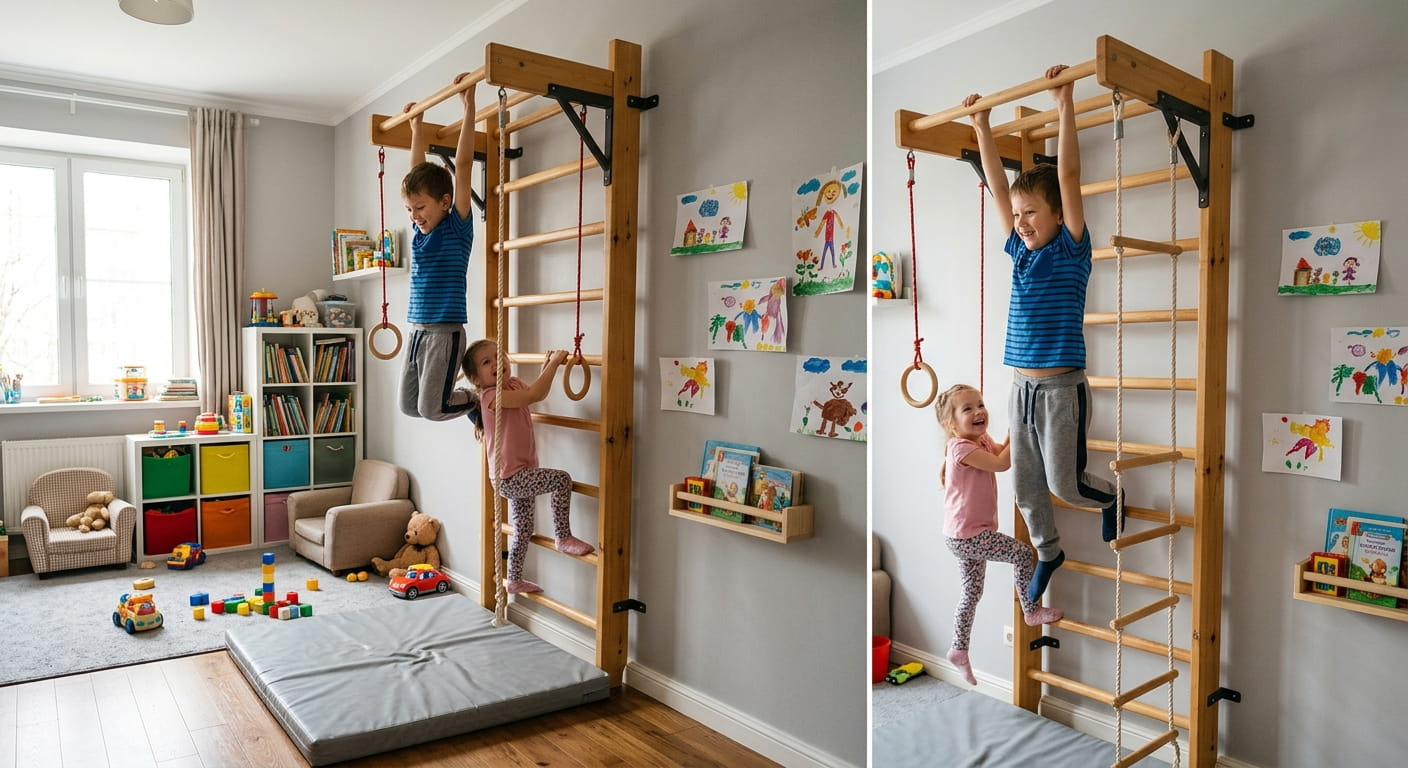
Formally the function is one and the same — a unit for the home where a family lives. But the installation conditions in a flat and a detached house differ noticeably. A flat more often has panel or brick load-bearing walls suited to anchor mounting, but sometimes the one free wall section turns out to be a plasterboard partition — then the choice shifts towards pressure mounting, if the ceiling height allows. The specifics of installing in a flat in particular, including typical ceiling heights in panel buildings, are covered in detail on the page wall bars for the apartment.
In a detached house, as a rule, there are more solid brick or block walls, so anchor mounting is available in almost any room. An added plus of a house is often higher ceilings, especially in attics and double-height living rooms, which widens the choice of models with pressure mounting and simplifies installing models with an integrated pull-up bar such as "Vershina".
In both cases the material stays the same: glued timber, hard beech or ash rungs, a hypoallergenic coating and concealed fasteners. The difference is only in the method of mounting for the specific walls and ceiling of the specific home.
One more point often pushed into the background when comparing a flat and a house is acoustics and neighbours. In a block of flats the sound of jumps and of grabbing the crossbar is partly heard through the slabs, so wood as the quieter material is especially justified here. In a detached house this factor usually isn't critical, but there's more freedom in choosing the spot — from the hallway to a dedicated training corner in the basement or on the ground floor.

Delivery across Belarus and ordering wall bars for home
Production is located in Zaslavl, Minsk District, at Stroitelnaya ulitsa, 7 — our own workshop, not resale of ready-made kits. Delivery is arranged across the whole of Belarus, so ordering wall bars for home is equally available in Minsk, in regional cities and in district centres.
For the retail buyer the model prices are listed above in the comparison table — from $92 for the children's "Maugli" model to $218 for "Moy Turnik" with adjustable grips. For wholesale customers separate terms apply: a minimum shipping batch from 10 units, the option of applying your own trademark under a Private Label scheme, and TR CU certificates of conformity for the whole range. Batch production takes from 15 to 35 days depending on the workshop's workload and the order mix, and dispatch of a finished order takes 3–5 business days. Delivery to the carrier's terminal is free, and self-collection straight from the warehouse in Zaslavl is also available.
Before buying, it's worth checking three things with a manager: the wall material at the installation spot, the floor-to-ceiling height and the family make-up — who will use it and how often. These three parameters determine the model, mounting type and set of add-on equipment almost unambiguously, and it's easier to pick the unit once by them than to buy a more suitable model later.
For those still unsure whether to buy a ready-made factory frame or order something similar from a private craftsman, it's useful to compare not just the price but what stands behind it: TR CU certificates, a 12-month warranty on the whole frame and add-ons, and an in-house workshop that controls every stage of processing the timber. Buyer reviews most often touch on exactly these points — the predictable build quality and the fact that the stated dimensions and load match reality after installation at home.
One more nuance worth raising with a manager in advance is the timing for a specific occasion. If wall bars for home are needed by a certain date — say, a child's birthday or a move to a new flat — it's better to place the order with time to spare, especially if the model is non-standard or several add-on items are ordered for it at once. Retail orders for models in stock in Zaslavl are usually processed faster than items built to order for non-standard wall-section dimensions.
Expert opinion
Over years of working with private orders, the same conclusion is confirmed again and again: choosing wall bars for home almost never comes down to design or price — it comes down to the wall and ceiling of the specific room. First we look at what the base is — concrete, brick or plasterboard — then we measure the ceiling height, and only after that do we suggest a model and the type of add-ons. This order saves the buyer time and money: there's no need to return a frame that physically wouldn't go on the wall, or to buy adapters for a different mounting type.
Wood for home use is not a nod to tradition but a rational choice: a warm material, quiet operation of the unit, a hypoallergenic coating and concealed fasteners with no sharp corners make the frame safer for daily contact with children and adults in a living room. With simple care — a dry wipe, a bolt-tension check every six months, a mat under the wall bars — a frame of glued timber and hard rungs serves a family far longer than the formal warranty period.
— Veronika Tarasevich, digital marketer, specialist in semantics and content for product niches.