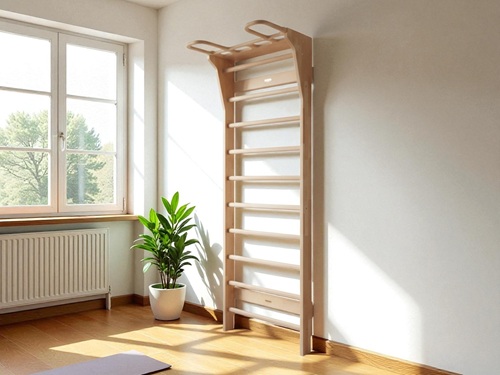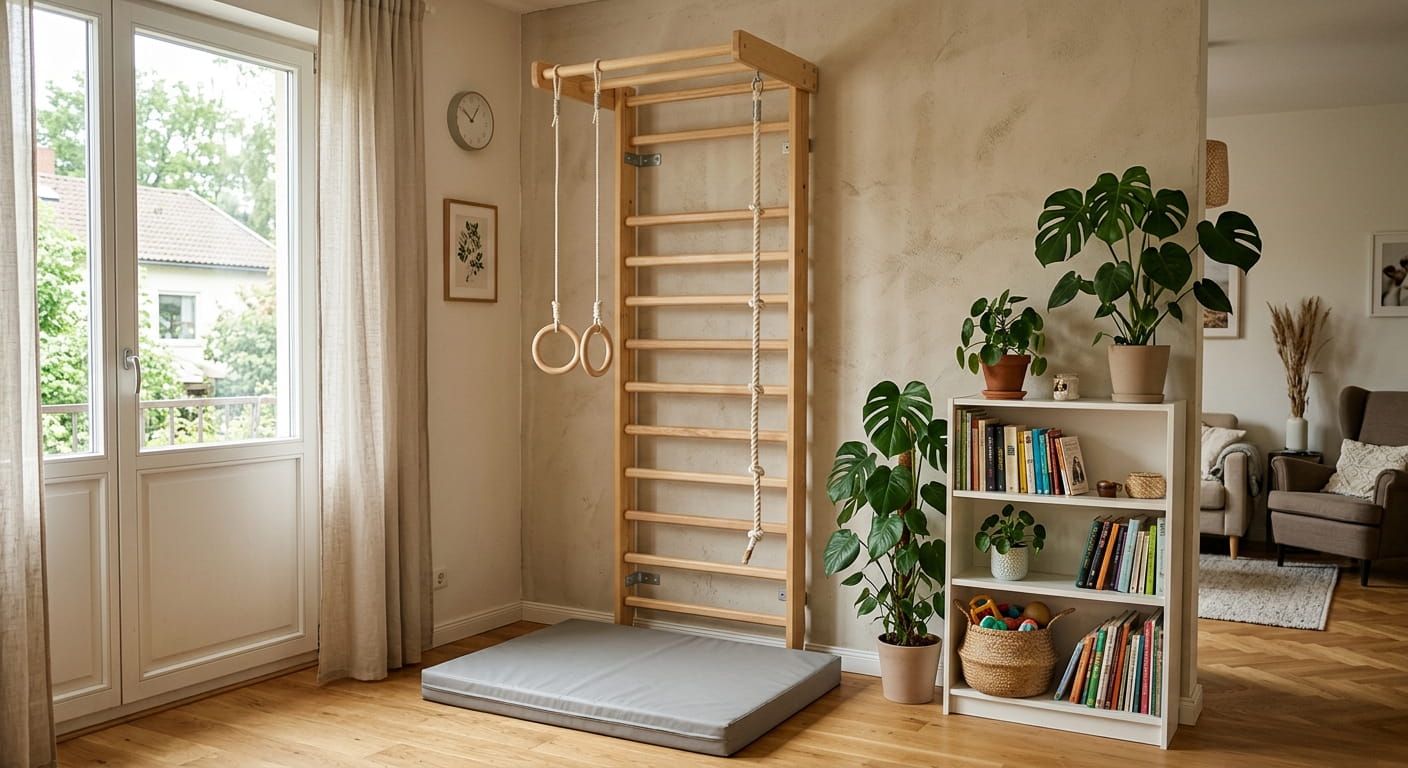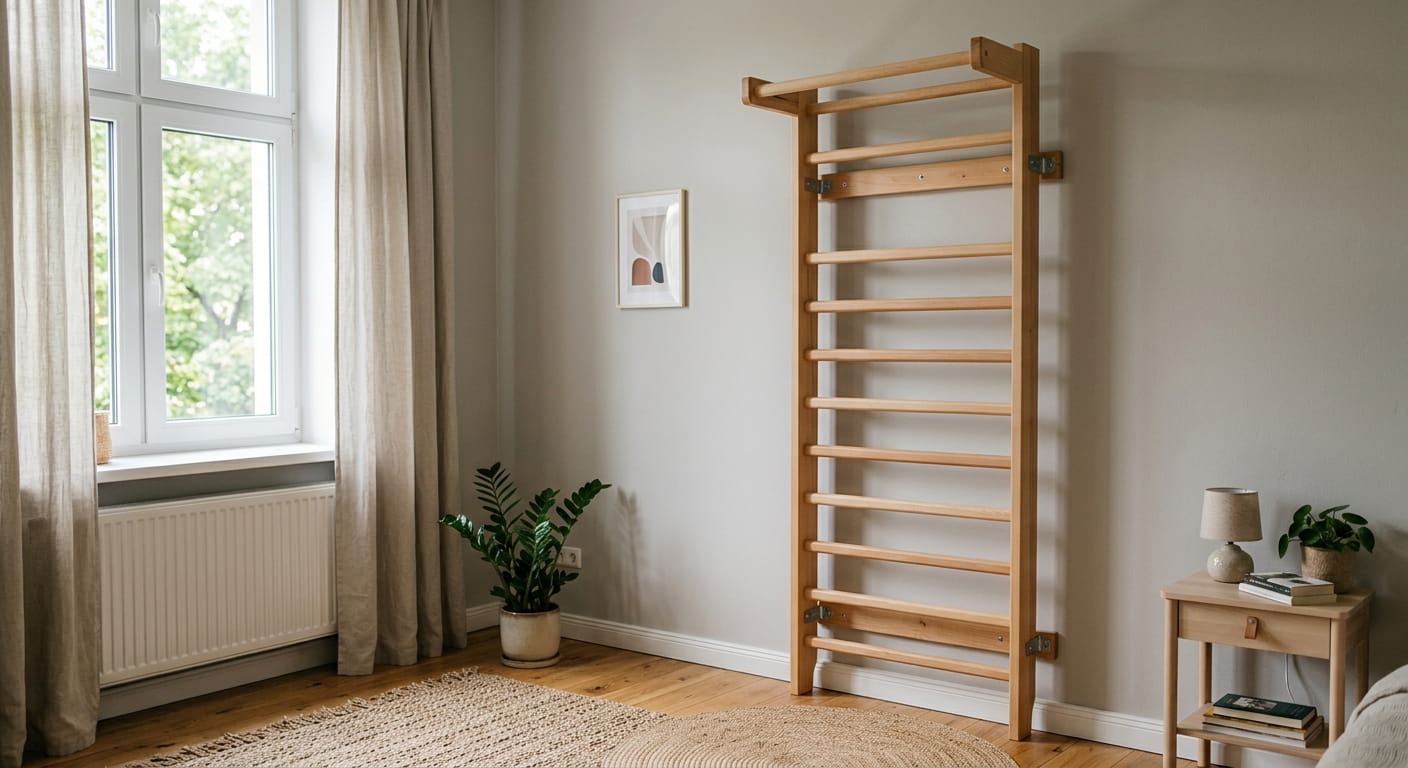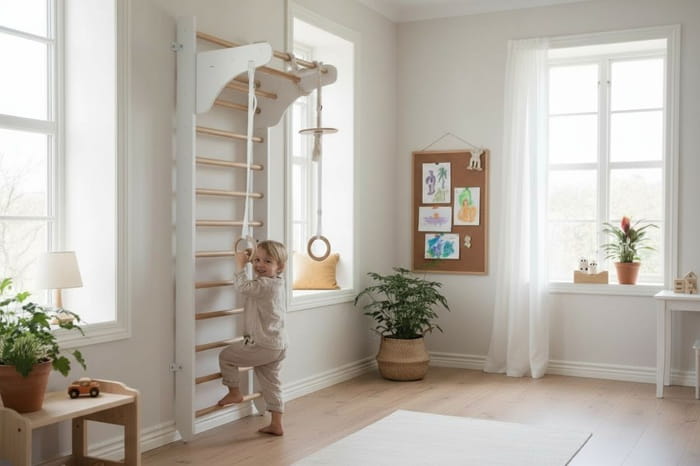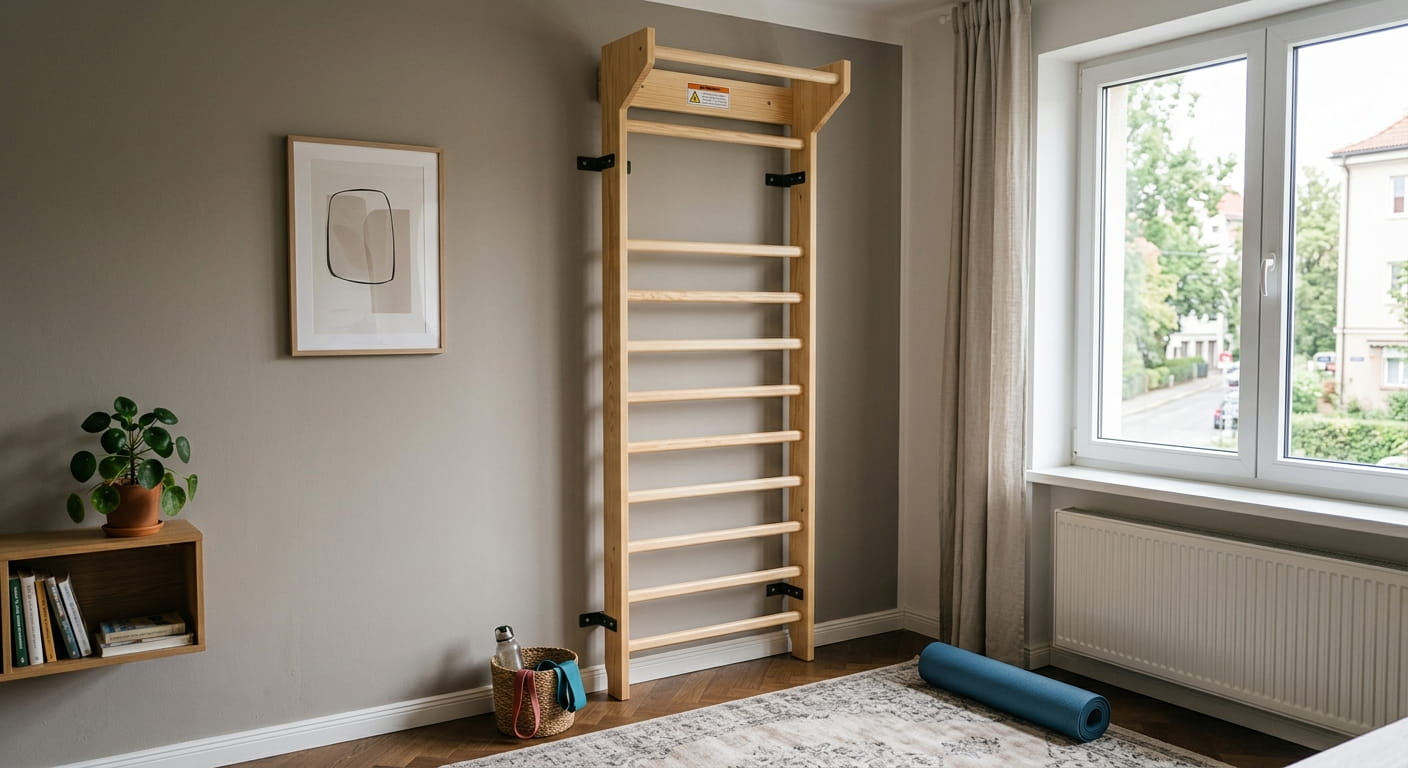
A child has climbed to the top rung of the wall bars and clearly wants to keep going — not up and down, but sideways, hand over hand. That is what the monkey bars are added for: a row of horizontal rungs to swing along, like the ones in a playground, only at home. Below we explain why monkey bars are paired with a pull-up bar, how they help adults and kids, how they fix to the wall or ceiling, how much space they need, and why the «Lider» model of wall bars with pull-up bar and monkey bars and a net is a practical choice.
Monkey bars on wall bars: what they are and how to use them
Monkey bars are a station familiar from playgrounds and school yards: a horizontal ladder of several rungs along which you travel, reaching one hand over the other. On a set of wall bars the monkey bars usually run to the side of the main section or continue it horizontally — starting where the vertical ladder ends and stretching a metre to a metre and a half sideways. The result is a combination: climb the wall bars to the height you need, grab the first rung of the monkey bars, and move hand over hand for as long as your strength — or the ladder — lasts.
Unlike a pull-up bar, where the main movement is pulling up and down at a single point of support, monkey bars work on travel across the horizontal plane. The body stays suspended the whole time, the hands take the rungs in turn, the torso swings slightly, and the legs can be tucked or, for more advanced users, used for momentum. For a beginner the first attempts are two or three reaches and a drop; for a trained person, dozens of rungs there and back without stopping.
Why a pull-up bar and monkey bars go on one set of wall bars
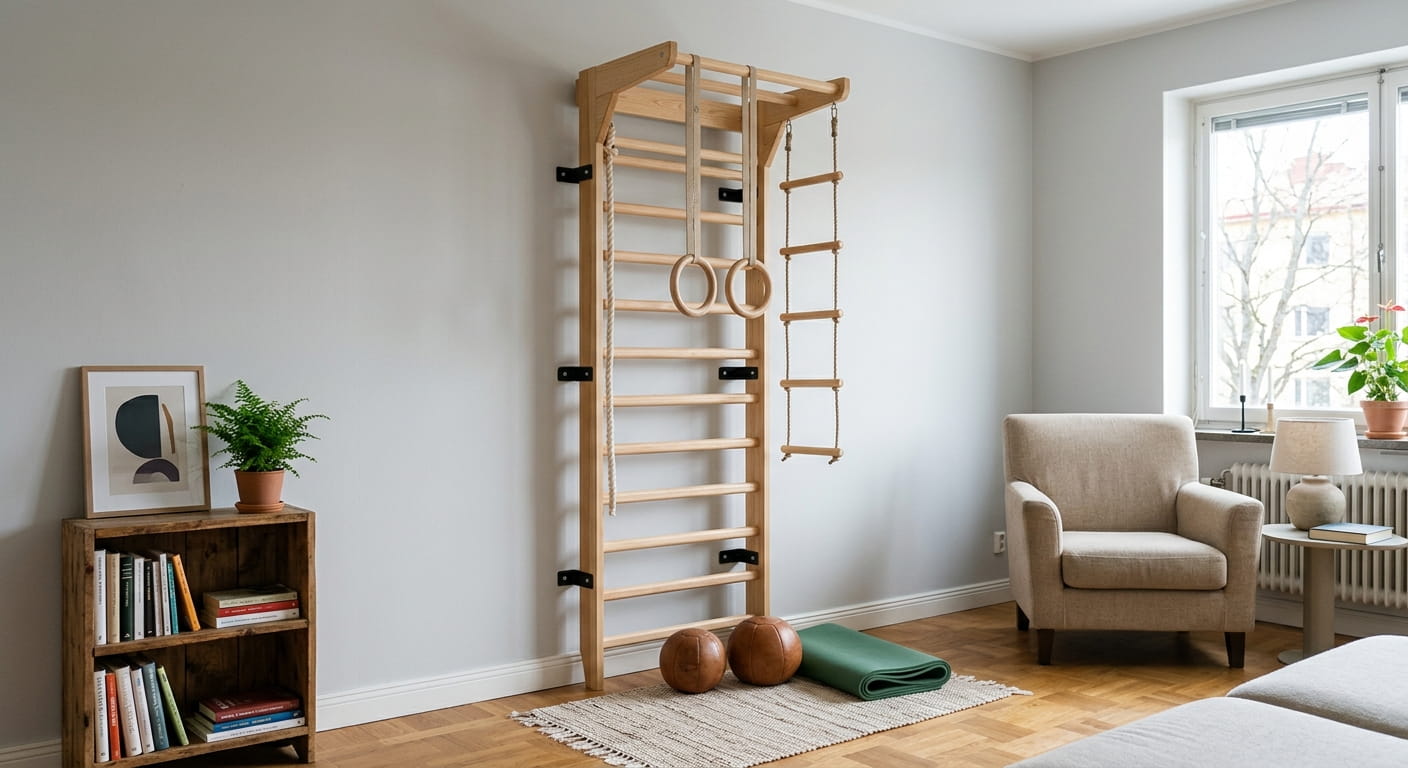
On their own a pull-up bar and monkey bars cover different jobs, but together on one set of wall bars they deliver a fuller load without extra equipment cluttering the room. The pull-up bar is vertical pulling: chin-ups, dead hangs, rotations. The monkey bars add horizontal travel and a timed static grip — exactly what the bar barely trains. When both are on the same frame, the workout runs with no pause to switch stations: a step to the side, and you are on a different type of load.
A practical observation from installations: if the monkey bars run out of the same upright as the pull-up bar, the total load on the mounting grows, and the anchor points need a more careful calculation. That is why on models with monkey bars the uprights are made thicker and the distance between fixing points smaller than on a basic I-shaped set of wall bars with no attachments.
The benefit of monkey bars: grip, shoulder girdle, coordination
Grip is the first thing that visibly weakens in a person who has spent the last few years working only with a keyboard and a steering wheel. Monkey bars train exactly that — the static and dynamic strength of the grip: the fingers hold body weight, the forearms are working at their limit by the tenth rung. After a few weeks of regular crossings the difference shows up in everyday trifles — a heavy bag is held more firmly, a tight screw-top jar opens more easily.
The shoulder girdle is loaded differently than on a pull-up bar. As you reach, the arm passes through a phase of almost full extension at the shoulder, then flexion as the torso pulls up to the next rung — a wider range that recruits the scapular stabilisers that work less during ordinary chin-ups. For anyone recovering from desk work with rounded shoulders, the monkey bars are a gentle way to restore mobility without special machines.
Coordination is a separate story, especially for children. To cross the monkey bars you have to time each reach, control the swing of the torso, and not lose the grip as the wrist rotates. This is not a pure strength exercise but a motor task that forces brain and body to work in sync. Children who regularly use the monkey bars pick up tree climbing, rope climbing and the wall bars as a whole more quickly — basic agility grows down the chain.
Agility from childhood
Regular crossings of the monkey bars build coordination and body confidence in children from 4-5 years old.
Grip strength
A static load on the hand and forearm that is hard to get on the usual machines in a gym.
For the whole family
One set of monkey bars on the wall bars suits both a child and an adult — only the height and intensity change.
A quick warm-up
A couple of crossings of the monkey bars before a strength session warm up the shoulder girdle and hands nicely.
The «Lider» model — U- or T-shaped wall bars with monkey bars
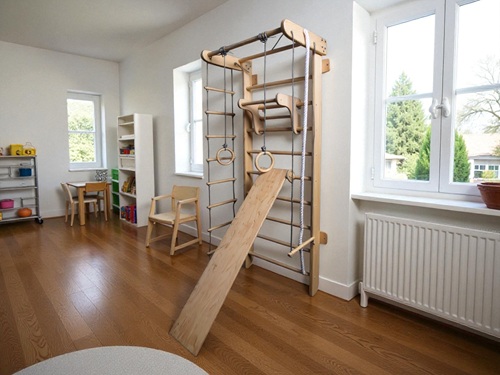
Of the factory's eight models, monkey bars come as a standard element in the «Lider» set — a U-shaped or T-shaped structure built from several sections. A classic single set of wall bars is one vertical frame against a wall. «Lider» is arranged differently: two or three sections are set at an angle to one another or continue one from the next, and a horizontal row of rungs is stretched between the top points — that very monkey ladder. The result is something between a playground sports complex and a compact home set.
In the version with a net, a vertical rope climbing net is fixed to the frame — it adds another type of load and usually appeals to children more than the wall bars on their own. The retail price of «Lider» starts from $195 — dearer than the basic «Krepysh» because of the extra material and the more complex mounting calculation, but noticeably more affordable than buying a pull-up bar, monkey bars and a climbing wall as separate items.
«Lider» is not the only way to get monkey bars at home. Those who want the accent on a pull-up bar with a variable grip, with the monkey bars a lower priority, should look at the wall bars with a pull-up bar and dip bars — a different logic of attachments, but the same principle of combining stations on one frame.

How the monkey bars fix to the wall bars — wall, ceiling, between uprights
The monkey bars are the longest horizontal part of the structure, and they need to be held at a minimum of two, more often three points. There are three mounting options, and all of them are tied to the way the wall bars themselves are fixed.
Wall-anchored mounting is the most rigid. The frame, including the supports under the monkey bars, is pulled with anchor bolts to a load-bearing wall: concrete or solid brick carry the load without question. Such mounting must not be used on plasterboard — the sheet will not withstand the pull-out force of vigorous swinging on the monkey bars, and the fasteners will simply tear out along with a chunk of the panel.
Floor-to-ceiling pressure mounting works without drilling the wall: screw supports press against the floor and the ceiling, clamping the frame in place. This needs a ceiling from 2.40 to 3.10 m high — outside that range the screw upright either will not reach or will run out of thread. The method is not suitable for stretch or suspended ceilings: the membrane will not hold the point pressure of the support foot, and a structure without a rigid top point loses stability exactly where the monkey bars create the greatest leverage.
Combined mounting — uniting the wall anchor with a floor-to-ceiling brace — is used in reinforced models like «Atlet». For structures with monkey bars, where the load is spread along an extended frame, the combined scheme provides a rigidity reserve that the pressure option alone lacks.
| Mounting type | Suitable for | Requirements | Note for monkey bars |
|---|---|---|---|
| Wall-anchored | Concrete, solid brick | Load-bearing wall, not on plasterboard | Maximum rigidity under extended monkey bars |
| Floor-to-ceiling pressure | Rented homes, thin walls | Ceiling 2.40–3.10 m, no drilling | Not for stretch or suspended ceilings |
| Combined | Top reinforced models | Combines wall and ceiling bracing | Extra rigidity reserve during swinging |
Height, length and safety of the monkey bars
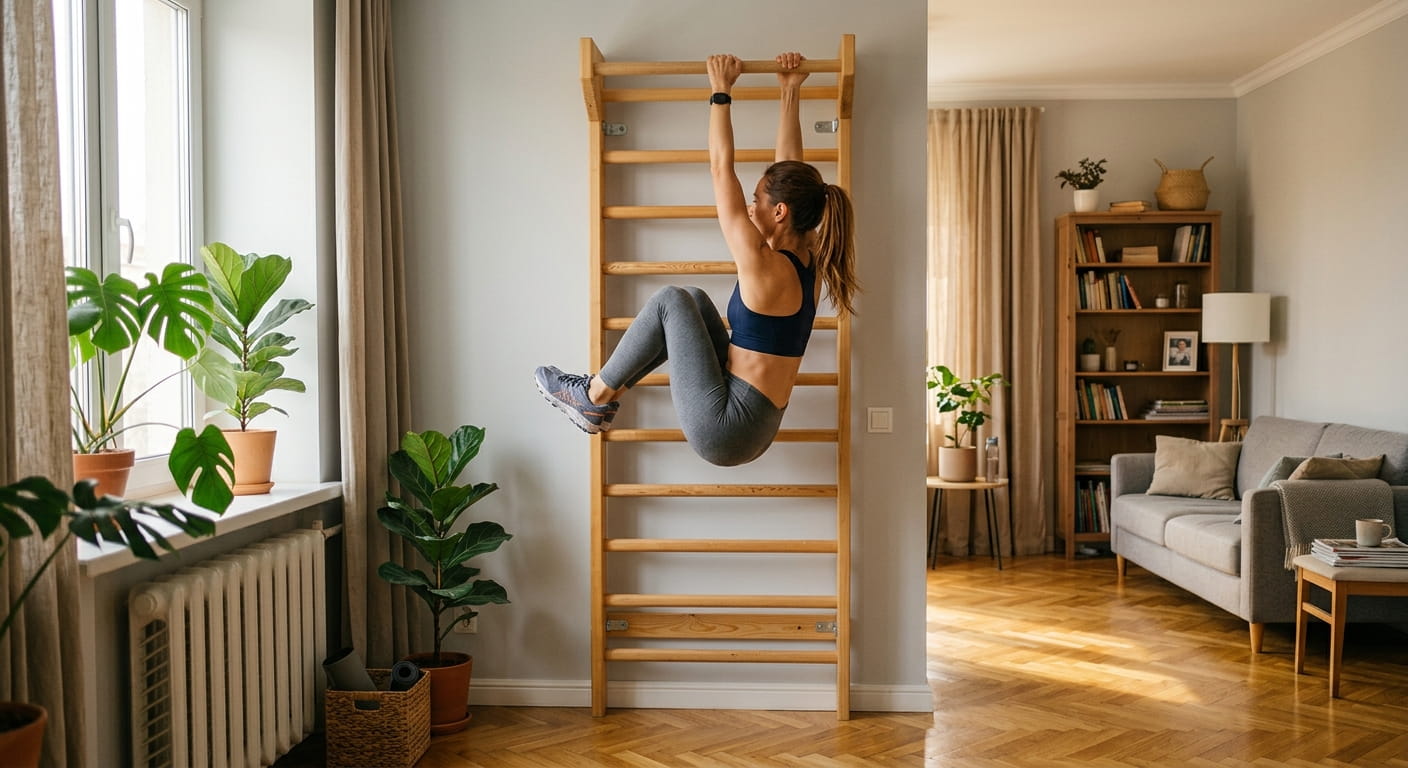
The mounting height of the monkey bars depends on who will use them. For an adult the lowest rung is usually set so the feet stay clear of the floor in a dead hang with fully straight arms — about 190-200 cm from the floor at average height. For a child's version the height is made lower so the child can drop off without the risk of twisting an ankle, and an adult can spot from below without crouching into an awkward pose.
The length of the monkey bars on models like «Lider» usually fits within 1-1.5 metres — enough for 4-6 reaches, which is already a noticeable load on the grip and shoulders. Making the monkey bars longer is most often simply impossible in apartment conditions, and the training effect of extra rungs is not critical: the same 4-6 reaches are easy to repeat several times in a row.
Under the monkey bars, as under any wall bars with attachments, a mat is essential. Dropping off a rung at adult standing height is not a rarity but a normal part of training, especially for children who are still getting used to the station. A sports mat absorbs the impact and reduces the risk of a bruise or a sprain.
- A mat under the monkey bars and across the whole landing zone
- At least 50 cm of clear space on each side of the station
- Checking the tightness of the mounting before a child uses it for the first time
- The height of the lowest rung set to the specific user's height
- No furniture or sharp corners within the swing radius
One more observation from installations: monkey bars set flush against furniture or a doorway regularly lead to a knocked elbow or knee during swinging. Before installation it is worth measuring in advance not only the height but the radius of clear space around the station — at least half a metre on each side, free of furniture corners, sockets at impact height, floor lamps and shelves.
Monkey bars for kids and for adults — what is the difference
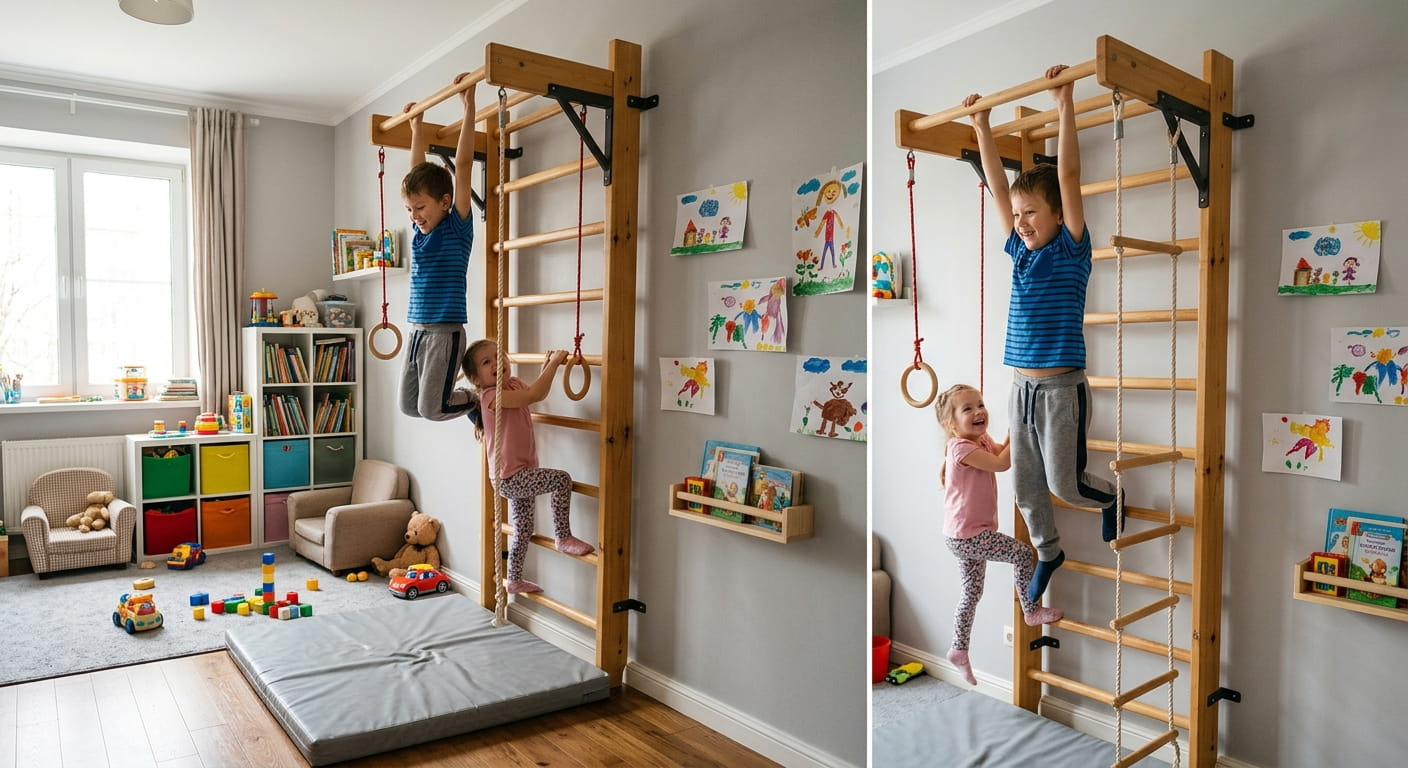
Formally the same monkey bars suit both a child and an adult — rungs of standard diameter hold a grip at any age. The difference is not in the station itself but in the mounting height, the intensity of the sessions and adult supervision.
For children aged 4-7 the monkey bars are first of all play and agility training, not a strength exercise. The task is to learn to reach hand over hand, not to fear the height, and to drop off confidently. In the first weeks a child usually crosses one or two rungs and drops off — that is normal and no reason to force the load. More on choosing stations by age is on the wall bars for kids page, which covers height, spotting and the order of mastering the different elements.
Schoolchildren and teenagers can already cross the monkey bars fully and several times in a row, using the station as part of more serious physical preparation — for general shoulder-girdle endurance, to prepare for school fitness standards, or simply to have a station for releasing energy at home rather than only on the playground outside.
For adults the monkey bars more often come as an addition to strength training on the pull-up bar and dip bars: a warm-up before chin-ups, a shoulder-joint stretch after pressing, extra grip load for those who do wrestling or climbing and prioritise the strength of the fingers and forearms.
Are the monkey bars worth it if there is only one child in the family
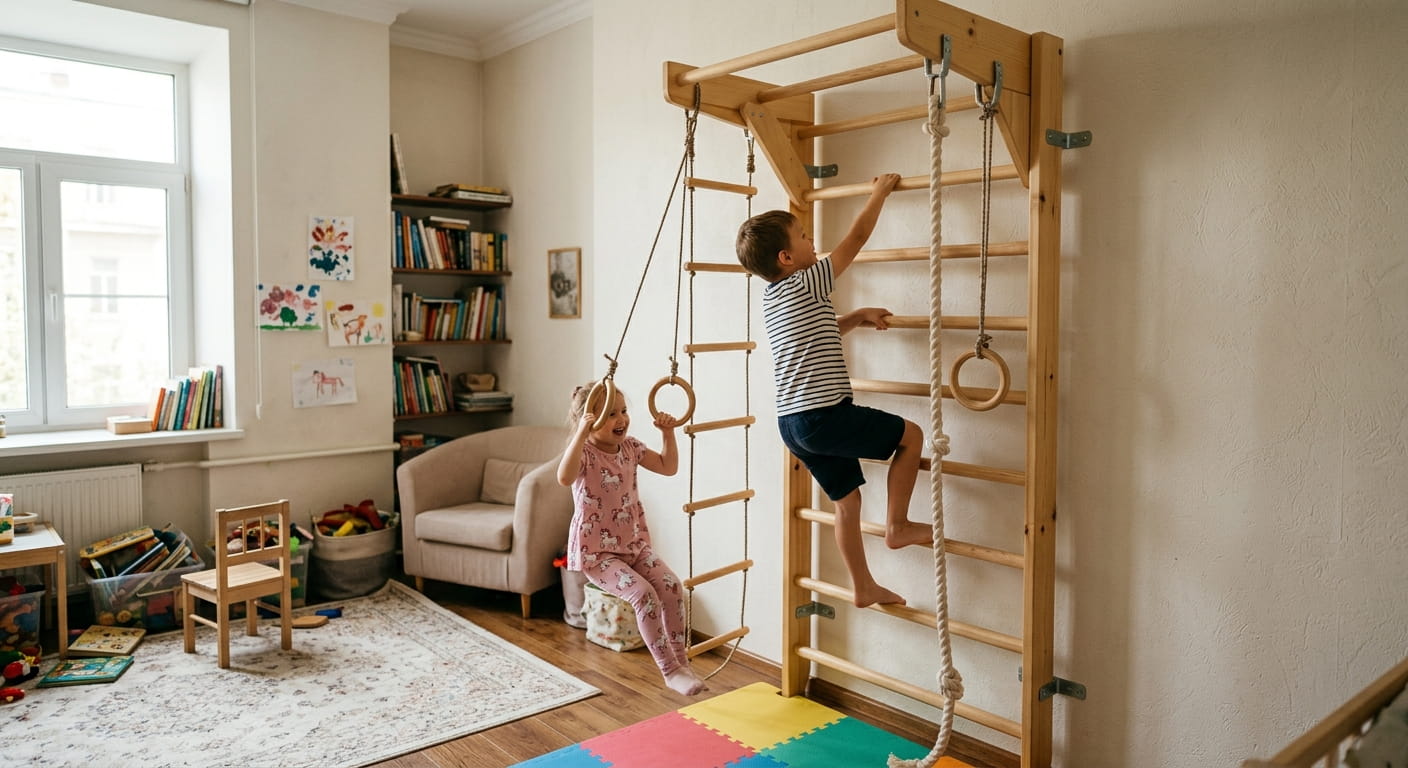
A common doubt when choosing a model with monkey bars is whether it is worth paying extra for a section that one child will use rather than two or three children of different ages at once. In practice the monkey bars earn their price even with a single user: the station does not get boring as fast as a pull-up bar or dip bars, because the technique can be varied — an ordinary crossing, going backwards, with a pause on a rung.
What is more, the child grows, and the monkey bars stay relevant for years ahead: at six it is play and first attempts, at ten it is already full grip and endurance training, and in adulthood it is a warm-up before chin-ups on the same wall bars. One section covers different stages of growing up with no change of equipment.
Load and materials — what the monkey bars are rated for
The standard load rating for wall bars with monkey bars, as for the rest of the range, is 120-150 kg. For a family with children and an adult within that weight range the margin is enough, all the more so because monkey bars are rarely loaded statically with full weight on one rung for longer than a second or two — the movement is constant and the load is redistributed between the hands.
If the family has an adult closer to the upper limit, or the training is meant to be heavy, with swinging and jerks, it is wiser to look at the reinforced «Atlet» model with a capacity up to 250 kg — thick uprights and dip bars with a bench included give a strength reserve that the basic version sometimes lacks under intensive use for years.
The materials are the same for the whole range, including models with monkey bars: the uprights are glued pine or birch beam, the rungs are beech or ash — dense, hard timber that does not crumble under grip load and does not get as slippery from sweat as glossy lacquer on soft pine. The finish is water-based lacquers and oils, hypoallergenic and certified, with no harsh smell after installation. The fasteners are concealed metal furniture ties — only the wood is visible on the outside, and not a single bolt sticks out under your palm on a rung of the monkey bars.
| Model | Design | Load | Retail price from |
|---|---|---|---|
| Krepysh | Basic I-shaped, narrow wall gaps | 120-150 kg | $198 |
| Vershina | I-shaped with a pull-up bar on top | 120-150 kg | $187 |
| Vertikal | I-shaped, rigid combined mounting | 120-150 kg | $183 |
| Atlet | Reinforced, thick uprights, dip bars and bench | up to 250 kg | $202 |
| Minsk Sport | Modular, removable adjustable attachments | 120-150 kg | $174 |
| Lider | U/T-shaped, sections, net, monkey bars | 120-150 kg | $195 |
| Moy Turnik | Removable adjustable pull-up bar with varied grips | 120-150 kg | $218 |
| Maugli | For kids, rope/rings/rope ladder | 120-150 kg | $92 |
Attachments for the monkey bars: rings, rope, an extra pull-up bar
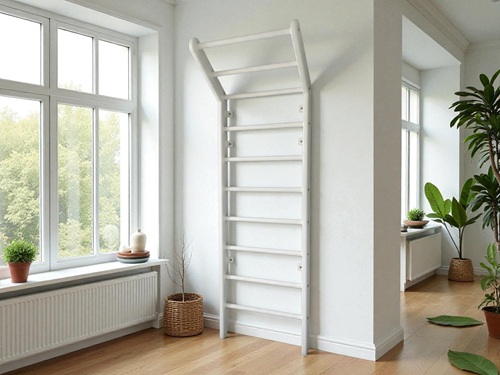
Monkey bars are rarely installed on their own — they are usually part of a set that also takes the rest of the attachments: a removable pull-up bar, add-on dip bars, a folding sit-up bench, gymnastic rings, a rope, a rope ladder, expanders. All of this fixes to the same frame that carries the monkey bars and is swapped around depending on who is training and for what.
Rings are a frequent choice alongside monkey bars: the two stations complement each other by grip type and range of motion, and the rings add an unstable support that recruits the shoulder stabilisers harder than a rigid rung. How that combination works in its own right is described in detail on the wall bars with rings page, which also covers the suspension height and strap-length adjustment.
A rope and a rope ladder are more often chosen for children — they do not demand as much grip strength as the monkey bars, yet they develop the same type of coordination through a different movement. A good combination for a family where the children's ages differ noticeably: the younger one masters the rope while the older one already crosses the monkey bars fully and several times in a row.
The warranty on attachments, including the monkey-bar fixings, is the same as on the main structure — 12 months. The exception is the natural wear of ropes and textile elements of rings, ropes and ladders: fabric and synthetic cord abrade faster than wood and metal from friction, which is not a manufacturing defect but a consumable part of use.
| Equipment | Best suited to | Warranty |
|---|---|---|
| Gymnastic rings | Teenagers and adults | 12 months, except textile wear |
| Rope | Children and teenagers | 12 months, except natural wear |
| Rope ladder | Children from 3-4 years | 12 months, except natural wear |
| Folding sit-up bench | Adults | 12 months |
| Expanders | Adults | 12 months, except rubber wear |
What movements are done on the monkey bars of wall bars
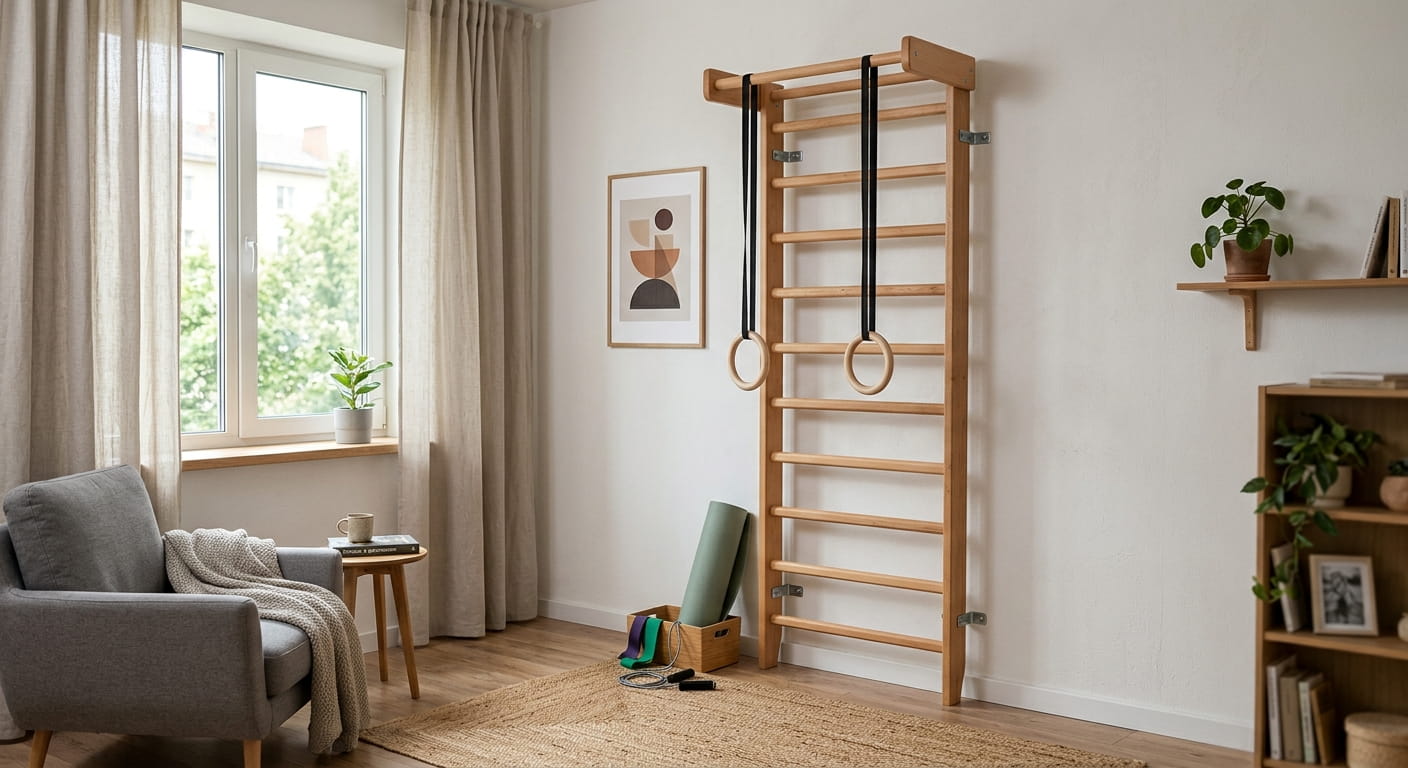
An ordinary forward crossing, rung by rung, is the basic movement everyone starts with, from a preschooler to an adult beginner. After that the load is varied without changing the station itself, simply by altering the technique: going backwards loads the rear of the shoulder differently than a straight crossing and usually demands more confidence in the grip.
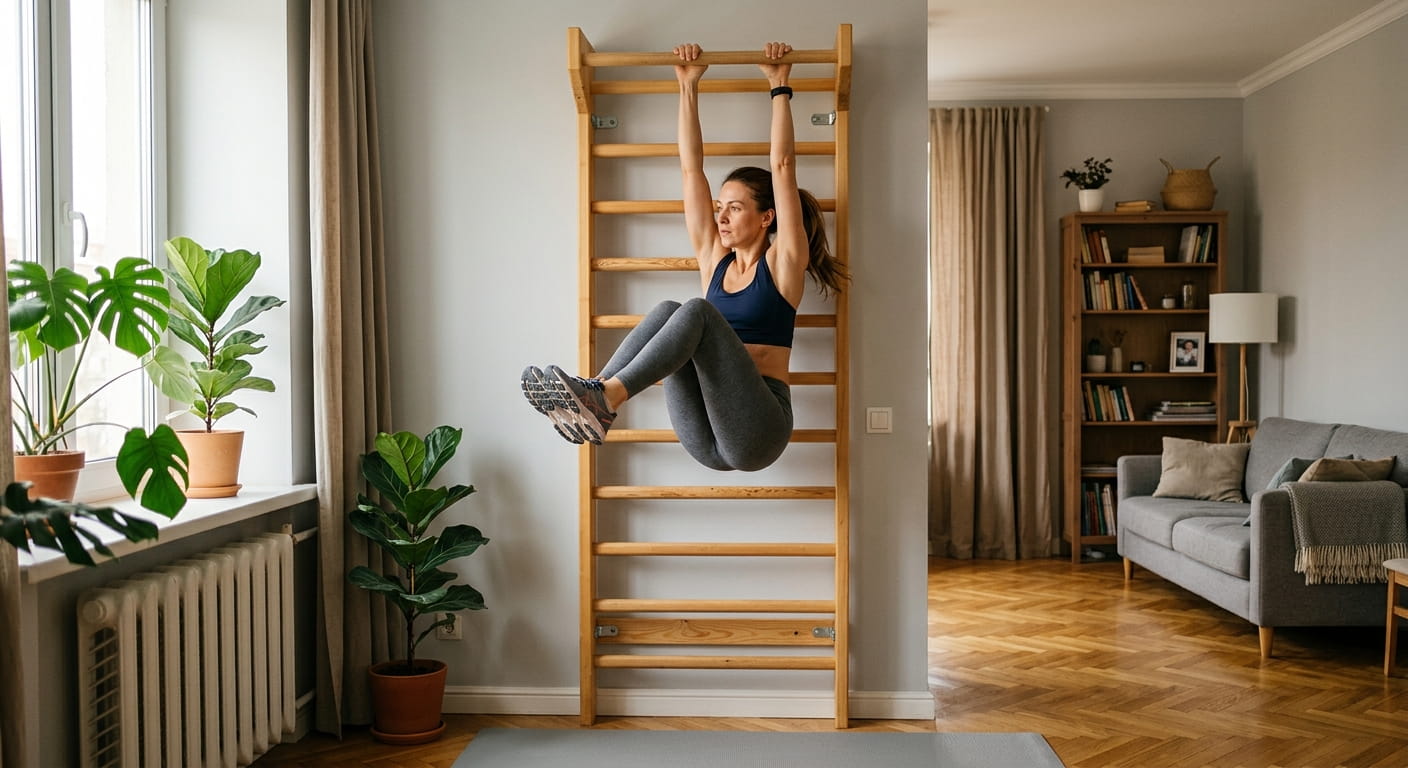
A slow crossing with a short pause on each rung is the option for those who deliberately train static grip strength — before climbing or wrestling, say, where it is not speed that wins but the ability to hold on longer than the opponent. A crossing with the knees tucked to the chest adds ab work right during the travel along the monkey bars — two exercises in one with no stop to reach.
Children usually find the simplest version enough — reaching from rung to rung with rare stops. Forcing complex technique before a child holds the grip confidently along the whole station is a bad idea: the monkey bars already load the hand enough without complicating the task with extra coordination.
How much space do wall bars with monkey bars take
The frame of the wall bars itself, even in a model with monkey bars, takes up little floor — around 0.2 sq.m under the support uprights. But the monkey bars add reach along the horizontal: the section of rungs stretches a metre to a metre and a half sideways, and that space has to stay clear along the full height of the hang, not only at the floor.
In U- and T-shaped models like «Lider», where two or three sections are set at an angle, the real footprint of the set is larger than it seems from a single vertical frame — it is worth sketching on the apartment plan in advance where the angle between the sections will sit, and whether it will run into a doorway or a windowsill.
For an apartment with no separate room for sport, a reasonable compromise is one section of wall bars with a pull-up bar on top and monkey bars to the side, without a second section and net: this saves both space and budget, while the set of exercises stays almost as complete.

Common mistakes when choosing wall bars with monkey bars
The first mistake is judging the monkey-bar height by eye without checking it against the height of everyone who will train on the wall bars. The result is either a child who cannot reach the lowest rung, or an adult who catches the floor with their toes in a model that is too low, losing part of the range in a full hang.
The second is saving on the mat, assuming the parquet or laminate under the wall bars is level enough as it is. A hard floor does not absorb impact in a fall, and the monkey bars by definition involve regular grip slips for beginners, especially children in the first weeks of use.
The third is choosing floor-to-ceiling pressure mounting for the wall bars without checking the ceiling type in the apartment in advance. Under a stretch or suspended ceiling the scheme does not work, and the rework costs more than the right choice of model from the start — it is wiser to discuss the ceiling and wall type with the manager straight away.
The fourth is setting the monkey bars flush against a wardrobe, sofa or doorway, leaving no room for the torso to swing. Half a metre of clear space on each side is not a box-ticking recommendation but the real radius the station uses during active movement.
How long it takes to master the monkey bars on wall bars
A child of 5-6 usually crosses the whole monkey bars on their own within a few weeks of regular attempts — first one rung, then two, after which progress speeds up because grip strength and confidence grow in parallel. There is no point rushing the process: a few minutes a day on the wall bars give a better result than one long session once a week.
An adult beginner with an untrained grip sometimes masters the station more slowly than a child — body weight, which has to be held by the fingers at every reach, tells. Here an intermediate stage helps: hanging on one rung of the monkey bars, swinging, then one reach, then two. After a month to a month and a half of regular sessions on the wall bars most people cross the monkey bars in full without stopping.
Installing monkey bars on wall bars yourself
Assembling a set with monkey bars takes from an hour and a half to three hours — it depends on whether a single section or a run of several is being installed. The kit includes instructions and all the fasteners, including anchors or screw pressure uprights for the chosen mounting type, so nothing needs buying separately.
The order is usually this: first the main frame is assembled and set level, then fixed to the wall or braced to the ceiling, and only once the frame is secured and checked for stability are the monkey bars and the rest of the equipment hung. Fitting the monkey bars before the main frame is fixed is a bad idea — extra weight on an unsecured structure raises the risk of it skewing during installation.
The level of the monkey bars themselves is checked separately — if the rungs run at even a couple of degrees off true, it is felt during active travel and creates an unpleasant side load on the shoulder. A level during installation is not a formality but what determines comfort in using the station.
After assembly it is worth loading the structure seriously once — hanging on the monkey bars with full weight, swinging — before letting a child on the station. This is a simple check that reveals an under-tightened joint before it becomes a problem during play.
Caring for wall bars with monkey bars
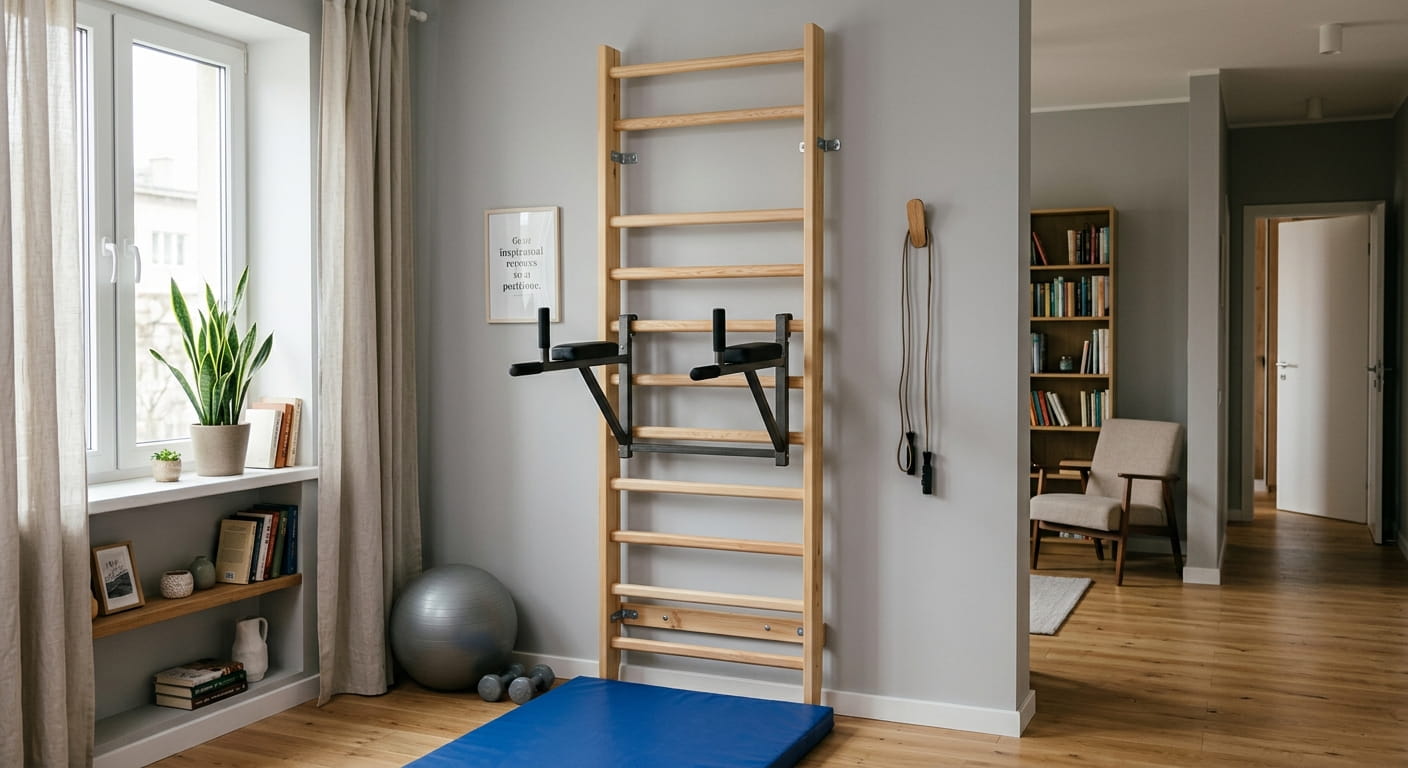
The rungs of the monkey bars are the most contacted part of the whole structure — hands touch them constantly, and this is where wear of the finish shows first. Care is simple: wipe with a dry or slightly damp cloth, without abrasives or aggressive chemicals that can dry out the protective layer on the beech or ash.
Every 3-6 months it is worth checking the tightness of the bolts — not only on the main frame but at the monkey-bar fixing points separately, since swinging during travel creates a variable load on the thread stronger than a static hang on a pull-up bar.
The mat under the monkey bars should be kept down permanently, not brought out only for a child's training — falls happen to adults too, especially when trying to cross the station at speed or with added weight.
Direct sun and proximity to a radiator dry the wood and finish faster than normal — timber that has dried out at a grip point on the monkey bars can crack exactly where the hand applies the most force. It is better to place the structure away from a window with constant sun and from heating appliances.
Monkey bars, a climbing wall or a pull-up bar with dip bars — how to choose between stations
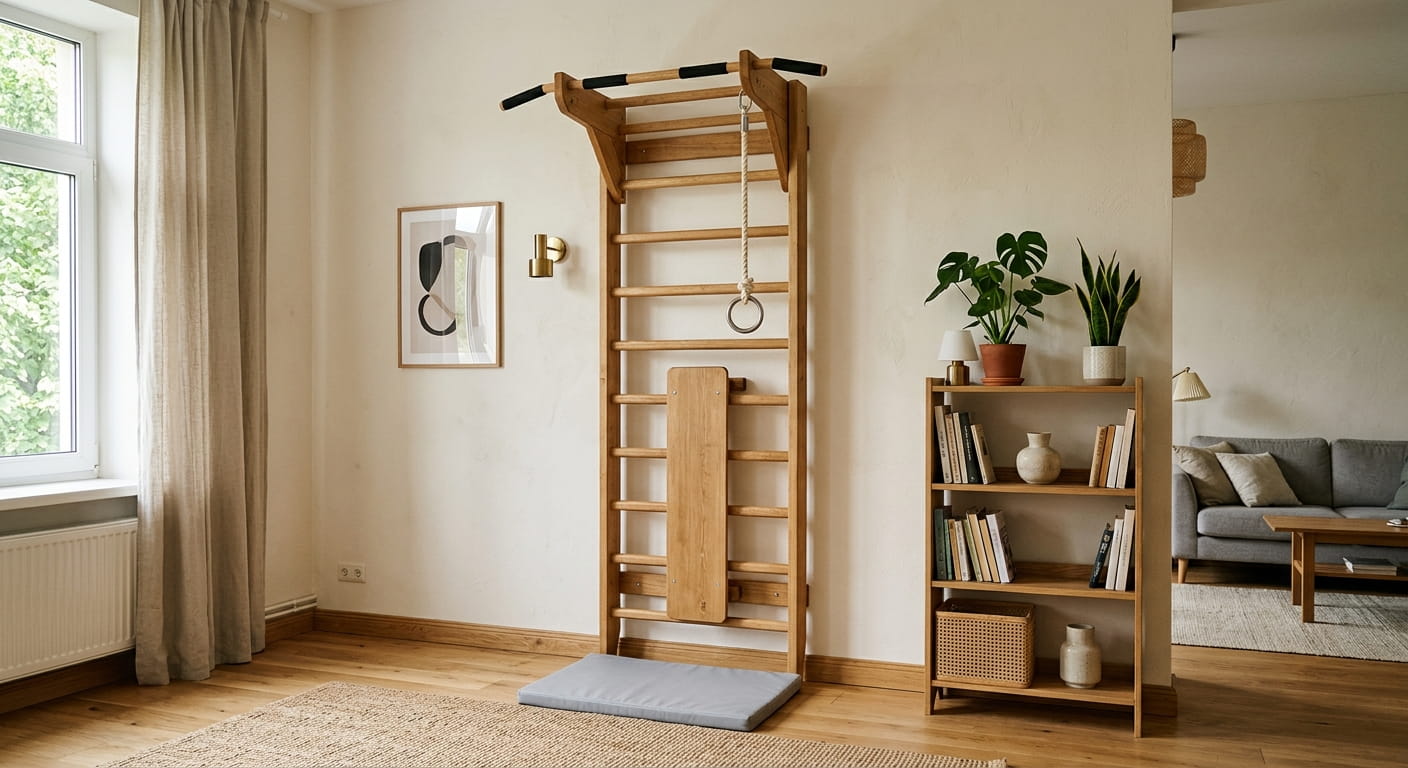
Monkey bars are not the only way to vary a basic set of wall bars. If the priority is vertical climbing rather than horizontal travel hand over hand, it is wiser to look at the wall bars with a climbing wall and holds — a completely different type of load on the legs and overall coordination, closer to mountaineering preparation than to a workout.
If the main goal is upper-body strength work and horizontal travel is secondary, a pull-up bar plus dip bars will cover the task more effectively: chin-ups, dips and leg raises for the abs give a more concentrated strength load than crossings on the monkey bars.
In practice many families do not choose one instead of the other but combine: basic wall bars with a pull-up bar and dip bars for an adult's strength work, and a separate children's corner with monkey bars, rings and a rope — all the easier since attachments can be bought later and swapped around after the main frame is installed.
Monkey bars and posture: how the sessions help the back and shoulders
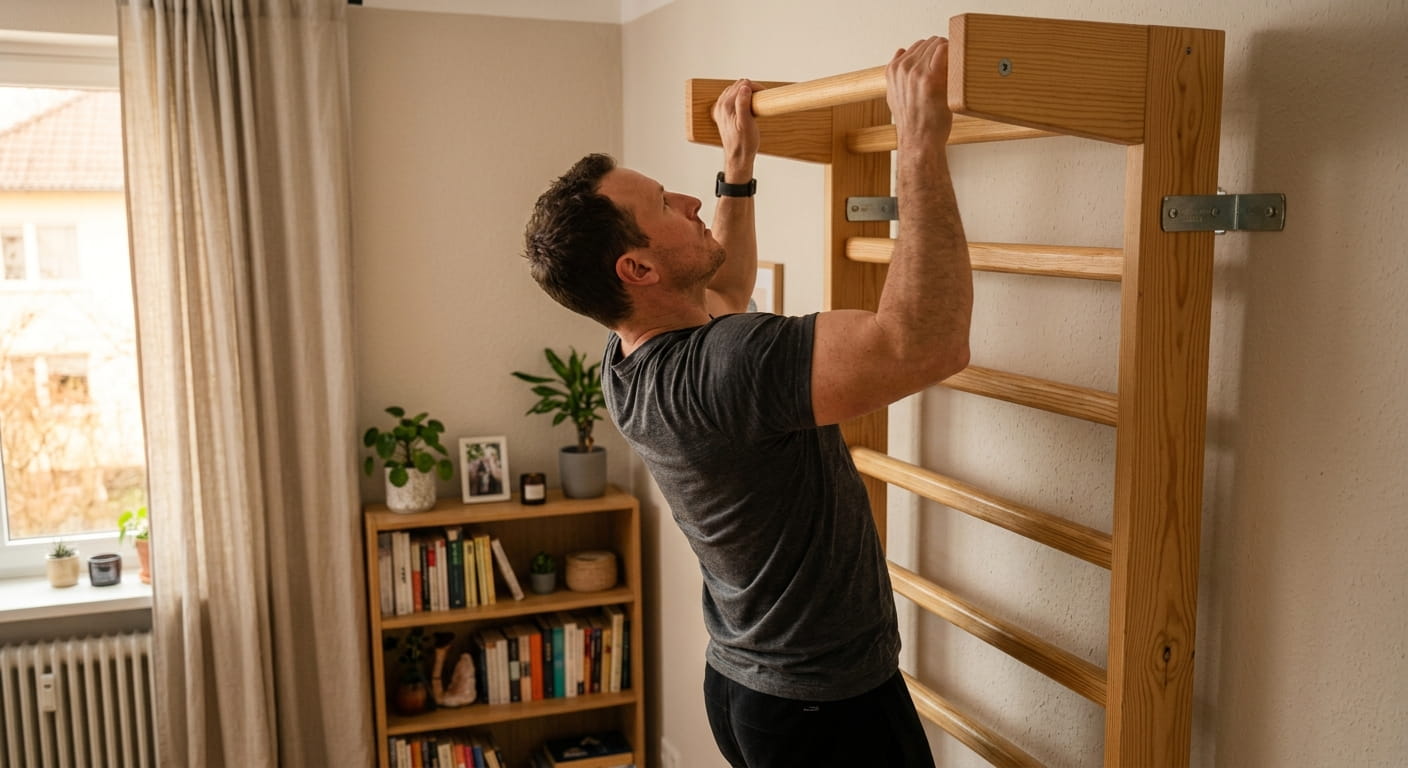
Desk work and study pull the shoulders forward and down — it shows in the silhouette: a rounded back, the head thrust forward, a compressed chest. A hang on the monkey bars is arranged so the shoulder joint opens through almost its full range: the arm reaches forward to the next rung, the body stretches along the whole length of the spine under its own weight.
This does not replace work on posture with a specialist if the problem is already pronounced, but as daily prevention for anyone who spends the whole day at a computer, a simple hang and a slow crossing on the monkey bars are a working, accessible tool. Five minutes morning or evening on the wall bars with monkey bars relieve part of the tension built up in the shoulders and chest over the day.
For children who spend a lot of time at a school desk, the same hang and crossings on the monkey bars help compensate for the static pose with movement in the opposite direction — the shoulders turn outward, the chest opens, the back lengthens. Regularity matters more here than the length of a single session: a couple of minutes every day is more effective than half an hour once a week.
Wall bars with monkey bars factory-direct — how to order
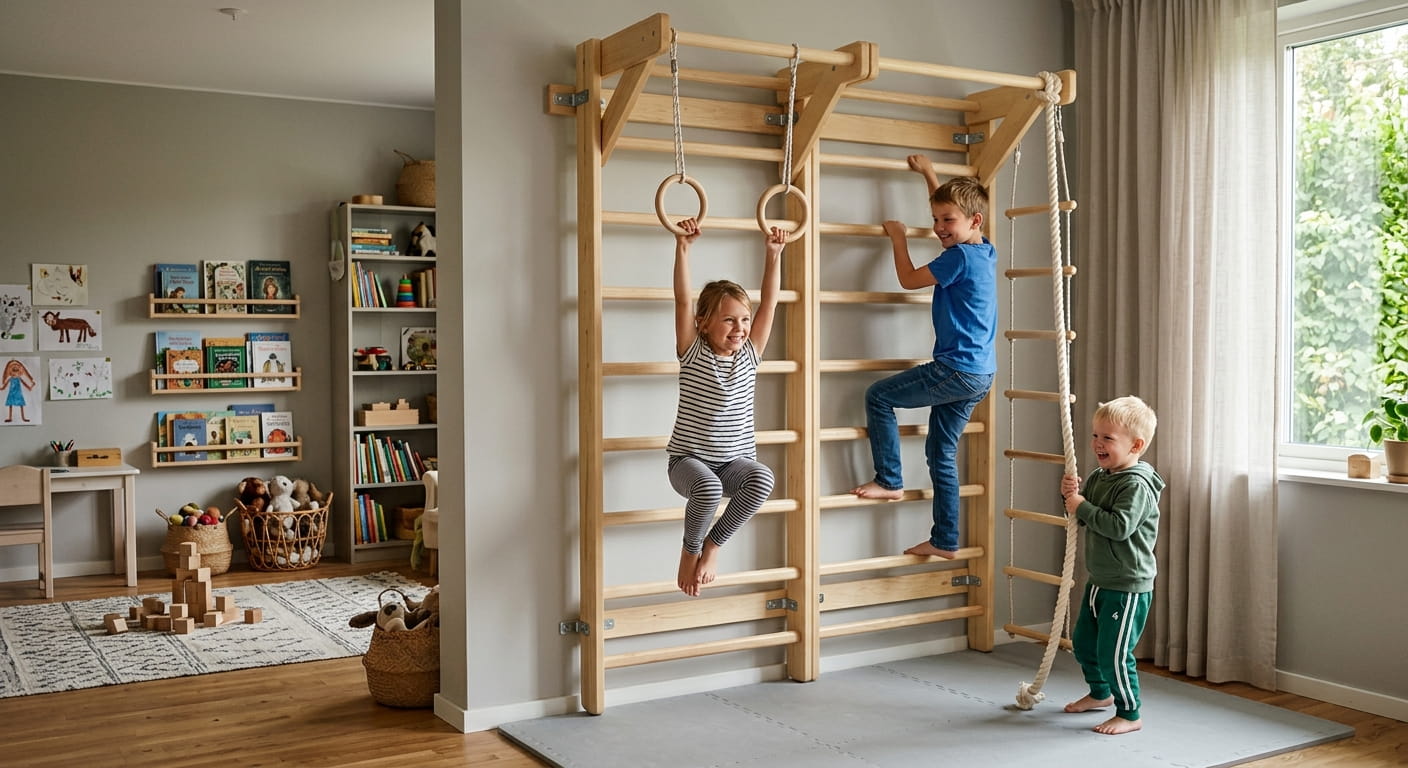
Sets with monkey bars are built in our own workshop in Zaslavl, Minsk District, at Stroitelnaya ulitsa, 7. Delivery covers all of Belarus, from Zaslavl to the most distant district centres, with lead times confirmed for your specific address at the time of order.
Retail takes a ready model off the shelf or built to standard sizes, from $195 for «Lider» with monkey bars. Wholesale and B2B orders start from a minimum batch of 10 units, with the option of own branding and private label for a chain or online store; EAC (TR CU) certificates are supplied for all products. Wholesale production takes 15-35 days, dispatch after completion is 3-5 working days, delivery to the carrier's terminal is free, and collection from the workshop is available for those closer to Zaslavl.
Before ordering it is best to confirm the mounting type for your specific wall and ceiling with the manager — room height, wall material, presence of a stretch ceiling. This saves assembly time and rules out the situation where a purchased model with monkey bars physically does not fit the chosen corner of the room.
A ready-made wooden set of wall bars with monkey bars usually costs less than a kit of a separately bought pull-up bar, separate monkey bars and a separate stand for rings — the saving comes from a shared frame, a single mounting calculation and one delivery instead of several orders from different shops. For anyone looking at a home sports corner for the first time, the pairing of a pull-up bar with monkey bars on one set of wall bars is the optimal entry point: not the cheapest basic model, but not the priciest reinforced one either — a sensible balance of price and range of options.
Expert opinion
Monkey bars on wall bars are an inexpensive addition that changes the character of training more than it seems at first glance: the grip, shoulder girdle and coordination are loaded differently than on a pull-up bar and dip bars, and children usually like the station more than the wall bars themselves. The «Lider» model with a U- or T-shaped frame, net and monkey bars is a practical option for anyone who wants to cover several types of load at once on one structure, without taking up a separate corner of the room for each station.
Before buying it is worth soberly assessing the ceiling height, wall material and the real radius of clear space around the monkey bars — this determines the mounting type and the final safety of the structure more than the choice of a specific model. A mat under the station, regular checks of bolt tightness and matching the height to the user's height are the three things that turn monkey bars from a potentially hazardous station into a safe part of the whole family's everyday activity.
— Veronika Tarasevich, internet marketer, specialist in semantics and content for product niches.