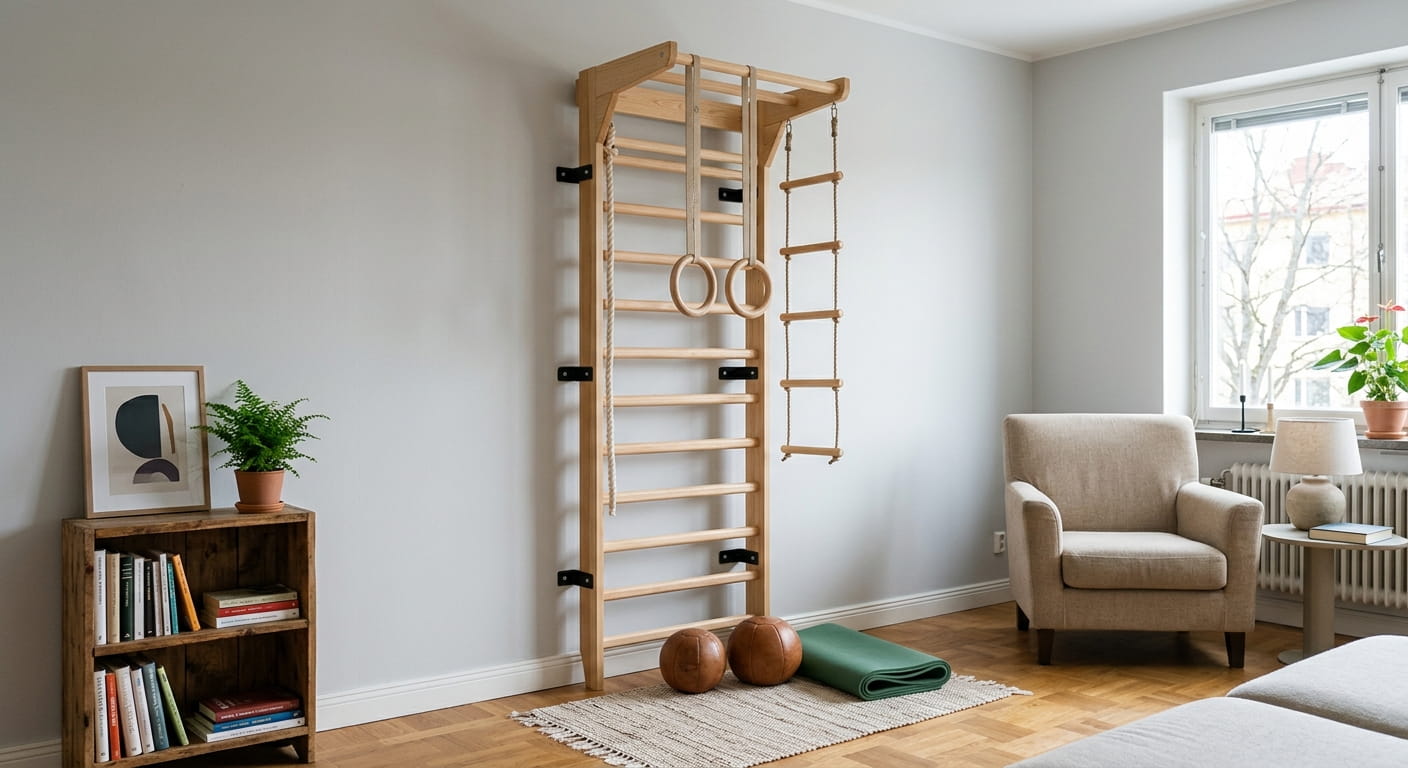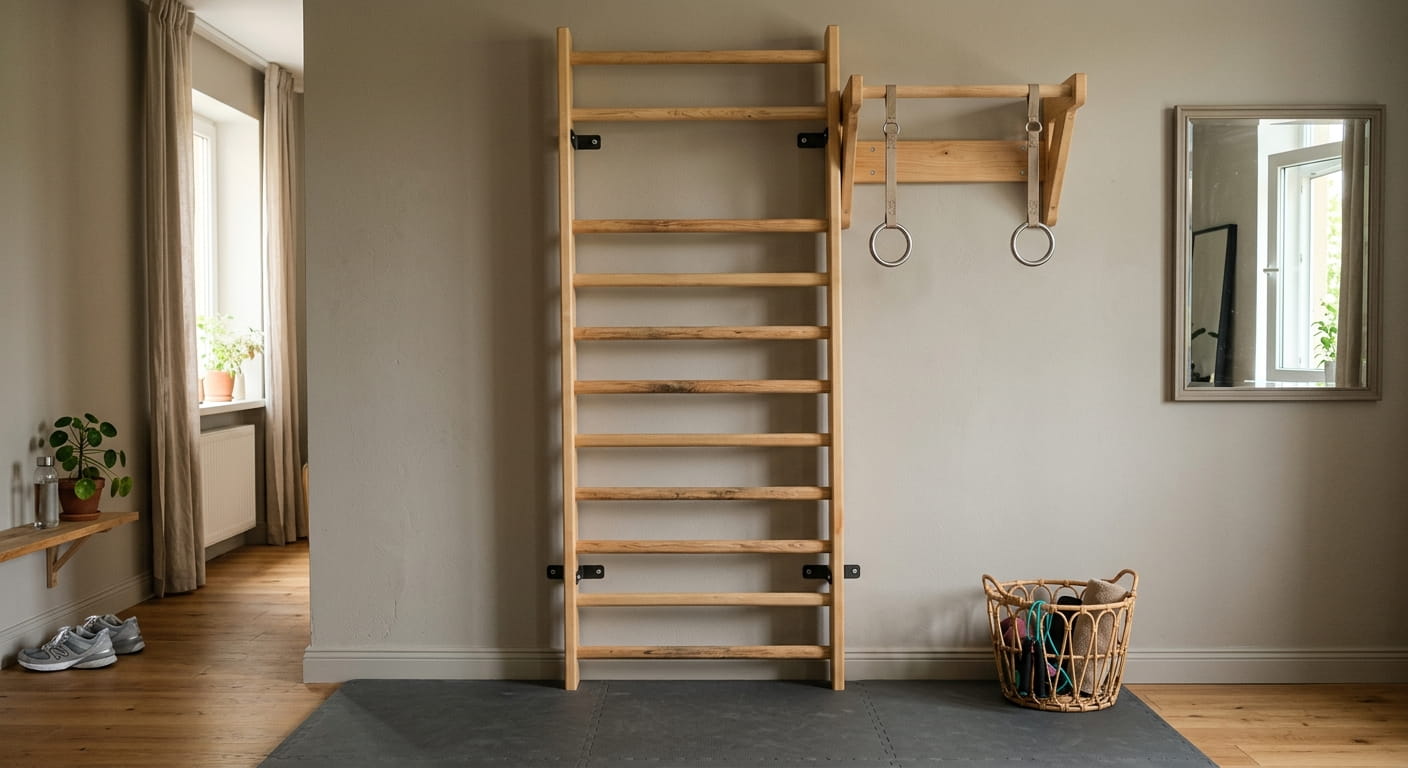
A rented one-bedroom flat, a two-metre-forty ceiling, drywall partitions with sockets every forty centimetres — these are usually the starting conditions when someone begins looking for wall bars for an apartment. There are always three questions: will the unit fit under a low ceiling, how to fasten it without holes in the landlord's wall, and what to do if there is a stretch ceiling overhead. Below, in order — mounting, ceiling height, compact models and care.
In practice the choice often comes down not to budget but to the physics of the home. A home gym corner either stands on braces between floor and ceiling or is fixed with anchors to a load-bearing wall, and there is hardly a third option — except for combined mounting on select models. For an apartment, especially a rented one, this is the decisive fork in the road.
It is worth separating expectations from reality straight away: wall bars for an apartment are not a replacement for a full-blown gym, but a compact unit for basic exercises on the rungs, dip bars and rings within the span of a single wall. Choosing wall bars for an apartment is, above all, about matching the unit to the room rather than chasing the longest feature list. Serious barbell strength training needs separate equipment and room for it, but a wooden ladder fully covers a morning warm-up, pull-ups, children's play and stretching — with no compromise on the apartment's floor space.
In practice, three situations come up most often. The first is a studio of 24–30 square metres, where every metre counts and the deciding factor is not price but the compactness of the frame and the ability to remove the attachments when the room is needed for guests in the evening. The second is a two-room apartment with a nursery, where the unit goes in the child's room and has to withstand active play for years to come, with a load margin for the future. The third is rented housing, where the landlord's permission and pressure mounting with no trace of drilling come first.
Wall bars for an apartment: where the choice begins
The first question to ask yourself before browsing the catalogue is whether the walls are yours or someone else's. Literally everything depends on the answer: the type of mounting, the list of suitable models and whether the unit can be installed in a particular room at all. Rented housing almost always means floor-to-ceiling pressure mounting; an owned apartment with load-bearing walls allows anchor mounting, the most rigid of all.
The second point is the wall material. A concrete slab or solid brick holds an anchor perfectly; a drywall partition does not — you simply cannot anchor wall bars to it, as the frame would tear out the fasteners under load. For drywall and for rented housing there is only one route left: pressure mounting.
For a rented apartment it makes sense to check with the landlord in advance whether installation is allowed at all, even without drilling. A pressure-mounted frame leaves no holes in the walls, but it does leave marks from the support plates on the floor and ceiling, and some owners are wary of any large equipment in the room. A five-minute conversation before ordering removes a potential conflict after the contract is signed.
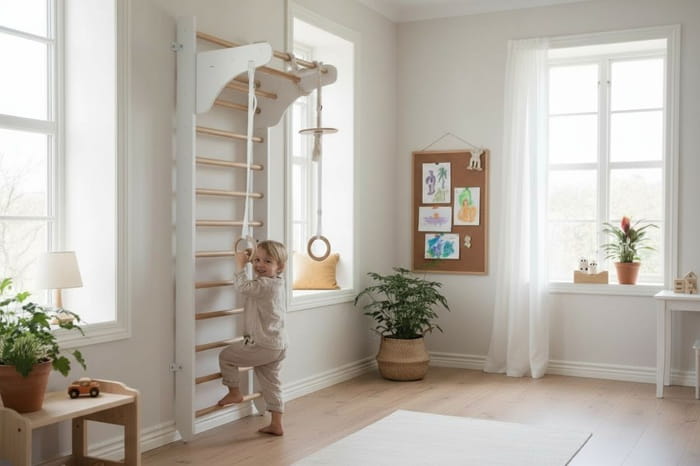
The third point is ceiling height, measured to the centimetre rather than by eye. An error of three or four centimetres is critical for a pressure-mounted frame: the screw jack will either fail to reach the ceiling or the uprights will have to be trimmed, which the manufacturer does not recommend. Measure at a minimum of two points in the room, because older panel buildings often have an uneven floor slab.
Compact
Takes up about 0.2 square metres of floor — less than a writing desk.
No drilling
Floor-to-ceiling pressure mounting suits rented housing and drywall.
Wood, not metal
Glued timber and hard wood are quieter than metal and do not ring under load.
12-month warranty
On the frame and attachments, excluding the natural wear of ropes and textiles.
Wall-mounted or pressure-mounted: two ways to set up wall bars in an apartment
Anchor mounting is the option for those who live in their own apartment and are ready to drill into the wall permanently. It is more rigid than any other, supports loads of up to 250 kg on reinforced models and is not afraid of active workouts with swinging. There is one drawback, but a significant one: removal leaves holes in the wall from the anchor bolts, which will have to be patched when moving out.
Pressure mounting without drilling for a rented apartment
A pressure system works differently: the frame is clamped by a screw jack between floor and ceiling, without a single hole in the walls. For rented housing this is effectively the only legitimate way to set up wall bars — the landlord will not see a single hole after you move out, only marks from the support plates at the top and bottom, which are easy to hide.
Here is how it works: the uprights are assembled, rest on the floor through an adjustable plate, and the screw mechanism at the top is wound out until it makes firm contact with the ceiling. No drilling, minimal tools, all the hardware included with the instructions. It assembles in one and a half to three hours; doing it alone is awkward, so two people are better.
Anchor mounting is simpler in terms of physics but more demanding of tools: a hammer drill, anchor bolts of a suitable diameter, levelled marking. On the other hand, once installed the frame does not need the jack retightened for seasonal changes in temperature and humidity in the apartment, which cannot be said of pressure mounting — the timber of the uprights "breathes" slightly, and every few months the jack should be checked for a tight fit against the ceiling.
Another practical nuance of pressure mounting is compatibility with the skirting and the ceiling cornice. If a wide ceiling cornice is already installed around the perimeter of the room, the support plate of the screw jack may press not against the slab itself but against a decorative element that is not designed for such a load. Before assembly it is better to clear this spot of the cornice or shift the installation point a few centimetres away from it.
Pressure mounting holds a load less well than anchor mounting during active swinging and jerking pull-ups. A standard pressure-mounted model is rated for 120–150 kg of static and moderate dynamic load — enough for a family with children and adult weight — but strength exercises with sharp jerks are better done smoothly.
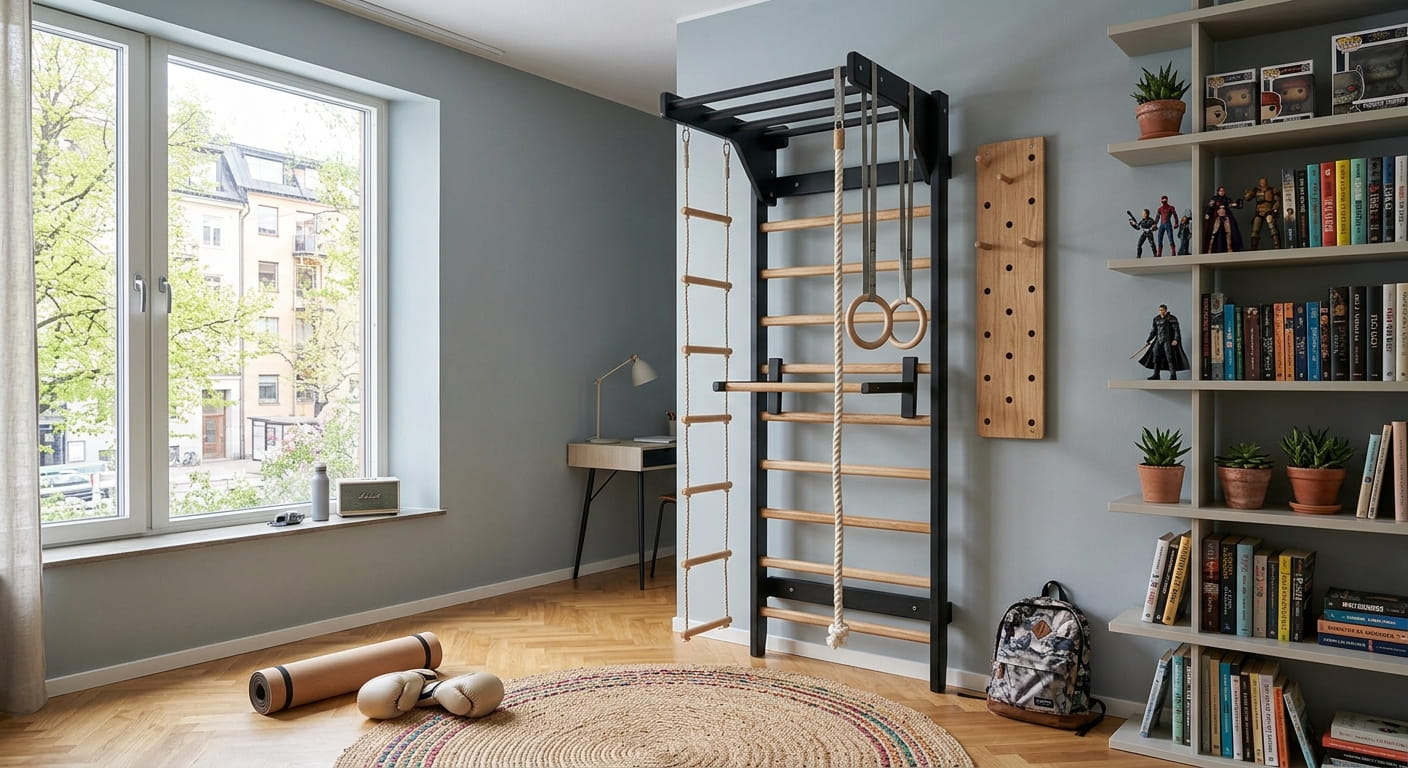
Ceiling height 2.40–3.10 m: without it a pressure-mounted frame will not stand
The 2.40–3.10 metre range is not a recommendation but a technical limit of the adjustment mechanism. Below 2.40 m there is simply nowhere to wind the screw jack, the frame ends up assembled overlapping and loses rigidity. Above 3.10 m the jack's thread is not enough to reach the ceiling — here only wall-mounted anchoring helps, provided the walls are load-bearing.
Panel buildings of mass-produced series most often fit within this corridor: a typical ceiling height of 2.50–2.70 m passes without question. It is trickier with older housing stock and some modern projects, where ceilings rise towards three metres and above — there it is worth checking with a manager the exact adjustment range of a particular model before ordering.
Measure with an ordinary tape from floor to ceiling at the highest and lowest point of the installation area — older buildings often "drift" in height by two or three centimetres within a single room, and the difference in exactly those centimetres determines whether the pressure-mounted frame stands tight or with play. If you only have a flimsy cloth tape on hand, it is better to use a laser rangefinder or ask the installer to take the measurement during the consultation.
| Ceiling height | Suitable mounting | Comment |
|---|---|---|
| up to 2.40 m | anchor only (wall-mounted) | the pressure jack does not reach the ceiling properly |
| 2.40–3.10 m | pressure or anchor | standard adjustment range of the screw jack |
| above 3.10 m | anchor only (wall-mounted) | a load-bearing wall is needed, the brace will not reach |
Separately, about stretch and suspended ceilings — here the issue is not height but the very construction of the ceiling, and that is a fundamentally different story.
Stretch ceiling and wall bars: what is and is not allowed
A stretch ceiling and pressure mounting are physically incompatible. A PVC or fabric membrane will not withstand the point pressure of the screw jack — it will bulge, stretch or tear at the point of contact, while the frame itself will not get a rigid support and will start to wobble. Installing pressure-mounted wall bars under a stretch or suspended drywall ceiling is not allowed — a rule with no exceptions.
How to choose wall bars for an apartment with a stretch or suspended ceiling
If the ceiling is already stretched and no one is going to redo it, the only route left is anchor mounting to a load-bearing wall, bypassing the ceiling entirely. In this case the whole load goes into the wall through the bolts, while the stretch membrane remains a decorative element above, playing no part in the structure.
Planning a renovation and haven't stretched the ceiling yet? It makes sense to install the wall bars on braces first, and then either leave that corner of the room without a stretch ceiling or keep a service access point for dismantling the frame in the future.
A second option for a room with a stretch ceiling is combined mounting, which merges elements of the anchor and pressure joints. It is used on top reinforced models and requires a consultation with a manager, because installation is tailored to the specific room.
The difference between PVC film and fabric membrane is not significant for this question — both stretch-ceiling materials are designed for an even load over the whole area, not for point pressure at a single spot. Even if the membrane feels sturdy to the touch, the local load from the screw jack will in time push through both the film and the fabric alike — the only difference is the speed of damage.
A frequent compromise at the renovation stage is to fit a stretch ceiling only in the main part of the room and leave an ordinary painted or drywall ceiling without a membrane above the corner reserved for the future wall bars. Then the pressure mounting gets its standard rigid support, while the rest of the room keeps the stretch ceiling as a decorative element. This boundary needs to be planned in advance, during the renovation, and not after the membrane has already been stretched across the whole apartment.
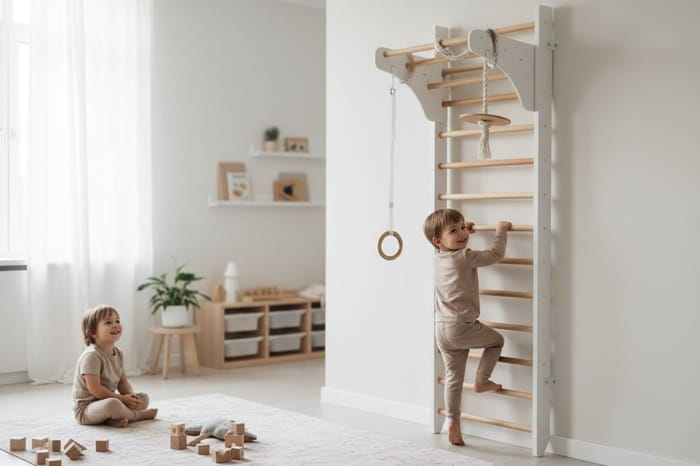
Compact models for a small room: «Krepysh», «Vertikal», «Minsk Sport»
For a small apartment the manufacturer offers three models designed specifically for limited space. The difference between them is not in the width of the opening but in the mounting design and the set of attachments.
«Krepysh» is the basic I-shaped model for narrow wall sections, from $198. A simple design with no extra joints, it mounts on both anchor and pressure fixings and suits places that need the narrowest possible unit without a pull-up bar on top and without dip bars.
«Vertikal» is also I-shaped, but with rigid combined mounting, from $183. Of the three compact models it is the most affordable and one of the most rigid at the mounting joint in its class — the combined system reduces the swaying of the ladder during active workouts.
«Minsk Sport» is a modular design with removable adjustable attachments, from $174. The logic is different: the base ladder stays minimalist, while the pull-up bar, dip bars or rings are hung and removed as needed, which is handy if the room is used for more than workouts during the day.
| Model | Construction type | Mounting | Price from |
|---|---|---|---|
| «Krepysh» | I-shaped, narrow wall sections | anchor or pressure | from 198 |
| «Vertikal» | I-shaped, rigid joint | combined | from 183 |
| «Minsk Sport» | modular, removable attachments | anchor or pressure | from 174 |
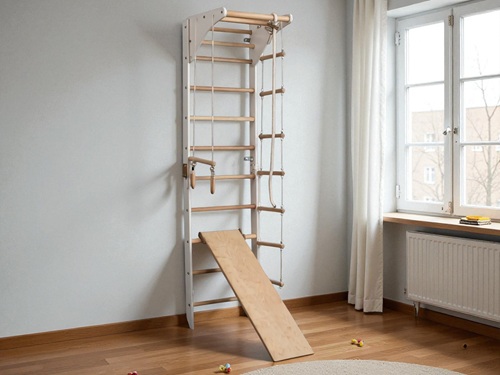
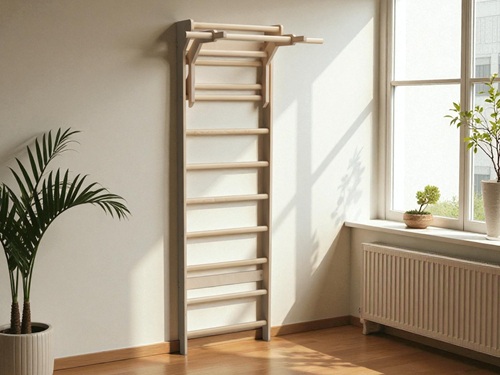
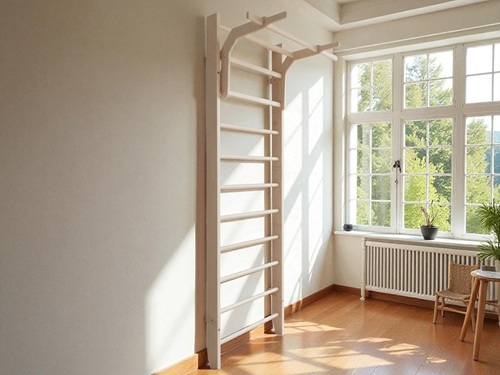
If there are children in the family and you plan additional attachments — rings, rope, rope ladder — take a look at the models with a pull-up bar: among the compact options a pull-up bar is not integrated everywhere, and sometimes it has to be hung separately.
For an apartment with permanent residence and load-bearing walls it makes sense to look wider — not only compact models but the whole range, including reinforced versions with dip bars and a bench. A detailed breakdown of models for different types of housing is on the page about wall bars for the home.
The price difference between the three compact models fits within fifteen dollars or so, so the deciding factor is almost always not the budget but the type of mounting and whether you need a pull-up bar integrated at once or prefer to hang it as required. «Krepysh» and «Vertikal» are designed for a permanent configuration, «Minsk Sport» for regular rearranging of attachments.
For a rough idea of width: a doorway in a typical apartment is usually 80–90 cm, while the compact wall bars models are noticeably narrower — designed for a narrow wall section, not a doorway. This does not mean the unit will automatically fit any niche between furniture: the catalogue width of a model serves as a guide, but the exact size of the wall section is still measured separately before placing an order.
How much space a gym corner takes up in an apartment
The figure most often quoted is about 0.2 square metres of floor under the frame itself. That is less than the footprint of a writing desk or a bedside table. But the real working volume is larger: you need a margin on the sides for safe exercise and, if you plan a bench or hanging dip bars, extra space in front of the wall bars.
In practice, the width of the wall section should be measured with a margin of at least 15–20 cm on each side beyond the stated width of the model — for free arm movement during pull-ups and to avoid catching your elbow on the corner of nearby furniture.
The height of the ladder is usually calculated so that the top rung stays a safe distance below the ceiling — this is not only a matter of aesthetics but also a safety requirement when working on the upper rungs.
Arranging the furniture around the unit is a separate task. The frame is often placed in the corner between a wardrobe and a window, and then it matters that the wardrobe door opens without colliding with the upright and that a curtain does not catch the top rung in a draught. A trifle, but it is precisely such details that most often come to light after assembly, when no one wants to move the unit again.
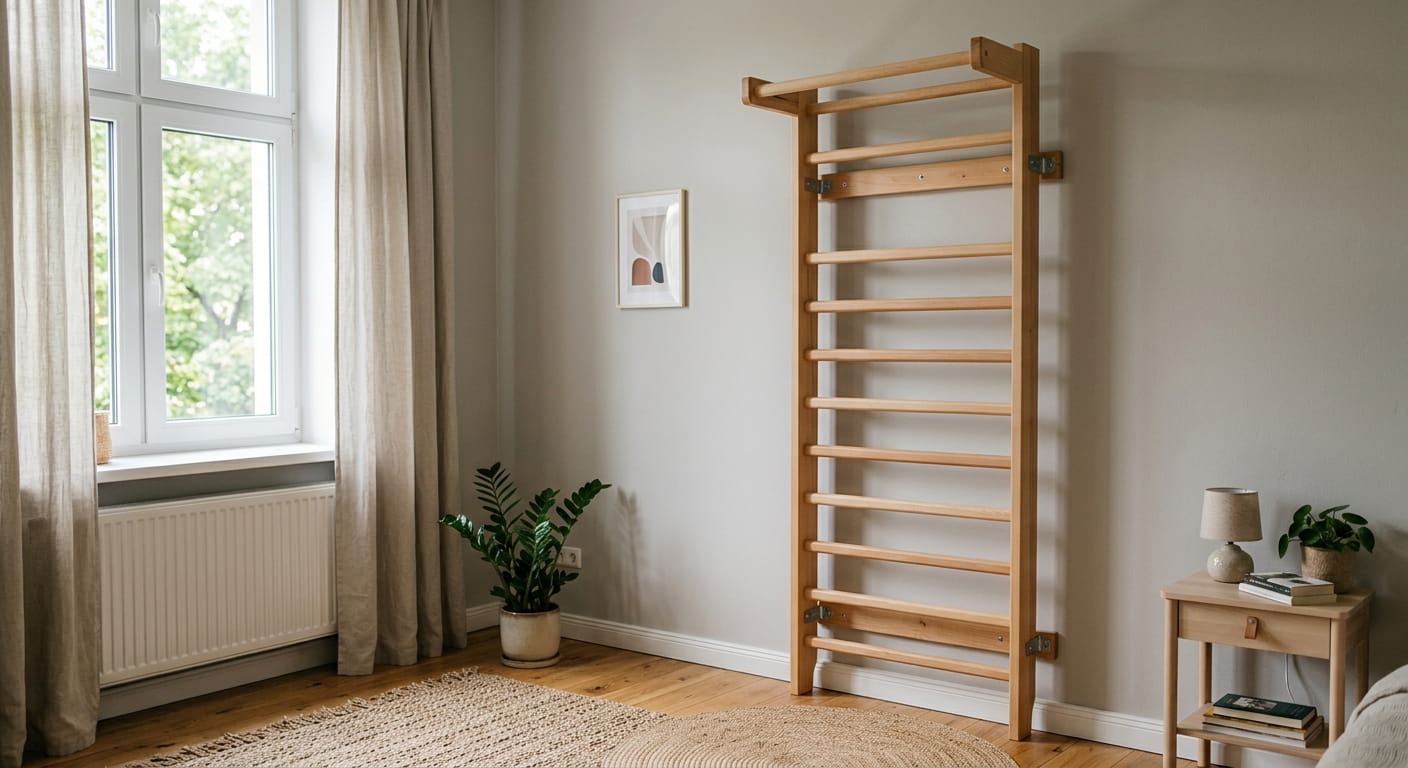
Wood versus metal: why the downstairs neighbours will hear less
Metal sports complexes transmit impact and vibration loads noticeably more than wood — a tubular frame resonates, especially on upper floors and in panel buildings with less-than-ideal floor sound insulation. Wooden wall bars made of glued timber dampen part of the vibration through the very structure of the material.
This does not mean a wooden frame is completely silent — jumps and active workouts still create sound that travels through the floor and the slab. But by the subjective perception of apartment-building residents, wood sounds duller than metal, without the characteristic metallic rattle under intense load.
A rubber or felt mat under the support plates of the frame reduces the noise further — it also protects the floor covering from point pressure and, at the same time, slightly softens the transfer of vibration to the slab.
There is also a subjective but frequent comment from owners: wood is more pleasant than metal to the touch, especially in winter, when a metal rung in an unheated loggia or a cold room is noticeably chilly to the hands, while glued timber and the hard wood of the rungs stay warm at the same air temperature. For an apartment where the unit stands permanently in a living room, this is more of a pleasant bonus than a decisive argument, but all else being equal it tips the choice towards wood.
If the apartment is on the second floor and there are neighbours below who value quiet, it is best to plan workouts without sharp jumps off the upper rungs and to cover the floor under the frame with a thick mat.
The time of day also affects how neighbours perceive the sound more than the loudness itself. The same workout at seven in the morning or at ten in the evening is perceived quite differently, even if the objective noise level is the same. A simple rule — moving active exercises to daytime and evening hours before nine — removes most everyday complaints without any technical tricks.
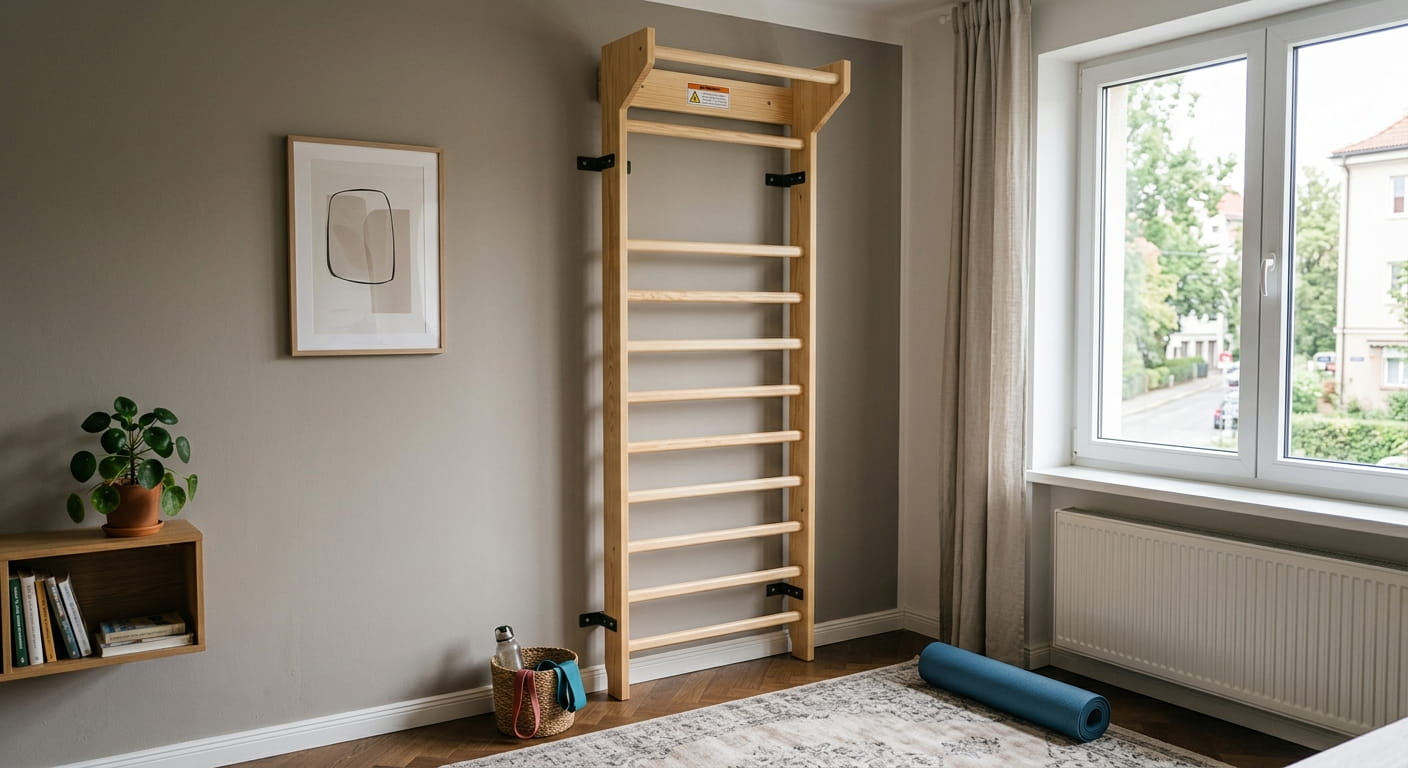
Attachments: pull-up bar, dip bars, rings without extra furniture
One practical solution for a small apartment is not to buy all the elements as fixed fittings at once, but to take removable attachments and hang them as needed. Here is a list of what can be fitted to the uprights of the wall bars:
- a removable pull-up bar — fixed at the desired height, taken off in a minute
- hanging dip bars — for push-ups and bodyweight work
- a folding ab bench — put away when not in use
- gymnastic rings — for children and adults, adjustable in height
- a climbing rope and rope ladder — a load option for children
- resistance bands — attach to the uprights, compact to store
A folding bench is especially handy in a studio apartment or a room that doubles as a home office or nursery during the day: put the bench away and there is free floor in front of the wall bars again.
Rotating the equipment is a working strategy for a one-room apartment where the gym corner sits next to a workspace or a child's sleeping area. In the morning a pull-up bar hangs on the uprights for an adult workout, in the evening it is swapped for rings and a rope for children's play, and at the weekend for an ab bench. One set of uprights serves three usage scenarios without buying separate equipment for each.
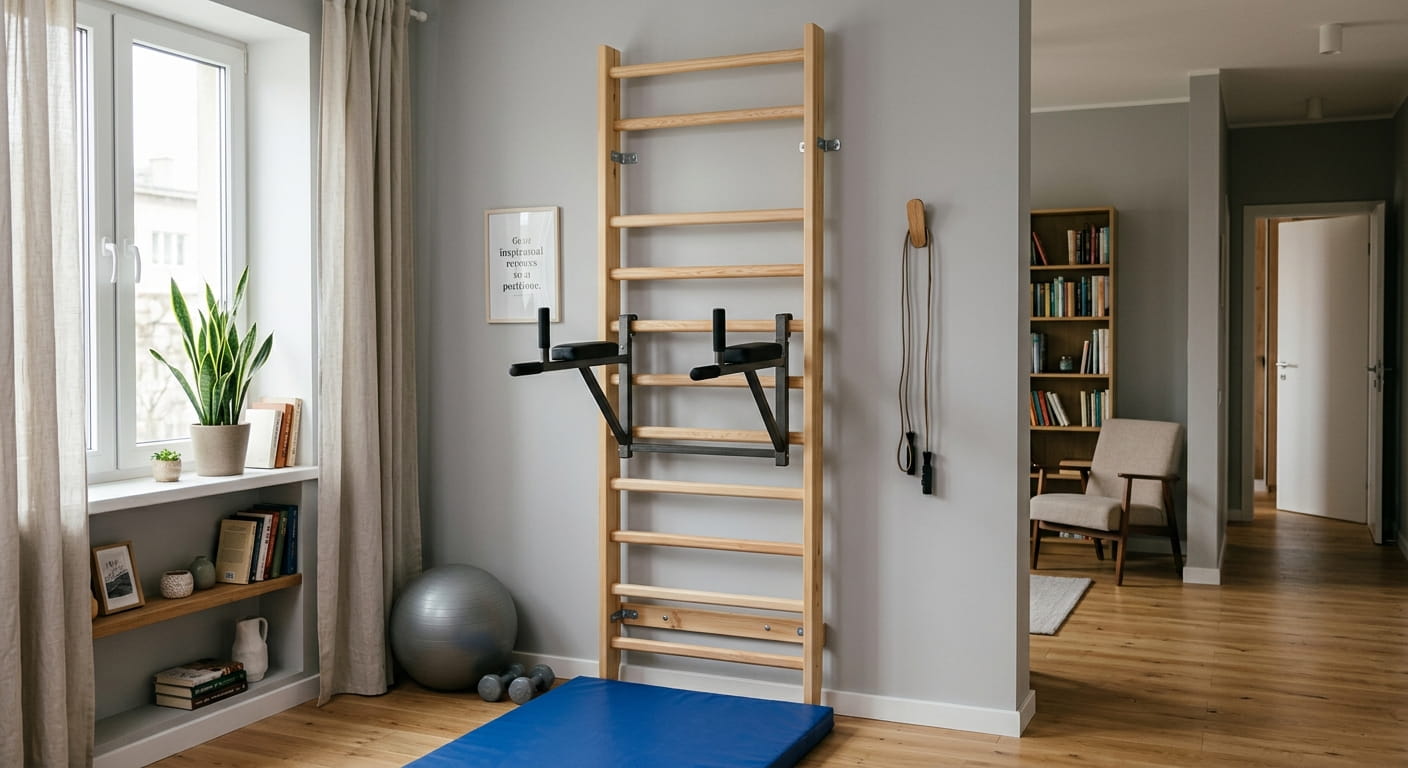
A full set with reinforced pull-up-bar mounting and various grip options is considered separately among models with a pull-up bar integrated on top — there you will find a breakdown of which height suits the user's stature and age, and how such an option differs from a removable hanging pull-up bar.
Child safety on wall bars for an apartment
The first thing to start with is not the height of the ladder itself but the floor surface around it. A soft mat or thick rug under the frame reduces the risk of injury from falls off the lower rungs — this rule applies regardless of the child's age.
The second is periodically checking the bolt tightness, especially in the first weeks after assembly, when the wood is still "settling" in its new place. Every 3–6 months it is worth going over all the joints with a wrench, without waiting for a rung to start wobbling noticeably.
The third is supervising small children on the upper rungs and gradually extending the permitted height as the child's skills grow. Gymnastic rings and a rope add variety to the load but require more coordination than ordinary climbing on the rungs.
The fourth, often forgotten, is footwear. Socks slip on the lower rungs on a smooth parquet more than a bare foot or a light slipper with a ribbed sole, and this affects stability when climbing up and down far more than it seems at first glance.
The rope ladder, climbing rope and textile attachments wear out naturally over time — this is not a factory defect and is not covered by the warranty. Check the fastening knots of such elements for strength from time to time.
The type of floor covering under the wall bars also affects the consequences of a fall. Laminate and parquet are noticeably harder than carpet, so on a hard floor a mat under the frame is not a box-ticking recommendation but practically a mandatory condition if a small child is growing up in the apartment and climbing on the rungs is still unsteady.
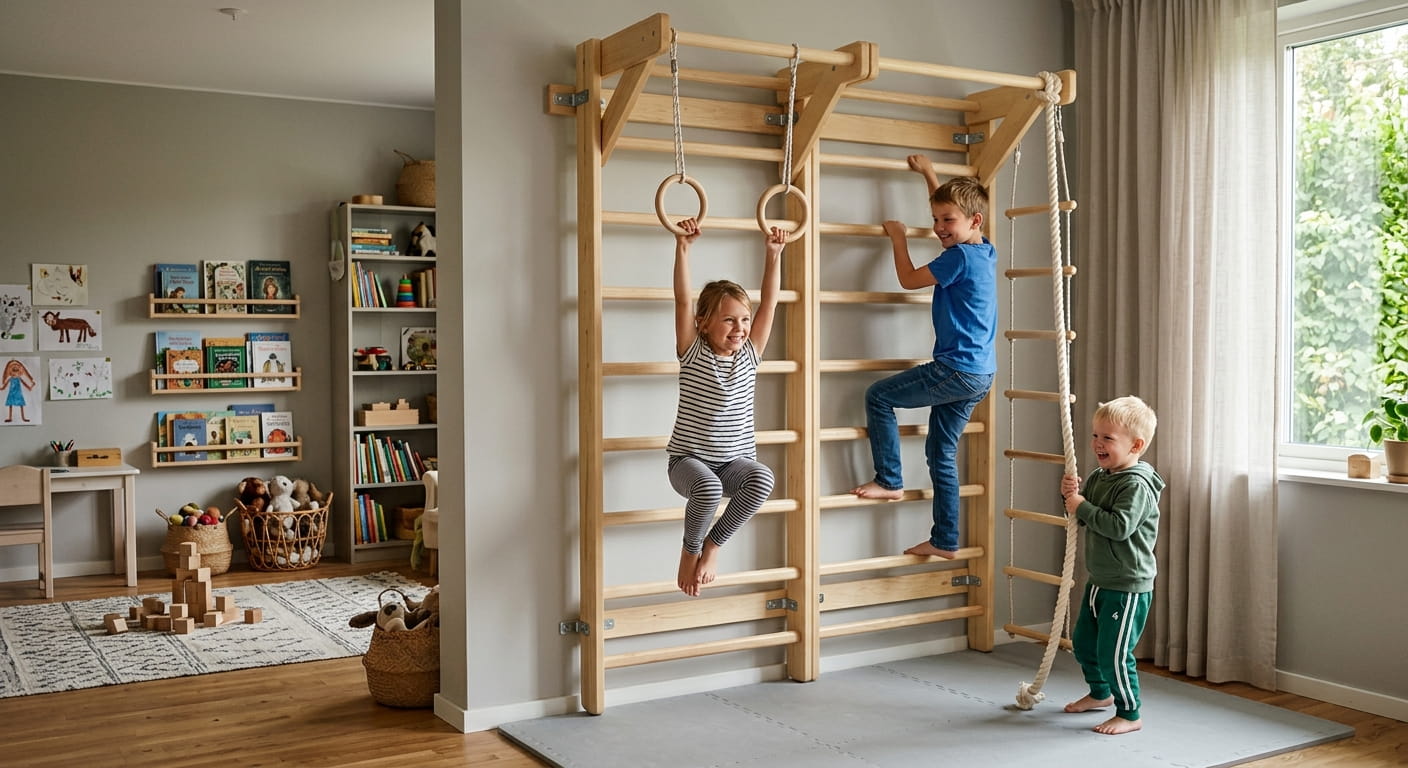
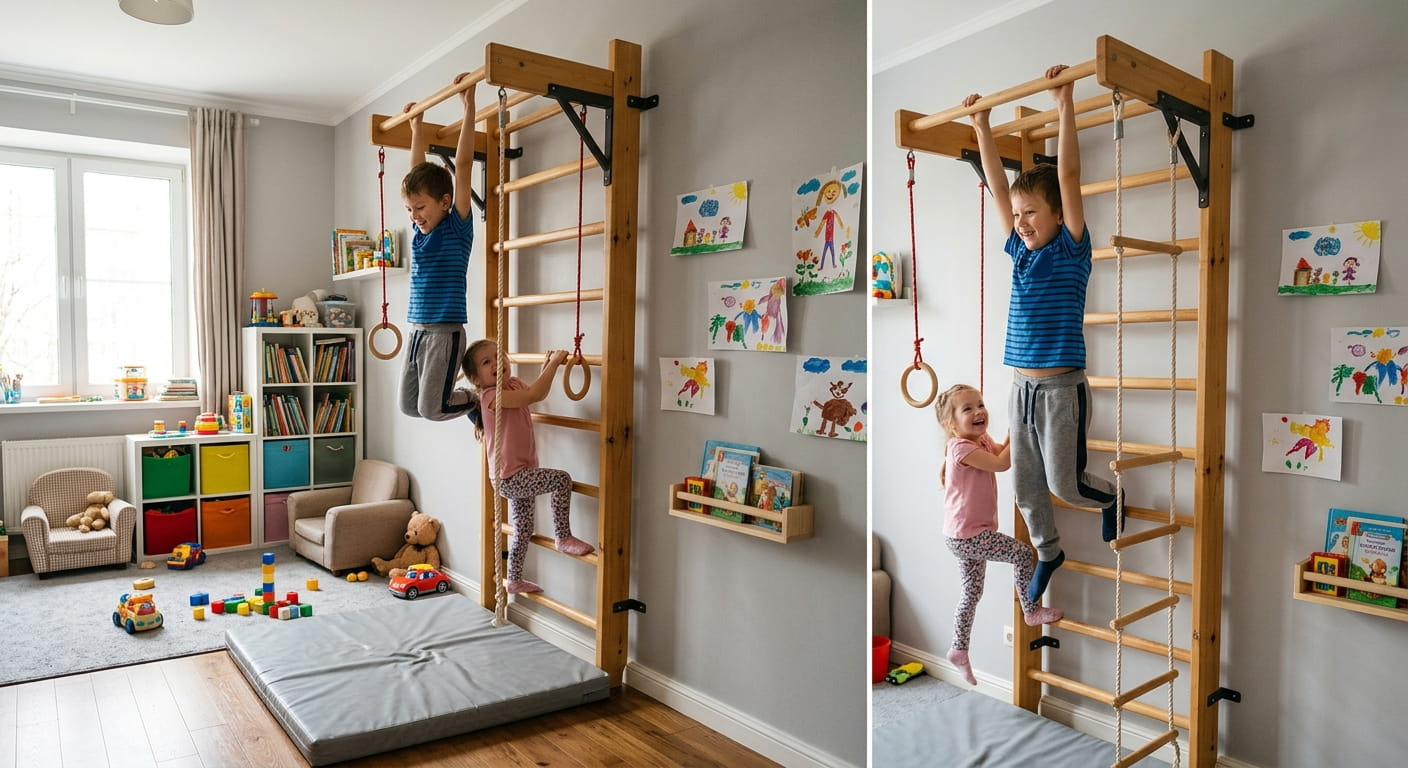
For a family with a preschool-age child there is a separate option — a children's gym corner with a rope, rings and rope ladder instead of a full-size adult frame: more compact and lower in height.
The manufacturer sets no age restrictions on the use of the ladder itself — the frame is designed for a wide range of stature — but the choice of attachments should be matched to the child's age. Rings and a rope require a developed grip and coordination, so for preschoolers a rope ladder is more often chosen as a simpler apparatus, and rings are added later, when the child grows up.
Caring for wall bars at home: how to extend their service life
Care is simple and requires no special products. Wipe the frame with a dry or slightly damp cloth, without abrasive powders and harsh sponges — the water-based finish does not like aggressive chemicals. The varnishes and oils the wood is treated with are certified and hypoallergenic, but that does not mean they should be scrubbed with strong compounds.
Every 3–6 months, check the tightness of all bolted joints — the same procedure as for child safety, only regular rather than one-off after assembly. Keep a mat or rug under the wall bars — both for quiet and to preserve the floor covering.
Placement also matters: do not put the frame in direct sunlight or right up against a radiator. Constant overheating or UV dries out the wood and finish faster over time than ordinary use in a room with an even temperature.
- wipe with a dry or damp cloth without abrasives
- check the bolt tightness every 3–6 months
- keep a mat under the support plates
- do not place near radiators or in direct sunlight
- check the condition of the rope and textile elements
The heating season is worth keeping in mind separately: dry air from radiators and sharp humidity swings between the heating period and summer affect the wood more than it seems. If the frame stands next to a radiator, a gap of half a metre to a metre and occasional airing of the room reduce the risk of the wood drying out and joints starting to creak faster than the product sheet suggests.

How to order wall bars for an apartment: assembly, warranty, delivery
Production is our own workshop in Zaslavl, Minsk District, Stroitelnaya ulitsa, 7. Delivery is arranged across the whole of Belarus, regardless of which city the customer's apartment is in.
Assembly takes from one and a half to three hours; the package includes instructions and all the necessary hardware — you will not need to buy anything separately, including the hardware for pressure or anchor mounting. The warranty on the frame and attachments is 12 months, excluding the natural wear of rope and textile elements mentioned above.
| Parameter | Value |
|---|---|
| Uprights | glued timber (pine, birch) |
| Rungs | beech, ash — dense hard wood |
| Finish | water-based varnishes and oils, hypoallergenic |
| Fasteners | hidden metal, furniture connectors |
| Load of standard models | 120–150 kg |
| Load of the reinforced «Atlet» model | up to 250 kg |
| Warranty | 12 months |
The fasteners are hidden — the metal furniture connectors are concealed inside the structure, so from the outside only the wood is visible, without the protruding bolts and brackets typical of budget metal analogues.
Before calling a manager it is useful to prepare three figures in advance: the exact ceiling height in the room, the wall material at the intended installation spot and the width of the wall section where the wall bars are to stand. With these details the consultation takes a few minutes and immediately rules out models that physically do not suit the specific apartment, instead of going through the whole catalogue by hand.
You can contact a manager through the form on the contacts page — there they also clarify current timeframes for the specific delivery city, help you decide between anchor and pressure mounting based on a description of the apartment, and answer questions about attachments if any doubts about a specific model remain after reading the article.
Our own workshop in Zaslavl works with wood at every stage — from preparing the glued timber to the final varnish or oil finish — so made-to-order production times are predictable and do not depend on outside suppliers of components. The same applies to attachments: pull-up bars, dip bars and benches are made at the same production base as the uprights themselves.
For those considering not just a ladder but a full-fledged training complex with an extended load range, it is worth looking at the wall bars exercise machine page — there you will find models with additional attachments.
If pressure mounting is technically impossible in a specific apartment — a low ceiling, a stretch construction overhead — discuss anchor mounting or a combined option with a manager. A breakdown of how pressure-mounted wall bars are built and what technical limits they have will help you get your bearings before the call.
Wholesale and small-wholesale is a separate line: a minimum shipping batch from 10 units, the possibility of working under your own trademark (private label), products certified to TR CU requirements. Shipping takes 3–5 working days when in stock; made-to-order production time is 15–35 days. Delivery to the transport company's terminal is free, and pickup from the warehouse in Zaslavl is also available.
For a retail customer who is buying a single set of wall bars for an apartment, this part does not directly concern the ordering process, but it indirectly affects timeframes: if the model is in stock, shipping is quick, while if a specific configuration is needed for a non-standard ceiling height or a rare combination of attachments, the timeframe should be set closer to the upper bound of the production cycle.
The overall logic for an apartment is simple: first measure the ceiling height and determine the wall material, then choose between pressure and anchor mounting, and only after that the model by the width of the wall section and the set of attachments. This order saves time and removes the risk of ordering a unit that physically will not fit in the room.
The mistake people make more often than others is ordering a model from a picture without a preliminary measurement, "by eye". In most cases everything ends well, but it is precisely the remaining percentage of stories with trimmed uprights or a mounting change on the spot that builds the reputation of a complicated process where in reality it is enough to spend five minutes with a tape and a level before placing an order.
Expert opinion
For an apartment the key constraint is almost always one of two: either the walls are not load-bearing and only suit pressure mounting, or the ceiling is stretched and pressure mounting is technically impossible. The models «Krepysh», «Vertikal» and «Minsk Sport» cover most requests for a compact unit, but the final decision on the type of mounting should be made after an accurate ceiling measurement and an inspection of the walls, not from a photo in the catalogue.
A standard load of 120–150 kg is enough for a family with children and adult workouts without strength extremes, and a wooden frame on glued timber is objectively quieter than metal analogues in everyday use in a panel building. This does not make the wall bars silent, but it removes part of the conflicts with neighbours typical of metal pull-up bars and ladders.
— Veronika Tarasevich, internet marketer, specialist in semantics and content in product niches.