Sport wall bars such as «Atlet» or «Lider» are not just a ladder on the wall but an enclosed sports complex: the bars themselves, a pull-up bar, dip bars, rings, a rope and a mount for an abdominal bench are all assembled on one frame and cover a workout for almost every muscle group. Below we break down which model is rated for which load, what the complex is made of, how to mount it and where to place it in an apartment so that you end up with a working mini-gym rather than a decorative corner.
The request usually sounds like this: you need an apparatus on which you can do pull-ups, dip on the bars, work the abs, while the child can also climb the rope or swing on the rings. You cannot fit separate machines for each task into an apartment — there is no room. Sport wall bars solve this in one installation: one frame, minimal footprint, maximum exercises.
What a set of sport wall bars for the home includes
Basic models like «Krepysh», «Vershina» or «Vertikal» are essentially the ladder-wall itself plus one element on top. The sport version is arranged differently: from the very start it is designed as a multi-functional unit that includes several add-on elements as standard rather than having them bought separately later. Hence the name — not a wooden wall with a pull-up bar, but a sports complex built on wood.
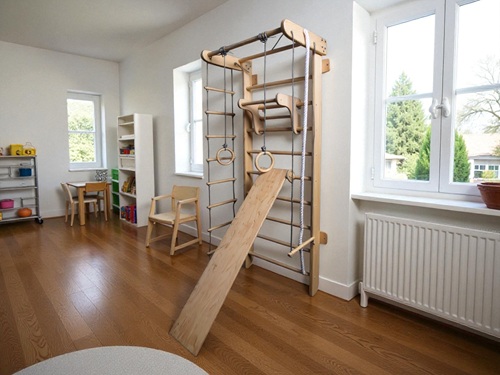
In the classic configuration, sport wall bars include the vertical ladder of rungs itself, a top or removable pull-up bar, side dip bars (fixed or detachable), a mount for gymnastic rings, a hook or loop for a rope and, often, a folding abdominal bench that folds back to the wall when not in use and takes up no floor space. In the «Atlet» and «Lider» models this is built into the design: there is a ready mounting point, a reinforced upright or an embedded part for every element.
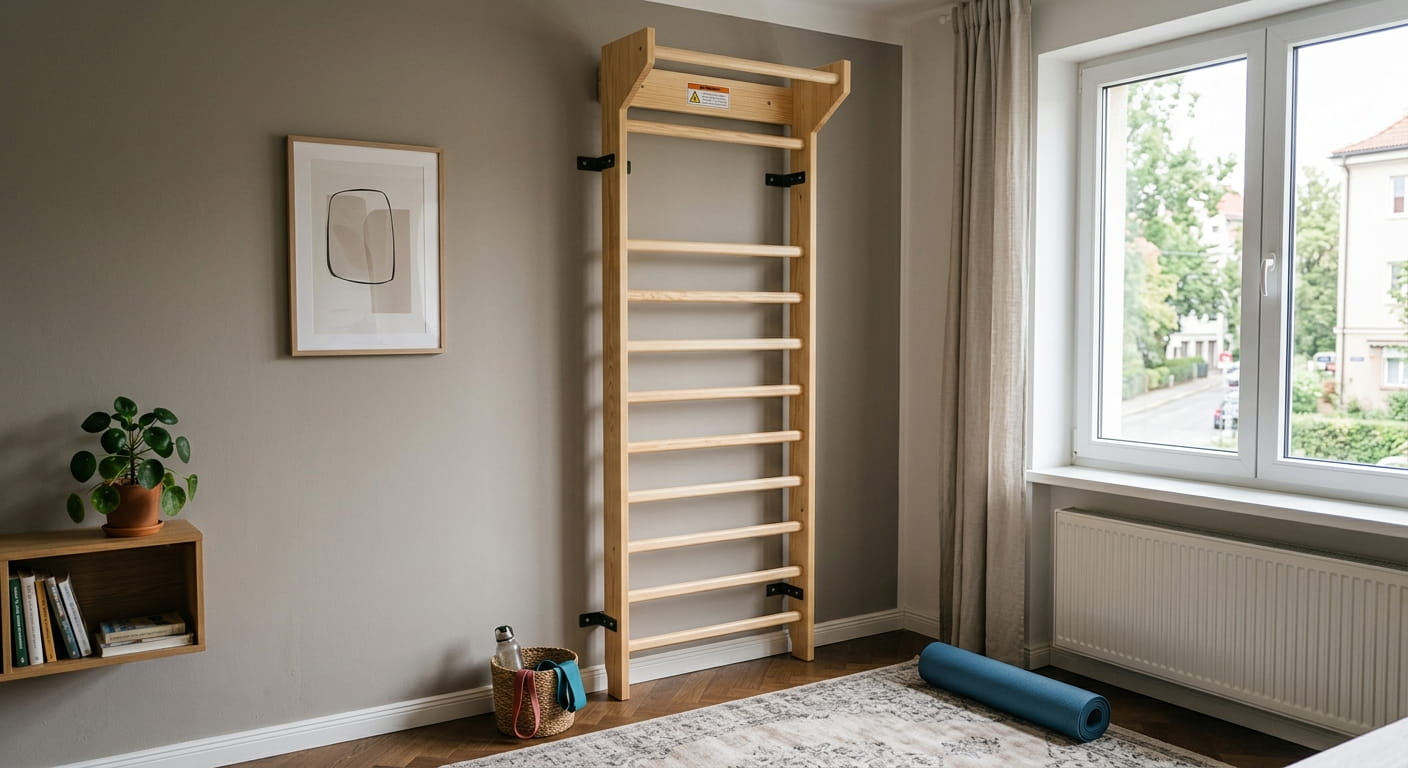
The difference from an ordinary ladder is felt not on paper but in training. On a standard I-shaped set of bars the range of exercises is limited — hanging, leg raises, stretching on the rungs. As soon as dip bars and a pull-up bar appear nearby, the exercise list grows many times over: pull-ups with different grips, dips on the bars, muscle-ups, hanging crunches, static ring work. A rope and a rope ladder add climbing — an exercise almost never found in apartment machines, which loads the forearms, back and legs at once.
What the complex consists of: bars, pull-up bar, dip bars, rings, rope
Let us go through the elements one by one, because each solves its own task, and together they cover the whole workout.
- The bars (ladder) — vertical uprights with rungs every 15–20 cm. The basis for hanging, stretching, leg raises and warming up the back and shoulder girdle.
- Pull-up bar — a top rung built into the frame or a removable adjustable one (as in the «Moy Turnik» model). A different grip shifts the emphasis: wide — onto the lats, narrow reverse — onto the biceps.
- Dip bars — parallel rails to the side of the wall bars, fixed or detachable. The main apparatus for dips onto the triceps and chest, as well as for leg raises in a supported position.
- Rings — hung on chains or straps from the top rung. Ring work engages the stabiliser muscles that an ordinary pull-up bar does not.
- Rope and rope ladder — mounted separately, usually to the side of the main frame. Rope climbing is one of the most energy-intensive exercises for the arms and back, available at home only on such a frame.
Separately, the reinforced models — «Atlet» — also include a folding bench in the set, which can be flipped down for abs or lying leg raises and then folded back to the wall.
There is also a practical reason why manufacturers separated the sport range from basic models like «Krepysh» or «Vertikal» at all. A buyer who takes wall bars for serious training usually adds a pull-up bar, then dip bars, then rings — one element at a time — and ends up overpaying for the separate installation of each part, while the frame was not designed for such a load to begin with. A sport model removes this problem: the mounting points for every add-on element are built in from the start, the uprights are thicker, and the hardware is rated with a reserve for dynamic loads, not just static weight.
In practice the difference is felt even visually: the «Atlet» uprights are noticeably thicker than on «Krepysh» or «Minsk Sport», and the «Lider» frame is wider thanks to its sections, because the monkey bars and the climbing net need a larger span between supports. This is not an aesthetic decision but a direct consequence of the structure holding more load points at the same time.
The «Atlet», «Lider» and «Moy Turnik» models: how they differ from one another
Three models cover different usage scenarios, although all belong to the sport range. Before choosing, it is worth understanding the difference in construction, not just in price.
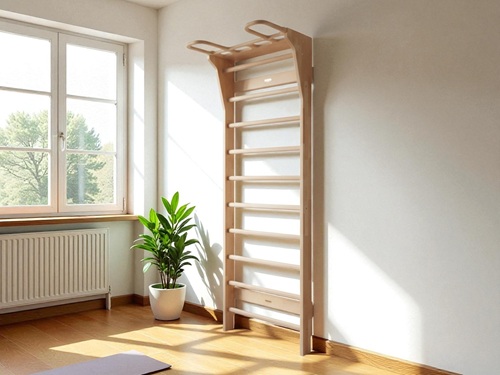
«Atlet» — reinforced sport wall bars with thick uprights, rated for a load of up to 250 kg. The set includes dip bars and a bench, with a combined mount (wall anchor plus pressure brace) that gives the frame maximum rigidity during strength exercises with jerks — weighted pull-ups, muscle-ups, explosive kip-ups. Price from $202. This is the option for an adult who trains intensively and does not want the frame to wobble on a sharp movement.
«Lider» — a U- or T-shaped frame assembled from sections, often with a climbing net and monkey bars. Such geometry is wider across the front, so it suits you if the room has a free wall of 1.5–2 metres and you want to place several zones at once — for climbing, for hanging, for ropes. Price from $195. Thanks to its modularity, «Lider» is easier to adapt to a specific ceiling height and the width of the wall pier.
«Moy Turnik» — a model with an emphasis on the upper body: a removable adjustable pull-up bar with different grips, which can be repositioned by height to suit a person and a specific exercise. It works well for families where both an adult and a teenager train — the bar is repositioned without tools in a minute. Price from $218.
| Model | Construction type | Add-ons included | Load | Price from, $ |
|---|---|---|---|---|
| Atlet | Reinforced, thick uprights | Dip bars, bench | up to 250 kg | from 202 |
| Lider | U/T-shaped, sections | Climbing net, monkey bars | 120–150 kg | from 195 |
| Moy Turnik | Classic I-shaped | Removable adjustable pull-up bar | 120–150 kg | from 218 |
If you need an even broader set — dip bars plus a pull-up bar as a single unit without add-ons — it is worth also looking at wall bars with a pull-up bar and dip bars, where this pair of elements is already integrated into the basic frame without superstructures.
Training for all muscle groups: what the complex really develops
Let us break it down by muscle group to make it clear: sport wall bars are not a «pull-up bar plus decor» but a working trainer for the whole torso.
- Back and lats — pull-ups on the bar with different grips, arched hanging, ring rows.
- Chest and triceps — dips on the bars, pressing movements on the rings, push-ups off the ladder rungs.
- Biceps and forearms — reverse-grip pull-ups, rope climbing, one-arm hangs.
- Abs and core — leg raises hanging from the bar or supported on the dip bars, crunches on the bench, a plank supported on the lower rungs.
- Legs and glutes — squats with a rung for balance, lunges with hands on the dip bars, rope climbing with the legs clamped.
- Shoulders and stabilisers — ring work (the rings are unstable, so they engage the deep muscles that isolated machines lack).
The logic is simple: the more add-on elements the bars have, the fewer gaps in the programme. On bare bars without a pull-up bar and dip bars the workout quickly hits the ceiling of possibilities — hanging, stretching, a little abs. Add a pull-up bar — the back and biceps open up. Add dip bars — the chest and triceps are covered. Rings and rope finish off the stabilisers and grip. That is precisely why the sport range appeared separately from the basic I-shaped models — for the request «I want to cover the whole body with one apparatus».
It is worth mentioning separately the progression of load without dumbbells and a barbell — a question most often asked by those assembling a home sports corner for the first time. On the bar and dip bars progress comes from the pace of execution, a pause at the bottom and top points, replacing an ordinary pull-up with a slow one with a 2–3 second hold. Further — a change of grip: straight, reverse, narrow, wide, mixed — each variant shifts the emphasis to another muscle group without changing the structure itself. When body weight becomes too light, you add a weight belt or a resistance band hooked to the lower rung of the ladder, and the frame holds this load without modification — this is exactly why reinforced models are made with a reserve in the uprights and mount.
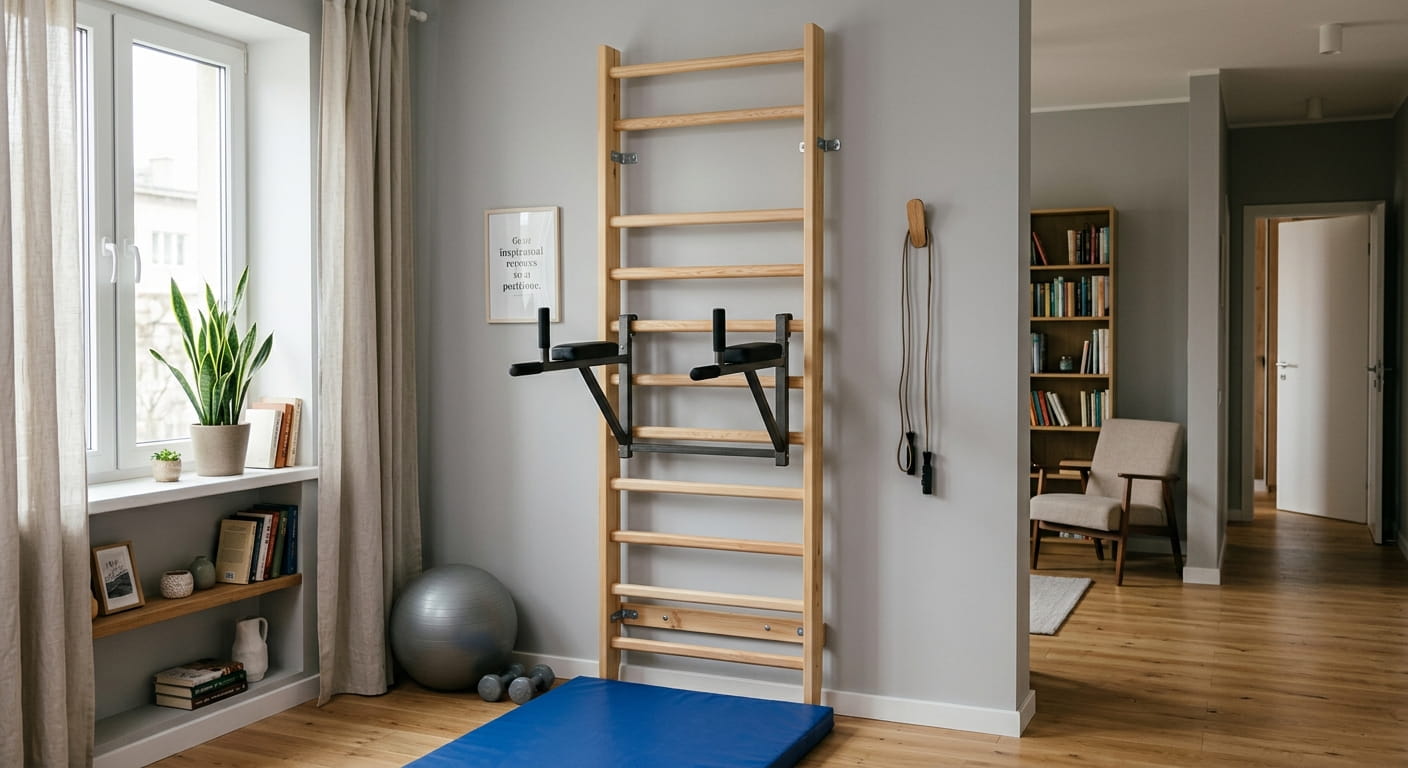
If the goal is to replace a gym membership with a minimal set of equipment, sport wall bars with a pull-up bar, dip bars and rings effectively cover the full programme for a beginner and intermediate level, without dumbbells and a barbell. Progression comes from pace, amplitude and the number of repetitions, not from weight on the bar.
It is worth saying separately about the monkey bars — the rungs along which you swing hand over hand, as on children's playgrounds. On «Lider» they come with a climbing net in the set. Monkey bars train the grip and shoulder girdle dynamically, which a static pull-up bar does not provide. Those who come specifically for such an apparatus as a whole usually find it more comfortable to look at a wall bars exercise machine — the focus there is specifically on strength functionality rather than decorative characteristics.
An example weekly programme on sport wall bars
To avoid guessing where to start, below is a working weekly layout for a beginner and intermediate level. It is built so that each add-on element of the complex gets its load, while the muscles have time to recover between sessions.
- Day 1 — back and biceps: wide-grip pull-ups on the bar (3–4 sets), narrow reverse-grip pull-ups, a held hang.
- Day 2 — chest and triceps: dips on the bars (3–4 sets), push-ups off the lower rungs of the wall bars, a static support hold on the rings.
- Day 3 — rest or light stretching on the bars, with no strength load on the pull-up bar and dip bars.
- Day 4 — abs and core: hanging leg raises on the bar, crunches on the folding bench, a plank with the hands on the lower rung.
- Day 5 — functional training: rope climbing, ring work, mixed-grip pull-ups.
- Weekend — free activity: the children use the rope ladder and rings, the adults — stretching and a light hang to decompress the spine.
Of course the scheme can be adjusted to your level: a beginner will manage with two strength days a week, while someone who trains systematically can add a third day with an emphasis on monkey bars and static ring work. The main thing is not to load the same add-on unit (for example, the pull-up bar) every day in a row, otherwise the ligaments do not have time to recover.

For children and adults: one frame for the whole family
A frequent question is whether you can install one complex if the family has both a first-grader and an adult doing strength training. The answer is yes, but with a caveat about adjustment.
«Moy Turnik» and some of the «Lider» models have removable and repositionable elements: the pull-up bar can be lowered to the child's height for pull-ups from a low start or for hanging, and then raised back for the adult. The rings and rope ladder are usually hung on the same top rung as the adult's bar — only the attachment changes, not the whole structure.
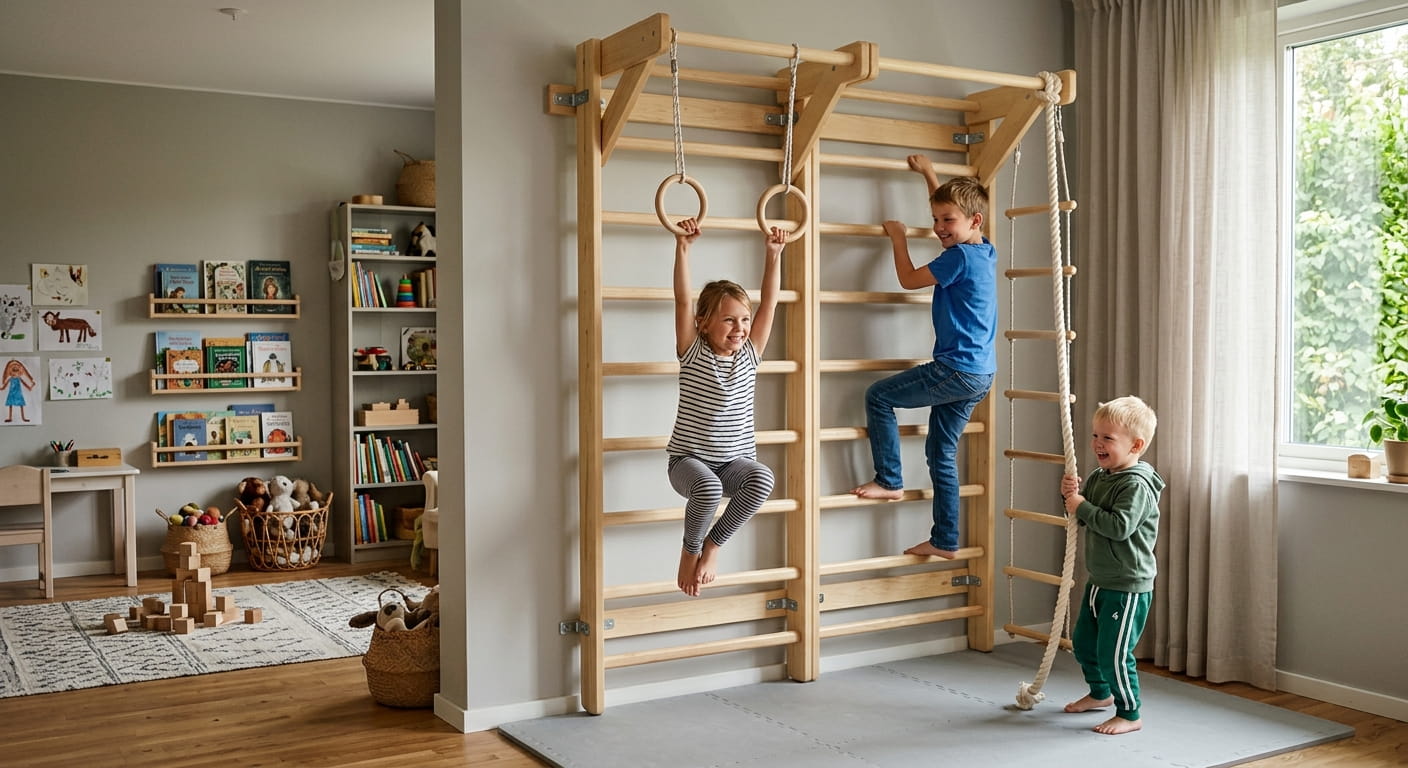
For children up to 5–6 years old a separate kids' model is more often chosen — «Maugli» with a rope, rings and rope ladder, without a strength bar and dip bars. But if the child is older and the family already has an adult training on the bar, sport wall bars with a full set of attachments cover both scenarios: the lower tier and the soft elements for the child, the upper bar and dip bars for the adult.
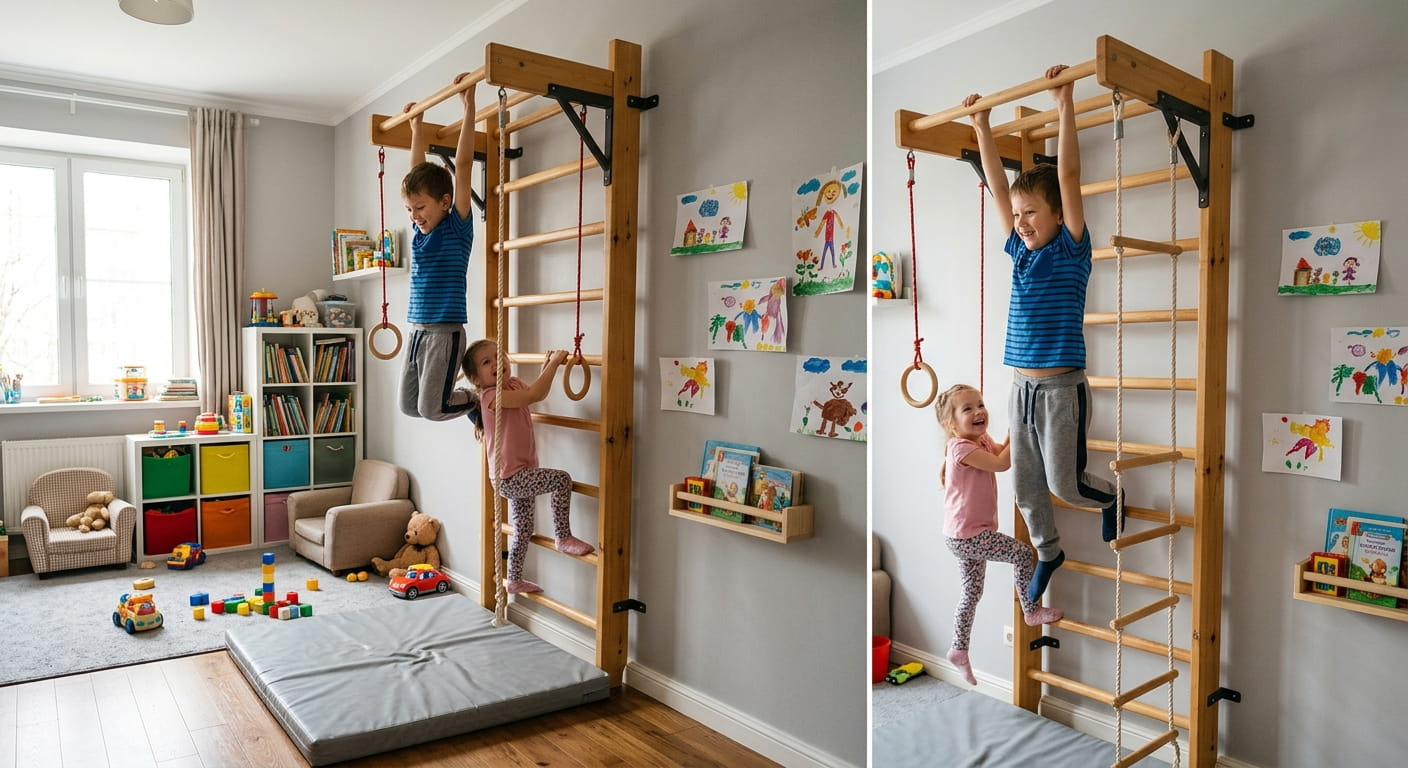
An important safety point for shared use: if the child is going to swing on the rings or climb the rope next to an adult who is doing pull-ups on the bar at the same time, it is best not to combine this at the same moment on one frame — the adult's movements create a sway of the whole structure. It is easier to space the sessions out by time, especially as the bars do not take up much room and stay in place permanently.
Another nuance often overlooked at the purchase stage: a child's interest in the apparatus usually comes in waves. For the first couple of weeks the child climbs the rope and hangs on the rings every day, then activity drops, and a month or two later it comes back again. This is normal and no reason to consider the purchase a failure — unlike one-off sports equipment, the bars stay in the room permanently and do not take up cupboard space while not in use.
Separately about age: the manufacturer does not state a rigid lower age limit for the add-on elements such as rings and rope — here the child's physical readiness and adult supervision during the first sessions matter more than a figure in the product passport. The rope ladder and the low rungs of the ladder are usually mastered earlier than a full hang on the rings or climbing the rope to full height.
A load from 120 to 250 kg: how to work out what is enough for you
The stated load is not an abstract figure for the advertising sheet but a parameter calculated with a reserve for dynamics: a jerking pull-up, a dismount from the bar, a swing on the rings. A person's static weight is one thing, and the impact load during a sharp movement is quite another — hence the difference between 120–150 kg on standard models and 250 kg on «Atlet».
| Construction type | Stated load | Who it suits |
|---|---|---|
| Standard I-shaped | 120–150 kg | One adult of average weight, a child, light strength work |
| Reinforced (Atlet) | up to 250 kg | An adult with weight closer to the upper limit, intensive strength work with jerks, weighted pull-ups |
If the weight of the person training is closer to 100 kg and above, or weighted pull-ups with an extra belt load are planned, it is wiser to look at the reinforced range straight away — reinforced wall bars with thick uprights and a combined mount, rather than a standard model with a subsequent hope for a strength reserve.
The stated load holds only with sound hardware. If the bolts have loosened and the mount has weakened, even reinforced wall bars rated for 250 kg start to wobble under an ordinary weight. Checking the tightening every 3–6 months is not a box-ticking recommendation but a condition for preserving the stated strength.
Materials: what sport wall bars are made of
The material directly determines both the load and the service life, which is why the approach to it in sport models is stricter than in decorative children's complexes.
Uprights — laminated timber
Pine or birch, laminated timber instead of solid wood — less risk of cracking and bending under load.
Rungs — beech or ash
Dense hardwood holds the grip during pull-ups and does not dent along the grain over time, unlike soft species.
Finish — water-based lacquers and oils
Hypoallergenic, certified compounds with no harsh smell — relevant when a child uses the bars too.
Hardware — concealed metal
Furniture connectors inside the uprights, with no protruding bolt heads where you could catch yourself during a pull-up or a climb.
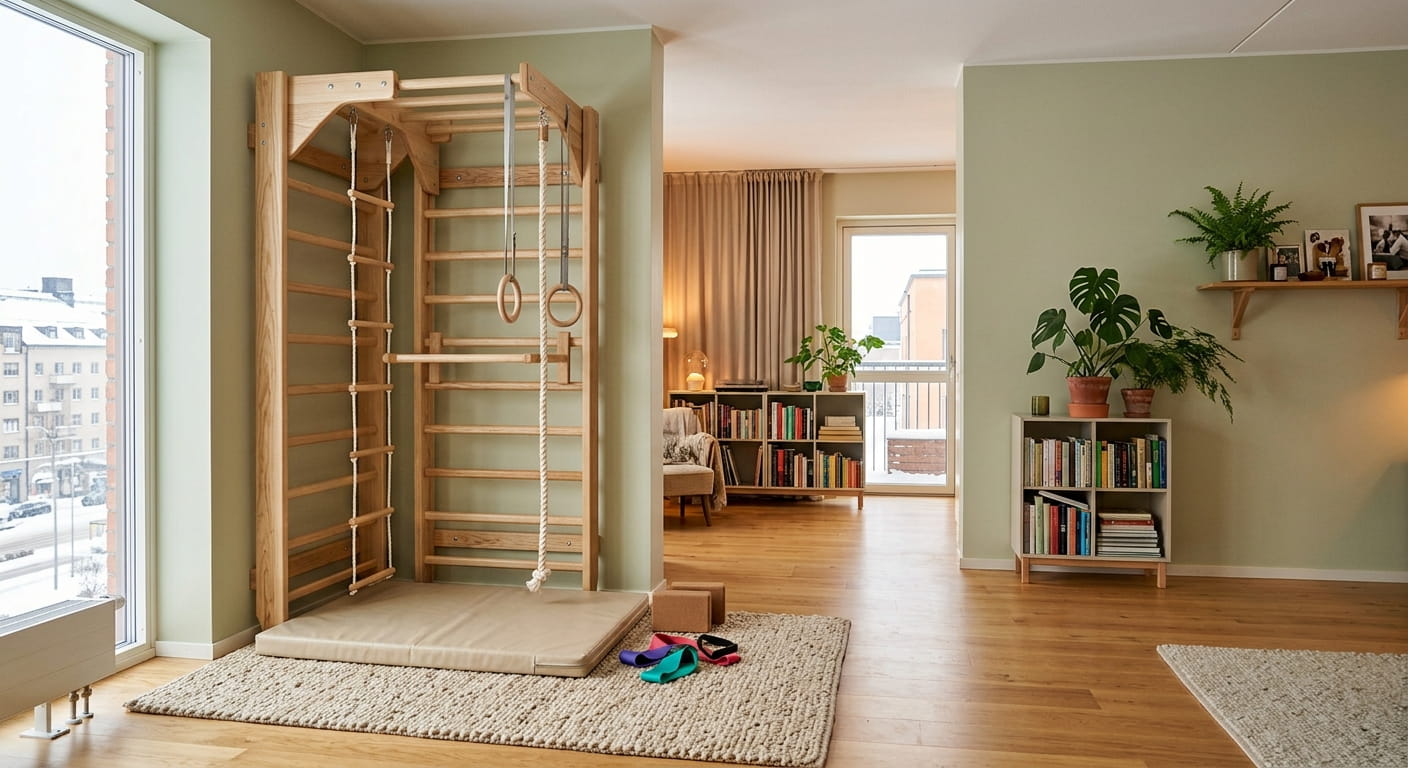
The difference between budget and well-made wall bars is most often precisely in the rungs. If a rung is made of soft pine rather than beech or ash, dents from the grip quickly appear on it during intensive pull-ups, the surface becomes rough, and over time it may even crack at a narrow point. On sport models, where the load is higher and more often dynamic, saving on the wood species of the rungs is the one place where economy quickly backfires.
Another detail that affects service life is the way the uprights are joined. Laminated timber consists of several lamellae glued along the grain under pressure, and thanks to this it «moves» less with humidity changes in the apartment, unlike solid wood, which can warp slightly or crack along an annual ring. For sport wall bars, where the uprights hold not only a person's weight but also the jerking load of pull-ups and swinging on the rings, this is a noticeable difference in service life.
About the finish separately: lacquer creates a harder protective film and is better suited to rungs that are in constant contact with the palms, while oil penetrates the wood more deeply and highlights the texture, but requires more careful care without aggressive chemicals. In practice, on sport models the rungs are more often treated with lacquer, and the uprights with oil or a combined compound.
Mounting: wall anchor, pressure or combined
The type of mount for sport wall bars is chosen not by taste but by the type of wall and ceiling — here a mistake costs more than in the choice of model.
Wall anchor
The bars are fixed with anchors straight to the wall — this works only on concrete or solid brick. It is the most rigid option, which wobbles least under jerking loads, so it is most often used together with reinforced models like «Atlet». An anchor mount cannot be fitted to drywall — the board simply does not hold the pull-out load during a pull-up.
Pressure (floor-to-ceiling)
A screw brace without drilling the wall — an option for rented housing or thin partitions where drilling is either not allowed or pointless. Here the ceiling height matters: a range of 2.40–3.10 m is suitable. Pressure-mounted bars absolutely must not be installed under a stretch or suspended ceiling — the brace pushes against the cladding rather than the load-bearing slab, and the structure is held unreliably.
Combined
A combination of an anchor mount to the wall and a floor-to-ceiling pressure support at the same time — used in top models, including «Atlet». It gives the maximum rigidity reserve, which is why the stated load of such models is higher.
| Type of mount | Wall/ceiling requirements | Where it is used |
|---|---|---|
| Wall anchor | Concrete, solid brick | Permanent installation, maximum rigidity |
| Floor-to-ceiling pressure | Ceiling 2.40–3.10 m, no stretch ceilings | Rented housing, thin walls, no drilling |
| Combined | Concrete wall plus a suitable ceiling | Reinforced models (Atlet) |

Before ordering it is worth measuring the ceiling height in advance and determining the wall material — this is what decides which type of mount will even be suitable technically, not just by price. At the selection stage the manager usually clarifies precisely these two parameters first.
You can determine the wall material of your home without a specialist: if the sound on tapping is dull and dense, and the drill goes in stiffly with concrete dust during a test hole — you are facing concrete or solid brick, and an anchor mount is suitable. If the sound is hollow and the drill goes in easily — it is most likely drywall or a hollow partition, and then the only working option is a floor-to-ceiling pressure mount, provided the height and type of ceiling allow it.
The mistake that occurs most often is installing a pressure mount right at the minimum height of 2.40 m with no reserve. The screw brace settles slightly over time from temperature fluctuations and the drying of the wood, and if no gap was left initially for re-tightening, the structure starts to wobble within a few months of use.
Mats and safety: what to provide for in advance
Sport wall bars with a pull-up bar and dip bars imply more active and riskier movements than an ordinary ladder — jerks, dismounts, swinging on the rings. That is why the question of safety is sharper here.
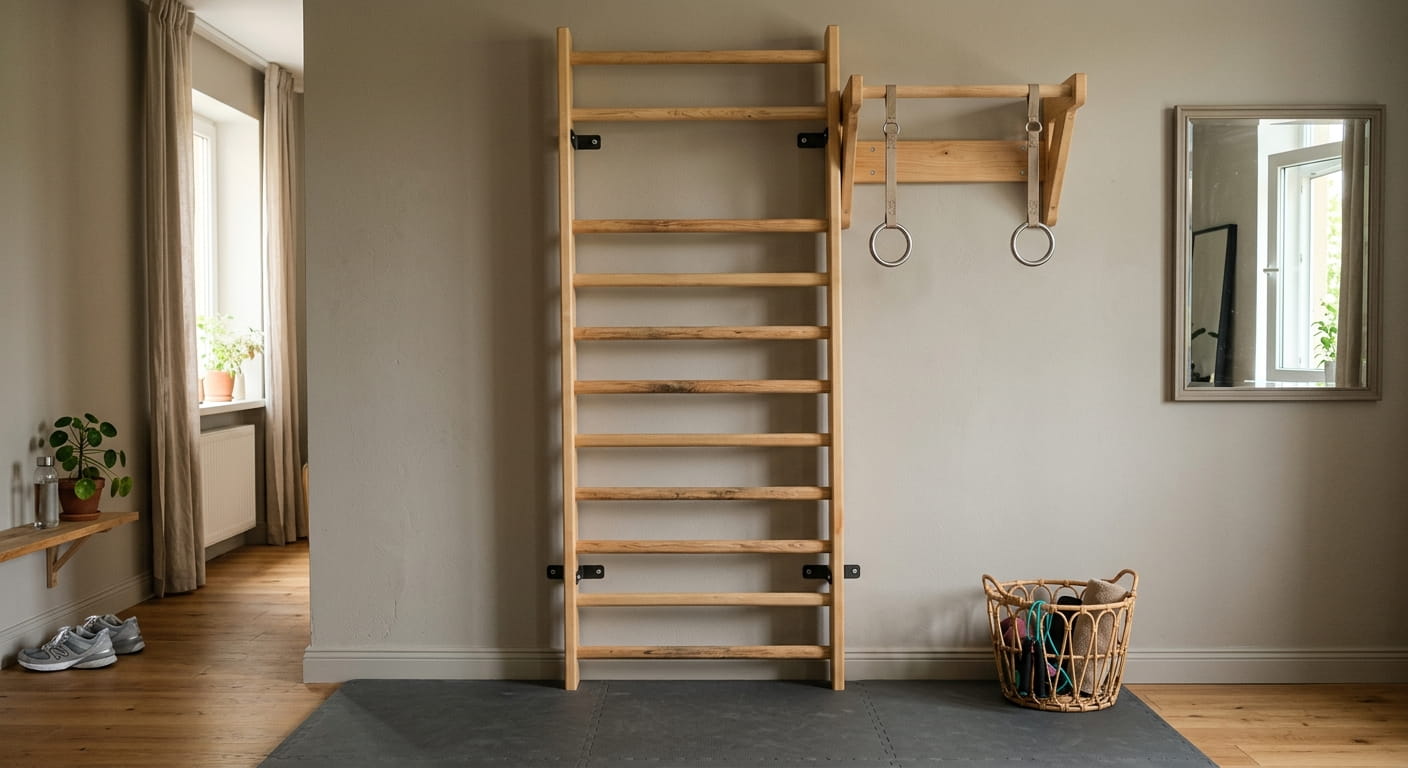
- A mat under the bars is mandatory where pull-ups, muscle-ups and ring work are practised: in a slipped grip or a failed dismount the cushioning is decisive.
- Checking the tightening of bolts and hardware — every 3–6 months, more often with intensive daily training.
- Do not install in direct sunlight or next to heating radiators — the wood dries out unevenly and the hardware loosens faster over time.
- Care — wipe with a dry or slightly damp cloth, without abrasives or solvents, so as not to damage the protective finish.
- Age and weight control — do not exceed the model's stated load and do not allow simultaneous use by several children unless the design provides for it.
The warranty on sport wall bars is 12 months, including the add-on equipment. The exception is natural wear of the rope and textile elements (rope, rope ladder, ring loops), which wear down from friction and over time require replacement separately from the wooden part.
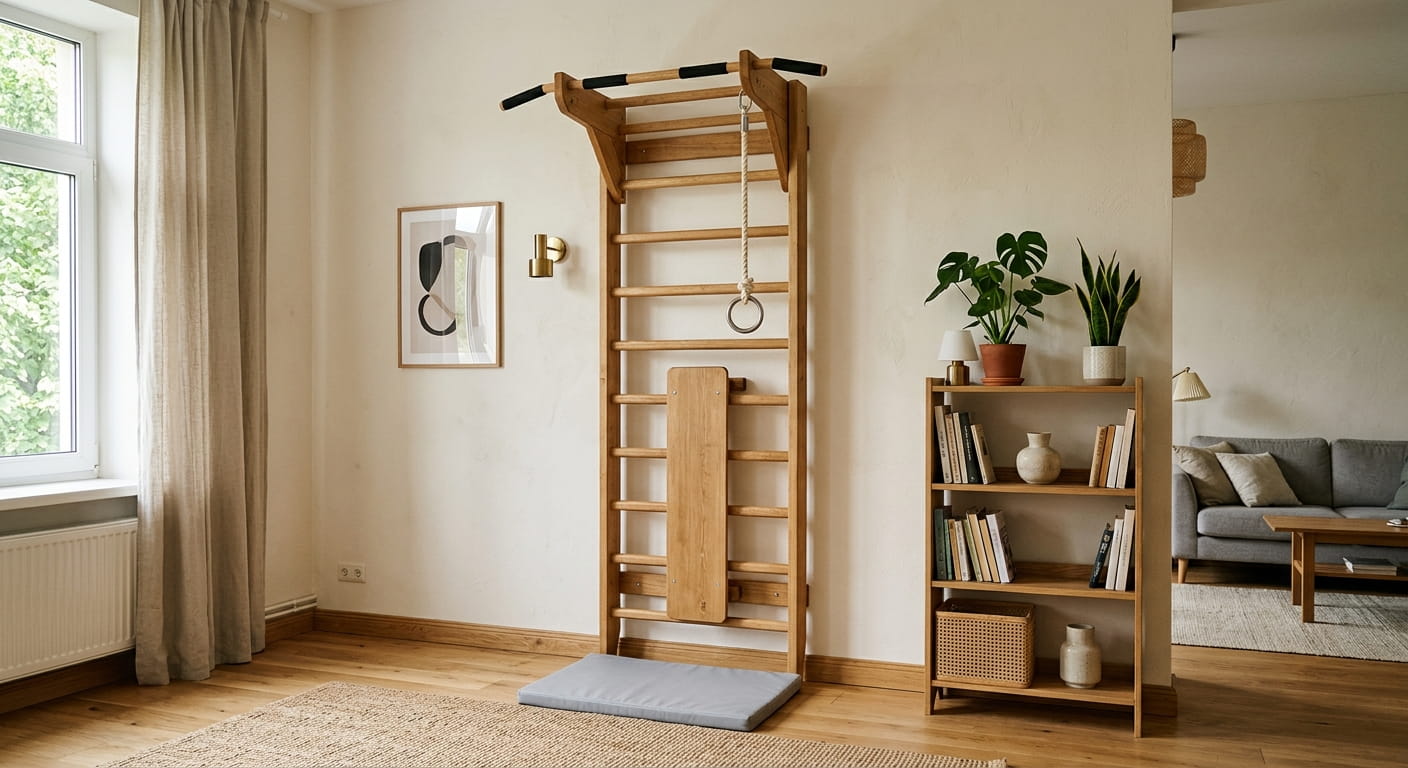
Separately about the rings and rope: before the first workout it is worth pulling on the suspension by hand with your full body weight, without starting an active exercise straight away — this lets you judge by eye how the mount behaves under load before trusting it with a jerk or a swing.
Add-on equipment: what you can buy later for sport wall bars
Even if the basic configuration does not include the full set, the frame of the sport range is designed from the outset with the later purchase of add-on elements in mind — without modifying the main structure.
The list of add-ons most often added to sport wall bars:
- Removable pull-up bar — if the base has only a fixed one, and you want to change the height for different exercises.
- Detachable dip bars — fitted to the side, removed when you need to free up the space next to the bars.
- Folding gymnastic abdominal bench — attached to the lower part of the frame, out of the way when folded.
- Gymnastic rings — on chains or nylon straps, adjustable by height.
- Rope — attached to the top rung or a separate hook to the side of the frame.
- Rope ladder — more often for the children's part of training, but also suitable for an adult's warm-up.
- Resistance bands — attached to any rung, adding strength work without increasing the size of the structure.
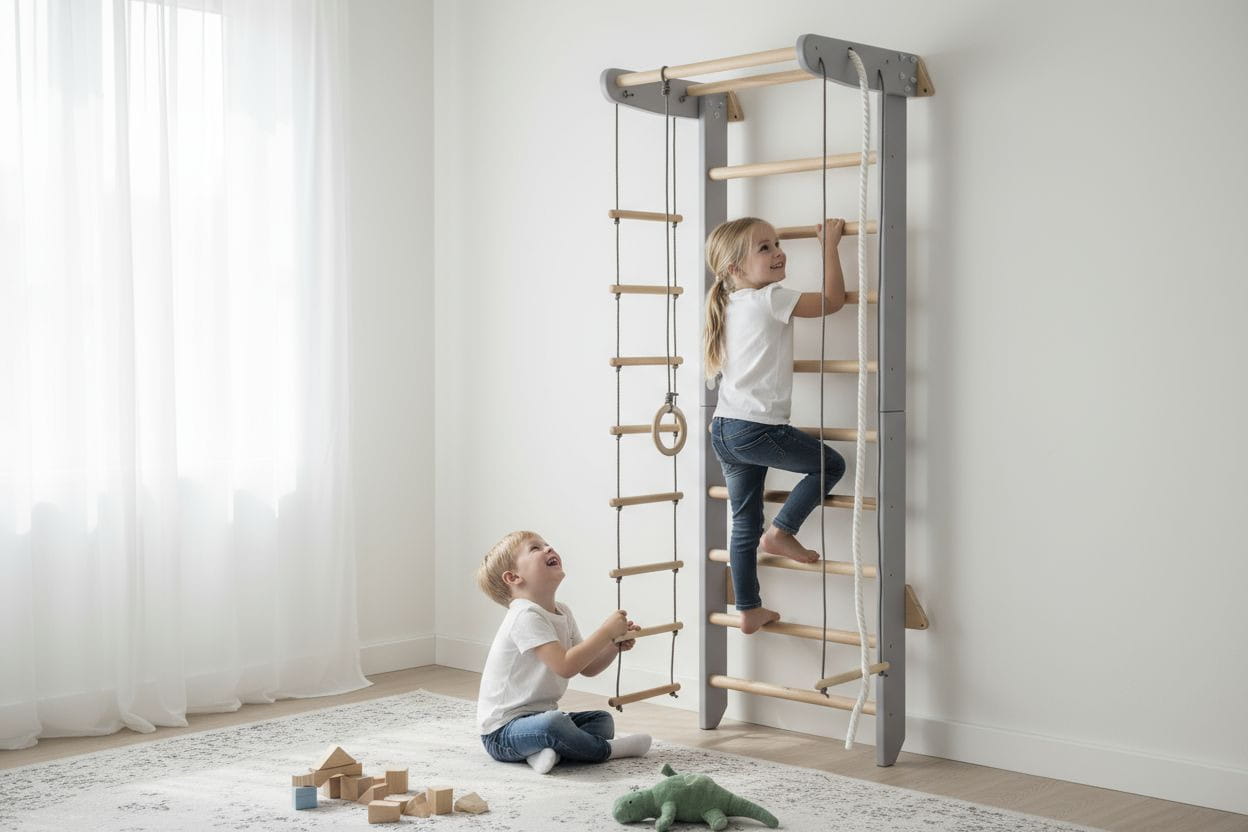
Gymnastic rings and a rope are the case of add-on equipment most often bought separately from the basic configuration precisely on sport models rather than on budget I-shaped ones. If the interest is specifically in this direction — acrobatics, ring work, climbing — it is logical to look straight away at gymnastic wall bars with a reinforced top rung for such attachments, rather than buying rings for ordinary bars designed for a minimal load.
Before buying add-ons separately from the basic set, it is worth checking with the manager which top rung the mounting unit for the rings or rope is rated for — on different models the diameter and method of fixing the rung may differ, and a homemade conversion reduces the stated strength of the unit. It is easier to order the required attachment together with the bars straight away, or through the same channel where the main structure was bought, than to choose a universal mount at random.
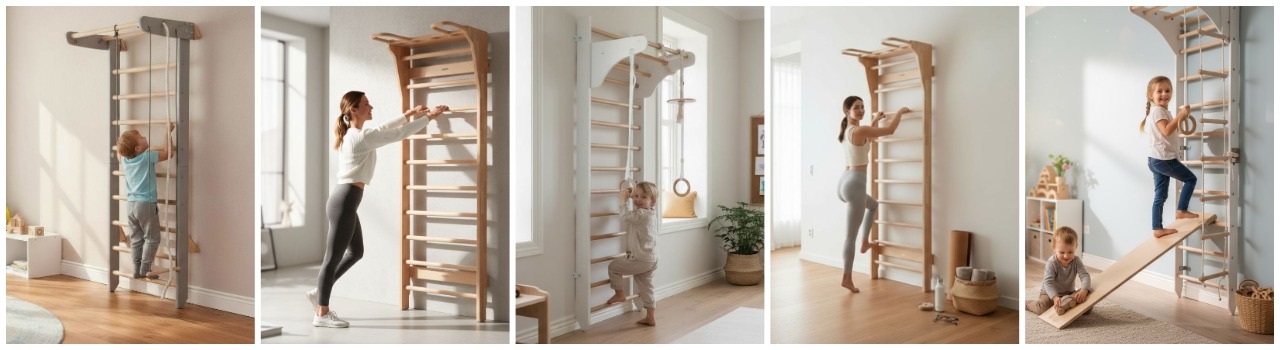
A home mini-gym on 0.2 sq m: how to place the complex in an apartment
The area that sport wall bars actually take up on the floor is about 0.2 sq m. That is less than the space for an ironing board when unfolded. The rest of the space works vertically — from floor to ceiling — rather than spreading across the room.
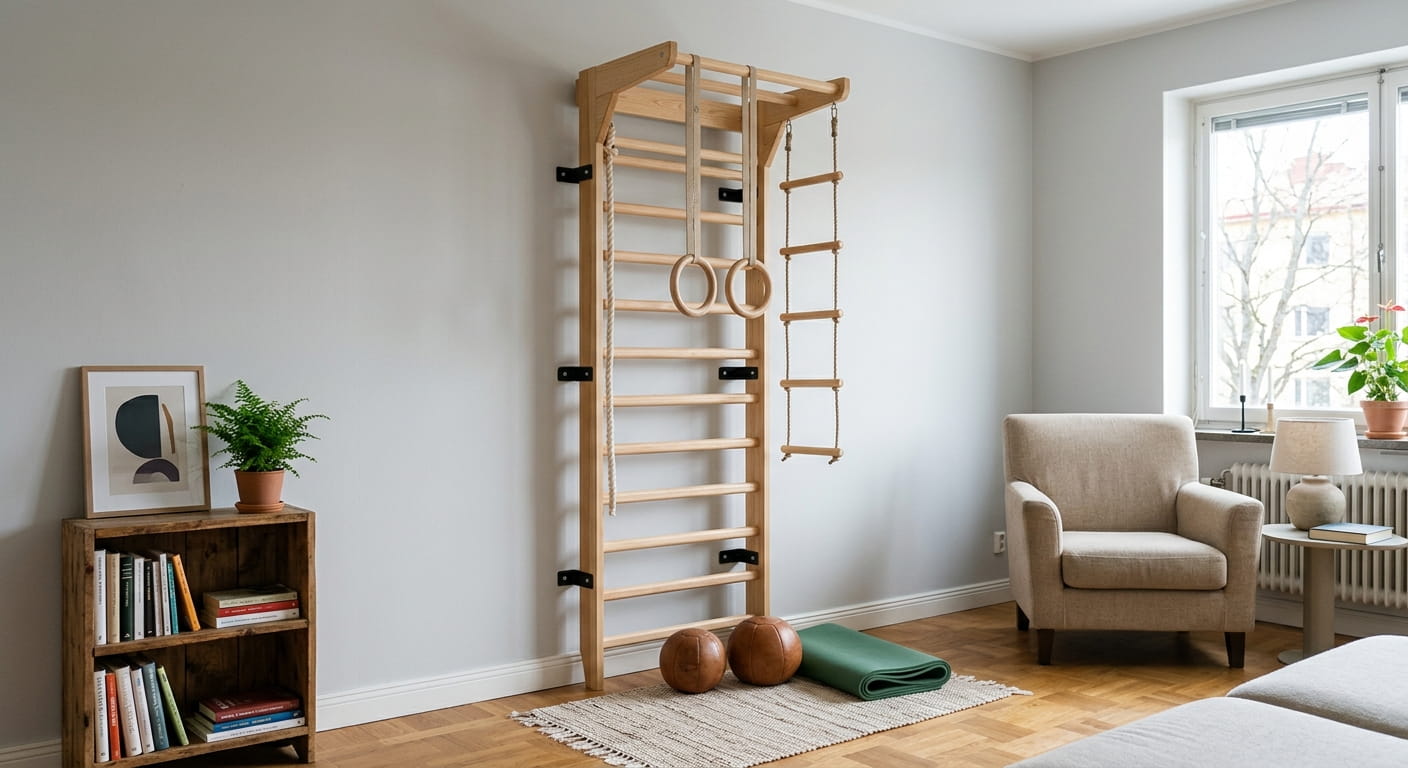
Practice shows that the complex is most often placed in a child's room by the window, in a hallway by the end wall, or in a corner of the living room where the corner was standing empty without furniture anyway. With a floor-to-ceiling pressure mount there is no need to occupy the wall with drilling at all — the structure stands wedged in place, and in theory it can be moved during a relocation.
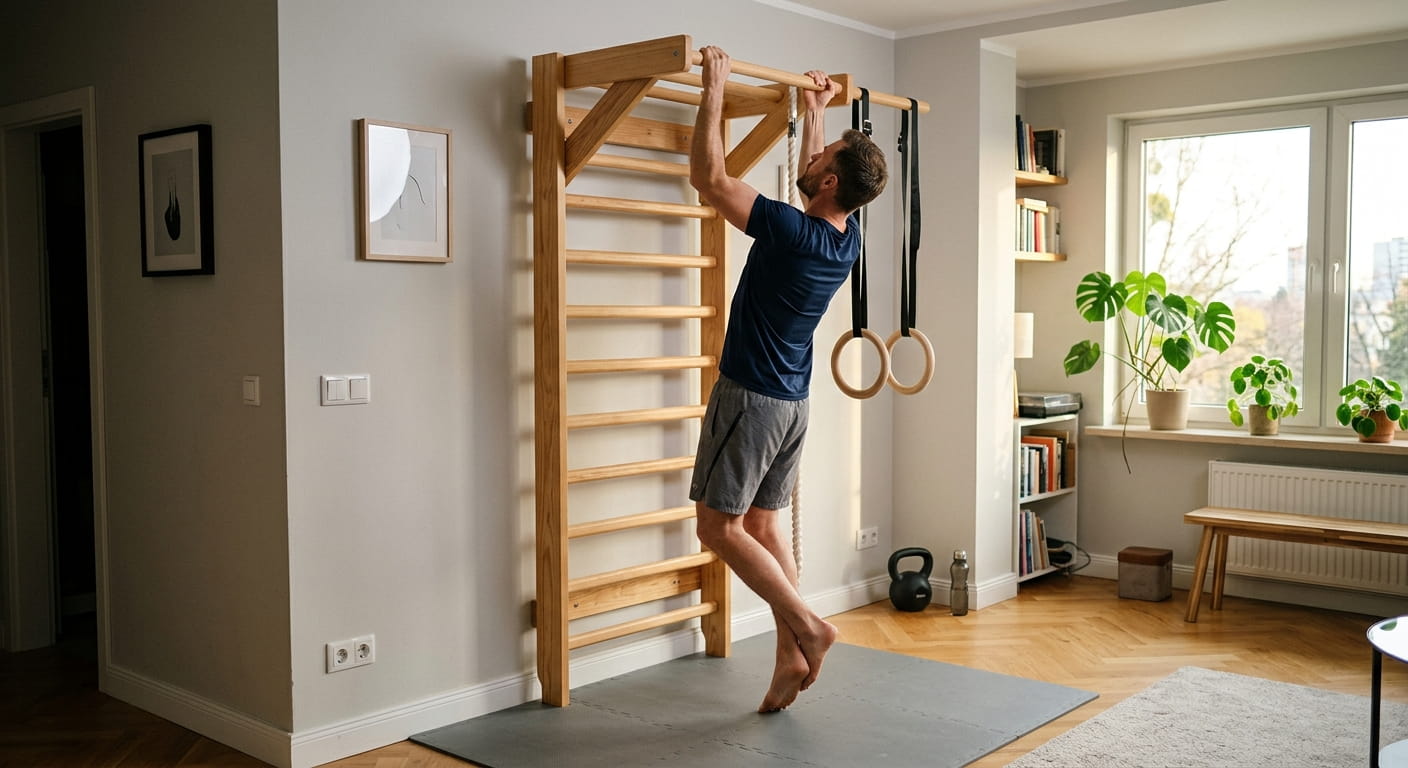
When planning the spot, you should allow not only for the footprint of the frame itself but also for the working radius: in front of the bars you need 1–1.5 metres of free floor for dismounting from the bar, swinging on the rings and climbing the rope. Such an apparatus should not be placed right up against a sofa or table — during active training the furniture will end up in the path of movement.
It works well when sport wall bars become part of the room's overall zoning rather than a standalone machine: a shallow shelf for dumbbells or resistance bands is hung nearby, and on the other side of the frame a free spot is left for a stretching mat. This way the corner turns into a finished sports zone rather than a set of randomly placed equipment.
How to order sport wall bars direct from the manufacturer
The complex is made at our own production in Zaslavl (Minsk District, Stroitelnaya Street, 7), with delivery arranged across the whole of Belarus. The order goes through the selection of a model for your specific conditions — ceiling, wall, weight and age of those training — rather than on the principle of «take the most expensive one just in case».
Assembly after delivery takes 1.5–3 hours — the set includes instructions and all the hardware, including the add-on equipment. You do not need to look for tools separately. The warranty is 12 months on the structure and attachments, except for natural wear of the rope and textile elements.
For wholesale buyers — a minimum batch from 10 units, with the option of a private label (OEM/Private Label); the products are certified under TR CU. Batch production time is 15–35 days, with dispatch after readiness in 3–5 working days. Delivery to the terminal of a transport company is free, and self-collection from the warehouse in Zaslavl is also available.
In price the sport range costs a little more than the basic I-shaped models, and the difference is explained not by a markup but by the composition of the set. «Krepysh» without attachments — from $198, «Vertikal» with a rigid combined mount — from $183, «Minsk Sport» with a modular detachable attachment — from $174. The sport models, however, include a pull-up bar, dip bars and often a bench from the start, so their price (from $195 to $218 depending on the model) is effectively comparable to a basic set of wall bars plus a separately purchased attachment set — only without the extra piecemeal installation.
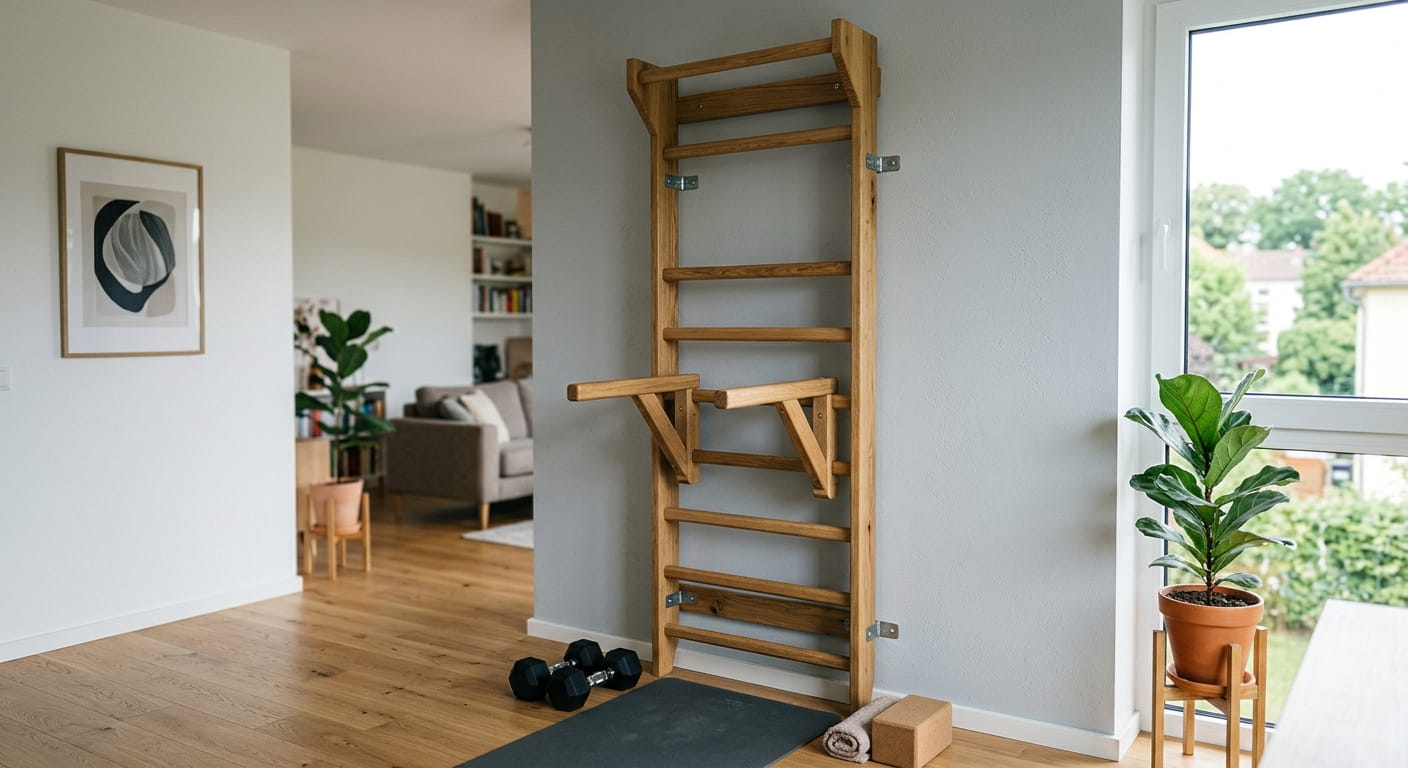
If the «sport» format seems excessive and you just need a sturdy base for a pull-up bar and dip bars without the full set of rings and rope, it is worth looking at a simpler option — the model with a pull-up bar and dip bars without the rest of the configuration; it will cost less with comparable frame rigidity.
Before placing the order it is sensible to check against a checklist: measure the ceiling height and the width of the wall pier, determine the wall material (concrete, brick, drywall), estimate the total weight of those training with a reserve for dynamic loads, and decide whether rings and rope are needed straight away or can be bought later. These four points cover almost all the questions that usually come up only after installation.
Another practical point is the position relative to sockets and heating appliances. A sports corner with a pull-up bar and dip bars implies active movement around the frame, so wires from household appliances or charging stations near the bars are best removed in advance rather than relocating a socket once the structure is installed and fixed. The same applies to long-pile rugs right under the bars — when dismounting from the bar a foot can slip or catch, and a flat surface or a thin gymnastic mat is safer than a fluffy rug.

The bottom line on choosing within the sport range is simple: «Atlet» — for active strength training and a weight closer to the upper load limit, «Lider» — for a family where the width of the frame and a variety of grip points matter, «Moy Turnik» — where the bar must adjust to the height of different family members. All three options remain a true sports complex rather than a decorative ladder, because they give a full workout for every muscle group on one frame and a minimal floor area.
Expert opinion
Sport wall bars pay off precisely when they are set up from the start as a working trainer rather than a decorative element of a child's room. The set of a pull-up bar plus dip bars plus rings and rope covers a workout from the back to the forearms on less than a square metre of floor, and the wooden frame serves for years if you do not save on the wood species of the rungs and do not ignore regular hardware checks.
The main mistake in choosing is taking a model by price without checking against the wall type, ceiling height and the weight of those training. A reinforced range like «Atlet» with a combined mount and a reserve of up to 250 kg costs a little more than standard models, but it saves you from the situation where, after six months of active training, the structure starts to wobble during jerking movements. The sensible approach is to build in a load reserve from the start rather than counting on the minimum.
— Veronika Tarasevich, internet marketer, specialist in semantics and content in product niches.