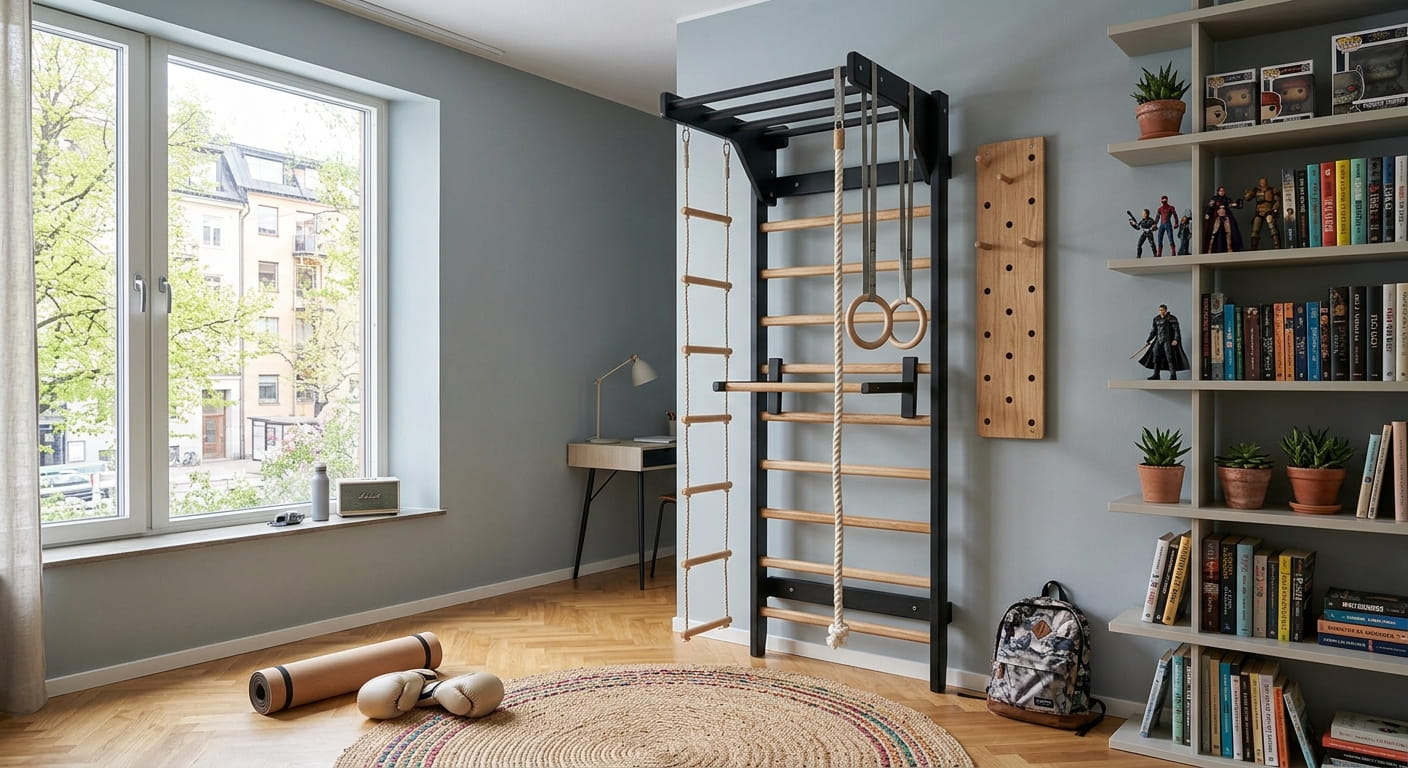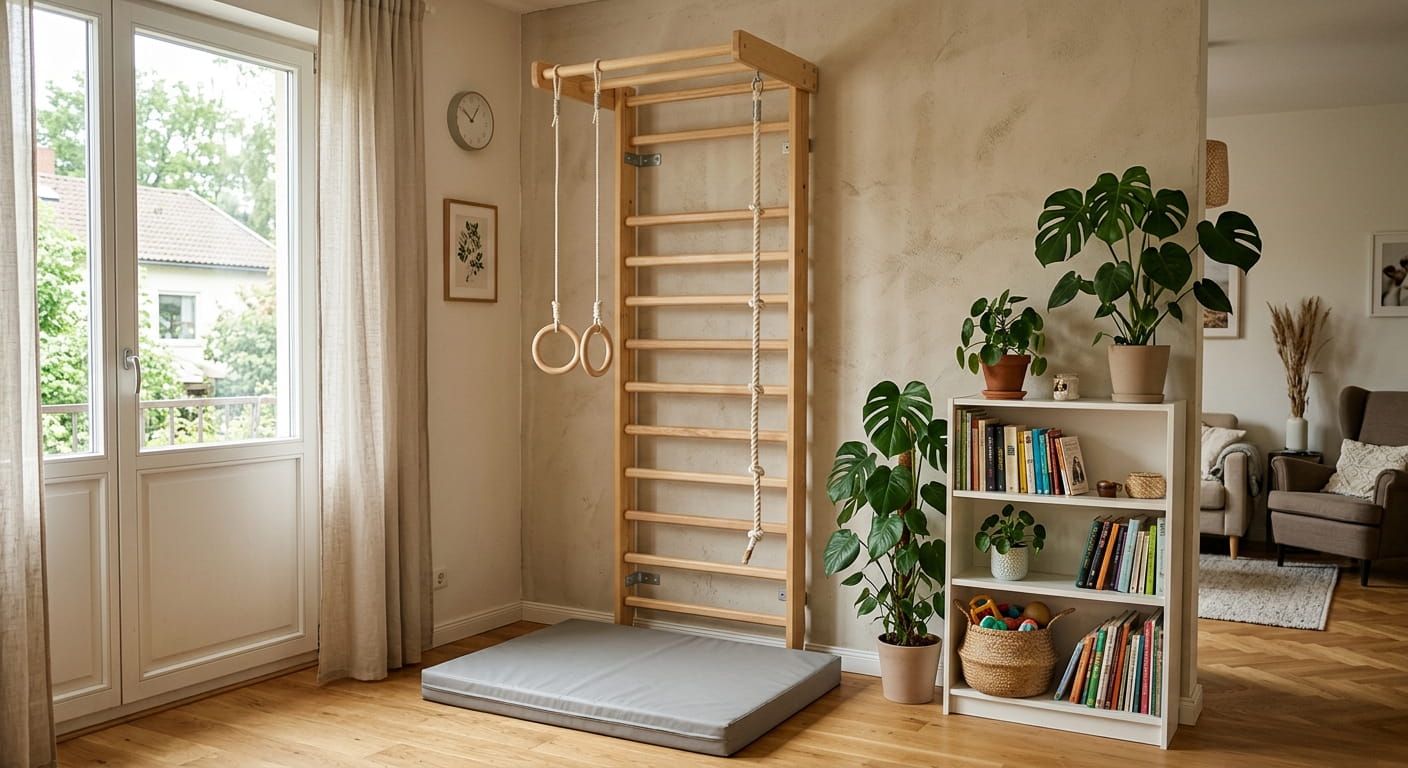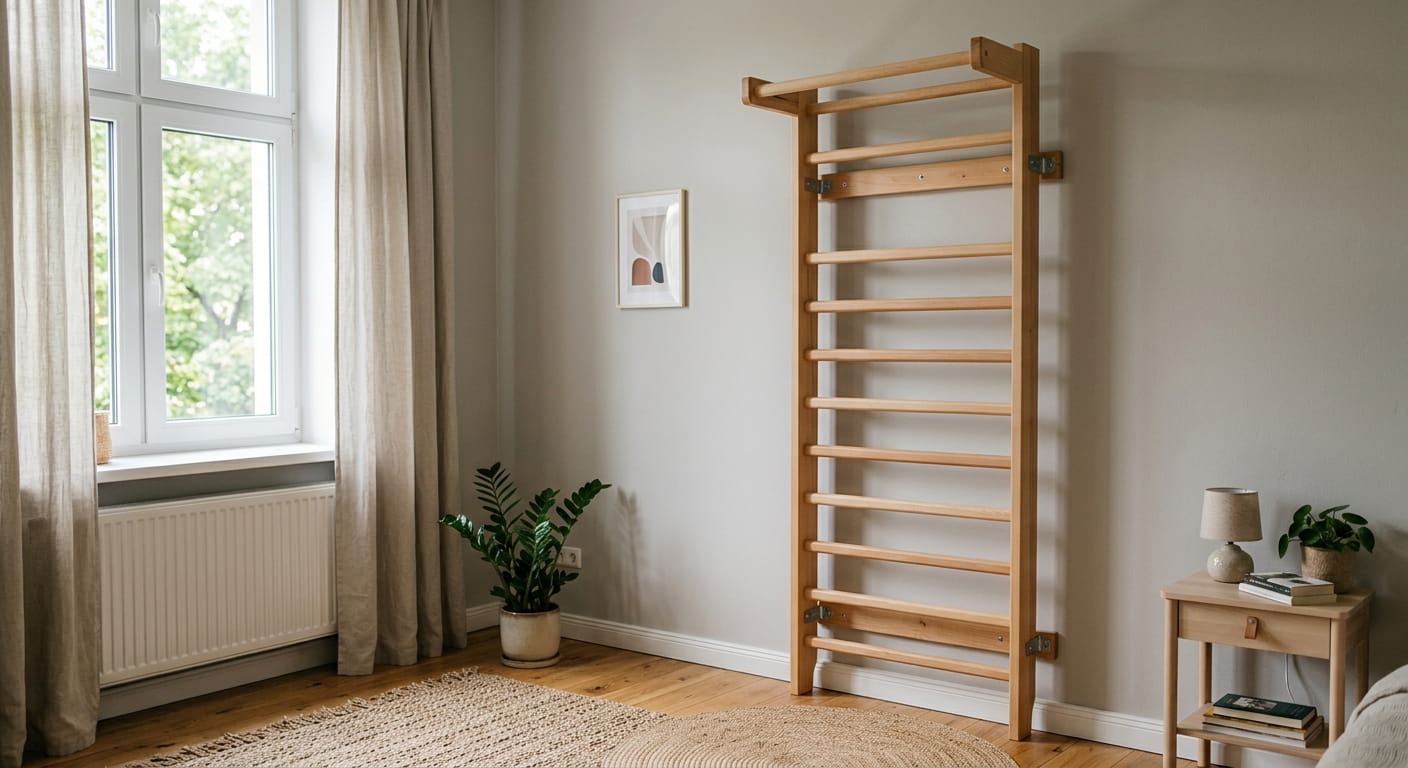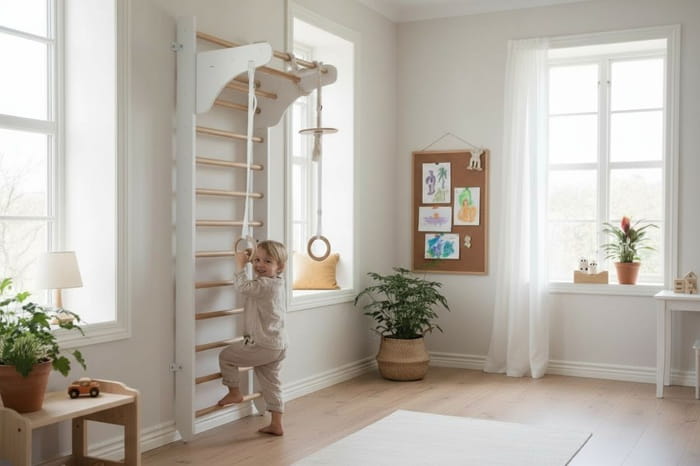
In a one-bedroom flat near the metro a family stood a wooden ladder along the wall — and took the pull-up bar out of the doorway, put the expander away in the cupboard and gave the ab bench to the neighbours: a wall bars exercise machine covered all of it at once on a single frame less than a metre wide. Pull-ups, dip bars, core work, stretching and the expander — below we look at which muscles each element works, how «Atlet», «Moy Turnik» and «Minsk Sport» differ, and how to choose the mounting to suit your flat.
Wall bars exercise machine: what a single unit really replaces
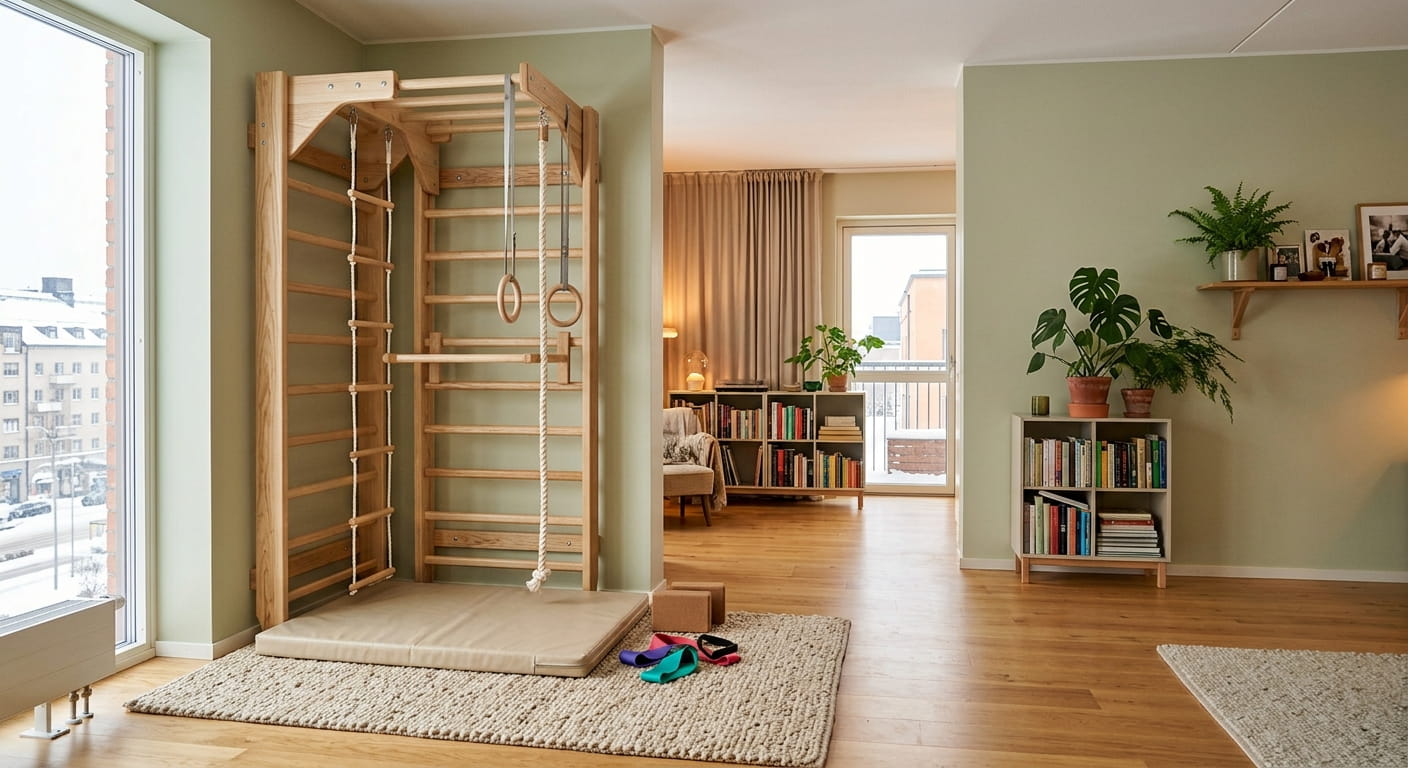
When a buyer compares the price of a wooden frame with the price of a standalone doorway bar, the sum is usually incomplete. A separate pull-up bar, separate dip bars, a separate ab bench, a separate stretching aid — that is four purchases, four places to store them and at least two different mountings around the flat. A wall bars exercise machine combines all of it in one frame: the rungs of the ladder work as a pull-up bar for narrow- and wide-grip pull-ups, dip bars clamp onto the sides, a folding bench tucks away below, and a resistance band ties to the upper rungs to stretch the shoulder girdle and back.
The maker has a dedicated line of add-on equipment built around exactly this logic: a removable pull-up bar with varied grips, fold-away dip bars, gymnastic rings, a rope, a rope ladder and a folding ab bench. You buy it all as your needs grow — first the basic frame, six months later the dip bars, another season on the rings for stretching the back. In effect the owner of the flat assembles a multifunctional home corner piece by piece, without moving furniture or drilling fresh walls for every new attachment.
There is also the reverse scenario: buying a model with an expanded spec from the outset. «Atlet» comes with dip bars and a bench as standard, «Moy Turnik» with a built-in removable adjustable bar for different grips. In both cases the finished wall bars take up the same roughly 0.2 square metres of floor as a bare ladder with no add-ons — all the fittings mount onto the uprights and don't widen the footprint.
Wall bars as a machine: how one unit covers the pull-up bar, dip bars and core
A doorway bar is a fussy thing: not every frame holds it, it's awkward to dismantle, and the grip is almost always the same. A removable pull-up bar on wall bars fixes at the height you need among the rungs of the ladder, and you can change grip simply through the varying width of the supports — from narrow to wide, with a neutral hand position or the classic overhand hold.
Dip bars solve the second most common complaint — where to train the triceps and chest if there is no separate two-metre sports corner in the flat. Add-on dip bars fix to the side of the ladder on the same frame, come off when they get in the way, and take up no space at all if they were never installed, as in the «Atlet» set.
The core is trained on a folding bench that, when folded, presses against the uprights and doesn't stick out into the room. Hanging from the upper rungs works the core too — hanging leg raises are one of the basic staples for anyone who bought a wall bars exercise machine for that purpose rather than for climbing.
Stretching is the thing people often forget at the choosing stage, only to discover later that the apparatus for it is already in the flat. The rungs of the ladder give support for bends, raising a leg to the height you need, and stretching the hamstrings and back right in a hang. A separate rubber expander loops onto any rung — you get a machine for arms, shoulders and back with no dedicated wall mounting specially for it.
The result is a logical replacement for five or six separate items from a sports shop: a pull-up bar, dip bars, a bench, an expander stand, a stretching aid and, in some cases, a children's sports corner if the model is bought for the whole family.
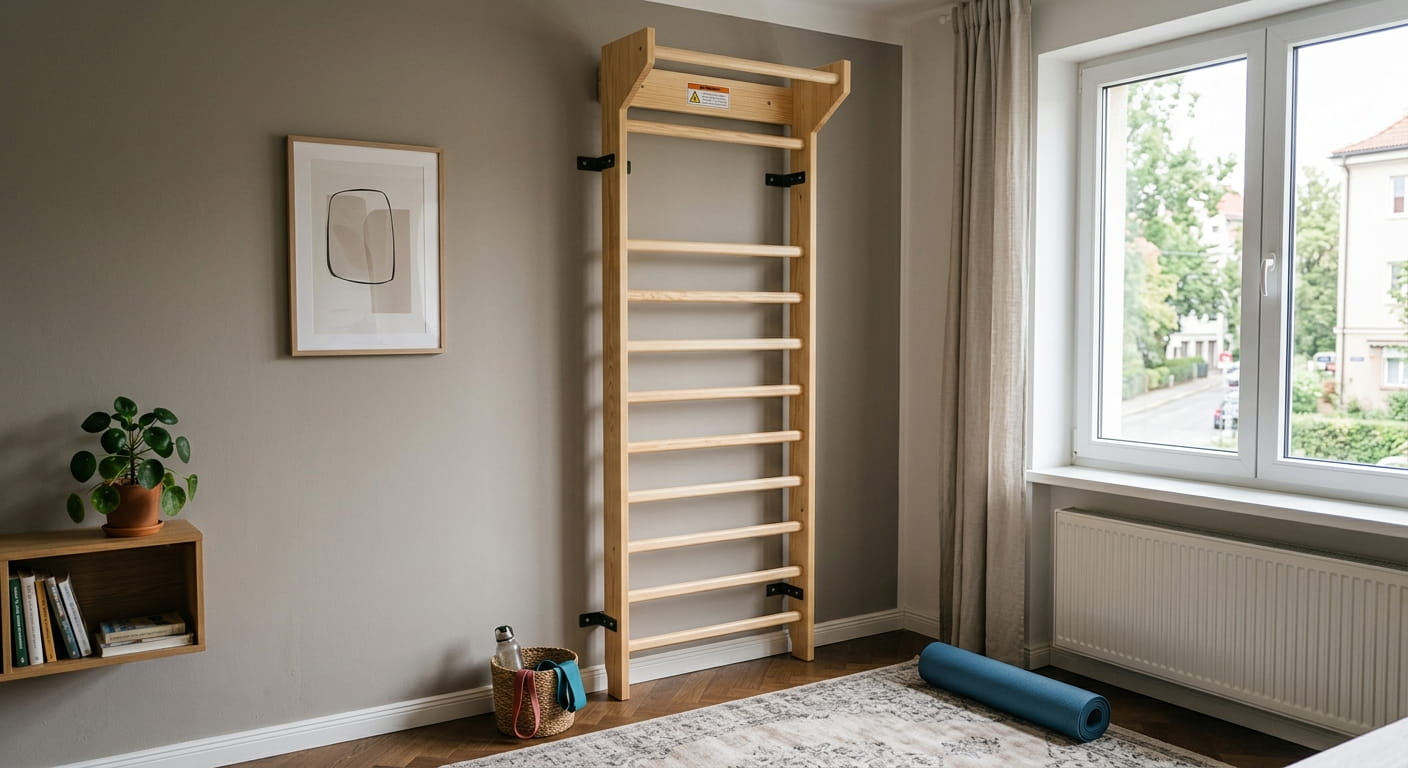
The «frame plus add-on equipment» combination comes out more compact than buying a pull-up bar, dip bars and bench separately as standalone items — and, crucially, it all stands in one corner of the room rather than scattered across three walls of the flat.
Which muscles wall bars work
The list of muscle groups depends on which element you use. On the pull-up bar you work the latissimus dorsi, biceps, forearms and the core muscles that keep the torso from swinging during the movement. On the dip bars the main load goes to the triceps, chest and the front heads of the deltoids. On the ab bench — the rectus and oblique abdominals, and a little of the hip flexors. A simple hang on the rungs already decompresses the spine and unloads the lower back, which people with sedentary computer work value in itself.
- Pull-up bar (pull-ups) — lats, biceps, forearms, core
- Dip bars — triceps, chest, front deltoids
- Ab bench — rectus and oblique abdominals
- Hang and leg raises — core, hip flexors, lower-back decompression
- Stretching on the rungs — hamstrings, back, shoulder ligaments
- Squats supported on the lower rungs — quadriceps, glutes
- Expander fixed to a rung — shoulder girdle, back, arms
It's worth noting the balance of load separately: wall bars are good precisely because they don't force you to train one zone of the body only. The classic set of exercises — pull-ups, dips, hanging leg raises and stretching — works the upper body, core and flexibility in a single session, with no moving between different machines in different corners of a gym or fitness-club zone.
There are less obvious load options too. Negative pull-ups — a slow descent from the top position — help beginners who don't yet have the strength for a full pull-up but do have it for a controlled lowering. Australian pull-ups, the body inclined with feet resting on a lower rung, load the back more gently than the classic version and suit recovery after a break in training. Static holds of an L-sit on the dip bars or in a hang engage the deep core muscles more than dynamic reps.
One unit instead of five
Pull-up bar, dip bars, bench, stretching support and the expander anchor point — in one frame on the wall.
Compact
Takes about 0.2 square metres of floor — less than the corner under an unfolded ironing board.
Grows with the family
Children's ropes and rings come off, freeing space for an adult pull-up bar and dip bars.
Solid wood
Uprights of glued pine or birch timber, rungs of beech or ash — dense, hard wood.
Hidden fixings
Metal connectors are tucked inside the parts — the unit doesn't snag clothing or graze the skin on contact.
Assembly in 1.5–3 hours
Instructions and all fixings in the box — no extra hardware to buy separately.
Training programmes on wall bars: from beginner to advanced
A beginner usually starts with a hang — just holding on for thirty to forty seconds without swinging is already a load for untrained shoulders and back. Next you add bent-leg raises in a hang for eight to ten reps, incline push-ups off the lower rungs, and partial squats supported on a rung for balance. Stretching at the end of the session is a must — five to seven minutes on the hamstrings and back relieve the tightness after the strength part.
The intermediate level already means full-range pull-ups, at least three sets of five to eight, dips on add-on bars with your own bodyweight, straight-leg raises in a hang for the core, and work with the expander on shoulders and back between sets. At this stage it makes sense to look towards models with ready-fitted dip bars such as «Atlet» — you no longer have to buy the add-on set separately.
The advanced level adds extra weight: a belt with a plate for pull-ups, pauses at the bottom of dips, a static L-sit for the core. Here it is not so much the wall bars themselves that matter as the strength margin of the frame — the reinforced «Atlet» structure holds a load of up to 250 kilograms for exactly these scenarios, whereas standard models are rated at 120–150 kilograms, which is plenty with a margin for one adult user without added weight.
A separate question is frequency. Three sessions a week of twenty to thirty minutes give a noticeable result within a month and a half to two months of regular training, provided you don't skip stretching and don't ramp up the weight too sharply. Chaotic one-off sessions once a fortnight don't produce that effect — muscles and ligaments don't have time to adapt, and the risk of tweaking a shoulder or elbow on a ragged schedule is higher.
A training log helps even on the simplest apparatus: writing down the number of pull-ups, the hang time and the number of sets on the dip bars is useful for seeing real progress rather than relying on feel. After a month or two of regular training on wall bars the difference between the first and the current entry is usually plain to the naked eye — and that motivates you to keep going better than a vague «it got easier».
| Level | Basic exercises | Load guideline |
|---|---|---|
| Beginner | Hang, partial pull-ups, bent-leg raises, stretching | up to 100 kg of bodyweight |
| Intermediate | Pull-ups, dips, straight-leg raises, expander | 100–150 kg |
| Advanced | Weighted pull-ups, paused dips, static core holds | 150–250 kg (reinforced model) |
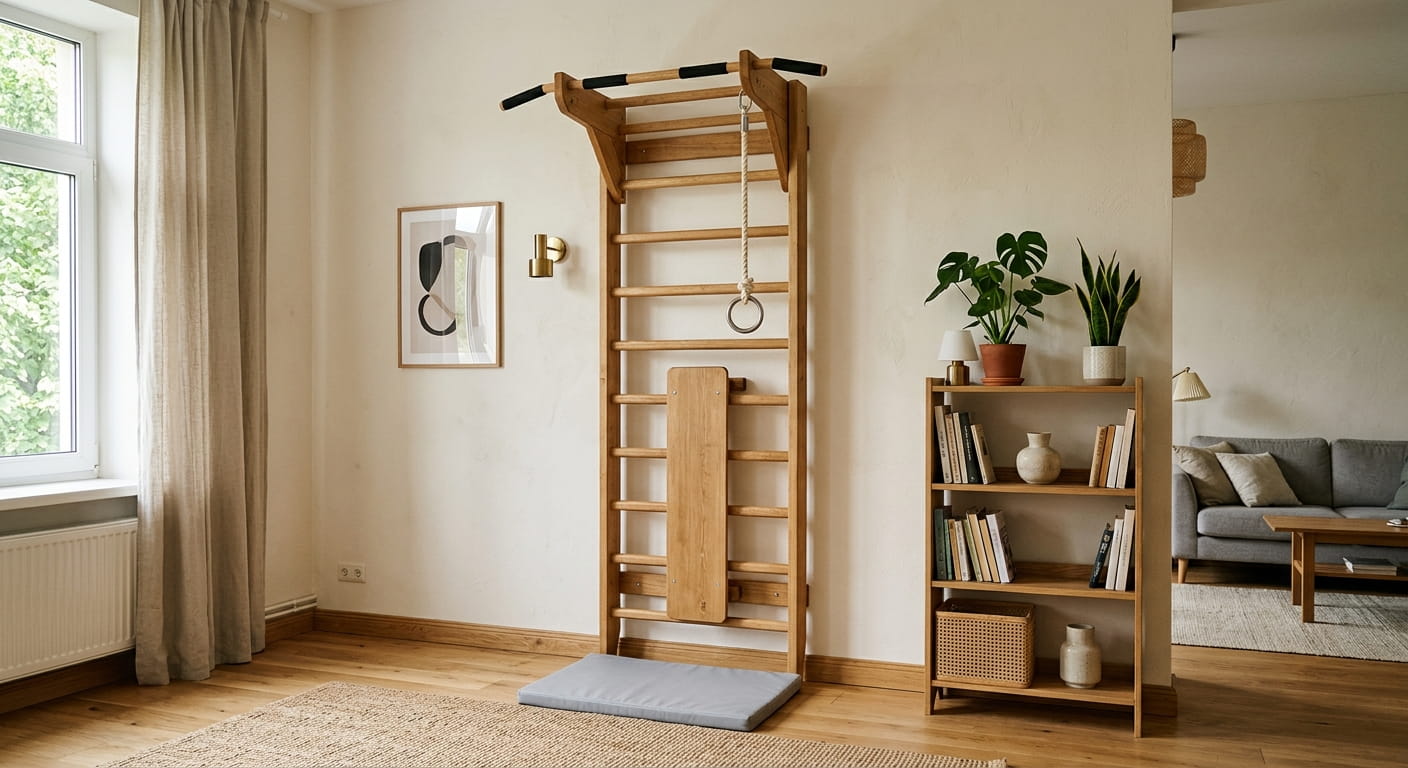
The «Moy Turnik», «Atlet» and «Minsk Sport» models: different takes on one machine
Three models solve one task in different ways, and which logic is closest to a particular buyer decides the choice of wall bars for the home.
«Moy Turnik» is built around the upper body: a removable adjustable pull-up bar with several grip options — the main scenario is pull-ups and work on the biceps, back and shoulders. The design is aimed at those who don't need dip bars and a bench right now but do want a convenient, quality bar with no play and no surplus kit.
«Atlet» is the reinforced version for a home where someone in the family trains seriously: thick uprights, a load of up to 250 kilograms, dip bars and a folding bench included. It is a ready-made mini-gym with no add-ons to buy, suited to strength training with extra weight and an advanced load.
«Minsk Sport» is built on modularity: removable adjustable add-on equipment lets you change the configuration as you go — a bar today, rings tomorrow, dip bars instead of rings a month on. This option is handy when the make-up of the family or the training goals haven't settled yet and there is no point paying up front for a fixed set of add-ons.
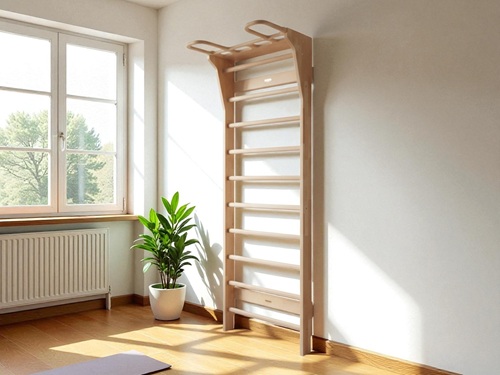
| Model | Build type | Included | Load | Price from |
|---|---|---|---|---|
| «Moy Turnik» | Upper-body focus | Removable adjustable bar with varied grips | 120–150 kg | from $218 |
| «Atlet» | Reinforced, thick uprights | Dip bars and folding bench included | up to 250 kg | from $202 |
| «Minsk Sport» | Modular | Removable adjustable add-on equipment | 120–150 kg | from $174 |
There are also models on the site with no explicit focus on the machine function — «Krepysh», «Vershina» and «Vertikal». They too take add-on equipment, but they were designed from the outset for narrow wall piers, a built-in upper bar or the most rigid combined mounting rather than for serious strength loads. If the aim is precisely to train rather than simply to have an apparatus for climbing and warm-ups, it is wiser to look straight towards «Atlet», «Moy Turnik» or «Minsk Sport».
The price difference between models isn't always directly tied to function as a machine — «Vertikal» is cheaper than «Moy Turnik» but isn't set up for a removable bar with varied grips, while «Lider» with its sections and monkey bars solves the task of active climbing rather than strength pull-ups. Before buying, it's worth answering honestly which matters more: a gymnastic apparatus for general activity or a machine for a specific programme with tracked load.
Those who want a pull-up bar and dip bars straight away in the factory spec, with no add-ons to buy, should look at the wall bars with pull-up bar and dip bars — there both elements come as a factory set rather than as a separate line in the basket.
Add-on equipment: how to extend what wall bars can do
The basic frame is only the skeleton. A true machine emerges when you hang extra equipment on it for a specific task. The maker offers eight add-on items: a removable pull-up bar, add-on dip bars, a folding ab bench, gymnastic rings, a rope, a rope ladder and expanders of varying resistance.
The logic of buying extras is usually this: first take the frame to suit the budget and the space in the room, then add what you actually need based on how you train, not on a catalogue picture. Rings and a rope are more often bought for stretching the back and shoulder joints than for strength work — they are more of a rehab and warm-up tool. A rope ladder and rope also go down well with children if the wall bars are used by the whole family rather than adults only.
By function the add-on equipment divides up like this: a removable bar loads the back, biceps and forearms and suits adults and teenagers; add-on dip bars hit the triceps and chest and are aimed at intermediate and advanced levels; a folding bench trains the core and obliques and is fit for the whole family without exception; rings and a rope work on stretching, the shoulder joints and coordination — taken by both children and adults for warming up before the main part; a rope ladder is mainly a children's story about coordination and general activity; expanders are universal and load the shoulder girdle, back and arms at any fitness level.
The add-on equipment is covered by the same 12-month warranty as the frame itself — except for the natural wear of the rope and textile elements, which chafe with active use and are replaced as consumables rather than as factory defects.
A further plus of the modular approach is that you don't have to guess in advance what configuration you'll need five years ahead. The child grows up — take off the rope and rings, fit the bar and dip bars. The adult gets into training — buy a second bench or a firmer expander. The frame stays the same; you only add to the attachment side, without replacing the whole structure.
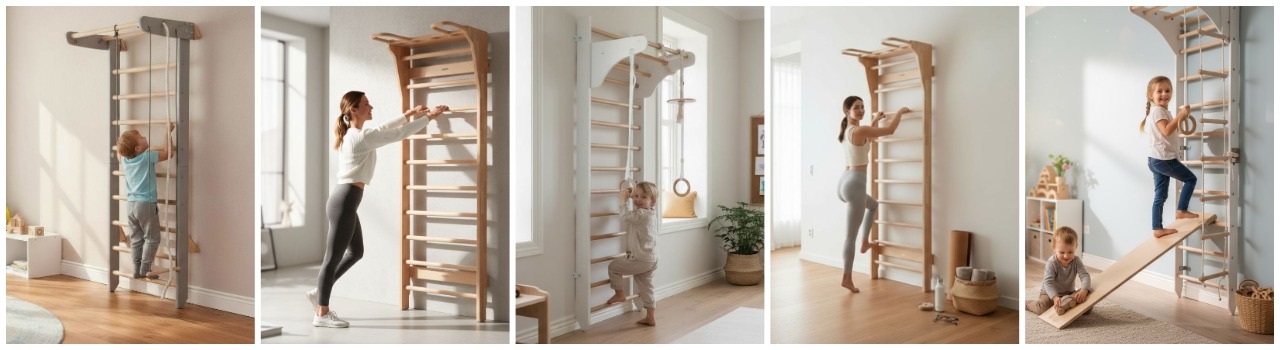
Compatibility of add-on equipment between models isn't absolute — the mountings are designed for a specific width and thickness of upright, so it's best not to buy a bar or dip bars from another maker for these wall bars; better to check with a manager for the right option to fit the frame you've already installed.
Load, mounting and safety
A standard wall bars exercise machine holds 120–150 kilograms — enough for an adult without added weight and with a big margin for a teenager or child. The reinforced «Atlet» line is rated at 250 kilograms thanks to thicker uprights and a combined mounting — an option for those who train with weight or simply want a strength margin for many years ahead with no upgrade to the structure.
In practice the load margin is rarely used to the full hundred per cent, but it takes away the worry of whether the wall bars will take a sharp jerk on a pull-up or a dismount from the top after a set. The more active and varied the training programme, the more sense a reinforced frame makes — the dynamic load on jerks is about one and a half to two times higher than the static bodyweight.
Mounting: wall-fixed, pressure-mounted, combined
A wall-fixed anchor mount is the most rigid option and suits concrete and solid-brick walls. Such a mounting is never put on plasterboard: the structure must push against a load-bearing wall, not against a thin cladding that simply won't take the pull-out load during active pull-ups.
A pressure mount works on the floor-to-ceiling principle: a screw system with no drilling into the walls, handy for rented homes and thin partitions. The ceiling requirement is a height of 2.40 to 3.10 metres, and there is an important limit here: a pressure mount must not be fitted under a stretch or suspended ceiling — the brace pushes directly against the solid floor slab, not against a decorative membrane that would simply sag or tear.
A combined mount is used in top models such as «Atlet» — it combines wall fixing with an extra support, and that is what gives the increased load margin of 250 kilograms during active strength training with weight.
| Mounting type | Where it suits | Limitations |
|---|---|---|
| Wall-fixed anchor | Concrete, solid brick | Not for plasterboard |
| Floor-to-ceiling pressure | Rented homes, thin walls, ceiling 2.40–3.10 m | Not under a stretch or suspended ceiling |
| Combined | Top models («Atlet») | Needs both a wall and a ceiling of the right height |
Mats and safety during training
A mat under the wall bars is not an option but a compulsory part of safe installation, especially when a child or a beginner who hasn't yet judged the grip on the bar is training on the apparatus. On a fall from the upper rungs a mat absorbs the impact; during an adult's intense sessions it protects the floor from constant footwork and scratches.
- Check the tightness of the bolts every 3–6 months
- Keep a mat under the wall bars permanently, not just during children's play
- Don't fit a pressure mount under a stretch or suspended ceiling
- Don't exceed the model's stated load (120–150 kg, or 250 kg for the reinforced one)
- Don't place the apparatus by a radiator or in direct sunlight
- Use the instructions and the supplied fixings, don't replace them with random hardware
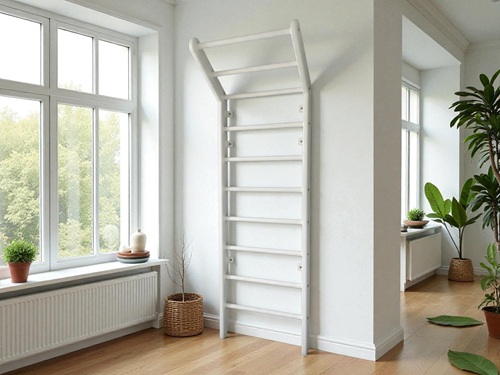
Wall bars for the whole family: from children's workouts to an adult machine
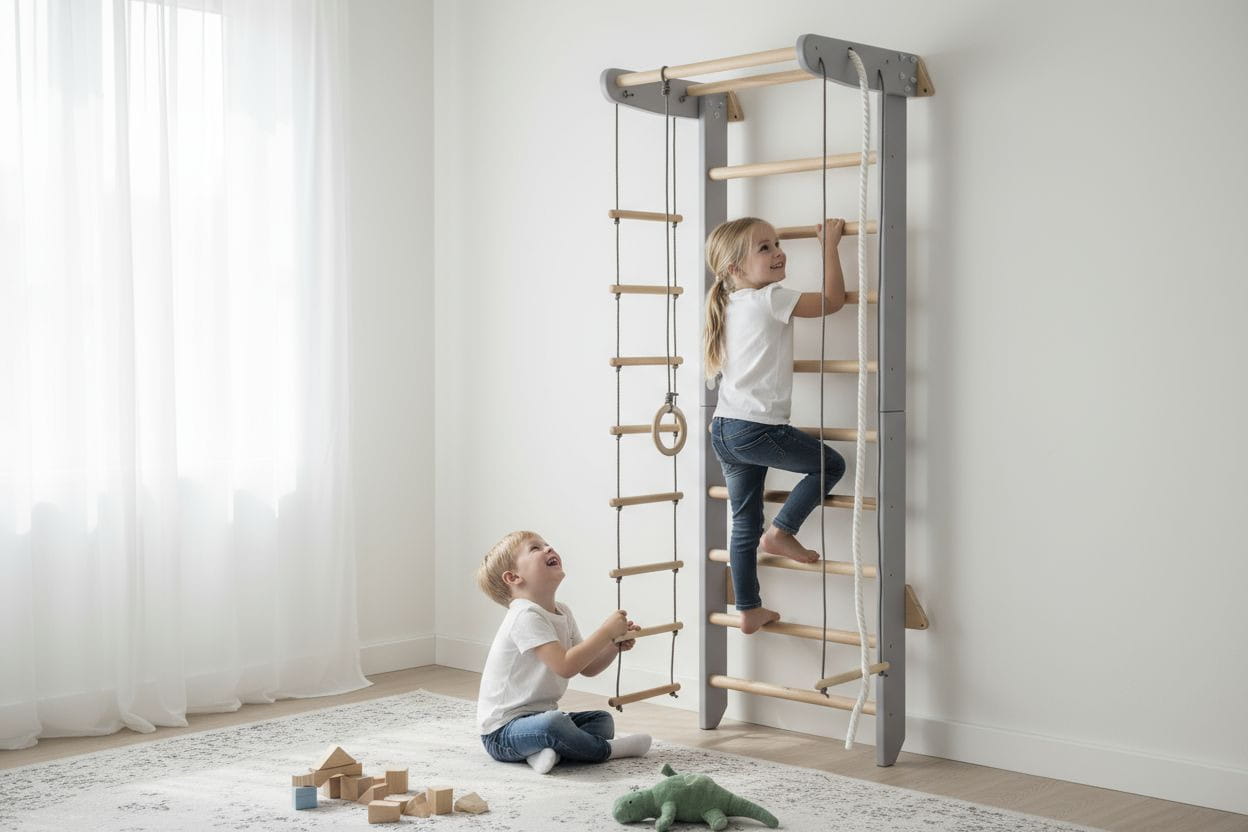
The same wall bars are rarely used by just one person in the home. A child climbs the rungs and swings on the rope, a teenager does pull-ups on the removable bar, an adult works on the dip bars and with the ab bench. The difference in load is solved by modularity: the children's add-ons — rope, rings, rope ladder — come off or are supplemented by an adult set as the family grows and interests change.
For a family with children it makes sense to look towards models with a load margin from the start, so as not to revisit the choice in a couple of years when the child grows up and starts training more seriously. The separate children's model «Maugli» with a rope, rings and a rope ladder is a good option for toddlers' active play, but if the plan is to grow the apparatus along with the child into the teenage years and beyond, it's worth taking an adult model with the option of add-on expansion from the outset.
Practice shows that families more often choose something in between: a basic frame with no narrow specialisation plus a gradual purchase of add-ons — first rings and a ladder for the youngest, then a bar and dip bars as the children grow. For those who want a more universal option straight away, it's worth looking at the sport wall bars — there the add-on set is wider than the standard factory kit from the start.
Another practical point for a family is the queue for the apparatus. If two or three people in the home train, usage time is spread across a schedule: the adult on pull-ups and dip bars in the morning, the child on the rope and rings in the evening. The compactness of the structure only helps here — the apparatus doesn't take up a separate room and doesn't stop others getting on with their own things nearby.
Mistakes when choosing and installing a home machine
The first typical mistake is taking a model for the current weight with no margin, then adding extra load a year on and hitting the ceiling of a standard set of wall bars. If strength training is seriously on the cards, it's wiser to look at a reinforced structure from the start rather than paying twice.
The second mistake is fitting a pressure mount in a room with a stretch ceiling without checking first. The result is either dismantling or a ruined membrane. The type of ceiling and walls is worth clarifying before ordering, not after delivery.
The third is skimping on the mat, treating it as an optional accessory. On a fall from the upper rungs or during intense jumping exercises a mat reduces the risk of injury and protects the floor at the same time; going without it is false economy on a genuinely inexpensive safety item.
The fourth common mistake is taking the minimal spec with no add-ons, then realising a month later that workouts are monotonous without dip bars or a bench. If the goal is precisely varied strength load rather than just a bar for pull-ups, a spec like «Atlet» with dip bars and a bench saves a repeat purchase straight away.
The fifth mistake is rarer but costs more — installing the wall bars yourself without checking against the diagram in the instructions, skimping on a couple of fixings «by eye». The kit is put together by the maker for the specific load of the structure, and even one missed bolt at a fixing point reduces the strength margin more than it looks.
Wall bars for the home versus a gym membership
The argument about saving time sounds trite, but it's the one that most often decides in favour of a home apparatus. The trip to the gym and back, waiting for a free bar or bench, getting ready — all of it eats more time than the workout itself. Wall bars stand in the room permanently: a five-minute pull-up between tasks is possible without changing clothes or leaving the house, and a full session takes exactly as long as you actually set aside for it.
The second point is the queue for equipment. At the gym the bar and dip bars are often occupied, so you wait or change your training plan on the fly. At home a wall bars exercise machine is entirely at your disposal at any hour, which is especially valued by those who train early in the morning or late at night, when fitness clubs are already closed or not yet open.
The gym, of course, offers a variety of equipment that one frame won't have — a barbell, leg machines, a cardio zone. But for the upper body, the core and stretching, wall bars for the home cover most of the basic needs with no membership and no tie to a club's timetable. Many use both in parallel: the gym for legs and general fitness, the home apparatus for everyday maintenance activity.
Caring for a wooden machine
Wood doesn't need complex maintenance, but a couple of habits add years to the life of your wall bars. Wipe the frame with a dry or slightly damp cloth, without abrasives or solvents — the water-based finish isn't meant for aggressive household chemicals.
Every three to six months it's worth checking the tightness of the bolts — from active training and constant vibration the fixings loosen a little over time, especially on a floor-to-ceiling pressure structure where the load passes through a screw mechanism. The mat under the wall bars also protects the floor from scratches and point impacts on dismount.
A separate recommendation is not to place the apparatus by a radiator or keep it in direct sunlight all the time: swings in temperature and humidity dry the wood out over time and can affect the geometry of the uprights. Water-based lacquers and oils are hypoallergenic and certified, but that doesn't cancel out basic care in everyday use.
The warranty on the structure and the add-on equipment is 12 months — the only exception is the natural wear of rope and textile elements such as a rope or ladder, which wear out from active use faster than wood and metal.
How to choose a wall bars exercise machine for your goals
The starting point is not budget or design but who will train and why on the wall bars. If the aim is pull-ups and back work with no surplus kit, it's more logical to look at «Moy Turnik» with its convenient removable adjustable bar. If the plan is strength training with dip bars and the core straight out of the box — «Atlet» with its reinforced frame and a load margin of up to 250 kilograms. If the make-up of the family and the goals aren't settled yet — «Minsk Sport» with modular add-ons gives the freedom to change configuration as you go without replacing the frame.
The second question is the type of wall and ceiling in the flat. Concrete or solid brick open the way to a wall-fixed mounting, the most rigid option for active strength training. Thin partitions or rented housing are a reason to look at a pressure structure, but only with a ceiling of 2.40 to 3.10 metres and no stretch membrane above. The maker has a dedicated line for exactly the high-rigidity scenario — reinforced wall bars with a combined mounting suit situations where a strength margin matters regardless of the wall type.
The third point is the space in the flat. The sum is simple: about 0.2 square metres of floor for the frame itself, plus a little margin at the sides for add-on dip bars if you plan to fit them straight away or buy them later. For comparison — that's less than the area an unfolded ironing board takes up, while covering far more functions with regular training.
The materials are the same quality across all models regardless of price: uprights of glued pine or birch timber, rungs of hard wood — beech or ash — and hidden metal fixings on furniture connectors. The difference between models is in the build, the spec and the permissible load, not in the class of material used.
If doubts remain after all the calculations, lean on the most common use case: a wall bars exercise machine is primarily for the upper body and core, not a universal replacement for a whole gym. With that caveat, the choice between the three key models comes down to a simple question — do you need a ready set for strength training, a flexible bar for grip variety, or a modular base for future expansion.
Ordering and delivery
Production is in Zaslavl, Minsk District, in an own workshop on Stroitelnaya ulitsa, where every set of wall bars is built to order. Delivery covers the whole of Belarus; for a retail buyer assembly takes one and a half to three hours by yourself following the instructions — all the fixings are already in the box, with no hardware to buy separately.
Wholesale buyers have a separate arrangement: a minimum batch from ten units, the option of own branding, certificates of conformity with the Customs Union technical regulations, dispatch in three to five working days from stock or made to order in fifteen to thirty-five days. Delivery to the carrier's terminal is free, and collection from the Zaslavl warehouse is also available.
In short, wall bars stop being just a ladder for climbing the moment you match them with the right add-on equipment for a specific person's task. A pull-up bar, dip bars, a bench, rings, a rope and an expander on one frame save both money and square metres — and a wooden structure with no sharp corners and no exposed fixings stays safe for children, provided it's fixed correctly and you don't forget the mat on the floor.
Expert opinion
Over years of assembly on site the same pattern is clear: people underestimate a wall bars exercise machine at the choosing stage and overestimate it after a month of training. The apparatus is first bought as a replacement for a bar or a piece of kit for a child, and then dip bars, a bench and expanders are added — and only then does the structure start to work as a full home gym rather than as a décor feature with rungs.
The main advice before choosing a model is to work out the load for years ahead, not for the first month. A standard 120–150 kilograms is enough for most, but if there is someone in the family who plans to train seriously and with weight, it's wiser to look straight away at a reinforced structure with a margin up to 250 kilograms than to revisit the whole installation later.
— Veronika Tarasevich, internet marketer, specialist in semantics and content for product niches.