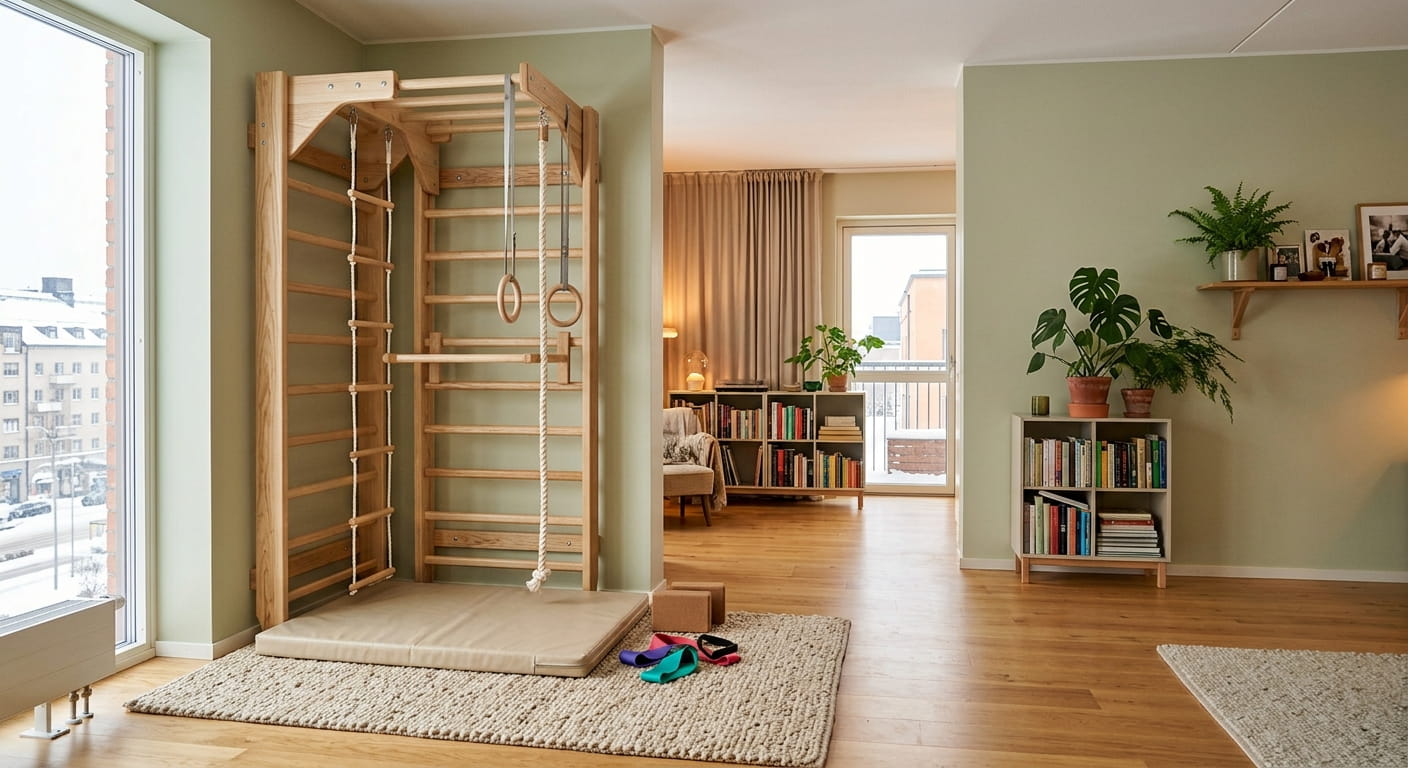
A garden veranda with no roof, three days of rain in a row — and an ordinary indoor wall-bar ladder would be streaked with water marks while the metalwork rusted over. Outdoor wall bars are built for exactly that scenario: a weatherproof finish on the wood, corrosion-resistant fasteners, and mounting to the house wall or a veranda support instead of a ceiling brace. Below, point by point — what to hang outside, what load is acceptable and how to care for the wood season by season, without the glossy promises.
Outdoor wall bars: how the garden version differs from the home one
Structurally the difference is small: the same uprights of glued laminated timber, the same hardwood rungs, the same hidden metal-bolt fastening. What changes is what that wood has to endure — not the dry 40-50% humidity of a flat but rain, morning dew, direct summer sun and sub-zero winter temperatures. For the indoor version the wood is coated with a water-based lacquer or oil first and foremost for hypoallergenic safety and looks. Outdoors a more serious job is added — to keep moisture out of the timber and stop the hidden metal from rusting.
The difference shows in a couple of figures. Indoor wall bars stand for many years without question in the calm climate of a flat — the wood does not shift with humidity, and the fasteners never meet the weather. The outdoor version, made from the very same wood but without a revised finish and care schedule, will start to lose its looks within a single season under the open sky: cracks in the lacquer film, darkening of the timber on the sunny side, traces of corrosion on the cut ends of the metalwork. That is where the whole difference in approach comes from, and it is worth working through in order.
What outdoor wall bars are made of so they do not rot
The uprights are glued laminated timber of pine or birch. Glued, not a solid log, because bonded lamellas warp less with changes in humidity: a solid board outdoors moves more with damp and heat, cracks along the grain and loses its geometry. The rungs are made of beech or ash — a dense, hard wood that absorbs less water through its end grain and keeps its shape under the load of gripping hands even after many seasons of use.
The fasteners are hidden metal — furniture bolts inside the timber. Outdoors this is no box-ticking detail: an exposed screw or bracket under sun and rain starts to rust in the first season, the streaks run straight onto the wood and eat into the finish from within. A hidden bolt sits inside the solid timber, meets less rain, and the assembled frame looks neater too — no protruding heads or rusty streaks on pale wood. That is exactly why outdoor wall bars from the manufacturer are assembled on the same hardware as the indoor ones, with no cutting corners on the visible joints.
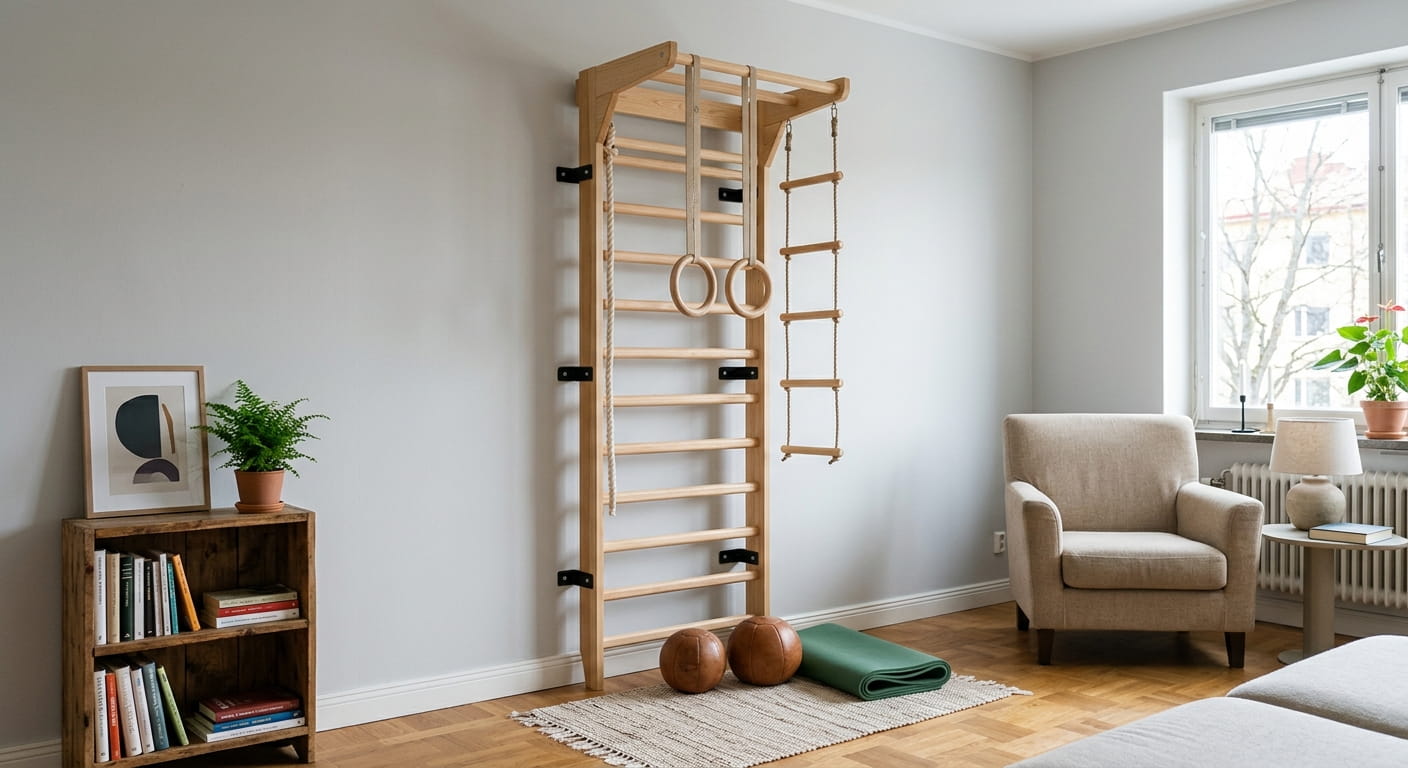
Wood treatment and fasteners for outdoors: what really protects the frame
The water-based lacquer or oil used to coat the models for a flat is fine for outdoors by composition — the base is the same, hypoallergenic and certified — but the treatment regime does differ. For outdoor use what matters is not only the coating at purchase but that the finish is refreshed regularly, not once and for all. Wood on a veranda or in an open yard takes UV light, which breaks down the top layer of the lacquer film faster than indoors behind a curtain, and moisture that seeks out any micro-crack in the coating to reach the wood fibres.
Honestly: no treatment makes wood eternal outdoors. It slows how fast moisture soaks in and shields against UV, but once every one or two seasons the layer of lacquer or oil is worth refreshing — especially on the horizontal rungs and the bench, where rain in summer and snow in winter land directly.
For the uprights that sit flush against the house wall the risk is lower — the roof overhang or an eave partly shelters them, if the building has one. For the cantilevered rungs and dip bars that jut out into the open yard the risk is several times higher: these are the elements of the frame to check first during the spring inspection, before the active training season begins.
Corrosion-resistant fasteners and hidden bolts on outdoor wall bars
The furniture bolts that hold wall bars together, whether for home or yard, are tucked inside the timber — which cuts the metal's contact with the weather but does not remove it entirely: at the point where the bolt enters the wood, moisture can still seep along the grain in a prolonged downpour. Hence a practical rule specifically for outdoors: tighten the bolts every 3-6 months not for appearance but because wood in the open air "breathes" a little more with humidity swings, and the fasteners loosen more noticeably over time than in a dry room.

Where to put them: garden, yard, veranda, gazebo
Three scenarios come up most often in practice. First — a covered veranda with walls and a roof: the wood there is partly shielded from direct rain, and in terms of use these outdoor wall bars differ little from an indoor set, except that winter temperature swings are sharper in an unheated space. Second — an open yard with no cover: the frame takes the full weather cycle — rain, snow and sun with no limits — and the finish will then need refreshing more often. Third — a gazebo with a roof but no solid walls: an in-between option where slanting rain and wind still reach it, but a direct downpour and scorching sun do not always and not at full force.
For a veranda with a roof, if the ceiling height falls within the 2.40-3.10 metre range, the same principle works as in a flat: pressure mounting floor-to-ceiling, by screw, with no wall drilling. That is handy when the veranda walls are thin or timber-framed, or when the structure is partly dismantled each autumn. For an open yard this option will not do at all — there is simply no ceiling there physically, and the only workable mounting method is to a load-bearing wall or to a rigid structural support of the building itself.
Pressure mounting floor-to-ceiling holds by a screw brace rather than drilling — but it absolutely needs a ceiling slab above it. In an open yard, in a gazebo with no ceiling or under a canopy on separate posts, this method will not work: there you need a load-bearing wall for the anchor or a ready-made rigid frame of the building itself.
What to consider when installing in an open yard with no cover
A fully open plot is the most demanding scenario for care, yet the most flexible for placement: there is no need to fit around a veranda's layout or a ceiling's height — a load-bearing house wall or a free-standing rigid support on the plot is enough. Before installing, it is worth gauging which way the wall faces: an upright on the south side of the plot gets more direct sun in summer, so its finish will fade and need refreshing a little faster than the same model in the shade of a fence or an old tree.
Another practical point is the distance to the house gutter and drip line. If the frame stands too close to the roof edge with no gutter, rainwater will drip straight onto the uprights and rungs, wearing the finish in one spot noticeably faster than across the rest of the surface. It is easier to shift the mounting point half a metre aside during installation than to touch up the lacquer in the same spot under the drip every season.
Mounting outdoor wall bars to the house wall or a veranda support
Wall anchoring is the most rigid and reliable option, whether in a flat or in the yard. It works on concrete and solid brick and is no good on plasterboard or any cladding with no load-bearing base behind it. For outdoor wall bars this is most often the house wall, an outbuilding wall or a load-bearing veranda support — that is, a structural element, not decorative siding or panelling that simply will not hold an anchor under load.
In the top models — for example the "Atlet" with its reinforced frame and a rated load up to 250 kg — combined mounting is used, to the wall and a support at once, for maximum rigidity under the serious load of gripping and pull-ups. For a garden where both adults and children train, and sometimes several people hang on the rungs at once, that reserve of strength is a solution, not an excess.
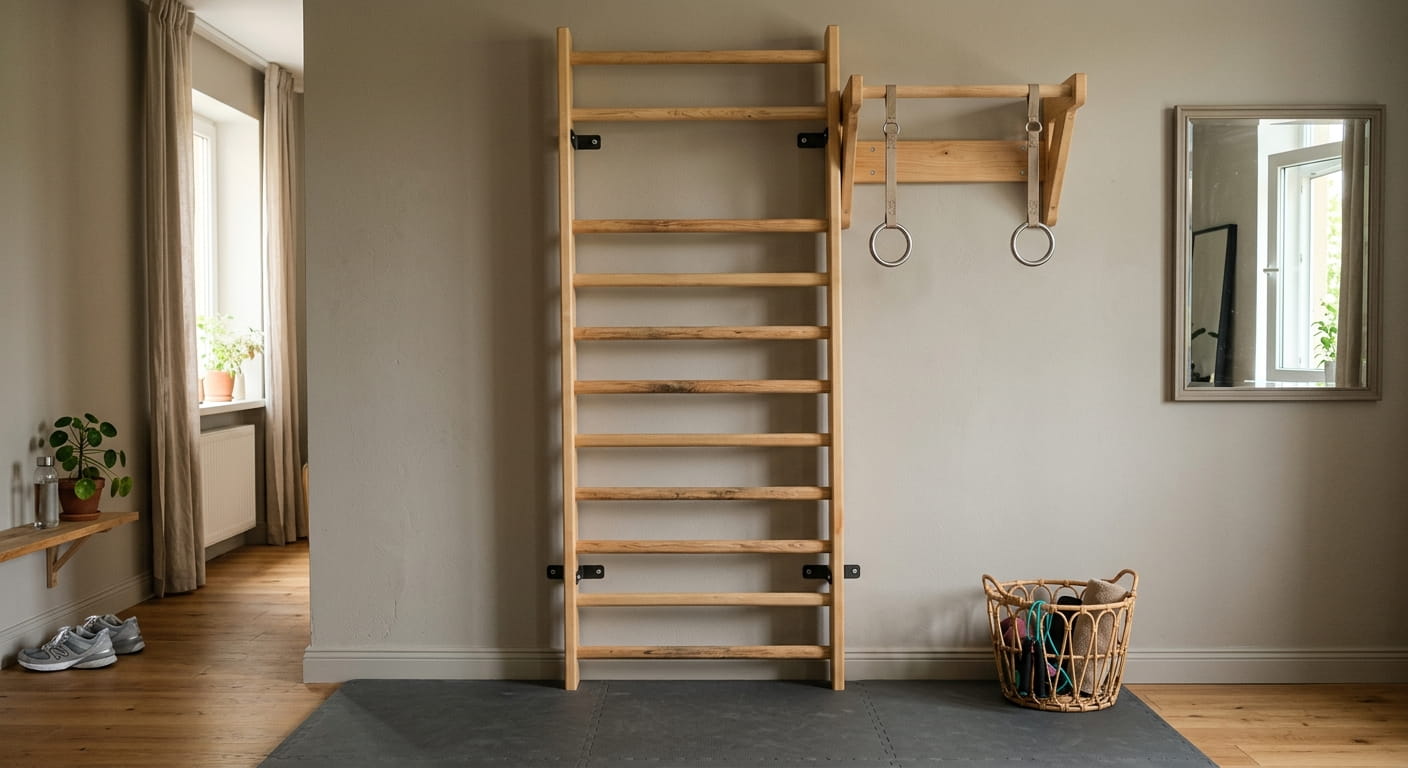
Add-ons for outdoors: pull-up bar, rings, rope, monkey bars
The yard and garden are exactly where add-ons truly come into their own: a removable pull-up bar, hang-on dip bars, a folding ab bench, gymnastic rings, a climbing rope, a rope ladder, resistance bands. In summer the unit gathers the whole family at once — one doing pull-ups on the bar, another climbing the rope, someone else working abs on the bench in the shade of a canopy.
The monkey bars deserve a mention of their own: a horizontal run of rungs to move along hand over hand appeals to children and to adults who are priming their grip before the pull-up bar or simply loosening the shoulder girdle after a desk-bound day. On models with sections and extra length, like the "Lider" with a U- or T-shaped frame and a built-in net, the monkey bars flow on from the main frame rather than looking bolted on the side. If monkey bars are a priority in your choice, it is worth a separate look at wall bars with a pull-up bar and monkey bars, where this solution is worked out specifically for a long hand-over-hand reach.
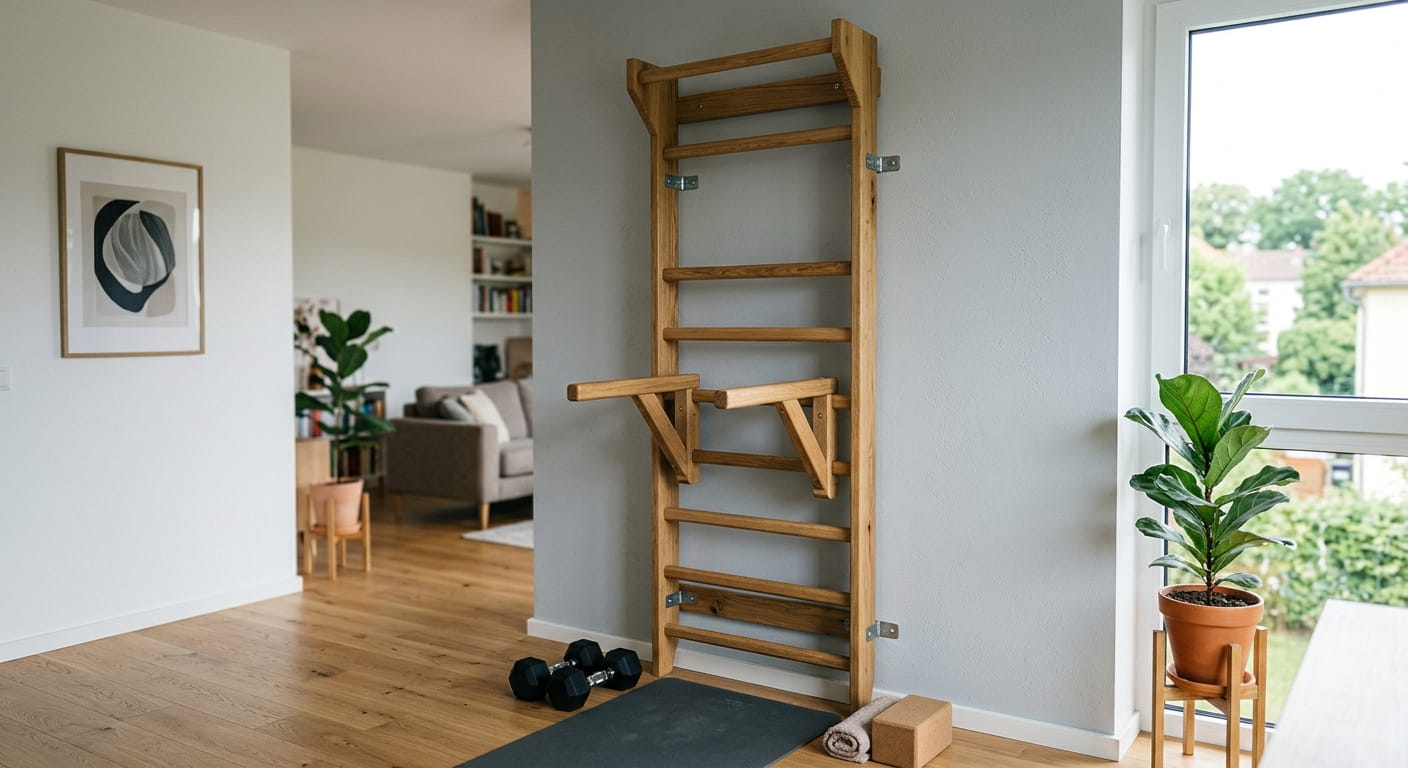
For the youngest, it is not the strength fittings that come to the fore but the rope, rings and rope ladder — things that call for no pull-up grip and instead train coordination and climbing. The "Maugli" model has exactly this set of add-ons and a gentler budget — from $92, which makes sense for a children's unit with no strength fittings and no dip bars.
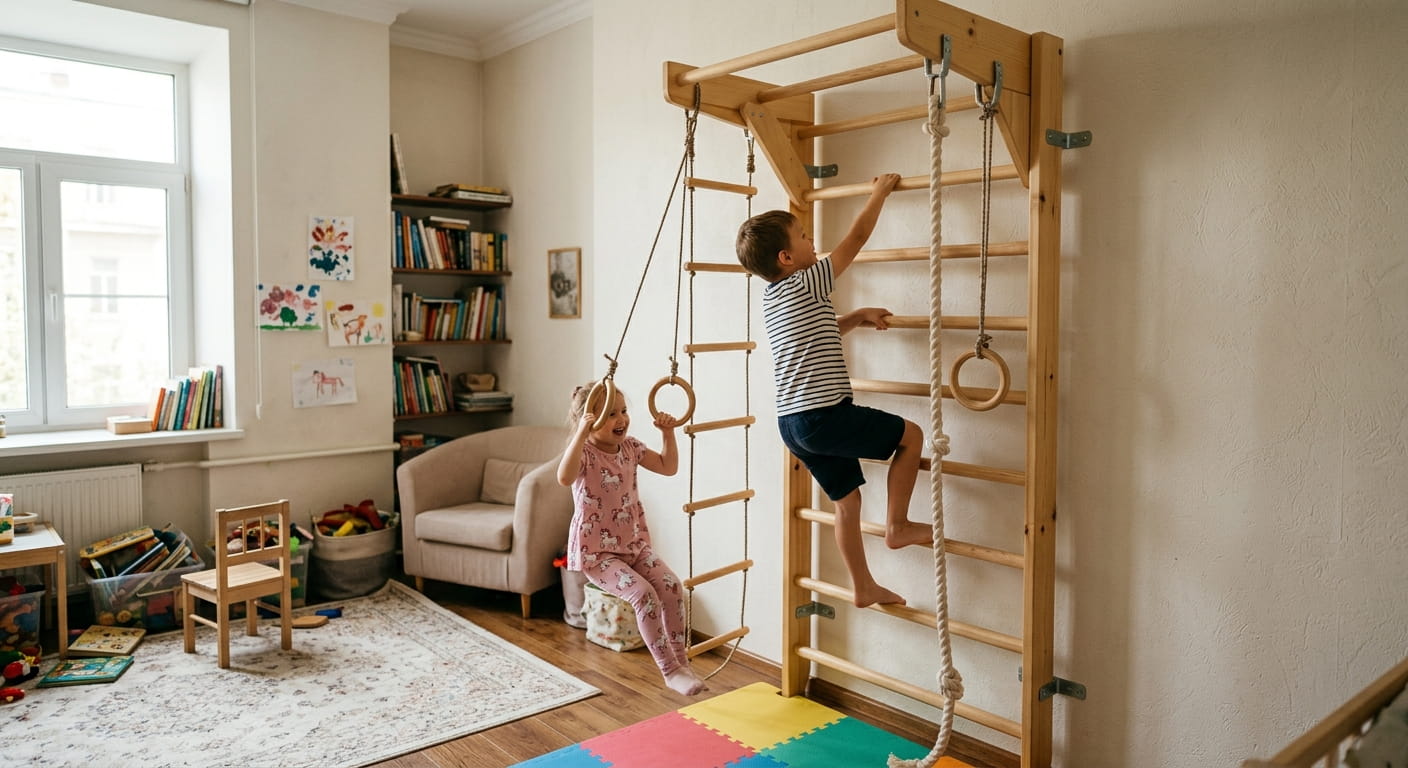
- Removable pull-up bar — for pull-ups and hangs
- Hang-on dip bars — for dips on straight arms
- Folding ab bench — stores compactly under a canopy
- Gymnastic rings — on adjustable straps
- Rope and rope ladder — climbing and coordination
- Resistance bands — warming up the shoulder girdle before the bar
Safe surfacing under the unit outdoors
A fall from the bar or rope onto the bare concrete of the yard is best avoided on principle, for a child and an adult alike. At home a gymnastic mat is laid under such equipment — the same principle carries over outdoors, only the choice of material is wider and depends on the weather. Rubber crumb keeps its shape under rain and does not rot for years; a thick gymnastic mat suits only a covered spot where rain does not wet it and it can be taken in for the night; and ordinary sand is the most budget-friendly, familiar garden option but needs levelling after every rain and topping up now and then.
The rule is simple: the higher the point of hang — the bar, rings on long straps — the thicker the surfacing under the unit should be. For the lower rungs and climbing a thin mat is enough, while for a pull-up bar at full arm's reach it is better to plan 15-20 cm of loose material: the same rubber crumb or sand with good drainage, so rainwater does not pool right under the unit.
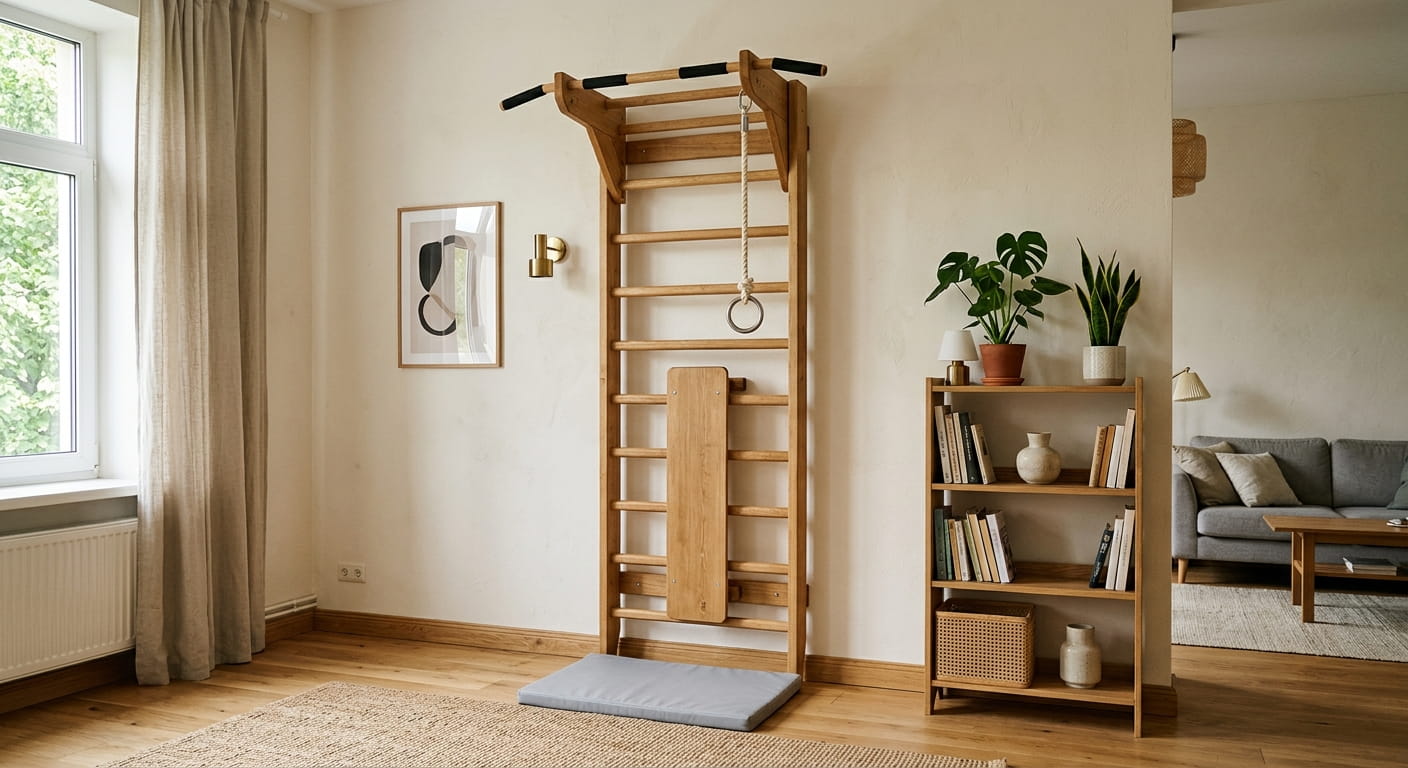
It is also worth planning the area under the climbing elements separately, if the yard has climbing holds or a sloping climbing wall — there the fall trajectory is wider than straight down from the bar, and the mat or crumb should be spread with a margin around the perimeter rather than in one spot under a single grip point.
Climbing wall and climbing elements in the yard
If there is more room in the yard and the scenario calls for not only a hang on the bar but real climbing, climbing holds or a sloping wall are added to the main frame — the vertical structure handles such a side load well, alongside the classic rungs, with no rebuilding of the whole upright. The types of holds, route height by child's age and frame options are covered separately on the wall bars with a climbing wall page — for the yard it is a handy addition to the usual pull-up bar and dip bars.
Comparing outdoor wall bars models
Eight models cover different scenarios — from a budget children's unit to a reinforced strength station. Any of them suits a yard or garden given a load-bearing wall or a rigid support to mount to, but they differ markedly in load, size and add-on set.
| Model | Frame type | Mounting | Load | Price, from, $ |
|---|---|---|---|---|
| Krepysh | I-shaped, narrow pier sections | Wall / pressure | 120-150 kg | from 198 |
| Vershina | I-shaped with a top pull-up bar | Wall / pressure | 120-150 kg | from 187 |
| Vertikal | I-shaped, rigid combined | Combined | 120-150 kg | from 183 |
| Atlet | Reinforced, thick uprights, dip bars + bench | Combined | up to 250 kg | from 202 |
| Minsk Sport | Modular, removable adjustable add-ons | Wall / pressure | 120-150 kg | from 174 |
| Lider | U/T-shaped, sections, net, monkey bars | Wall / pressure | 120-150 kg | from 195 |
| Moy Turnik | Removable adjustable pull-up bar with grips | Wall / pressure | 120-150 kg | from 218 |
| Maugli | Children's, rope/rings/rope ladder | Wall / pressure | 120-150 kg | from 92 |
For a spacious yard and a crowd of active children the "Lider" with its sections and net makes more sense — it is larger in footprint but you can hang almost everything on it at once, from monkey bars to a rope. For a veranda with a limited pier section the "Krepysh" or "Vershina" are more compact — narrower in width, they fit more easily between windows or doorways. If a heavy adult trains in the yard or several people hang on the bar at once, the "Atlet" with its reserve up to 250 kg is worth a look.
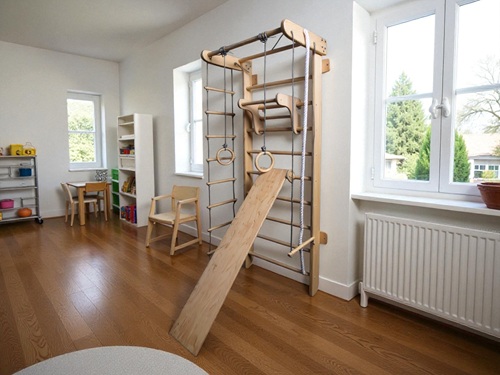
If the aim is not just a yard corner but a full strength workout in the open air, it makes sense to compare with the more specialised sport wall bars, where the emphasis is on the strength fittings and preparing for fitness standards rather than a children's play scenario.
How much load the outdoor frame holds
The standard load for most models is 120-150 kg, enough for an adult, a teenager and even two children at once on different rungs. The reinforced version is rated up to 250 kg — a reserve for when a large adult uses the unit or several people hang on the bar together, which happens far more often in a yard with several children than in a flat with one child at home.
Wall bars take up little space — about 0.2 sq m of footprint, less than the area under an ordinary chair. On a veranda or in a corner of the yard that loss of space is negligible, while the payoff in a working zone for training and climbing is incomparably greater, especially if there is already a sandbox or a swing nearby and the unit logically extends the children's area.
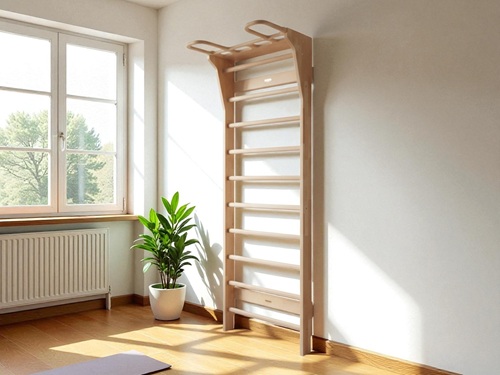
For children and adults: how to combine them on one unit
The difference between children's and adult use is not in the frame itself but in the add-ons and the grip height. A child is more drawn to the lower rungs, the rope, rings on a short strap and the rope ladder. An adult — to the top pull-up bar, dip bars, an ab bench. On a single set of wall bars this combines with no trouble: the removable parts reset in height for a given user in a few minutes.
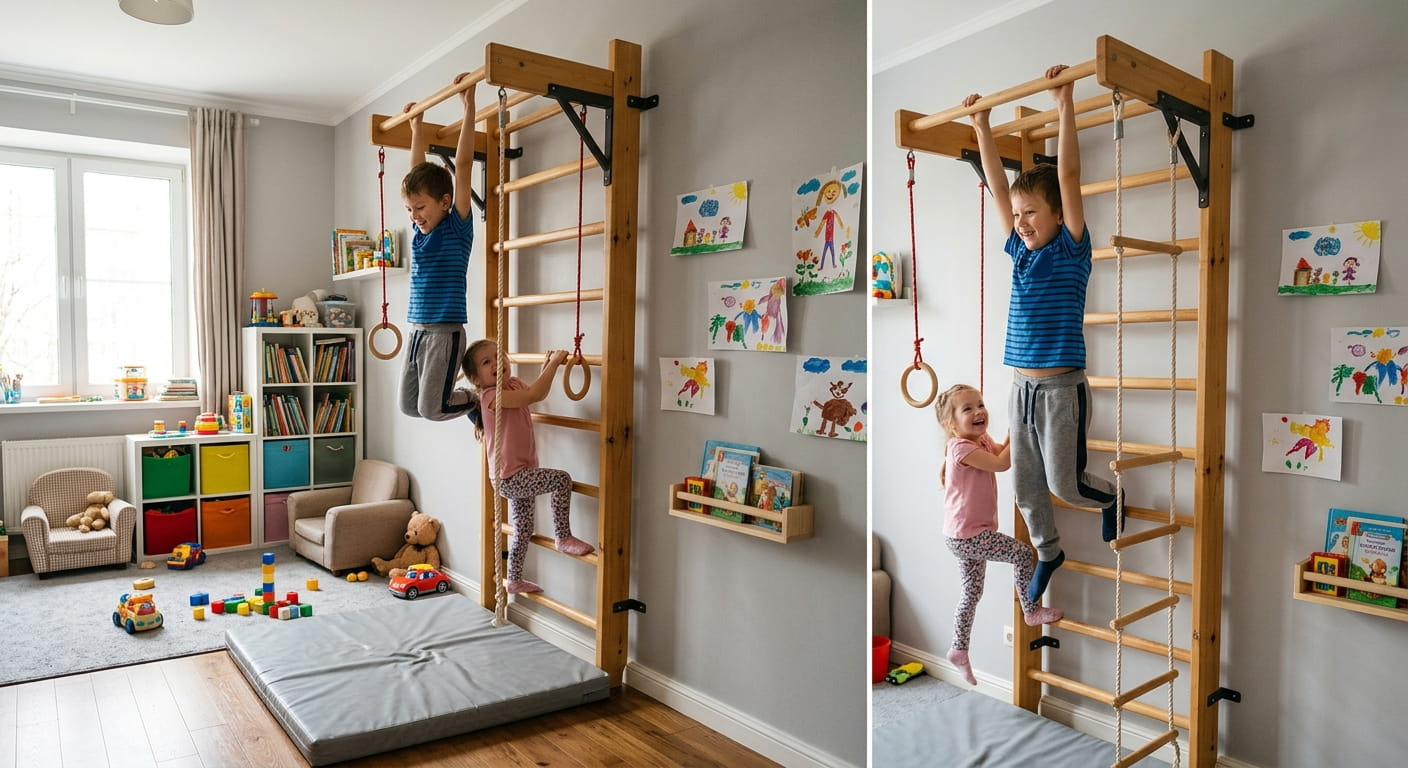
In practice many families keep one unit for exactly two scenarios at once — a child trains on it with neighbourhood friends by day, and in the evening an adult does pull-ups and abs before dinner. If the request is primarily a children's one, it is worth a closer look at models built for that scenario separately — the review on the wall bars for kids page covers the age-related nuances of choosing add-ons and rung heights in more detail.
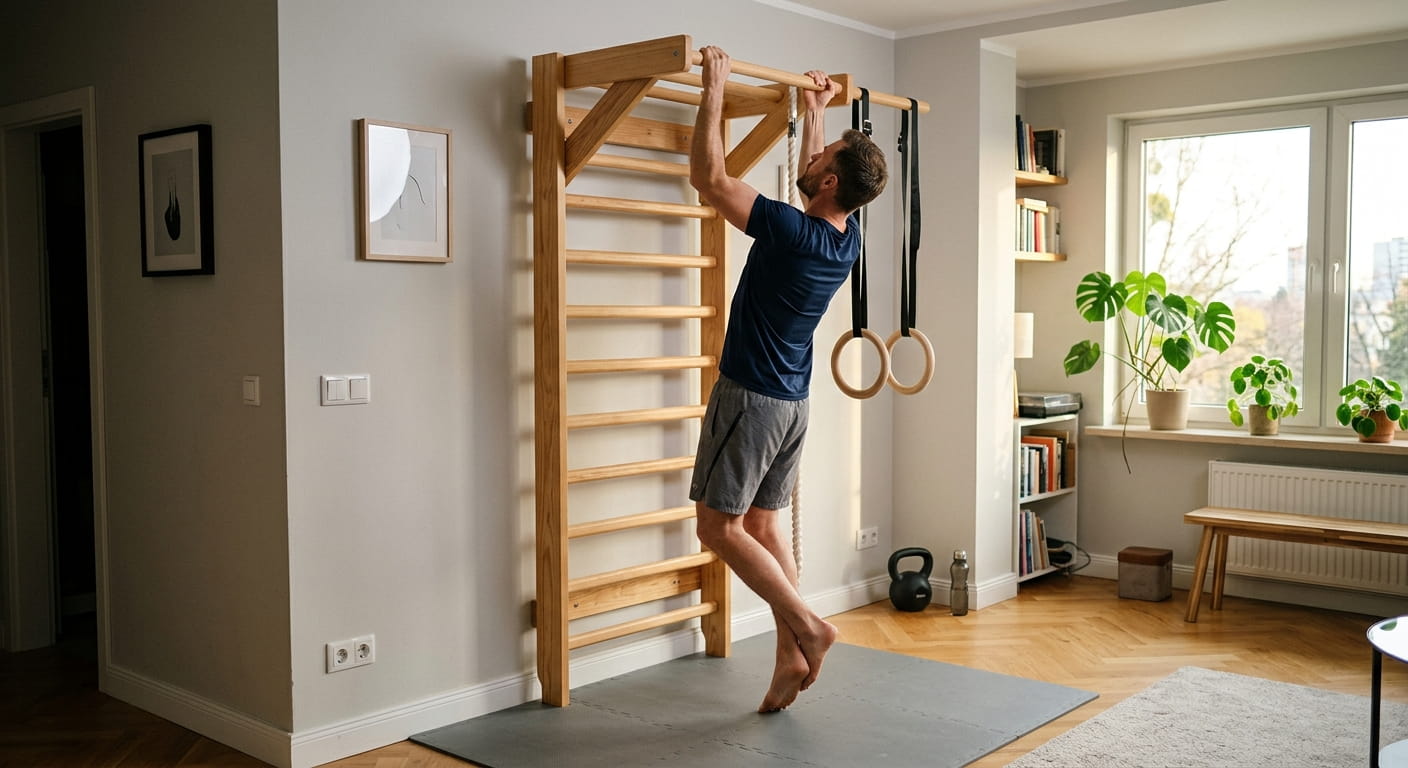
Fresh air
Training outdoors is also screen-free time on the move, which for a child at the garden usually settles the "what to do" question on its own, with no coaxing.
Company at once
In the yard, neighbourhood children and adults usually gather round the unit — one pull-up bar and a rope become a shared playground for several families at once.
Compact
About 0.2 sq m of footprint — the frame does not eat up space on the veranda or in the corner of the yard, already tight with furniture and garden tools.
Sturdy wood
Glued laminated uprights and hard beech and ash on the rungs fear humidity swings less than a solid board.
Seasonality and care: what to take in for winter and what to refresh
The garden is a seasonal affair, and outdoor wall bars live by the same calendar. Part of the work on them has to be done not once at purchase but regularly, year after year — and here it is worth speaking plainly, without gloss: wood outdoors needs more attention than the same wood in a flat behind a double-glazed window.
Textile and rope parts — the rope, rope ladder, gymnastic rings on straps, resistance bands — are best taken down for winter and stored somewhere dry. Frost alone is not that hard on rope, but cycles of soaking and freezing wear the fibre out noticeably faster than the warm climate of a room. The 12-month warranty applies to the add-ons too, but natural wear of rope and textile does not fall under it — that is a consumable under active outdoor use, not a manufacturing defect.
| Period | What to do |
|---|---|
| Spring | Inspection after winter, check bolt tightness, inspect the finish for cracks and refresh lacquer or oil as needed |
| Summer | Monitor the condition of the rope and rope ladder, wipe with a dry or lightly damp cloth, no abrasives |
| Autumn | Take textile and rope parts in for storage, re-check the fasteners before winter |
| Winter | Clear snow and ice from the rungs, store removable add-ons somewhere dry |
Every 3-6 months the bolts on any wall bars are worth tightening — for the outdoor version this is not a box-ticking tip but a real necessity: wood in the open air "breathes" noticeably more with humidity swings, and the fasteners loosen more perceptibly over time than in a dry room. Wipe the frame with a dry or slightly damp cloth, with no abrasives — they strip the top layer of the finish and open the wood to moisture where a protective film used to be.
For the indoor version the advice is usually simple — do not place it by radiators or under direct sun through a window. Outdoors there is no such luxury, as a rule: sun and rain are part of the deal when the unit stands in the yard or on an open veranda. So the only working lever here is not the choice of spot but the regular refreshing of the finish and the monitoring of the fasteners on the calendar above.
To be completely honest: an outdoor finish lowers the risks but does not cancel care entirely. Once every one or two seasons it is worth checking the lacquer or oil film on the rungs and uprights — where it has worn off or cracked, the wood is defenceless against moisture, and it is exactly these spots that start to darken and rot first.
- In autumn, take the rope, rings and rope ladder in for storage
- Check bolt tightness before winter and right after it
- Do not leave snow and ice on the horizontal rungs
- Once a season, inspect the finish for cracks and chips
- Do not place the unit right up against the roof gutter
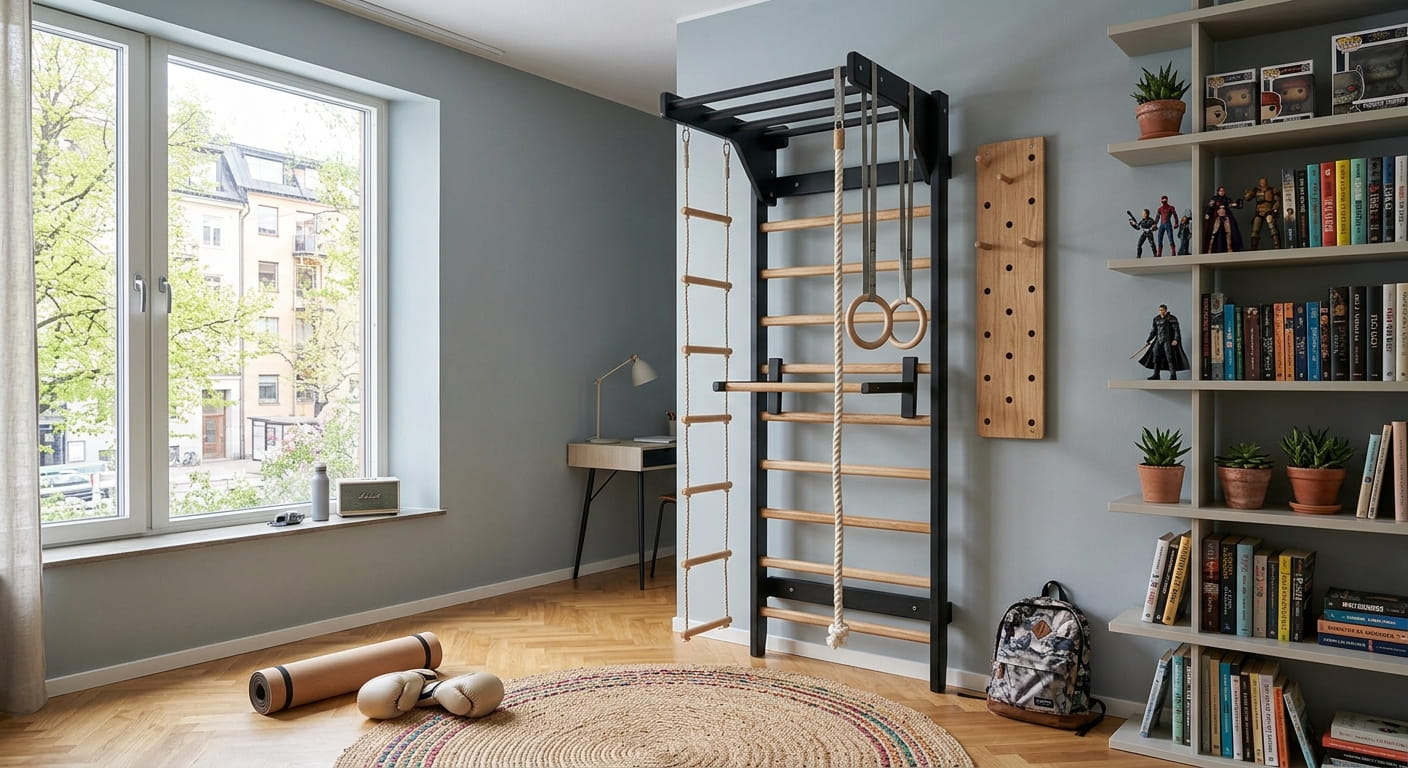
Outdoor wall bars versus indoor: which to choose
In construction and price there is almost no difference — the same eight models, the same glued laminated uprights and hardwood rungs of beech or ash. The difference lies entirely in use: the outdoor version calls for a more attentive care schedule and a readiness to take the add-ons in for winter, but it takes up space in the yard, where for training there is already fresh air and room for a rope or monkey bars at full height, with no ceiling limit.
| Criterion | Outdoor (yard, garden, veranda) | Indoor (flat, house) |
|---|---|---|
| Mounting | House wall, veranda support, combined | Wall, floor-to-ceiling pressure, combined |
| Load on the finish | Rain, sun, temperature swings | Dry indoor air, stable temperature |
| Frequency of care | Inspection each season, finish refreshed every 1-2 seasons | Wiping, bolt check every 3-6 months |
| Textile and rope | Take in for winter, store somewhere dry | May stay in place year-round |
| Footprint | About 0.2 sq m | About 0.2 sq m |
The indoor version is more convenient year-round with no seasonal fuss, but runs up against the ceiling height and the size of the specific room. The outdoor one wins where several people gather in the yard or garden at once — children and adults — and you want to train under the open sky rather than in a corner of the living room between the cupboard and the TV.
There is an in-between option often overlooked: an enclosed, heated veranda is in fact closer in conditions to a flat than to an open yard, and the wood there can be cared for on a gentler schedule — almost as for the indoor version. An unheated veranda, though, even a glazed one, freezes through in winter almost like the outdoors and calls for the same autumn removal of textile parts and spring inspection of the finish.
Practical experience of use in the yard and garden
From the practice of installing on open plots, several recurring points stand out. First — about expectations of the finish: people sometimes count on one layer of lacquer or oil protecting the wood for the whole service life, whereas in fact, on the sunny side of the plot the film dulls within a single season, and that is normal wear, not a defect of the frame. Second — about the fasteners: if the anchor is chosen wrong for the wall type, for example driven into thin cladding instead of load-bearing masonry, loosening happens faster precisely outdoors, where wind vibration and temperature swings add to the usual load from training.
Third — about the textile. A rope ladder or rings forgotten over winter in frost and under snow wear out noticeably faster than if taken into the shed or an enclosed veranda in time. This is the one part of the frame where the owner's seasonal discipline directly affects service life — the uprights and rungs of glued laminated timber and hardwood are more resistant to weather swings than ropes, rings on textile straps and rope ladders.
Delivery, assembly and warranty
Production is our own workshop in Zaslavl, Minsk District, Stroitelnaya Street, 7. Delivery is arranged across the whole country, so a garden plot in any region gets the same kit as a customer in the capital or a regional centre.
Assembly takes 1.5-3 hours; all fasteners and a detailed manual come in the box — there is no need to buy hardware separately. The warranty on the frame is 12 months and on the add-ons also 12 months, except for natural wear of ropes and textile parts — that is expected consumption under active outdoor use, not a manufacturing defect.
For those buying wall bars in bulk — for a holiday camp, a children's camp or a chain of yard playgrounds — wholesale shipment from 10 units is available, with the option of your own trademark and Private Label, and conformity certificates included in the supply. Shipment takes 3-5 working days from stock, made-to-order production 15-35 days, delivery to the carrier's terminal is free, and self-collection from the warehouse in Zaslavl is also available.
How much outdoor wall bars cost and how to choose a model
Prices for the models suited to the garden and yard start from $92 for the children's "Maugli" and reach $218 for the "Moy Turnik" with an adjustable removable pull-up bar and varied grips. The spread is logical: a children's unit with no strength fittings is cheaper than a reinforced station with dip bars and an ab bench.
To make a choice, it helps to answer three questions in advance. First — what wall or support there is for mounting: a solid brick or concrete one suits an anchor, while a timber-framed veranda with a 2.40-3.10 m ceiling suits pressure mounting. Second — who will use it more often: a child — then look towards the rope and rings; an adult — towards the pull-up bar and dip bars; or better, both options at once on one unit with interchangeable add-ons. Third — are you ready to take the add-ons in for winter every year, or is it more convenient to pick a simpler model straight away, with no extra textile and rope parts.
- A load-bearing wall or a veranda ceiling of 2.40-3.10 m for mounting
- The age and weight of the main user — a child or an adult
- Readiness to refresh the finish every 1-2 seasons
- Budget — from $92 for a children's option to $218 for a strength one
- Room for safe surfacing under the unit
Reviews from owners of garden wall bars agree on one thing: a unit standing under the open sky repays the care, if you really keep to the calendar above. A rope ladder forgotten over winter or fasteners left un-serviced for years is almost always the single reason the outdoor version "did not live up to expectations" for a given family. With regular inspection and timely refreshing of the finish, a wooden wall-bar ladder outdoors serves no worse than an indoor one — it simply needs a little more attention to the calendar of seasons than to the manual at assembly.
Sizes between the models do not differ dramatically — all of them are designed for a standard pier section and a narrow footprint of about 0.2 sq m, so the main choice criterion for a yard is not "will it fit" but "what the mounting meets" and "who will use it more often". With those two answers in hand, the model for a garden or veranda is chosen in a single conversation with a manager, without long doubts and repeat measurements.
It is also worth asking the manager about the mix of add-ons for a specific family: for example, the "Vershina" with an integrated top pull-up bar plus separately bought rings on straps covers both an adult's strength workout and a child's climbing activity on one pier section. And for a family with children close in age — an older schoolchild and a preschooler — the modular "Minsk Sport" with removable adjustable add-ons is more convenient, where the height of the bar and dip bars can be changed to the child's height as they grow from season to season.
Expert opinion
Outdoor wall bars are not a separate product category but the very same wooden frame placed in more demanding conditions. The difference is not in the strength of the frame but in the discipline of care: refresh the finish every one or two seasons, take the rope and rings in for winter, check bolt tightness more often than in a flat. Whoever takes this calmly, like ordinary garden upkeep on a par with painting the fence, gets a unit that serves in the yard no worse than the same wall bars in a room.
When choosing a model for outdoors, it is worth starting not from a pretty picture but from two things: what there is for mounting — a load-bearing wall or a covered veranda with a suitable ceiling height — and who will use the unit more often, a child or an adult. The rest, including load and add-on set, the manufacturer has already thought through across eight ready scenarios, from a budget children's unit to a reinforced strength station.
— Veronika Tarasevich, internet marketer, specialist in semantics and content in product niches.