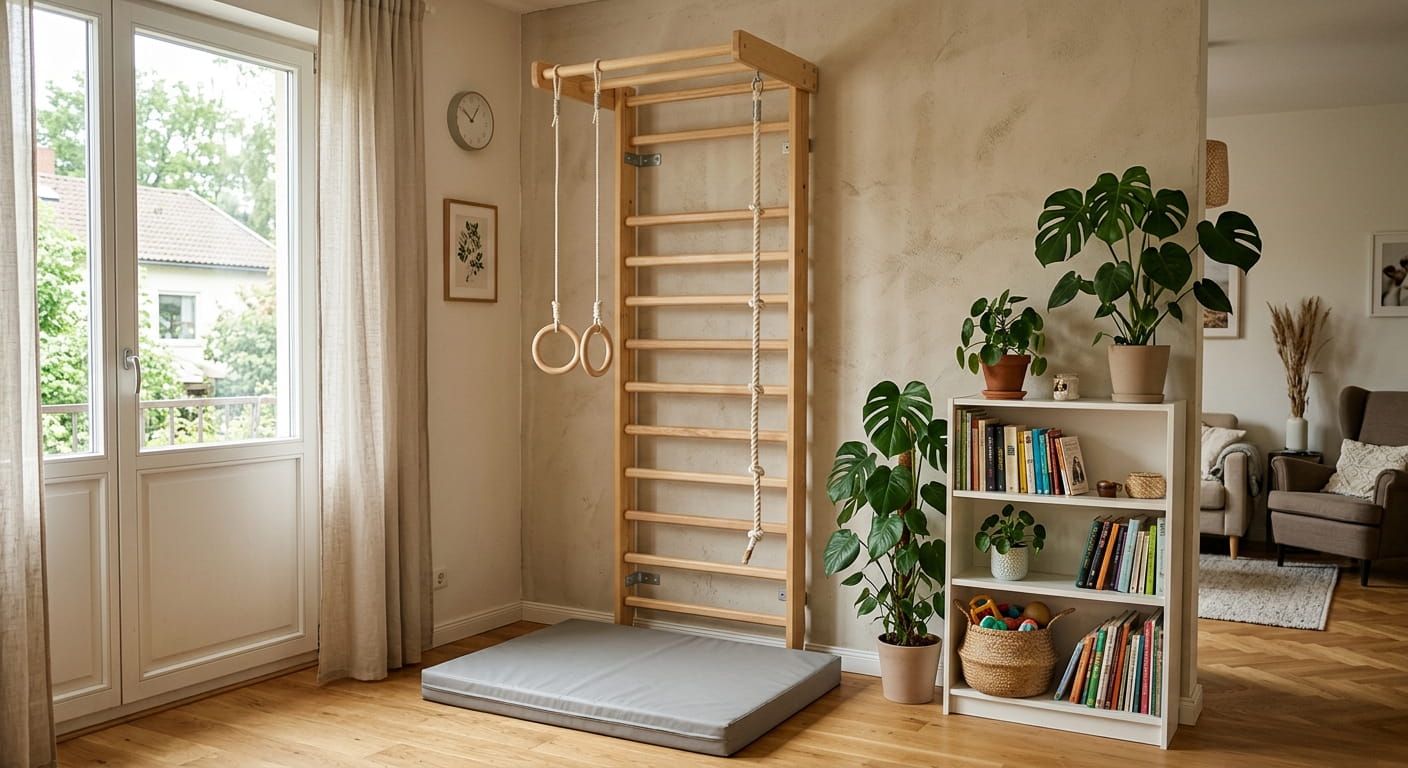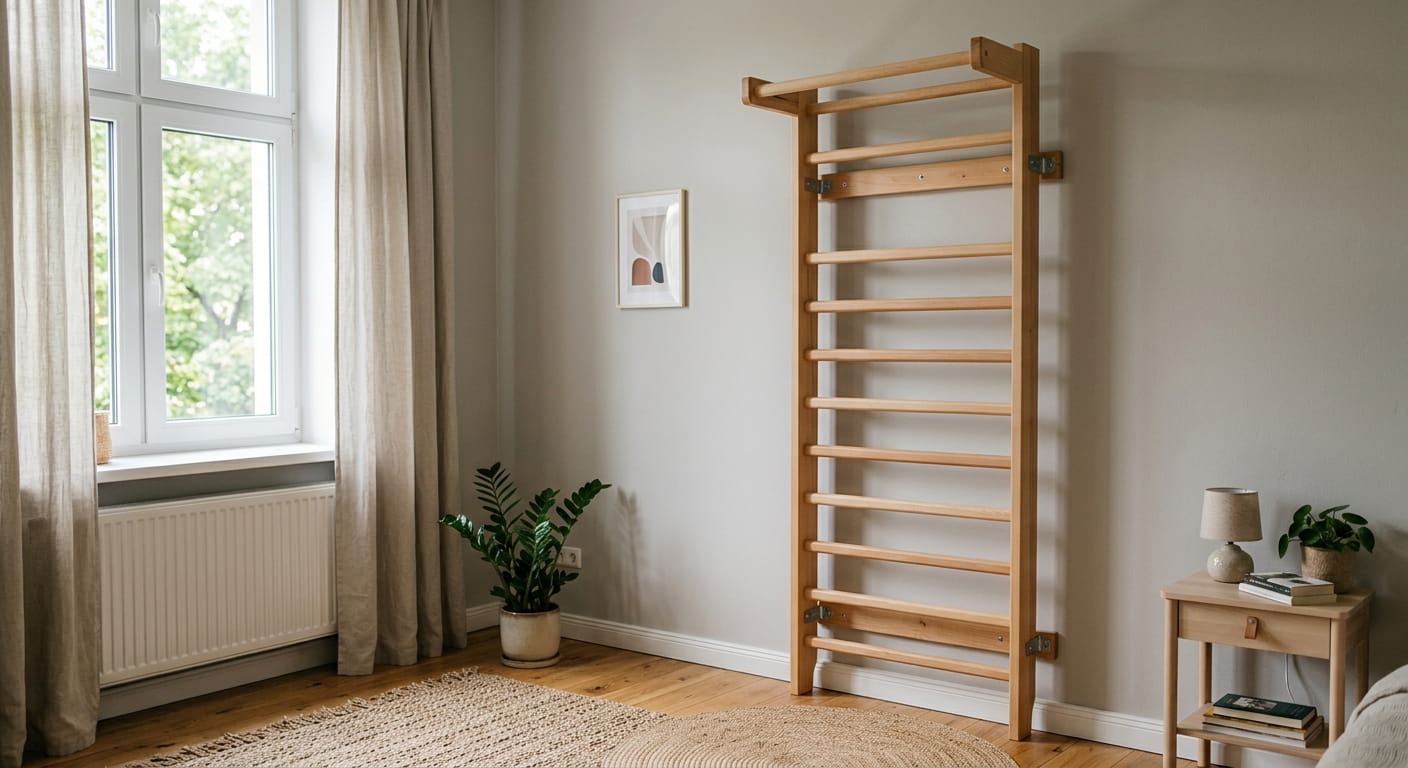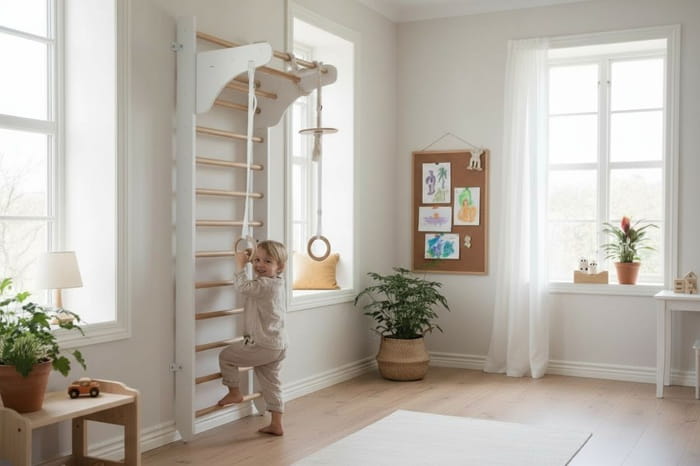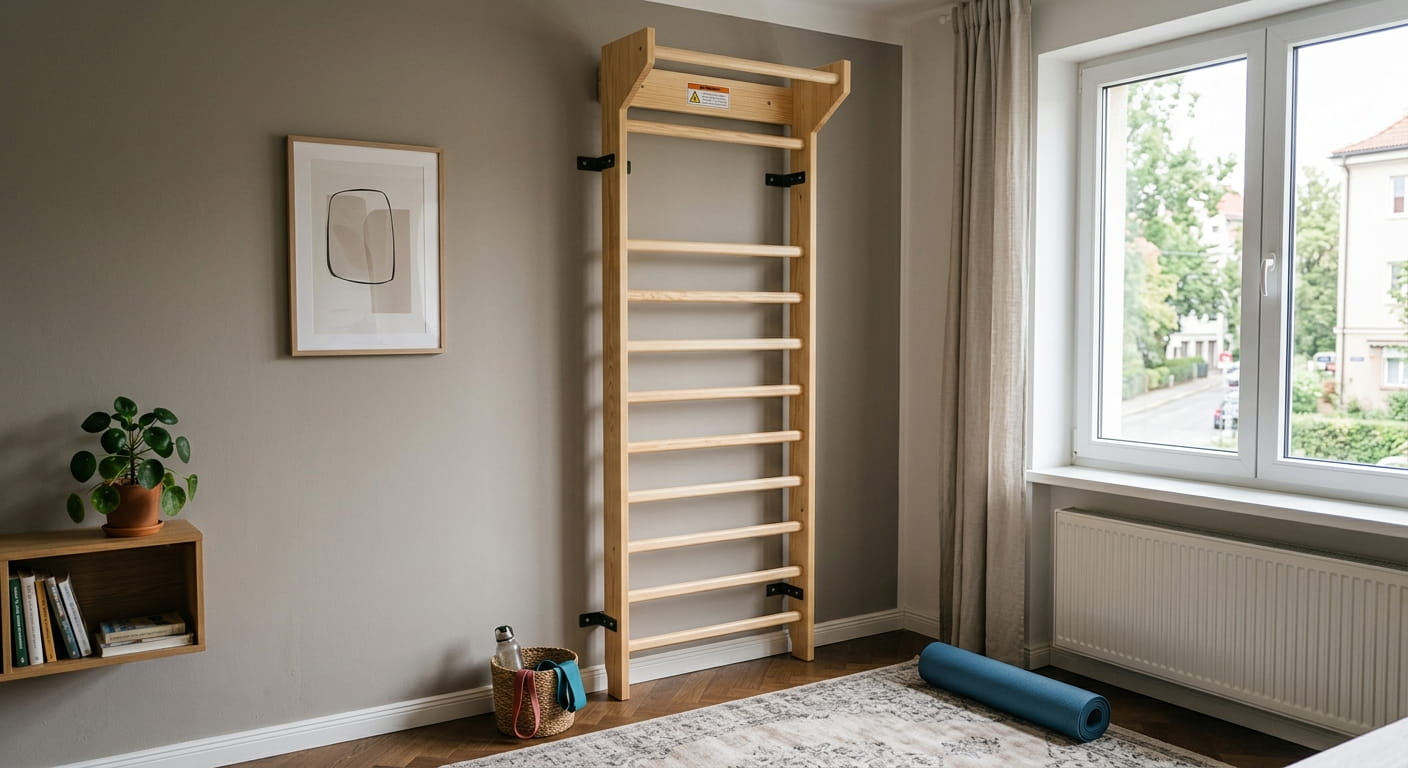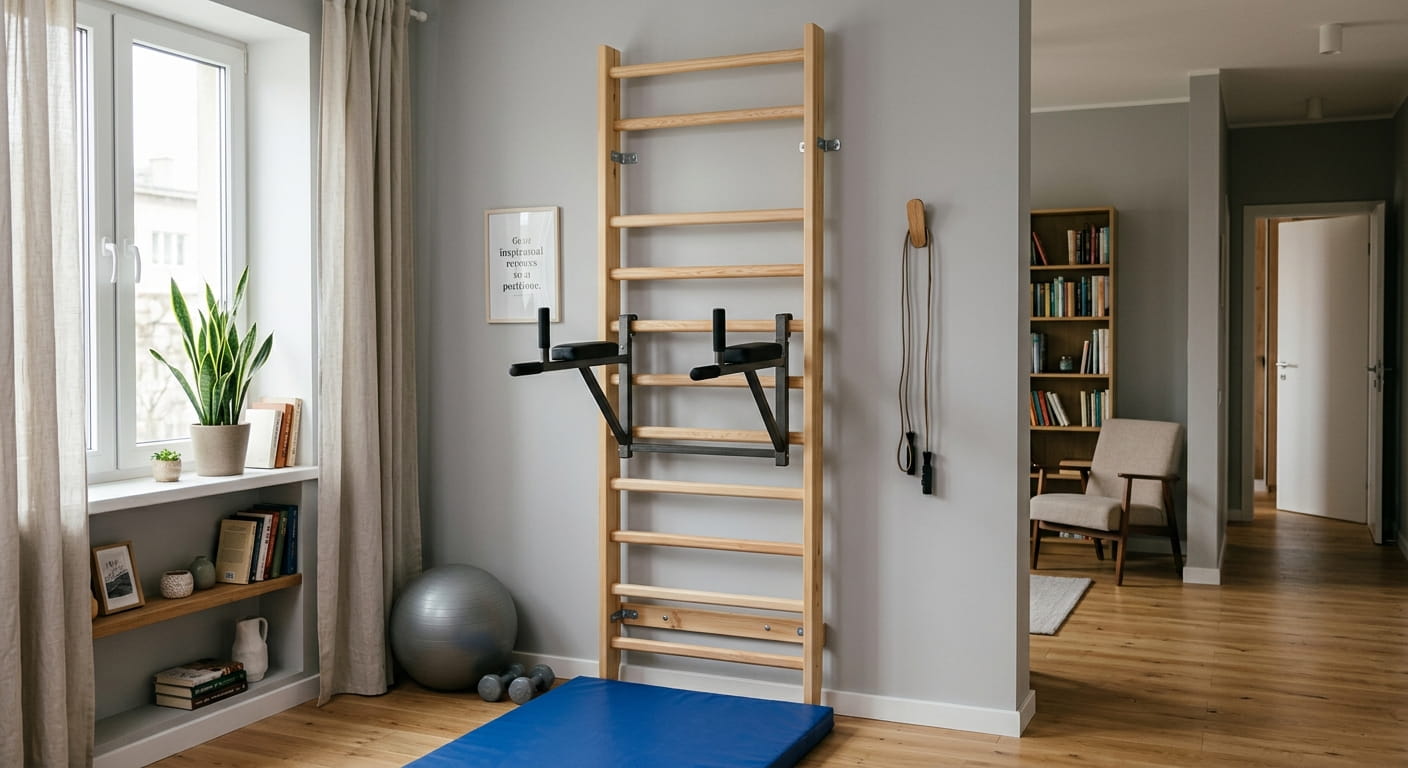
Some sellers stick the word «reinforced» on as a label, but real figures have to back it up. On honest reinforced wall bars the uprights are noticeably thicker and wider than standard, the rungs and hardware are rated for serious weight, and the stated load reaches 250 kg against the usual 120–150 kg of a typical model. Below we break down what the reinforced «Atlet» wall bars are built from, who actually needs them, how they are mounted and how they differ from the ordinary ladder on your neighbour's landing.
A request for a reinforced version usually comes not from a vague wish to be «safer», but from a concrete situation. A father weighing over 100 kg wants to do pull-ups alongside his teenage son. A family with three children expects the unit to stand for fifteen years and outlast every age group. A wrestling coach puts a wall bar in a small studio where a dozen different people hang off a single pull-up bar within an hour. In all these cases a standard frame technically works, but its safety margin is designed for an average user, not for extreme and constant loads.
How reinforced wall bars differ from ordinary ones
The difference starts not with a marketing word but with the cross-section of the timber. On standard models — «Krepysh», «Vershina», «Vertikal» — the uprights are made of glued pine or birch beam sized for a 120–150 kg load with a normal margin. On the «Atlet» model the uprights are thicker and wider: the same glued wood, but a larger cross-section, which directly raises the bending moment the frame can take without sag or creak. The difference is not obvious at a glance — the proportions stay balanced, the wood is finished and tinted the same way — yet by feel and by the weight of the parts, reinforced wall bars are clearly denser.
The second difference is the rungs. The material is the same: hard, dense wood, beech or ash, which does not crumble under load and does not slip in sweaty palms. But the diameter and the way the rungs are fixed in the reinforced version are sized with a margin for intense grips — wide-grip pull-ups, hanging with swing, work with extra weight on a belt.
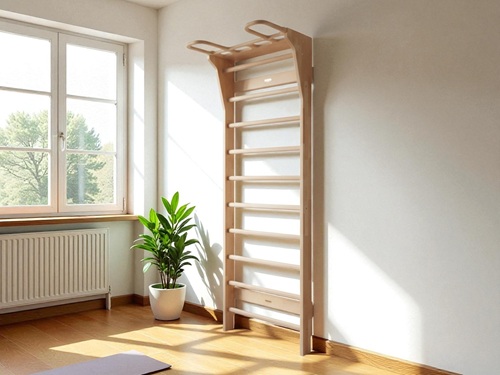
The third is the hardware. Standard models use concealed metal fixings, furniture connectors that hold the rungs firmly in the uprights with no visible heads or burrs. On reinforced wall bars the number and grade of fixing elements are increased — where an ordinary model has one connector, here there may be a joint of two, plus extra reinforcement at the points of peak load: at the base of the uprights and where the dip bars and bench attach.
Thickness and width of the glued uprights — what it changes in practice
Glued beam is stronger than solid timber in itself: several layers of wood are bonded so that the grain compensates for stress, and the structure does not warp with humidity swings in a flat between winter and summer. But with glued beam, as with any material, strength grows faster than the cross-section — increasing the thickness by a quarter gives a markedly larger margin against bending. So the «thicker» uprights are not a cosmetic choice but an engineering calculation aimed at a specific figure of 250 kg.
In practice it feels like this: step onto the lowest rung of the reinforced wall bars with your full weight and rock slightly — the frame stays still, with no vibration up its whole height. On a standard model with a person weighing 130–140 kg a slight give in the uprights is already noticeable, though not critical for the stated load. The reinforced version damps that give through the mass and cross-section of the beam itself.
- The upright cross-section is increased over standard models in the range
- The wider profile gives more area to attach the dip bars and bench at once
- The glued structure keeps its geometry through seasonal humidity swings
- Extra hardware at the load points reduces the risk of loosening over time
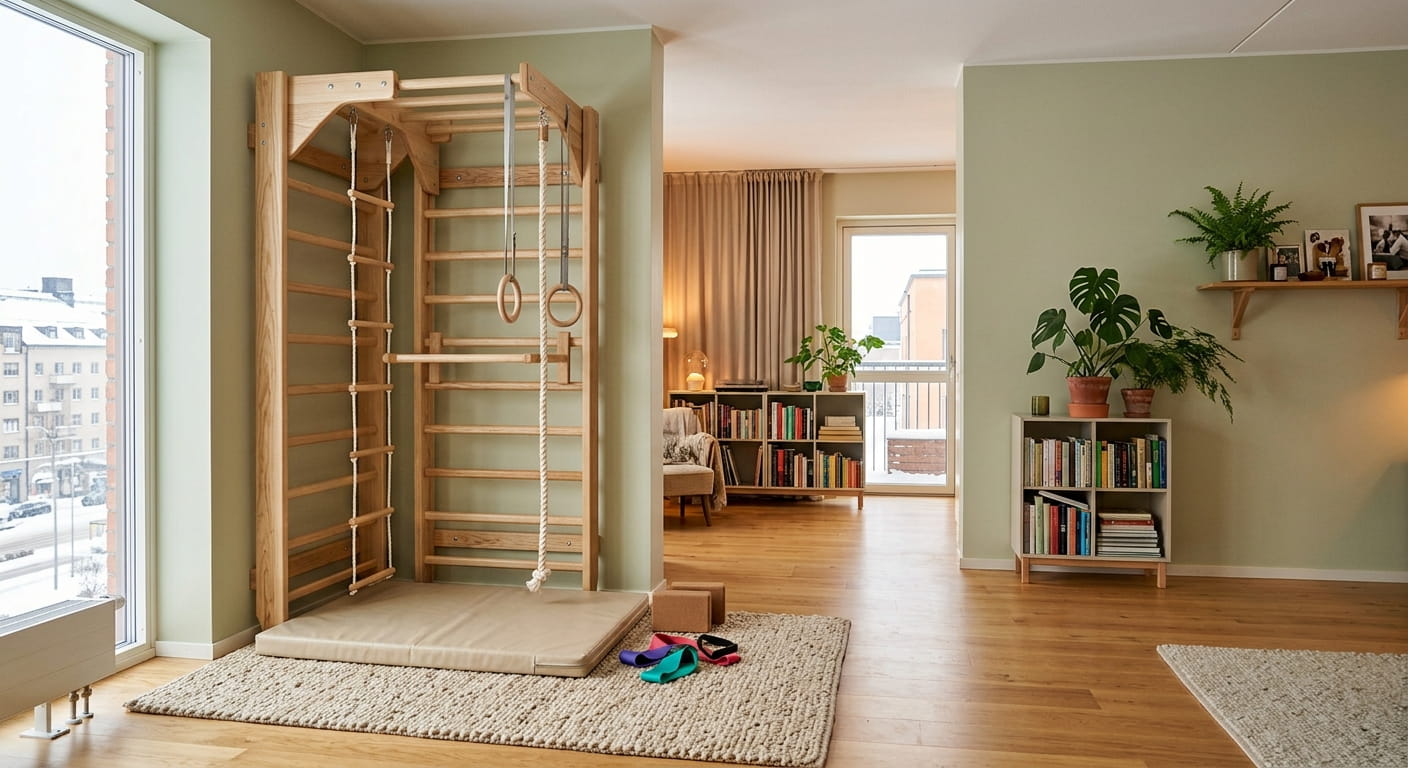
The «Atlet» model: reinforced wall bars for home, gym and an active family
The «Atlet» is the concrete embodiment of all these solutions in a single model. The retail price starts at $202, which is above the basic I-shaped models like the «Krepysh» or «Vertikal», and that price gap is exactly the cost of the larger beam cross-section, the extra hardware and the reinforced set of add-on equipment. In construction the «Atlet» stays a classic ladder: two vertical uprights, a row of rungs, a mount to the wall or a pressure fit — but every joint is designed for an increased load.
The base «Atlet» package includes reinforced dip bars and a folding ab bench — so the buyer does not get a bare ladder but a working strength corner: pull-ups on the rungs, push-ups on the dip bars, crunches on the bench. For a home where one unit should cover several kinds of exercise without a separate machine, that is a real saving of space and money.
The «Atlet» uprights come in natural wood tones — a finish of water-based lacquers and oils does not change the texture of the wood, it only protects it and makes the surface pleasant to the touch. Certified hypoallergenic coatings mean the unit can stand in a nursery or bedroom with no worry about smell or fumes — that applies to every model in the range, but for the reinforced version it matters especially: it more often stands in rooms with intensive use, where the finish is tested for durability every day.
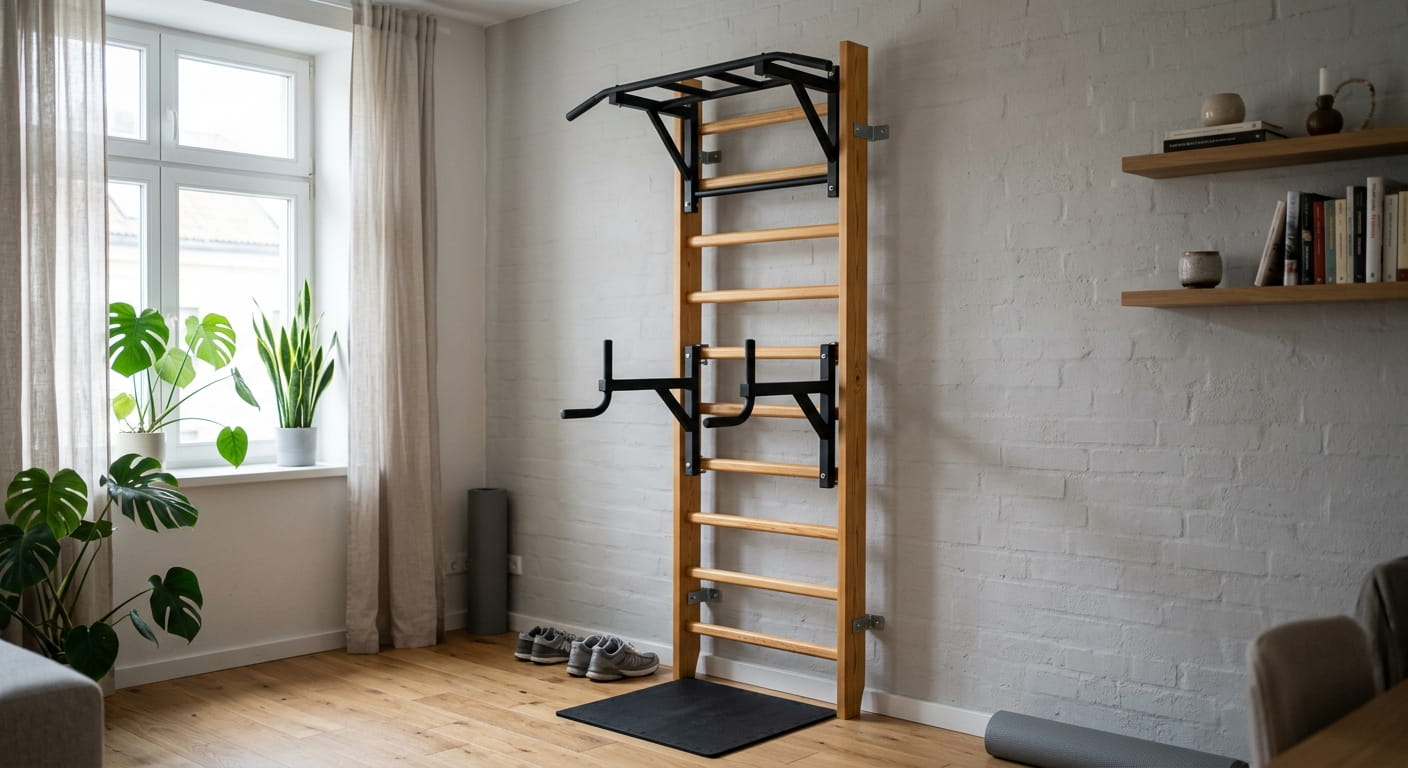
The «Atlet» takes up the same area as a standard wall bar — around 0.2 square metres of floor projection. The larger upright cross-section adds literally a couple of centimetres to the width of the frame, which is almost never critical when choosing where to install it, even in a compact flat.
Who needs reinforced wall bars
The first and most obvious group is people of above-average weight. This is not only about athletes: an ordinary adult man over 185 cm tall often weighs 100–110 kg simply by build, with no excess fat. For such a user a standard load of 120–150 kg leaves too thin a margin, especially once you add dynamics — the jerk of a pull-up, swinging, the weight of a belt plate.
The second group is active families where several people of different weight and age use the unit at the same time or in turns. A child weighs 30 kg today and 80 kg in ten years, and a unit bought once should serve all of that range without replacement. In this sense reinforced wall bars are an investment for years ahead: no need to recalculate whether the frame will hold a grown teenager or a guest who decides to do a pull-up at a gathering.
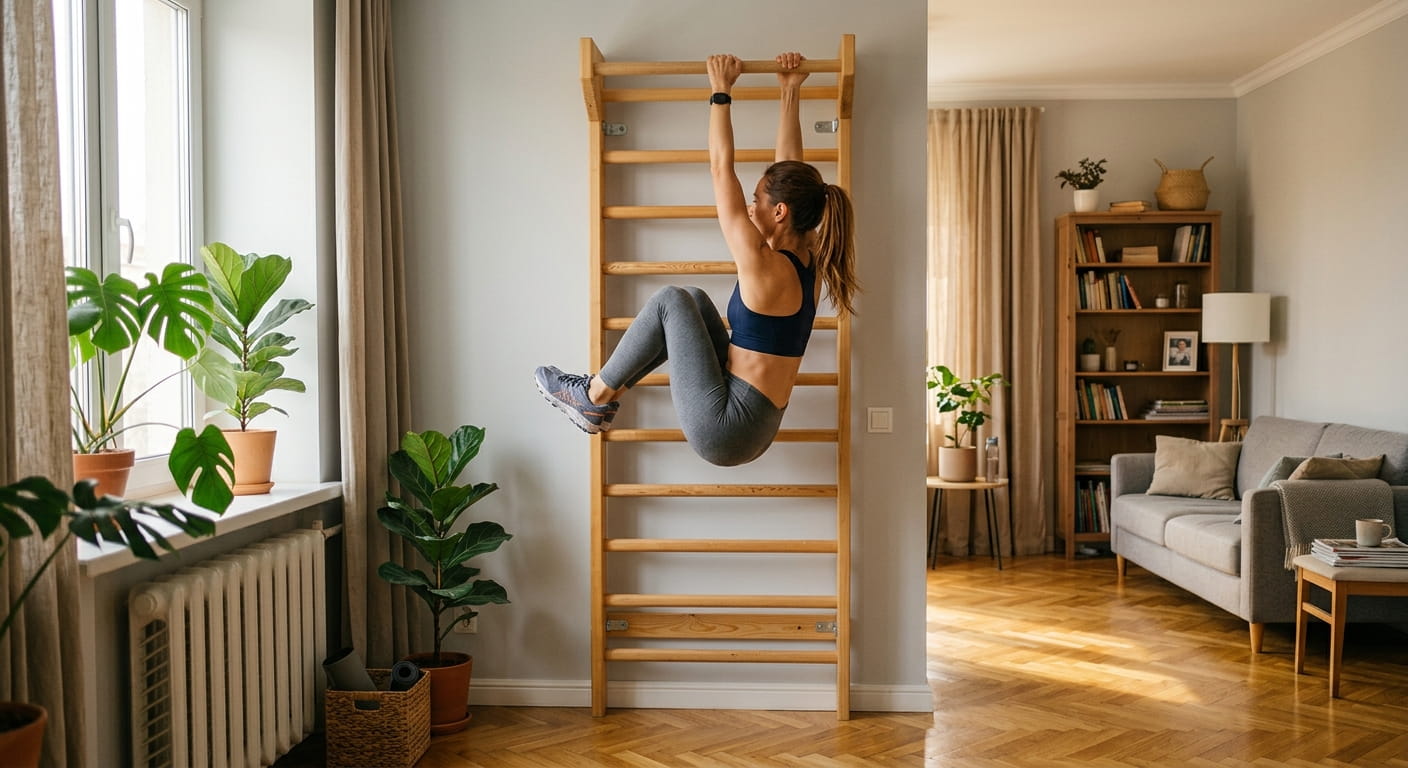
The third group is people with a semi-professional approach to training: those who do street workout, wrestling, strength multi-events and use a home unit not for a light morning stretch but as a full part of a training cycle. For them not only peak load matters, but also the endurance of the frame under repeated daily sets — here the reinforced hardware and thicker uprights work for longevity just as much as for load capacity.
Load up to 250 kg
The stated limit of the reinforced «Atlet» wall bars is almost double the standard range.
For the whole family at once
A single unit covers the needs of both an adult athlete and a growing teenager.
Dip bars and bench included
The reinforced package turns a ladder into a full strength corner.
Combined mount
Wall anchoring plus pressure fit — maximum rigidity with no compromise.
The combined mount: why it is essential for a reinforced model
Standard models usually have a single mount: either wall anchoring or a floor-to-ceiling pressure fit. The wall option is a rigid fixing to a solid wall of concrete or solid brick — the most reliable method, but one that needs drilling and a suitable wall (you cannot mount onto plasterboard like this — the frame would simply tear the fixings out with the cladding). The pressure option is a screw floor-to-ceiling system without drilling, a lifesaver for rented homes and thin partitions, but with a requirement for a ceiling height of roughly 2.40–3.10 m and an absolute ban on stretch or suspended ceilings.
Top models, the «Atlet» among them, use a combined mount — wall anchoring and a pressure brace at the same time. This is not two options to choose from but one system where the load spreads across two independent circuits: the wall holds the horizontal component of the force, the brace the vertical one. At loads up to 250 kg this sharing of forces is not a luxury but a necessity: a single mounting type rated for 150 kg physically cannot give the needed margin with a heavier user or a dynamic load.
The combined mount of reinforced wall bars needs both a solid wall and a suitable ceiling height at the same time. Before ordering it is worth checking with a manager which option fits your particular layout — it saves time during installation.
What not to do with reinforced wall bars during installation
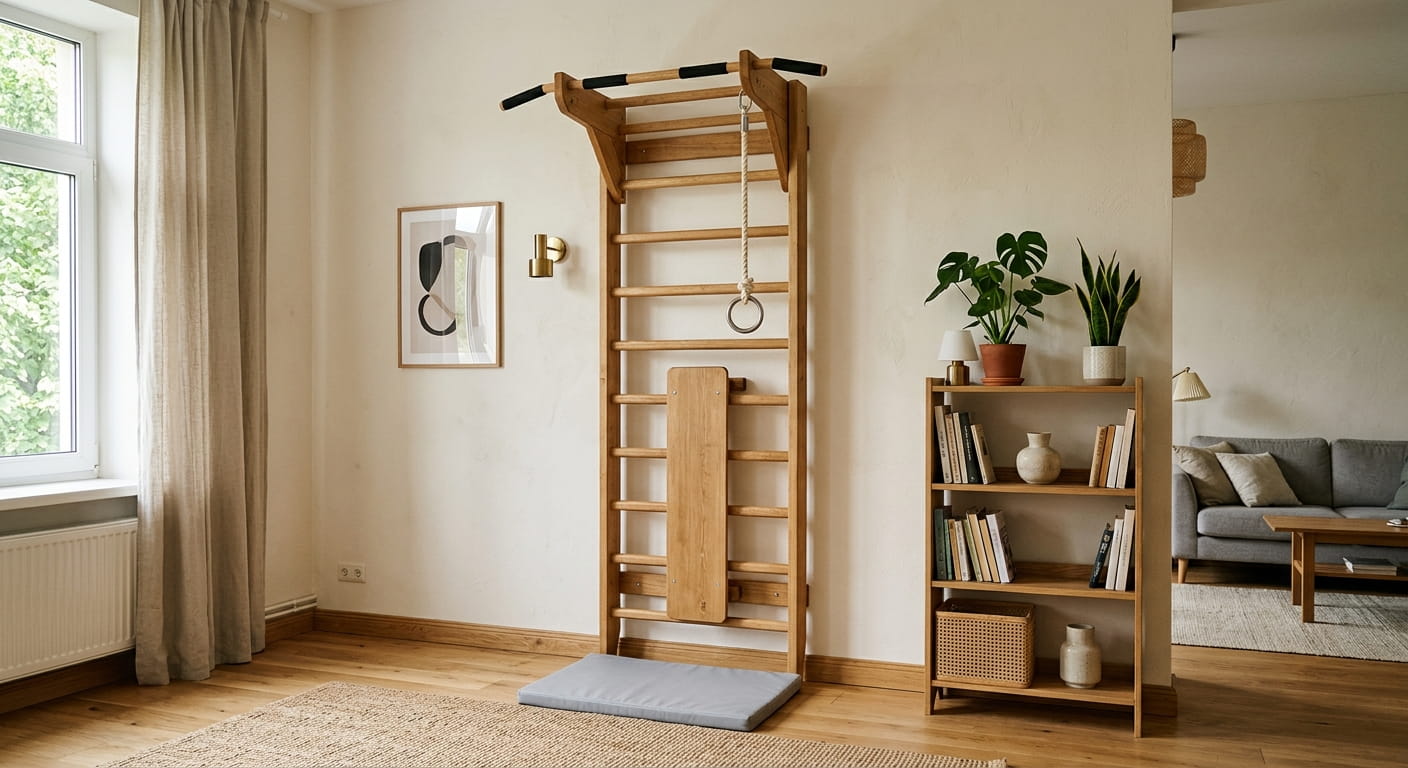
There are three typical mistakes that undo all the engineering of a reinforced frame. The first is mounting to a plasterboard partition without reaching a solid wall: even the thickest uprights will not help if the screw holds in a 12.5 mm plasterboard sheet rather than in concrete. The second is setting the pressure joint under a stretch or suspended ceiling: the screw brace must bear against a rigid slab, not against a decorative membrane that simply gives way. The third is skimping on hardware tightening during assembly: even a reinforced joint needs the control torque given in the instructions, not a «by eye» guess.
- Check the wall material — concrete or solid brick for anchor mounting
- Measure the ceiling height — 2.40–3.10 m for the pressure joint
- Make sure the ceiling is not stretch or suspended at the brace point
- Tighten all hardware to the instructions, and re-check after the first week of use
One more practical point: when choosing a reinforced model, parents often ask whether the frame will be «too grown-up» for the younger children in the family. The straight answer is no. Thicker uprights and reinforced rungs in no way stop a child hanging, doing an assisted pull-up or climbing the lower sections; the grip diameter stays the same as on a standard model, while the safety margin for the future is already built in.
Materials and safety margin of the reinforced model
The wood for the uprights is glued pine or birch beam — the same principle as across the range, but with a larger cross-section. Pine gives lightness and good springiness, birch a denser structure and slightly better surface wear resistance; both species go through the same kiln drying before gluing, which rules out later cracking from humidity swings in a flat.
The rungs and dip bars are dense hardwood, beech or ash. These species are no accident: with pine or birch the rung diameter would have to be made noticeably thicker at equal strength, which is awkward for the grip. Beech and ash keep a comfortable diameter of 28–32 mm under a high bending and breaking load, which matters especially in the reinforced version, where the pull-up rungs and dip bars work at the edge of their range.
| Parameter | Standard model | Reinforced «Atlet» model |
|---|---|---|
| Maximum load | 120–150 kg | up to 250 kg |
| Upright cross-section | standard glued beam | increased, thicker and wider |
| Rung material | beech/ash | beech/ash, reinforced fixing |
| Joint hardware | concealed metal, basic | reinforced, doubled at joints |
| Mounting type | wall or pressure | combined wall + pressure |
| Package | chosen separately | dip bars and bench included |
| Footprint | ~0.2 sq m | ~0.2 sq m |
| Retail price | from $183 | from $202 |
| Warranty | 12 months | 12 months |
The finish is water-based lacquers and oils, certified and hypoallergenic. Here the reinforced model is no different from the rest of the range: the formula is chosen so that it gives off no smell or harmful fumes even during long use in a closed room, while the surface stays pleasant to the touch and does not slip under sweaty palms.
How much space reinforced wall bars need
By floor projection the reinforced model is almost no different from a standard one — about 0.2 square metres, that is, roughly a strip 90–100 cm wide along the wall. The larger upright cross-section adds literally a few centimetres to the overall width, which in practice is only noticeable with furniture packed very tightly against it.
Far more important is the space in front of the unit — at least a metre and a half of clear zone for leg swings, pull-ups with swing and dip-bar work without the risk of hitting furniture. If you plan to add an ab bench separately from the main frame, set aside room for it too — unfolded it projects another 60–80 cm forward.
The «Atlet» within the wall bar range — what it is compared with most often
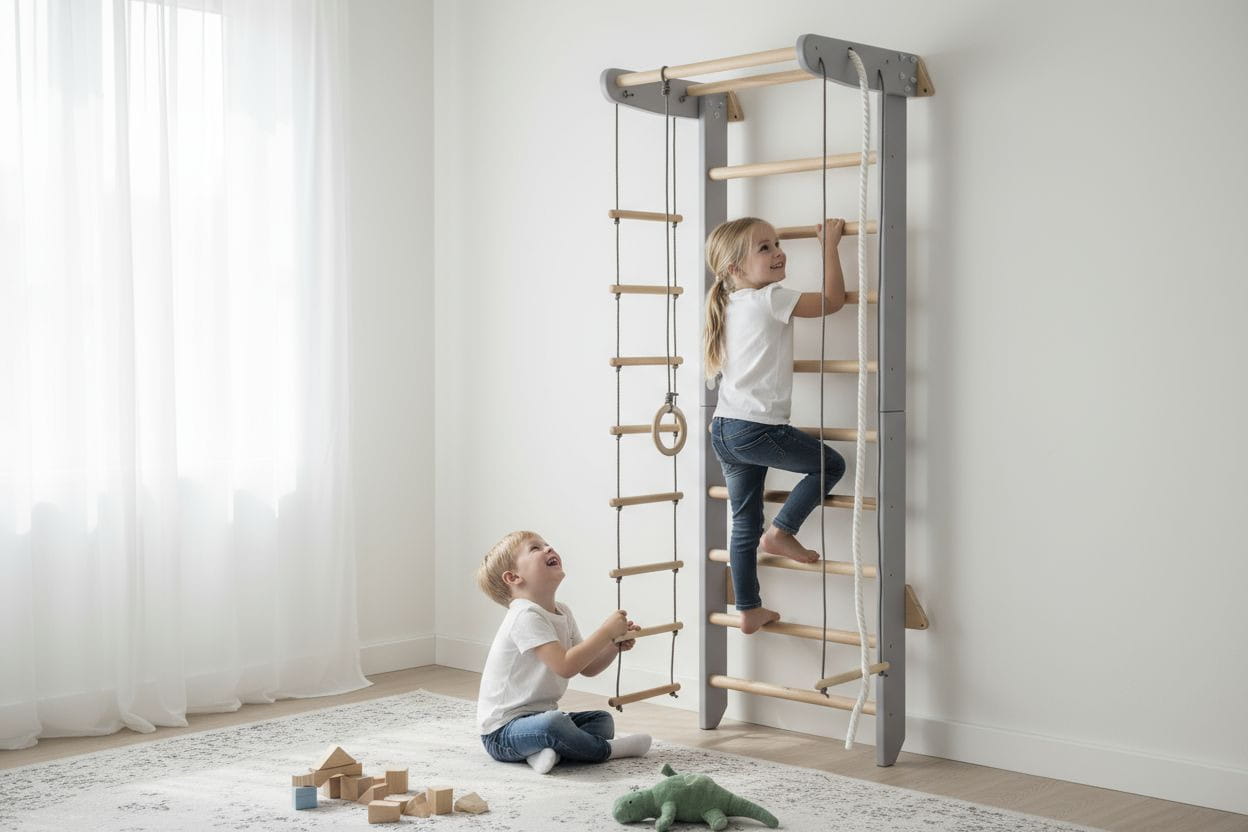
The full range of our own wooden wall bars includes eight models, and the «Atlet» holds a distinct niche — not the cheapest option, but the only one with a stated load up to 250 kg. The other models solve different tasks: the «Krepysh» is a compact basic ladder for narrow wall gaps, the «Vershina» an I-shaped frame with a built-in top pull-up bar, the «Vertikal» a rigid version with a combined mount at standard load, the «Minsk Sport» a modular system with removable adjustable add-on equipment, the «Lider» a U- or T-shaped frame with sections, a climbing net and monkey bars, the «Moy Turnik» a model focused on the upper body with a removable pull-up bar offering different grips, and the «Maugli» a children's set with a rope, rings and a rope ladder.
| Model | Frame type | Load | Price from |
|---|---|---|---|
| Krepysh | basic I-shaped, narrow wall gaps | 120–150 kg | $198 |
| Vershina | I-shaped with an integrated pull-up bar | 120–150 kg | $187 |
| Vertikal | I-shaped, rigid combined mount | 120–150 kg | $183 |
| Atlet | reinforced, thick uprights, dip bars and bench | up to 250 kg | $202 |
| Minsk Sport | modular, removable adjustable add-ons | 120–150 kg | $174 |
| Lider | U/T-shaped, sections, net, monkey bars | 120–150 kg | $195 |
| Moy Turnik | removable adjustable pull-up bar with grips | 120–150 kg | $218 |
| Maugli | children's, rope, rings, rope ladder | rated for a child's weight | $92 |
The main point is clear from this table: the reinforced «Atlet» wall bars are neither the cheapest nor the dearest position in the range, but the only one where load capacity is a distinct specification rather than a default. Compared by the ratio of price to stated load, the «Atlet» beats similarly priced models like the «Lider» or «Moy Turnik» on exactly this parameter, though those models have their own strengths — the net and monkey bars on the «Lider», the variety of grips on the «Moy Turnik».
Bench testing: how the strength of reinforced wall bars is verified
Before a model reaches the production line, the frame goes through load testing at our own workshop. The idea is simple: the stated figure of 250 kg is not taken from the beam supplier's catalogue but confirmed by static and dynamic loading of a finished joint — an upright with rungs fixed, the dip-bar attachment point, the folding bench mechanism.
In practice the test looks like a series of consecutive loadings of the same joint. First the upright is loaded with a static weight one and a half times the stated limit and held for a control period, recording whether the beam returns to its original position after the load is removed with no residual sag. Then the same joint is run through cyclic loadings — hundreds of repeats of hanging and releasing weight that simulate months of daily pull-ups in a few hours of bench testing. If the hardware starts to loosen faster than the norm at this stage, the joint is reworked before going into production, not after the first customer complaints.
Static testing is hanging a weight that is a multiple of the stated load for a control period, to track residual deformation of the beam and hardware. Dynamic testing simulates real use: jerk loading, swinging, repeated cycles of loading and release that reproduce months of real use in a short time. Joints that show unacceptable play or deformation are reworked at the design stage, not after complaints.
The folding bench mechanism is checked separately — it is loaded not only with the weight of the seated person but also allowing for the jerk load of a sharp sit-up on crunches: this is the most mechanically stressed joint in the whole reinforced set, because the folding hinge works in bending more often than a static upright.
Reinforced wall bars vs standard: when the extra cost pays off
The retail gap between a basic model and the «Atlet» is about $20 compared with the «Vertikal», and noticeably more compared with the cheapest position in the range. The question is whether that gap pays off for a particular family or studio.
If the home has only children up to 10–12 and adults of average build, and the unit is meant for calm use — stretching, light hangs and morning exercise — a standard model is quite enough, and the extra cost of the reinforced version brings no tangible practical benefit. It is another matter if at least one future user weighs over 100 kg, if weighted strength training is planned, if the unit is meant for teenagers who will put on adult weight within a few years, or if the wall bars stand in a high-traffic room — a training corner in a block of flats, a sports class, a small martial-arts studio.
A separate scenario is buying «for the future» with decades in mind. Children grow, guests drop by, someone's weight changes from year to year — a reinforced frame removes the need to recalculate the permissible load every time the mix of users changes. Given that sport wall bars are usually bought once for many years rather than replaced each season, a $20–30 difference up front often turns out to be sensible insurance.
Three questions to ask yourself before choosing a reinforced model
First — what will be the maximum weight of the unit's users in five to ten years, not just now. Second — how intensive the use will be: a few minutes a day, or full strength training with extra weight. Third — whether the unit stands in a high-traffic room where different people, including guests and the children's friends, will train on it.
Reinforced wall bars do not cancel the basic safety rules: a mat under the unit, regular checks on hardware tightness and supervision of children at height stay mandatory regardless of the frame's stated load capacity.
Add-on equipment for reinforced wall bars
The «Atlet» package includes reinforced dip bars and a folding ab bench — that is the base. But the add-on range does not end there: for reinforced wall bars you can add a removable pull-up bar, gymnastic rings, a rope and a rope ladder, expanders for extra strength load. All of these attach to the same reinforced uprights and fixing points, which give a safety margin for the add-on equipment too, not only for the main ladder.
A removable pull-up bar is handy where the mix of trainers changes: today an adult does pull-ups, tomorrow a child hangs on the rings lower down. Hanging dip bars on the reinforced frame take the load of push-ups and triceps work without the swing that happens on lighter frames during sharp movements. The folding bench is stowed away when not in use and does not permanently occupy room space — relevant for flats where every square metre counts.
Gymnastic rings and a rope are more often chosen by families with school-age children — these elements develop coordination and grip without impact load on the joints. On the reinforced frame the mounts for rings and rope are fitted at the same points rated for up to 250 kg, so even an adult swinging actively on the rings poses no risk to the fixing joint.
For anyone looking for a unit focused on the upper body and dip-bar work at once, it makes sense to look at the wall bars with a pull-up bar and dip bars — a separate category in the range where the pull-up bar and dip bars are built into the frame from the start rather than bought separately.
Where reinforced wall bars are installed most often
A home training corner is the most common scenario. Usually that means a living room or bedroom in a flat where a family wants one unit for everyone instead of a separate pull-up bar for the adult and a light sports frame for the child. The reinforced version covers both cases at once: while the teenager grows, the frame needs no replacement, and the adult can train on the same dip bars with no worry about the safety margin.
The second scenario is a country house or cottage, where a whole room or veranda is often set aside for a sports corner. There reinforced wall bars are frequently installed not alone but together with extra add-on equipment — rings, rope, expanders — turning a corner of the room into a full mini-arena for the whole family, guests at the weekend included.
The third scenario is small sports clubs and martial-arts studios, where a single unit is used in a session not by two or three people but by a dozen of different weight and fitness level. Here a reinforced model is not a whim but a necessity: the intensity of use is such that a standard safety margin wears out noticeably faster.
Installing reinforced wall bars: timing and what comes in the kit
Assembly takes from one and a half to three hours — the same figure for a standard and a reinforced model, because the assembly principle is identical; the only difference is the weight and cross-section of the parts. The kit always includes detailed instructions and all the hardware needed; nothing extra has to be bought for a standard installation.
The usual order of work is this: first the spot is marked out on the wall or between floor and ceiling, then the uprights are assembled with the rungs already fixed (or the rungs are fitted in place, depending on the model), after which the frame is anchored to the wall and the pressure joint is tightened at the same time, if the mount is combined. The dip bars, bench and extra equipment are fitted last.
For a combined mount it is important to keep the sequence: first fix the anchor part rigidly to the solid wall, and only then align and tighten the screw pressure brace to the ceiling. Do it the other way round and there is a risk the upright will not be exactly vertical, and the anchor holes in the wall will not match the actual position of the frame.
- Mark out the wall and ceiling to the instructions in the kit
- Assemble the uprights and do a trial fit before drilling
- Fix the anchor part to the solid wall
- Tighten the floor-to-ceiling pressure joint
- Fit the dip bars, bench and add-on equipment
- Do a final check on the tightness of all connections
Caring for reinforced wall bars
Care is no different from the rest of the range, but with more intensive use it is worth checking the joints a little more often. The basic rules are simple: wipe with a dry or slightly damp cloth without abrasives, do not put the frame in direct sunlight or near radiators — temperature swings and dry air dry out the wood and finish over time more than a stable room climate does.
It is recommended to check the tightness of bolts and fixing joints once every three to six months, and with active use of the reinforced model closer to the lower end of the interval, that is, once a quarter. A sports mat should be kept under the unit — it protects the floor from load during jumps and lowers the risk of injury in case of an accidental slip off a rung.
Textile and rope elements of the add-on equipment — rope, rope ladder, expander loops — wear out faster than wood and metal by nature; this is not a manufacturing defect but the normal service life of the material under regular use. The warranty covers the add-on equipment just as it does the main frame, but natural wear of textile and rope is not included.
| Action | Frequency |
|---|---|
| Checking hardware tightness | every 3 months under active load |
| Wiping with a dry/damp cloth | as it gets dirty |
| Inspecting textile elements of the add-on equipment | every 1–2 months |
| Checking the pressure joint (if combined mount) | every 3–6 months |
Warranty and ordering the reinforced «Atlet» wall bars
The warranty on the reinforced model is 12 months, add-on equipment included, except for natural wear of ropes and textile elements. Production is in Belarus, in Zaslavl, Minsk District, at 7 Stroitelnaya Street — our own workshop, not a resale of ready kits, so if a defect is found the parts are replaced directly by the manufacturer, with no middlemen.
Delivery is arranged across Belarus. For those looking for a model specifically for an adult user of increased weight, it also makes sense to look at the wall bars for adults — there the range's models aimed at exactly this audience are gathered, the reinforced «Atlet» included.
Before ordering, a manager helps choose not only the model but also the mounting type for your particular wall and ceiling height in a flat or house — this matters especially for the reinforced version with its combined mount, where a mistake in measurements costs more than on models with a single fixing type. If the plan is not just a pull-up bar and ladder but a full strength corner with extra equipment, it is worth checking with a manager which wall-bars exercise machine will fit the set without needless extra purchases.
The bottom line is simple: reinforced wall bars are not a universal «just in case» choice but a deliberate decision based on specific weight, load intensity and family make-up. Where a standard model copes without strain, the extra cost makes no sense. Where the users' weight is above average and the unit is meant to be used hard for years, the price gap pays off in peace of mind about the frame's strength at every approach to the bar.
Expert opinion
Over years of working with our own wooden wall bars we see one pattern: buyers rarely err on the side of excess strength, but they often underestimate the weight of future users over a five-to-ten-year horizon. The reinforced «Atlet» model exists precisely for the cases where that horizon is already visible — a growing teenager, an adult man over 100 kg, active training with extra weight. Thick glued uprights, reinforced dip bars and a bench, a combined mount — this is not a marketing set of words but a combination of solutions, each of which removes a specific risk in use.
If you are torn between the standard and reinforced versions, take your bearings not from the present moment but from the heaviest person who could potentially step onto the rung over the whole service life of the unit. The price gap between the ranges is incomparable to the cost of replacing the frame or, more importantly, to the risks of an underestimated load.
— Veronika Tarasevich, internet marketer, specialist in semantics and content for product niches.