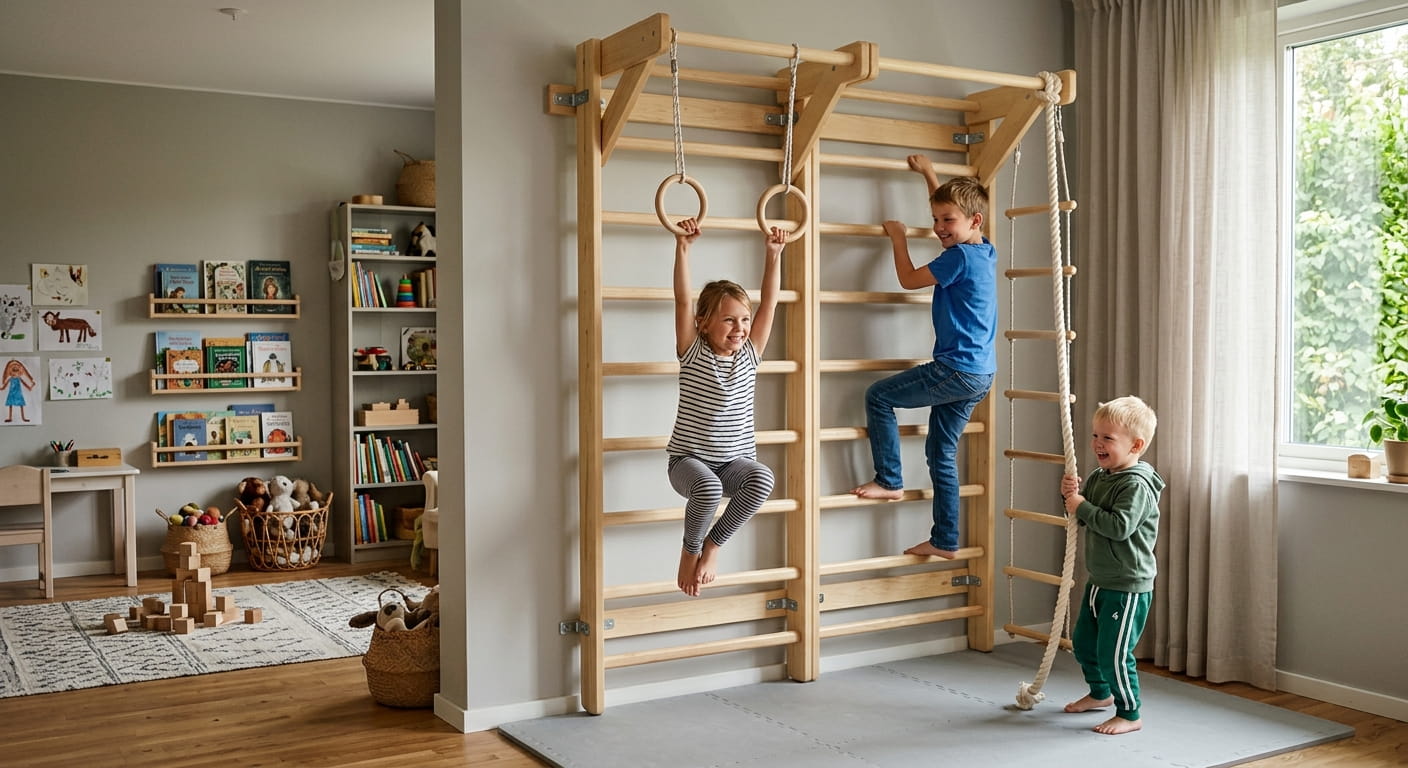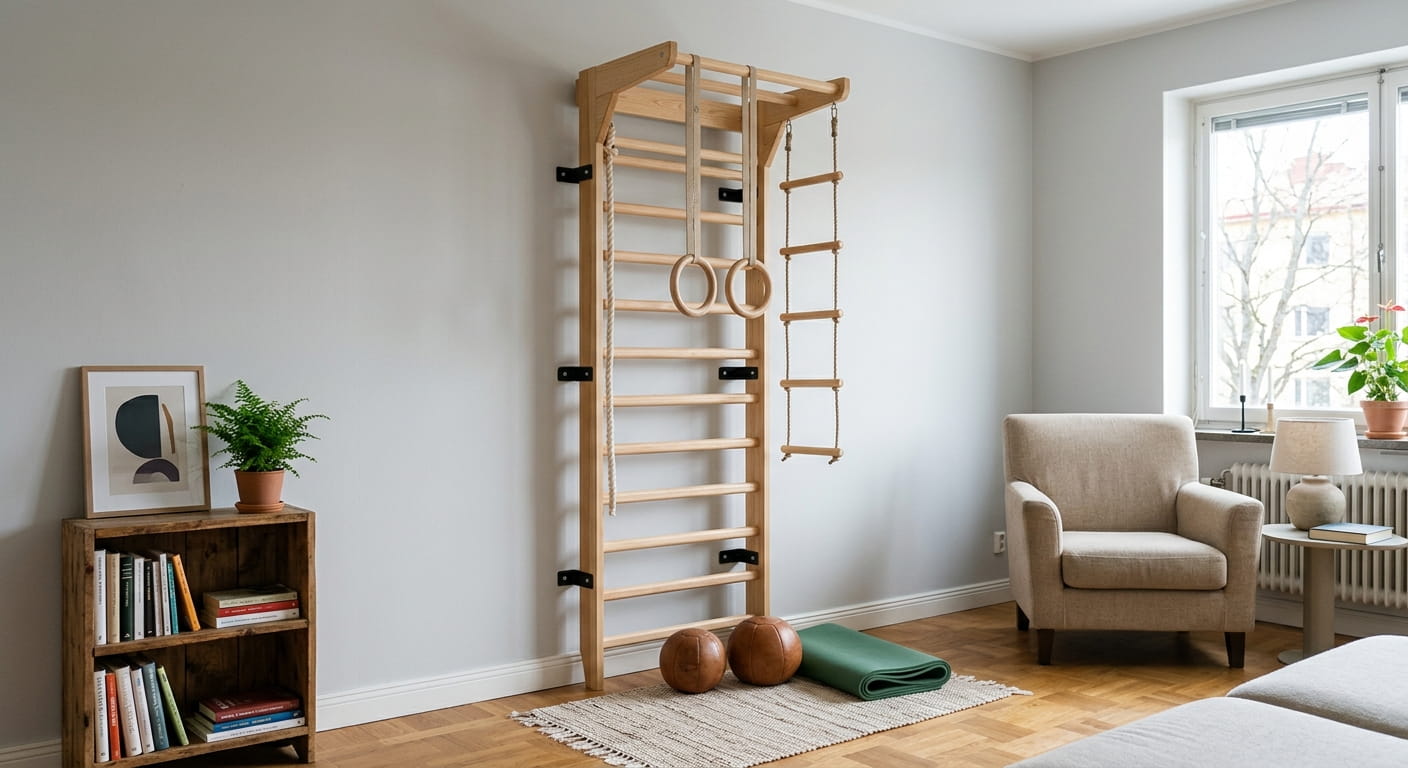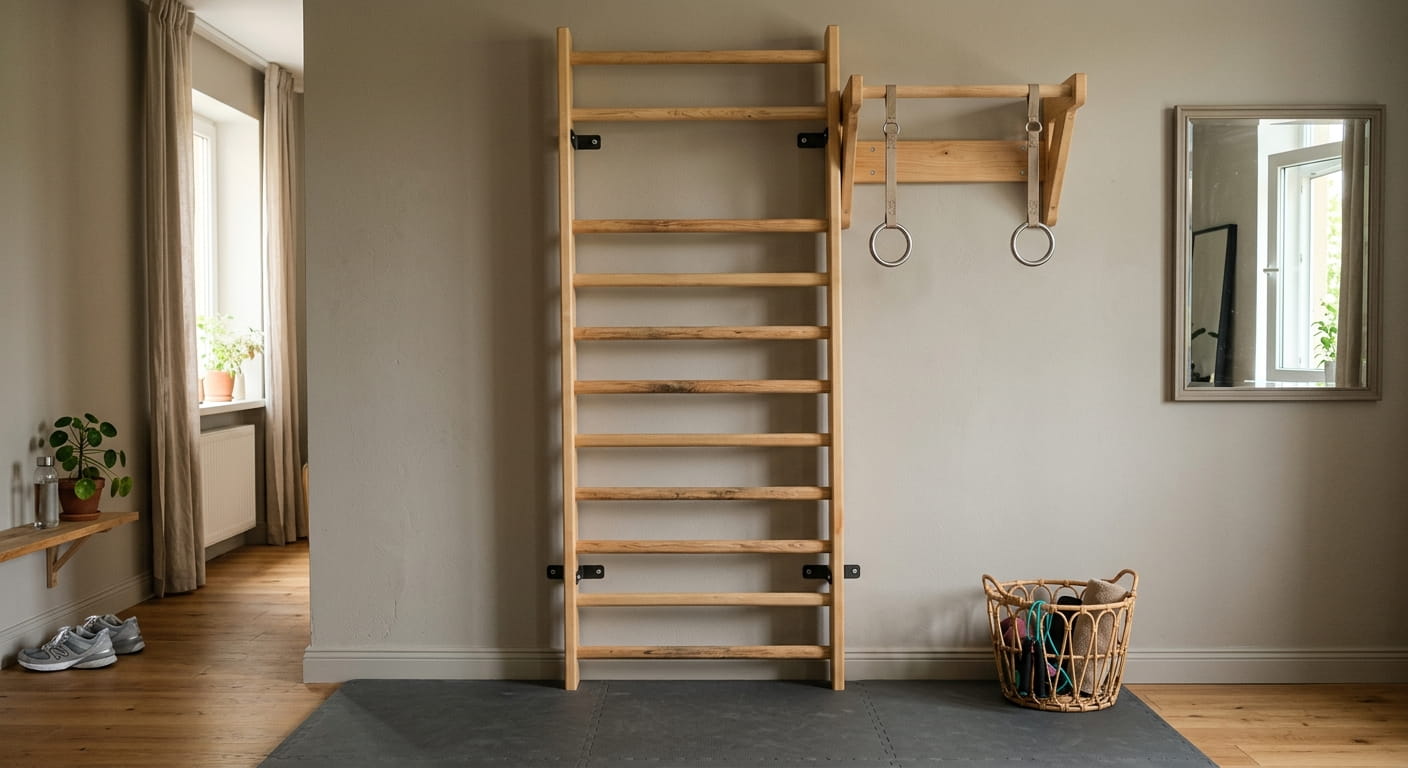
Every few days the same question comes up in conversations with buyers: is a plain pull-up bar enough, or should you go straight for wall bars with a pull-up bar and dip bars? The short answer — if your plans include not only the hang but also straight-arm dips, you need the dip bars from the start, because buying an add-on set later works out more expensive and more of a hassle. Below we break down which models can handle this combination, how it is mounted for jerking loads, and which exercises actually work on a pull-up bar and dip bars at home.
The idea is nothing new — in old Soviet gyms the pull-up bar and dip bars almost always stood side by side, because together they cover the entire upper body: back and biceps from the bar, chest and triceps from the dips. On home wall bars the same logic works on the scale of a single room. The only question is which frame will take both loads at once and not work loose within six months.
Wall bars with pull-up bar and dip bars: why combine two stations on one frame
A standalone wall-mounted pull-up bar is one load vector: the hang and the pull-up. Dip bars add completely different mechanics — a straight-arm support, dips, an L-sit for the core. When both stations sit on one wall bars frame, the room saves space: you do not need two mounting points in different corners, one load node covers almost the whole set of upper-body exercises.
Practice shows that people who fit a bar on its own usually buy add-on dip bars within a month or two, because training without straight-arm dips quickly hits a progress ceiling — the back grows, while the chest and triceps are left without load. It is cheaper and more sensible to look straight away at a model with both stations.
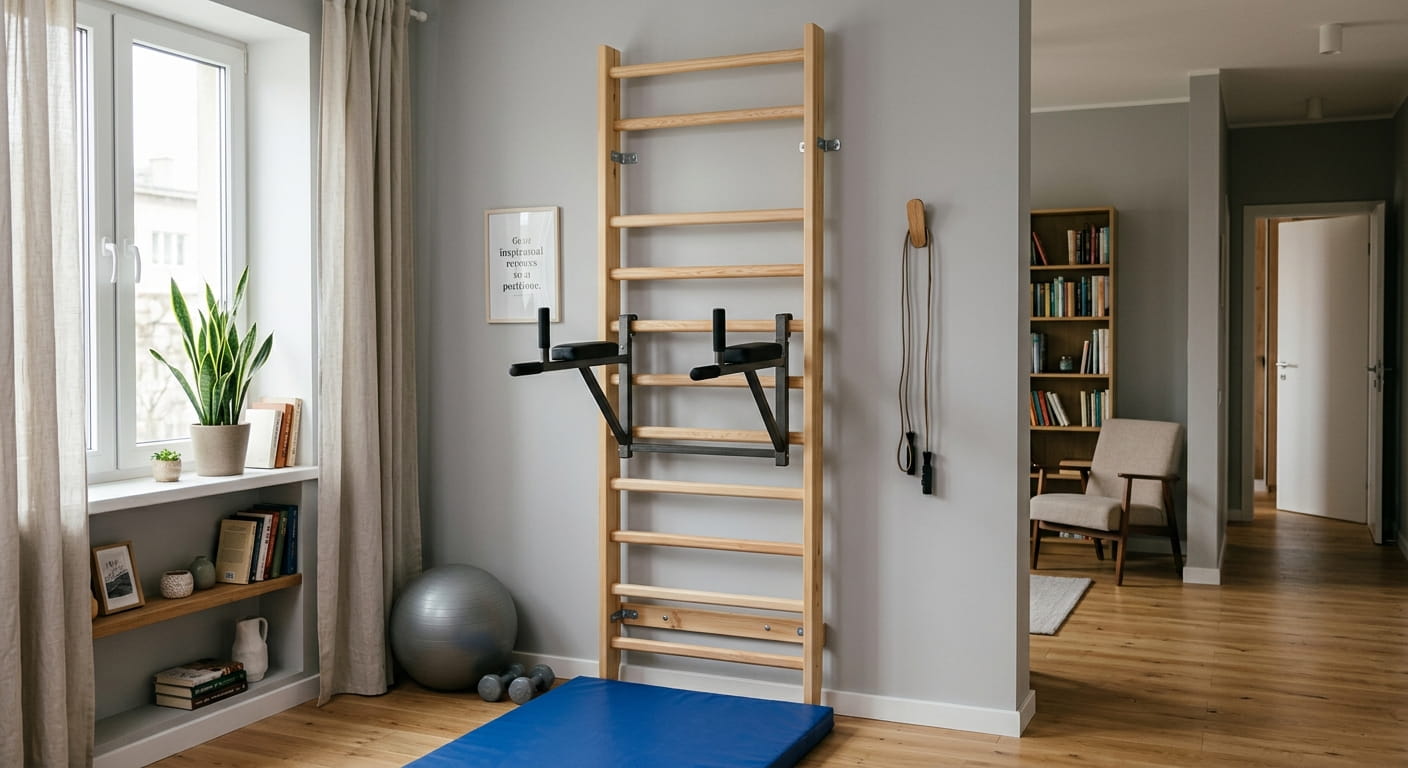
All-round load
Back, biceps, chest, triceps and core — with no rearranging of equipment and no extra machines cluttering the room.
Compact footprint
One node on the wall instead of two separate stations — the floor area under the wall bars stays around 0.2 sq.m.
For the whole family
An adult pulls up and dips; a teenager uses the same stations with a smaller range and their own pace.
Hidden fasteners
Furniture-grade metal ties are concealed in the wood — not a single bolt sticks out or catches clothing.
Our own workshop in Zaslavl, Minsk District, Stroitelnaya ulitsa 7, makes these sets as a single structure, not as a pull-up bar plus dip bars bolted on by hand. The difference is felt from the very first pull-up — the frame does not sway and the dip bars do not loosen under a jerk.
For an apartment this combination is especially justified — the area under the wall bars themselves is about 0.2 sq.m, yet it covers as many functions as two or three separate machines. For a detached house the question of floor space is less critical, but the convenience argument remains: it is far easier to keep one load node in a fitness corner than to spread equipment across different rooms and lose time switching between stations.
There is a flip side too: not every family actually needs a pull-up bar with dip bars in this configuration. If the task is simply to let a child climb and hang, without strength work on the dip bars, it is more sensible to look at basic models without this node. But if there is an adult or a teenager in the house who wants to train systematically, saving on dip bars almost always ends in buying them within the first year of using the wall bars.
Removable versus built-in dip bars: what really takes the jerk
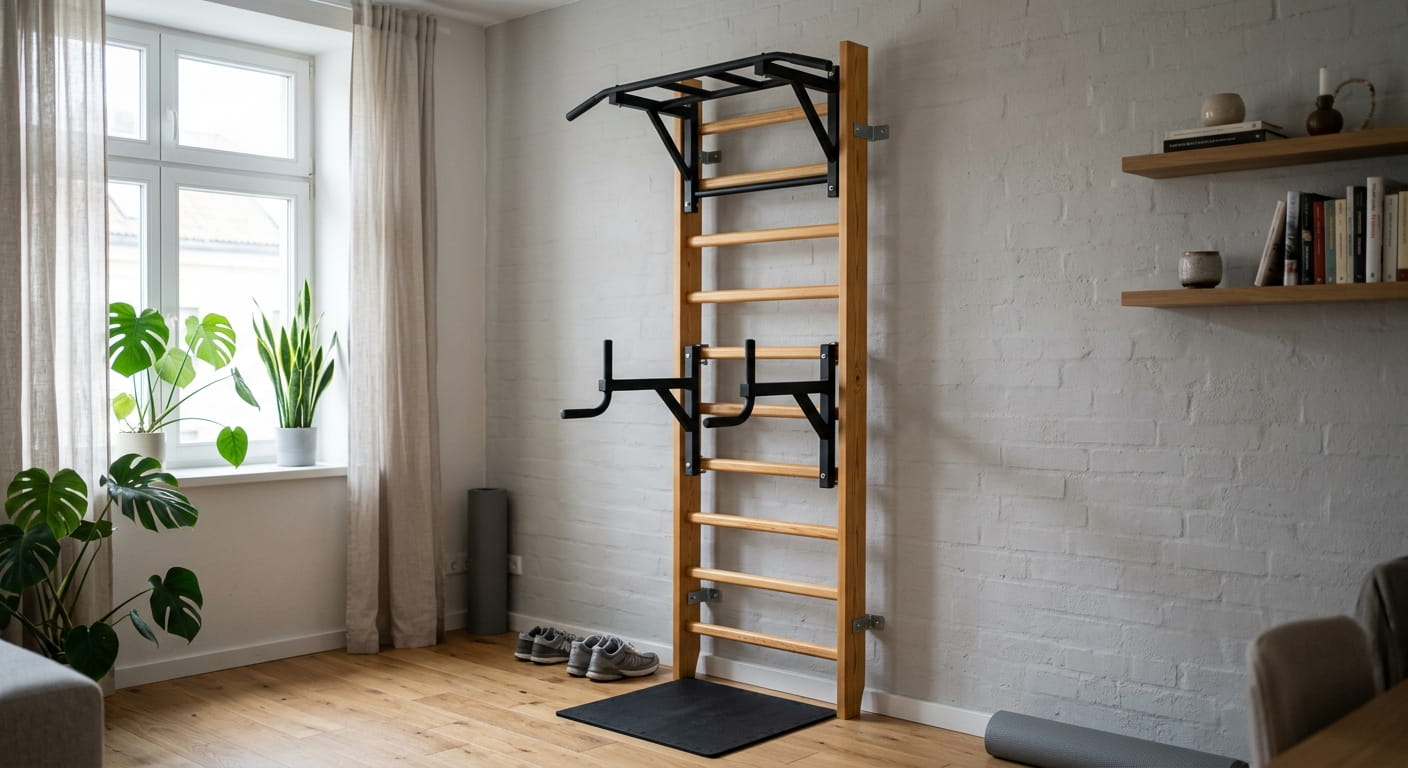
Here is a fork in the road that few people consider before buying. Built-in dip bars are part of the load frame, welded or bolted rigidly at the assembly stage, and cannot be removed. Removable dip bars are a detachable module that hooks onto the ladder rungs with hooks or clamps and can be taken off in five minutes if needed.
The difference is not just about convenience. During dips the load comes in jerks — the body does not simply hang, it swings up and down with acceleration, and at the bottom point the mounting node takes noticeably more than a person's plain body weight. Built-in dip bars are engineered for that dynamic from the start because the frame was designed around them. A removable set is only suitable for sturdy wall bars with a reserve of load capacity — hanging it on a thin budget structure is risky.
Dropping your weight sharply onto the dip bars when jumping down is not allowed on either a built-in or a removable structure — the impact load is several times higher than the static one, and it is precisely this that most often works loose the mounting to the wall or floor-to-ceiling.
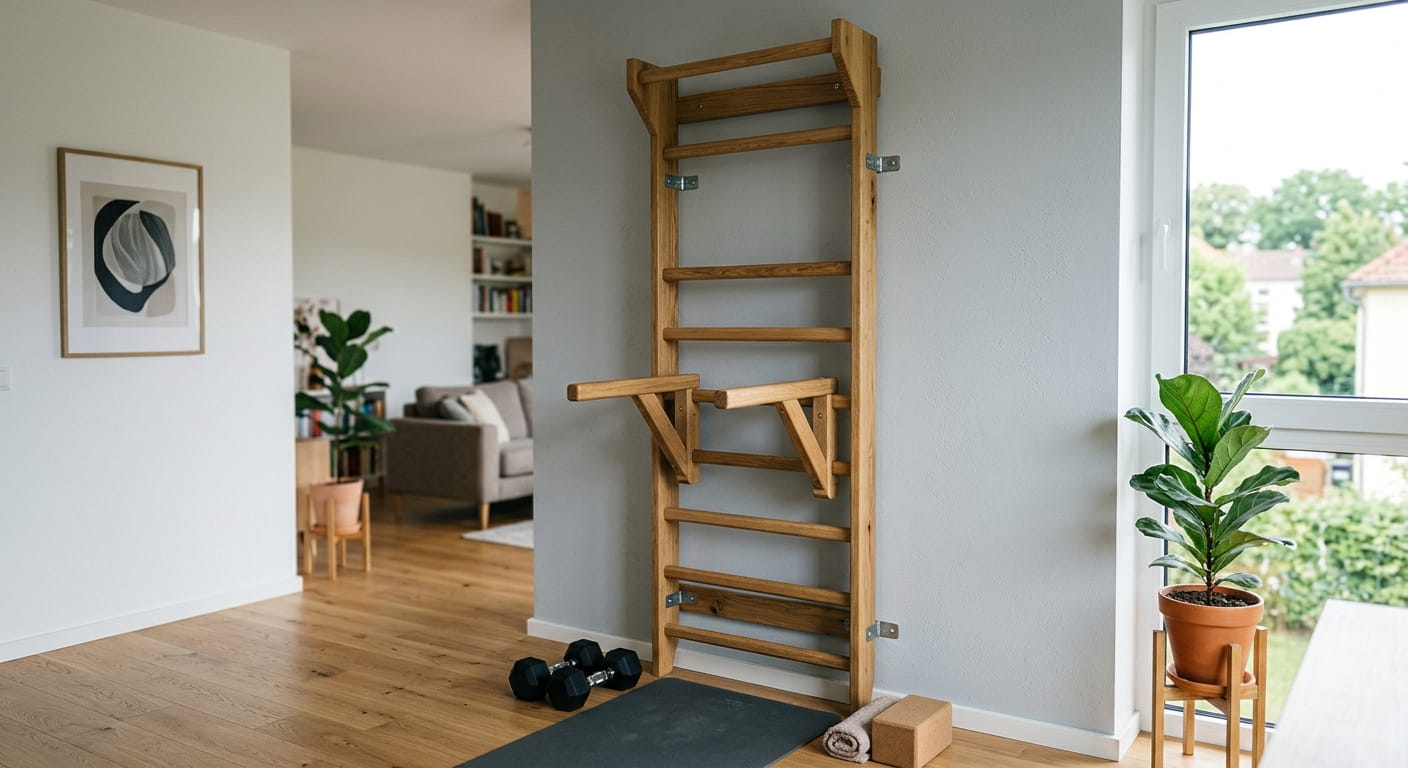
| Parameter | Removable dip bars | Built-in dip bars |
|---|---|---|
| Removability | Come off in minutes, free up the wall bars | Part of the frame, no dismantling envisaged |
| Rigidity under a jerk | Depends on the strength of the frame | Engineered for the dynamic from the start |
| Height adjustment | Usually present, grip width adjustable | Fixed position |
| Where they fit | On reinforced models, rented housing | In models with dip bars "included" |
In practice the built-in option is more often chosen by those who set up wall bars with a pull-up bar and dip bars once and for the long haul, with no plans to re-hang anything. A removable module suits families who rent an apartment or want different equipment at different times — dip bars today, rings tomorrow on the same mounts.
In terms of material there is no difference between removable and built-in dip bars — in both cases the rails are beech or ash, dense hard wood that does not bend under an adult's weight and does not crumble from constant gripping. The only difference is in the node connecting to the frame: on the built-in version the joint is reinforced at the production stage, while on the removable one it depends on how sturdy the wall bars themselves are.
Price is worth a separate mention. A removable dip bar set is usually cheaper if bought separately from a finished model, but if you add up "basic wall bars plus a removable module later", the total almost always exceeds the price of a model where the dip bars are built into the structure from the start — as on the "Atlet" or "Minsk Sport".
Mounting wall bars with a pull-up bar and dip bars: three options for different walls
Wall-anchored mounting is the most rigid of all. It goes onto concrete or solid brick, with the posts seated on anchors right through the wall. On plasterboard such mounting is simply unsuitable — the sheet will not hold the pull-out load from pull-ups and jerks on the dip bars.
Pressure mounting works differently: the posts brace between floor and ceiling, without a single hole in the wall. A screw adjustment lets you set the required tension for a specific ceiling height from 2.40 to 3.10 metres. This is the option for rented housing or thin partitions where there is nowhere to drive an anchor. But it has a hard limit: a pressure-mounted structure cannot be used under a stretch or suspended ceiling — the bracing pushes directly into the ceiling slab, and a light decorative structure will not take that point load.
Combined mounting blends both principles — into the wall and in pressure bracing at once. That is exactly how the top models such as the "Atlet" are assembled, where the loads from the dip bars and the pull-up bar add up and a large safety margin is required.

A mistake often made when choosing mounting on your own is to look only at the price, not at the real wall material in the room where the unit will be installed. A panel building with load-bearing concrete walls and an old wooden house with thin partitions call for completely different approaches, and no online guide replaces an on-site measurement. So before ordering it is worth at least roughly deciding: a concrete or brick wall suits wall-anchored mounting, while a thin wall or temporary housing calls for the pressure-mounted option.
One more detail that is rarely thought about in advance: the distance from the side posts to the nearest furniture. During active pull-ups and especially during dips the body moves sideways, and if a wardrobe or cabinet stands nearby, the elbows will catch the furniture at the bottom of the movement. A comfortable margin is at least half a metre of free space on each side of the wall bars frame where the dip bars are located.
Before ordering it is worth measuring the ceiling height and the wall material — this directly determines which mounting will suit and which model of wall bars with a pull-up bar and dip bars even makes sense to consider.
Which exercises to do on a pull-up bar and dip bars: a working home programme
The list is long, but the foundation rests on three groups of movements — the hang with a pull-up, the support with a dip, and static core work.
- Wide overhand pull-ups — back and rear delts
- Narrow underhand pull-ups — emphasis on the biceps
- Neutral-grip pull-ups on parallel handles, if included in the kit
- Hanging straight-leg raises to the bar — core and hip flexors
- Dips with the torso vertical — triceps
- Dips with the torso leaning forward — chest muscles
- L-sit in support on the dip bars — static work for the core and front delts
- Knee raises on the dip bars — an easier version of core work for beginners
For a beginner there is nothing shameful in starting with negative reps — lowering slowly from the top because you do not yet have the strength to pull yourself up. After three or four weeks of such practice you can usually manage your first clean pull-up.
Combined exercises deserve a separate mention — moving from the pull-up bar to the dip bars without a break, doing a set of pull-ups and then, with no pause, dips. This combo loads the entire upper body in one go and cuts training time almost in half compared with two separate stations in different corners of the room.
A folding bench, included with models such as the "Atlet", adds another layer of exercises — torso raises for the core with the feet fixed, crunches, back extensions. In effect it is already a mini-gym, not just wall bars with a pull-up bar and dip bars in the basic configuration.
For teenagers the programme is usually shortened — fewer reps, more attention to technique, no sharp jumps down from height. Assisted pull-ups with a resistance band work better than forced negatives at this age, because they take off part of the weight smoothly, without a jerk on the ligaments.
A simple weekly guide for a beginner on wall bars with a pull-up bar and dip bars: Monday — pull-ups and core hangs; Wednesday — dip bars and the L-sit; Friday — a combined session switching stations with no rest between sets. After a month or so this cycle usually brings a noticeable gain — both in the number of reps and in how confidently the torso holds static positions on the dip bars.
It is important not to confuse the warm-up with the workout itself. Before a set on the bar or the dip bars it is worth spending at least a couple of minutes rolling the shoulders and loosening the wrists — cold ligaments tolerate jerking loads worse in the very first set, and it is precisely the first set that most often causes strains for those who train at home without a warm-up, rushing between chores. Anyone who has already had shoulder-girdle injuries should start with a plain hang without pull-ups, simply hanging for thirty or forty seconds before moving on to active movements on the pull-up bar and dip bars.
A word on training frequency: daily sets for the same muscle group give no advantage, rather the opposite — the ligaments and joints do not have time to recover between loads. Every other day or two for the upper body works better than daily work on the same node without a break, and the dip bars in this sense load slightly different muscles than the bar, so alternating between the two stations within one week covers recovery naturally.
A separate question is whether to fit a pull-up bar and dip bars if the family so far has only a small child and the adult trains irregularly. The logic here is simple: the wall bars frame is designed for years ahead, children grow fast, and the pull-up bar and dip bars remain relevant for a schoolchild, a teenager and an adult alike — unlike purely play equipment that children quickly outgrow. So even with irregular training now, the pull-up bar and dip bars combo pays off later, when an interest in strength work appears in the child on its own, without outside pressure from the parents.
Gymnastic rings, a climbing rope and a rope ladder are also part of the attachment equipment that fits onto the same frame as the dip bars and the bar. Rings add an unstable support, which makes dips and pull-ups harder through the work of the shoulder stabilisers — the same exercise, but higher intensity for the same number of reps. Many adults who have already mastered basic pull-ups and dips move on to rings as the next level of load without changing the wall bars themselves.
Models with a pull-up bar and dip bars: "Atlet", "Moy Turnik", "Minsk Sport"
Three models cover different usage scenarios, and they should not be confused — saving on the choice often turns into overpaying to add missing equipment later.
"Atlet" — a reinforced structure with thick posts, rated for a load of up to 250 kg against the standard 120–150 kg of most models. Dip bars and a folding bench are included right away, and the mounting is combined — into the wall and in pressure bracing. Price from $202. This is the option for an active adult man who does not want to think about the frame's safety margin with every set. More about a structure of this level is on the reinforced wall bars page, which focuses specifically on strength characteristics.
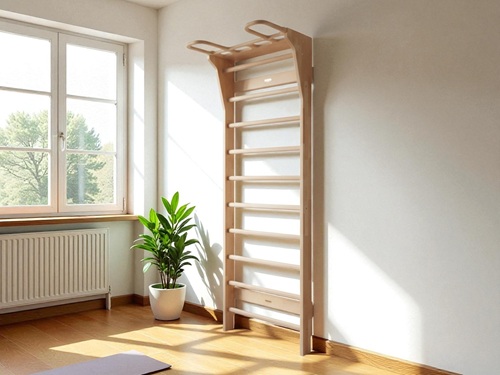
"Moy Turnik" — a model with a different emphasis: a removable adjustable bar with various grips, focused on the upper body as a whole. Price from $218. The bar can be re-hung by height to suit the stature of a particular family member, and the grips — narrow, wide, neutral — give variety without buying extra handles.
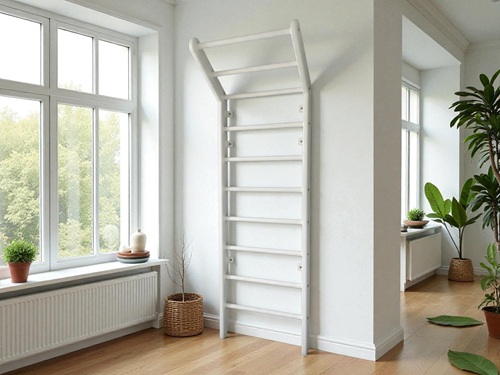
"Minsk Sport" — a modular structure where the attachment equipment, including the dip bars, is removable and adjustable. Price from $174. Such wall bars suit families with children of different ages: hang the dip bars for an adult today, take them off tomorrow and fit rings for the child on the same mounting points.
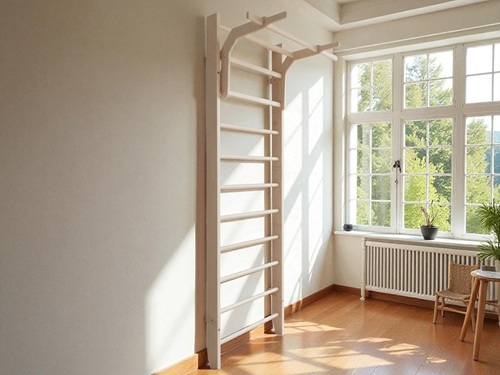
| Model | Price from | Dip bars | Load | Mounting |
|---|---|---|---|---|
| Atlet | $202 | Included, built-in + bench | up to 250 kg | Combined |
| Moy Turnik | $218 | Removable bar, grips | 120–150 kg | Wall-anchored / pressure |
| Minsk Sport | $174 | Removable, detachable | 120–150 kg | Wall-anchored / pressure |
| Vershina | $187 | Not included, has a top bar | 120–150 kg | Wall-anchored / pressure |
For comparison, the "Vershina" model is geared from the start towards the pull-up bar alone, integrated into the top rung of the ladder, with no dip bars at all. If the goal is precisely the pull-up bar and dip bars combo, this model will not suit — but it has a lower price and a simpler design for those who do not need dip bars at all.
To sum up the choice between the three main models briefly: people take the "Atlet" when a safety margin and a full strength set at once, including the bench, matter; "Moy Turnik" — those who want flexible adjustment for different statures in the family and a variety of grips on the bar itself; "Minsk Sport" suits where modularity matters and the ability to change the attachment equipment depending on who exactly is training today — an adult or an older child.
The range also has other models without a ready pull-up bar and dip bars combo — the "Krepysh", a basic I-shaped unit with narrow side panels, from $198; the "Vertikal" with rigid combined mounting from $183; and the "Lider", a U- or T-shaped structure with sections, netting and monkey bars, from $195. All three are a good base if dip bars are not needed at the start, yet their mounting and frame are strong enough to add a removable dip bar module later, should a demand for such a load arise.
A word on the children's line: the "Maugli", with a climbing rope, rings and a rope ladder, costs from $92, but it has no pull-up bar or dip bars in the usual sense — the structure is designed for toddlers' play activity, not for the strength work of a teenager or adult.
Grip covers for the pull-up bar and dip bars: whether you need them and which to fit
A bare beech or ash rail is a dense, hard material in itself, and slips less than metal, but during intensive training the palms still chafe, especially for beginners without calluses on their hands. Grip covers solve exactly this problem.
Three types are most often used: fabric sleeves on elastic — the cheapest and simplest option; foam pads — softer to the touch but wearing out faster; and foamed-rubber covers — these last the longest and do not slip even with a damp palm. On the dip bars covers are fitted less often than on the bar, because the support goes through straight arms rather than a finger grip, but during long static holds in the L-sit they also reduce the discomfort of pressure on the palm.
Grip covers are a consumable item, and the manufacturer's warranty does not extend to them, just as it does not to the textile and rope elements of the attachment equipment: natural wear of fabric and rope is not part of the warranty obligations.
A separate topic is the monkey bars — extra grips along the top rail for grabbing hand over hand. On wall bars with a pull-up bar and dip bars, the monkey bars are not part of the basic configuration of any of the models listed, but they are fitted as an add-on if the family has a teenager who finds the dynamics of hand-over-hand travel more interesting than a static pull-up. A breakdown of this option is on the wall bars pull-up monkey bars page.

Hygiene is another reason grip covers are bought even in families without intensive training. Wood absorbs sweat less than metal, but with daily use by several family members the sleeve on the rail is removed and washed separately, whereas the wooden rail itself should not be wetted unnecessarily — water spoils the water-based protective finish faster than ordinary abrasion from hand gripping.
On the dip bars covers are more often fitted not on the rails themselves but as soft wrapping on the nearby posts, if a child in the family grabs the frame with their hands when trying to climb — this is more about safety than about an adult's grip comfort during strength training.
For adults and teenagers: how the load and height of the pull-up bar and dip bars differ
The difference is primarily in height and weight, not in the structure itself — the frame of standard models is rated for 120–150 kg, which is enough for both an adult man under a hundred kilograms and a teenager. The difference lies elsewhere: the height of the bar on adult wall bars is set for a stature of 165 cm and above, so that during a pull-up the legs do not touch the floor even at the lowest point of the hang.
For a teenager under 14–15 a lower grip point or an adjustable bar is often needed — as on the "Moy Turnik" model, where the height is changed for a specific user. Dip bars for a teenager also require a narrower grip width, because the shoulder girdle is still forming, and an adult-format wide stance creates excessive stretching in the shoulder joints during a dip.
The rail material is the same across all models — beech or ash, dense hard wood that does not crumble or give splinters even after years of active use. The posts are laminated pine or birch timber, with a water-based lacquer and oil finish, hypoallergenic and certified, so there is no difference in material safety between a children's and an adult model at all — the difference is only in the geometry and the mounting point of the stations.
A detailed breakdown of adult usage scenarios, including matching the model to height and weight, is on the wall bars for adults page. It also has a table matching bar height to user stature.
An important safety point for families with children of mixed ages: if a teenager trains on the pull-up bar and dip bars on their own while a younger child plays nearby, the landing zone must be clear of toys and furniture. A sharp jump down from the bar with someone else nearby is a common cause of minor injuries, and this has nothing to do with the strength of the wall bars themselves, only with how the space around them is organised.
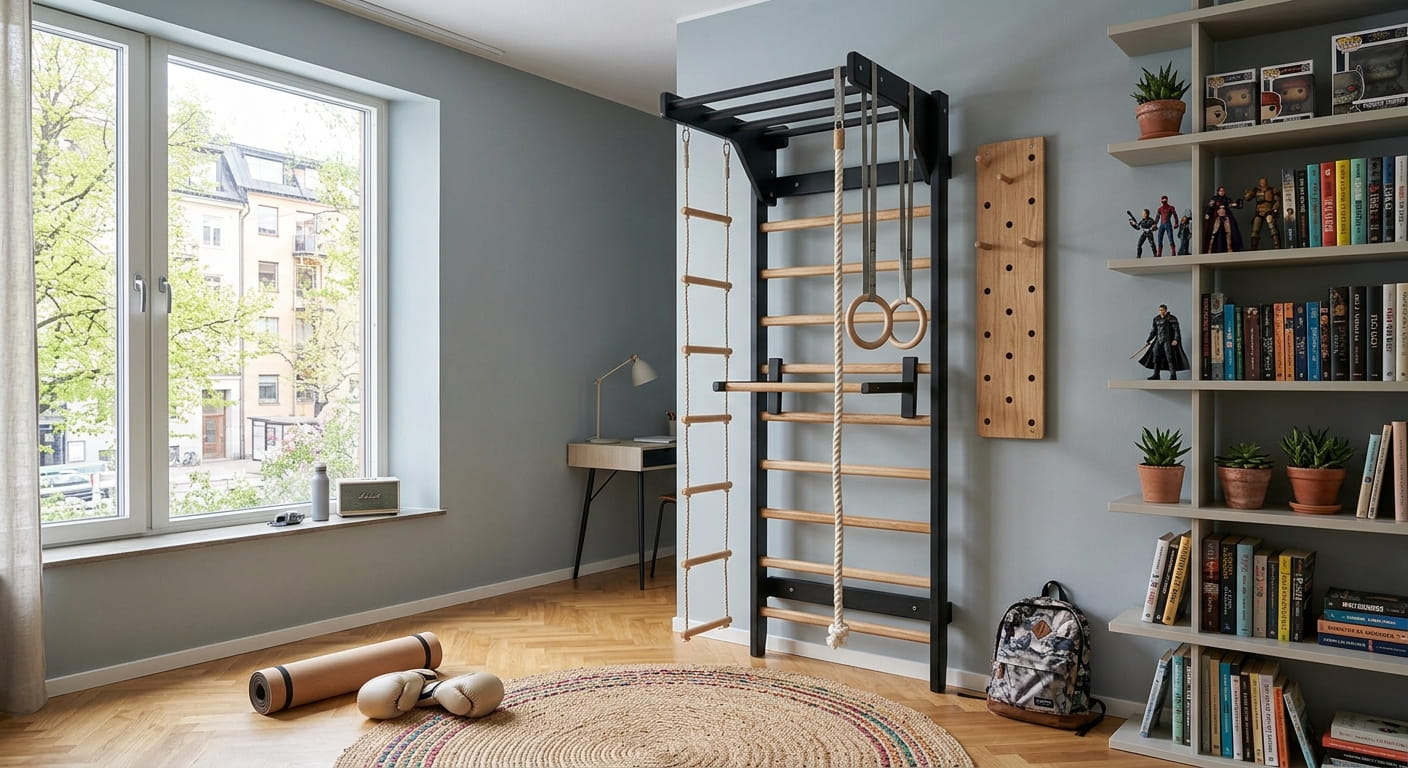
An adult user's weight is worth checking in advance, not as a formality — the models are rated for the 120–150 kg range with a margin, but if there is a person heavier than this limit in the family, it is more sensible to look straight towards a reinforced frame rather than counting on a standard structure to hold a near-limit load for years without consequences for the mounting.
Assembly and warranty of wall bars with a pull-up bar and dip bars
Assembly takes from one and a half to three hours — the spread depends on the model and the mounting type. Combined mounting, as on the "Atlet", takes longer, because you have to set both the pressure bracing and the anchor points at once, making sure both systems hold the load in sync, without skewing the frame.
The kit includes instructions and all the hardware — there is no need to buy anchors, bolts or dowels separately for any model. The warranty on the structure is 12 months, and it covers not only the frame itself but also the attachment equipment — the pull-up bar, dip bars and bench. The exception is the natural wear of rope and textile elements such as a climbing rope or rope ladder, if included: the warranty does not extend to a rope stretched by years of use, which is a consumable item by its nature.
| What to do | How often |
|---|---|
| Wipe with a dry or slightly damp cloth, no abrasives | As it gets dirty |
| Check the tightness of bolts and ties | Every 3–6 months |
| Lay a mat under the landing zone | Always during active training |
| Keep away from radiators and direct sunlight | At the installation stage |
Checking bolt tightness is not a formality. It is precisely on the pull-up bar and dip bars, where the load is dynamic and repetitive, that the hardware loosens slightly over time from the vibration of each set. Once a quarter or half-year it is worth going over all the joints with a spanner — it takes ten minutes and removes almost all the risk of the structure working loose over years of use.
A mat under the landing zone is not an option but a mandatory part of the safe use of the pull-up bar and dip bars. When dropping off the bar or after a series of pull-ups, the legs land with a noticeable load on the joints, and a hard floor without cushioning makes itself felt in the knees over time, especially in overweight adults. A sports mat under the wall bars solves this problem entirely and is inexpensive compared with the structure itself.
The placement of the wall bars in the room also affects the lifespan of the wood. Direct sunlight dries the timber unevenly, and proximity to a radiator speeds up the same process on the back of the post — together this leads to micro-cracks on the finish surface faster than with ordinary use in the shade. When installing, it is enough to step back from heating appliances and not place the frame right against a south-facing window without a curtain.
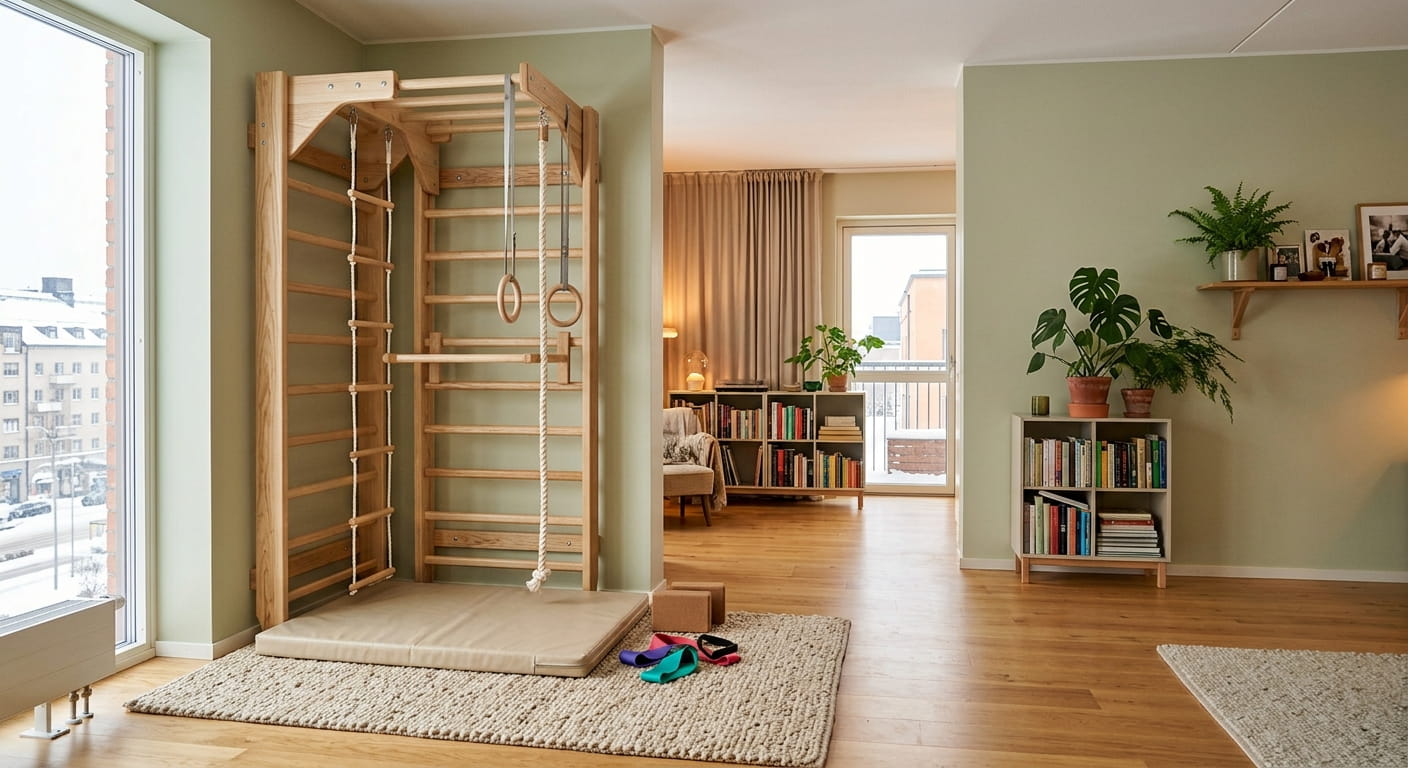
The hidden furniture-grade metal fasteners used in all models are not visible from outside and do not interfere with the grip during a pull-up — an important detail precisely for structures with a bar, where the hand occasionally slides along the post during a re-grip.
Self-assembly requires no special skills — a screwdriver and an adjustable spanner are enough, and the instructions lay out the order step by step. Those who do not want to handle the installation themselves can ask the manager about on-site assembly — this is discussed individually when placing the order, together with the choice of mounting for a specific wall.
How to order wall bars with a pull-up bar and dip bars
Our own production in Zaslavl, Stroitelnaya ulitsa 7, ships finished items across the whole of Belarus with door-to-door delivery or pickup from the warehouse. Before placing an order the manager usually checks three things: the wall material, the ceiling height and the approximate weight of the most active user in the family — this determines which model and which mounting will suit without overpaying for an excessive safety margin.
If the task is to start with a basic pull-up bar and look at dip bars later, it makes sense to compare the full range on the wall bars with pull-up bar page, which gathers models without mandatory dip bars in the kit. But experience shows that adding dip bars as a separate attachment module six months to a year later works out both more expensive and trickier to fit to an already installed frame.
The price of models with a pull-up bar and dip bars starts from $174 for the modular "Minsk Sport" and rises to $218 for the "Moy Turnik" with an adjustable bar. Between them sits the "Atlet" at $202 with a reinforced frame and a folding bench in the kit. The spread is explained by the set of attachment equipment and the mounting type, not by a different thickness of wood — the material is of the same quality across all models.
Buyer reviews are worth a separate mention, and they most often note the same thing: the pull-up bar and dip bars combo on one set of wall bars saves space in an apartment far more noticeably than it seems at the choosing stage, and the habit of training at home forms faster when the equipment is always to hand in the next room rather than at a gym across town.
Another frequent comment in reviews is about the underrated role of the bench in the "Atlet" kit. Buyers initially focus precisely on the pull-up bar and dip bars, and then admit that the folding core bench gets used almost more often than the dip bars themselves, especially at the stage while pull-ups are still hard and basic core work is already fully available.
If the model is already chosen but questions remain about installation in a specific room — a non-standard ceiling height, an uneven wall, proximity to a window or radiator — these details are easier to discuss before payment, not after delivery. The production works with such inputs constantly, and for almost any room configuration there is a mounting solution without compromising the strength of the whole structure of wall bars with a pull-up bar and dip bars.
Expert opinion
From the point of view of engineering logic, wall bars with a pull-up bar and dip bars are not just two stations side by side but a single load system, where the load from jerks on the dip bars and pull-ups on the bar is distributed across one frame. That is exactly why the choice of mounting and model cannot be made on looks or price alone: combined mounting on a concrete wall will take a jerking load several times more reliably than a pressure structure on a thin partition, even if both look equally sturdy on the showroom floor.
For a family with users of different ages it is more sensible to look at modular options such as the "Minsk Sport" or adjustable ones like the "Moy Turnik" — they let you tune the height and grip to a specific person without replacing the whole structure. And where the training is already serious and the user's weight approaches the upper limit of the standard load, a reinforced frame with a margin of up to 250 kg settles the question of mounting strength once and for all.
— Veronika Tarasevich, internet marketer, specialist in semantics and content for product niches.