Searching for "wall bars with pull-up bar" and unsure how a built-in bar differs from a removable one? The difference is fundamental and affects the price, the installation and who exactly will be training. In this guide we break down both options, show the «Vershina», «Moy Turnik» and «Atlet» models, and explain grips, bar height for your build, the load on the structure, the ways to fasten it to the wall and what comes with the assembly and warranty.
In practice buyers often confuse the two approaches: they think the pull-up bar is just the top rung of any ladder, when in fact what matters is where it is fixed, whether it will hold an adult's weight and whether you can adjust the grip and height. Let's work through it step by step, with concrete figures and models.
Wall bars with pull-up bar: built-in bar or removable adjustable one
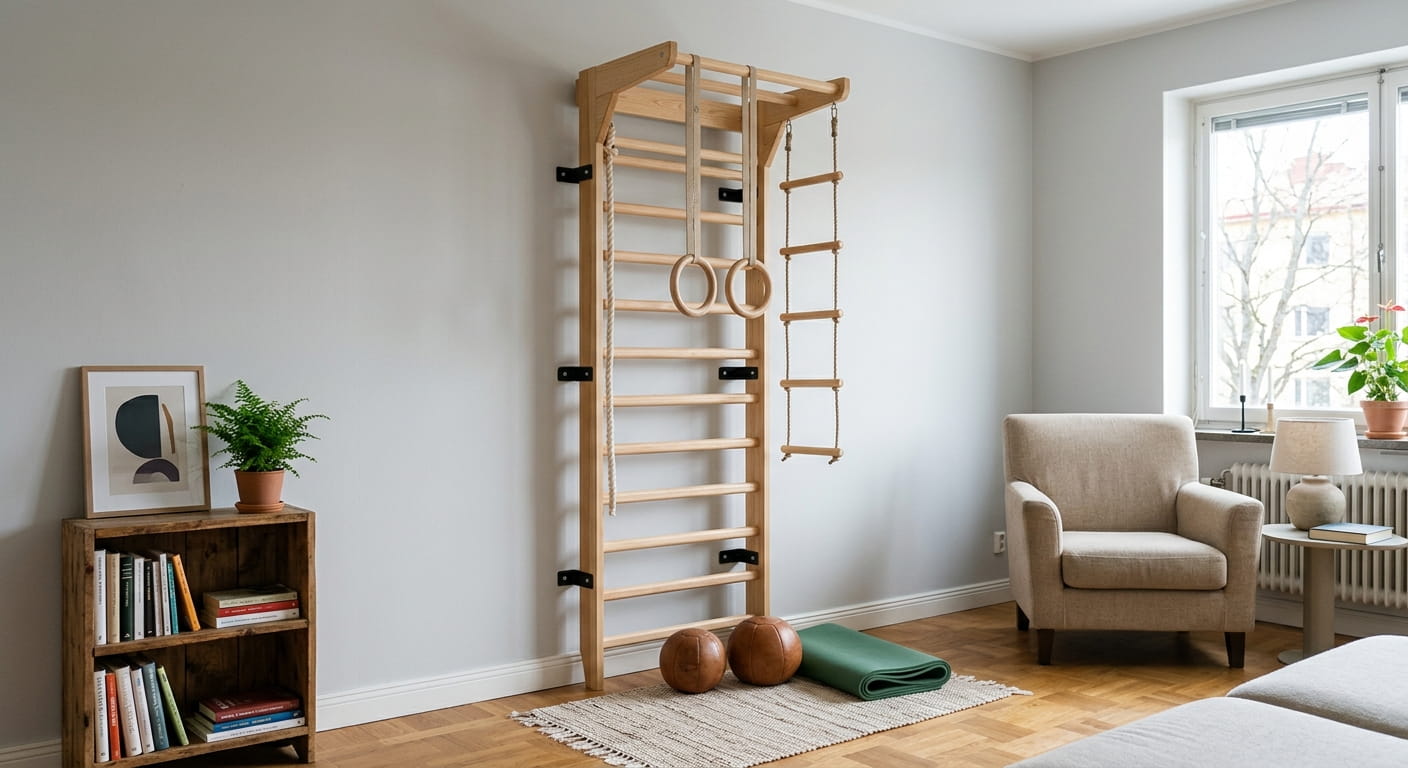
On wall bars the pull-up bar comes in two constructional types. The first is integrated straight into the upper part of the ladder: a single frame, no extra fixings, installed once and never removed. The second is a separate removable unit that hangs onto a section of the wall bars and slides up and down, and can be taken off entirely when needed, freeing up the space above the ladder.
The difference shows up both in cost and in convenience. A built-in pull-up bar barely adds to the price of a model compared with basic I-shaped wall bars — it is part of the rigid frame and needs no extra hardware. A removable adjustable pull-up bar is usually dearer because of the mounting unit and clamps, but the whole family can tune it: an adult is 180 cm tall, a teenager 160 cm, and the bar sits at the right height each time.
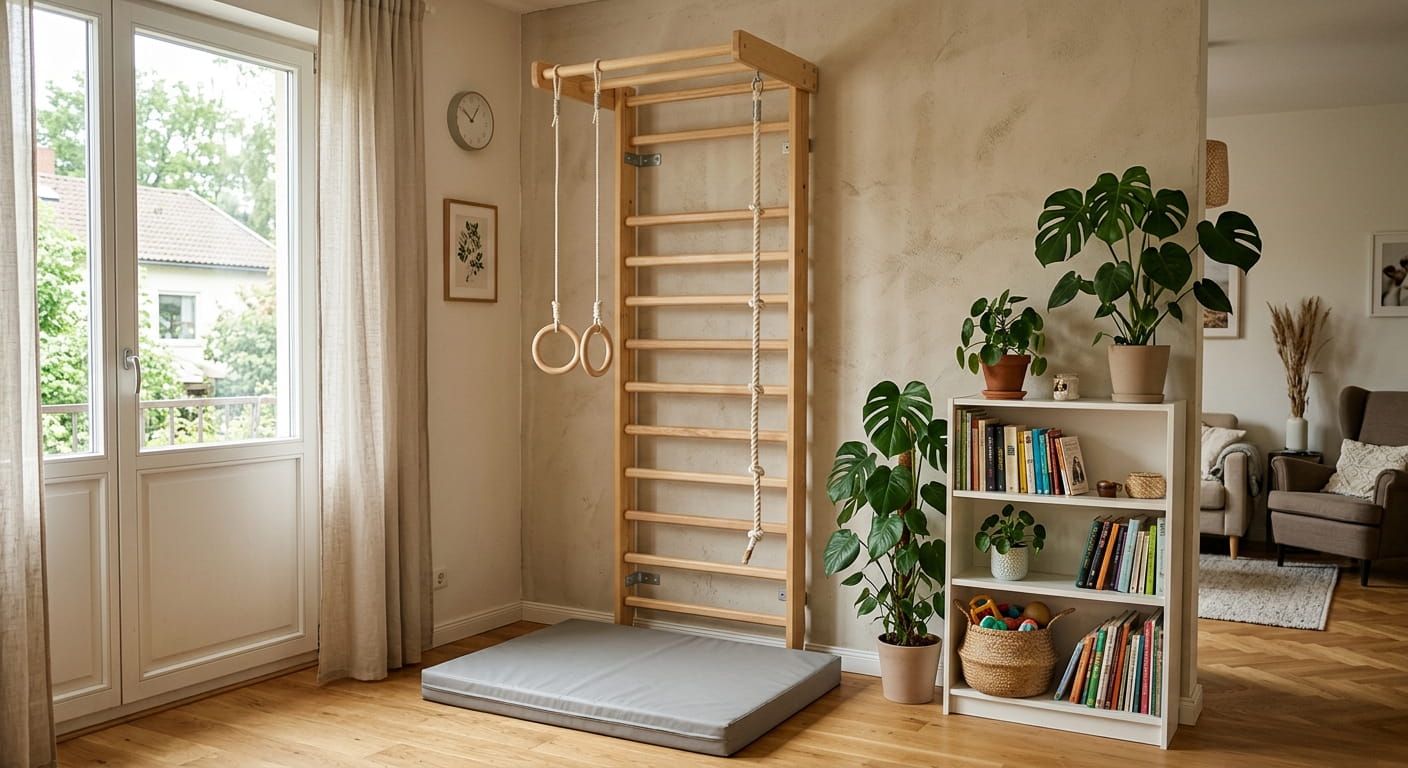
There is also a third scenario — a separate pull-up bar is not needed at all, because the top rung of the wall bars already works as a bar by default. That is how the basic range is built, for example: the top of the ladder is already a support for the palm, just without the rigging for different grips and without adjustment. For a short hang and light pull-ups it is enough; for systematic strength work, not always.
Built-in bar on top: the «Vershina» model
The «Vershina» is I-shaped wall bars with a pull-up bar built straight into the upper part of the frame. The retail price starts from $187. Constructionally it is a single unit: the uprights of laminated beam (pine or birch) rise upward and end in a bar of beech or ash — the same dense timber as the rest of the ladder rungs.
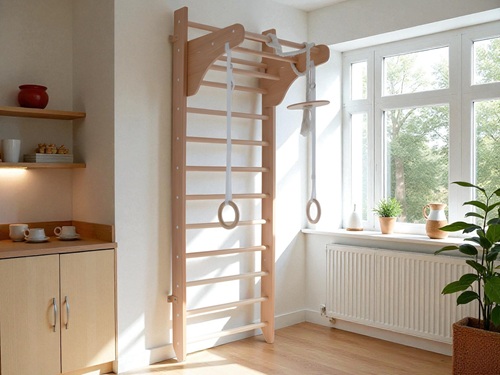
The advantage of this solution is rigidity. The bar does not wobble, needs no monthly tightening of clamps, and the whole unit is rated by the factory for the standard 120–150 kg load. The downside is the fixed bar height: you cannot lower or raise it to a specific build, other than changing body position during the pull-up if the ceiling or your height does not allow a full hang.
The «Vershina» fits well into a room with a ceiling from 2.40 m, where the bars are set with a wall-mounted anchored fixing to a solid wall. For a flat with concrete or solid-brick walls it is a workable option with no compromises: minimum parts, maximum rigidity, and the pull-up bar does not "roam" under an adult's weight even during vigorous pull-ups.
Removable adjustable bar: «Moy Turnik» and «Atlet»
The «Moy Turnik» model is built around the opposite idea: the bar is removable, adjustable in height and designed for different grips. The price is from $218 — dearer than the «Vershina», because the set includes a separate unit to fasten the bar to the wall-bars section plus the grips themselves along the sides of the main bar.
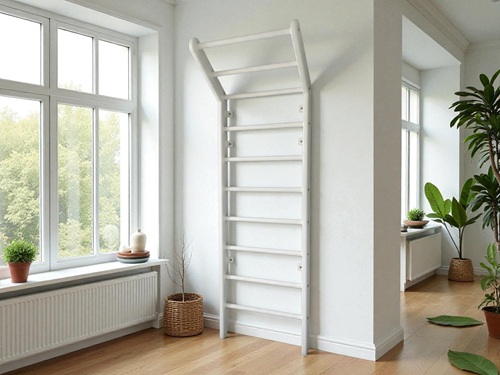
The removable bar is repositioned along slots or holes in the uprights, so the same exercise corner serves both an adult close to two metres tall and a schoolchild — the bar simply sits at the right height for the hang each time, with no slack and no falling short of the bar.
The «Atlet» is reinforced wall bars with a pull-up bar, dip bars and a folding bench included, from $202. The uprights here are thicker than on the basic models, and the load rating is up to 250 kg against the standard 120–150 kg. The pull-up bar on the «Atlet» is also removable and adjustable, but built for more intensive use: if someone in the family weighs over 100 kg or weighted strength pull-ups are planned, it is a sensible choice.
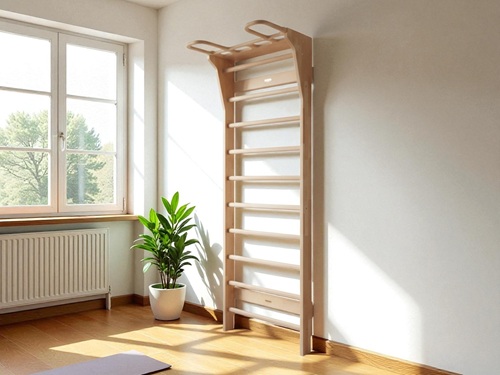
If more than one person will be training in the flat or house — a child and an adult, or two adults of different heights — a removable adjustable pull-up bar is more practical than a built-in one: the height is adjusted for each person without buying a second set of wall bars.
| Parameter | Built-in bar | Removable adjustable bar |
|---|---|---|
| Models | «Vershina» | «Moy Turnik», «Atlet» |
| Height adjustment | No, fixed | Yes, for build and grip |
| Joint rigidity | Maximum, part of the frame | High, needs fixings checked |
| Approximate price | from $187 | from $202-218 |
| Best suited to | One user, stable height | Family of varied heights, kids and adults |
| Can the bar be removed | No | Yes, when needed |
Wall bars with pull-up bar vs a doorway pressure bar
Before buying, people often compare wall bars with a pull-up bar against an ordinary pressure bar that slots into a doorway without any ladder. The pressure bar has one advantage — price and compactness — but the load goes onto the door jambs, which were not designed for it, and the bar itself is held at just two points without any supporting frame around it.

Wall bars with a pull-up bar solve several tasks at once rather than one: besides the bar for hanging and pull-ups, there are rungs for stretching and climbing, and points for add-on dip bars, a rope and gymnastic rings. The structure stands on the floor or is fixed to the wall and ceiling along its full height rather than hanging on two points, so the swaying during a vigorous pull-up is noticeably less.
There is a flip side too — wall bars with a pull-up bar occupy a vertical plane of the wall and require more serious installation than a pressure bar in a doorway. But if the task is not a one-off workout but regular training for one person or the whole family, the gain in convenience and safety outweighs the difference in installation effort.
Grips on the wall-bars pull-up bar: what they are and why different ones matter
The bar on wall bars with a pull-up bar usually has not one grip diameter but several zones — a straight section and parallel handles at the sides. This is not decoration but a functional part: different grips load different muscle groups of the back and arms, and without them the pull-up bar turns into an apparatus for a single exercise.
- Wide overhand grip — the classic pull-up, with the main load on the lats.
- Narrow overhand grip — works the biceps and the middle of the back more.
- Underhand grip (palms toward you) — emphasis on the biceps, easier for beginners.
- Neutral grip (parallel handles) — a gentler option for the wrists and elbows.
- Wide behind-the-neck grip — an advanced variant that requires good shoulder mobility.
In practice, for the home and especially for a child, what matters is not the number of grips but their comfort: the bar should not be slippery, too thin or too thick for a small palm. On models like the «Moy Turnik» and «Atlet» the bar and parallel handles are made of hard timber — beech or ash — without cuts or burrs, and coated with a hypoallergenic water-based lacquer.
Climbing the wall bars as a warm-up before the pull-up bar
Before pull-ups on the bar it is worth warming up on the ladder of the wall bars itself — a few climbs up and down the rungs warm the shoulder joints and grip more than static floor stretching. Two or three minutes of climbing up and down before the main set reduce the risk of pulling a muscle cold during a sharp pull-up on the bar.
For a child, climbing the bars can be even more interesting than the pull-up bar itself — it develops coordination and confidence in their own body, and the bar up top becomes a logical continuation rather than a separate, frightening apparatus at an unclear height above the floor.
How to calculate the pull-up bar height for build and ceiling
The formula is simple: stand under the bar and raise your arm — the distance from your fingertips to the ceiling should be at least 15–20 cm for a free hang with outstretched arms. If there is only one person in the family and the height is stable (an adult who is no longer growing), the height can be fixed once and for all — then the built-in bar of the «Vershina» fits too.
If the wall bars are used by a child who will grow 10–15 cm over a couple of years, it makes more sense to take a removable adjustable pull-up bar straight away — the «Moy Turnik» or «Atlet». The bar is simply moved higher as they grow, without buying new wall bars or dragging up a stool to reach the bar.
A separate point is the ceiling height in the room. A floor-to-ceiling pressure mount for wall bars needs a ceiling of 2.40 to 3.10 m, and in that case the pull-up bar is automatically limited by the top point of the structure. For a wall-mounted anchored fixing there is no such rigid limit — the bar can be raised higher if the room ceiling is high enough.
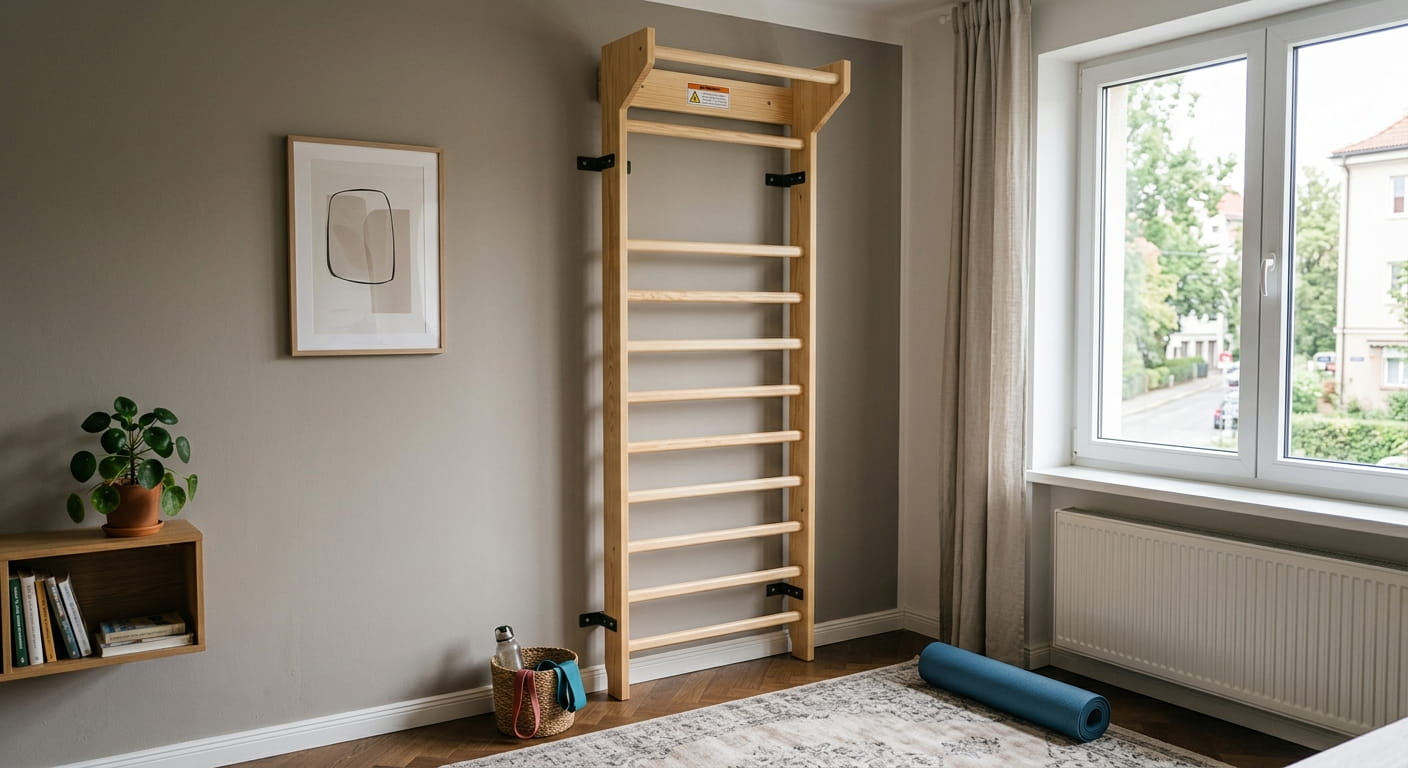
Hanging and pull-ups on the bar: basic exercises for home
A simple hang on the pull-up bar is not a token warm-up but a real load on the spine and shoulder girdle. It decompresses the intervertebral spaces, relieves some of the compression after a sedentary day and strengthens the forearm grip. For someone who spends the whole day at a computer, ten to fifteen seconds of hanging several times a day give a noticeable effect within a couple of weeks of regular practice.
Pull-ups on the wall-bars bar with different grips
The pull-up is the next level after the hang. It is best to start with the negative phase: jump up or step onto a support so the chin is above the bar, and lower down slowly over 3–5 seconds. This strengthens the muscles in the lengthened position and prepares the body for a full pull-up without jerks or swinging.
Next come resistance bands (hung on the bar as extra support) or a partner's help — they hold under the knee, taking off part of the weight. After a month and a half to two months of regular practice, most adult beginners do 3–5 clean-grip pull-ups on their own without assistance.
Abs on the bar: leg raises and the L-sit
The pull-up bar on wall bars works excellently for the abs too — raising bent or straight legs in a hang loads the lower abdomen more than classic floor crunches. It is best to start with knee raises to the chest, gradually moving to straight legs and holding an "L-sit" for a few seconds at the top.
If a folding abs bench is included (as with the «Atlet»), it adds another mode — incline crunches with the feet fixed at the top of the structure. The "bar plus bench" combination covers almost the entire basic set of abs exercises without a separate machine in the room.
Example of a weekly programme on the wall-bars pull-up bar
For a beginner, three short workouts a week of 10–15 minutes are enough for the pull-up bar on the wall bars to start delivering results rather than gathering dust in the corner. The point is not volume but regularity: short sets every other day work better than one long marathon once a week at the weekend.
- Monday — hanging on the bar, 3 sets of 20–30 seconds; pull-ups or their negative phase, 3 sets.
- Wednesday — pull-ups with different grips (wide, narrow, neutral), 3 sets for each grip type.
- Friday — leg raises in a hang on the bar, 3–4 sets; if dip bars are available, dips right after.
After a month of regular training on the wall bars with a pull-up bar the programme is made harder: add weight (a weighted belt or a backpack with a load) or increase the number of sets. For a child there is no need to ramp up the load so aggressively — what matters is not the number of pull-ups but the very fact of regular hanging and pull-ups without pressure from the parents.
The wall-bars pull-up bar and posture: what really works
Hanging on the bar is often recommended as a way to straighten the back, but the effect here is preventive rather than therapeutic. Regular hanging relieves part of the vertebral compression and strengthens the stabiliser muscles of the back and shoulder girdle — their weakness is what causes the stooping during ordinary walking and long sitting at a desk or table.
For a schoolchild who sits at a desk all day and then over homework at home, a few minutes of hanging and light pull-ups on the wall-bars pull-up bar are a simple way to offset the static load on the spine. This is not about serious strength achievements but about regular light activity that is built into daily routine rather than requiring a separate trip to a club across town.
For an adult with a sedentary job the logic is the same: a pull-up bar on wall bars in the hallway or child's room relieves part of the load accumulated over the day on the lower back and thoracic region. It does not replace full physical training, but it noticeably reduces the discomfort of long sitting, especially if hanging and pull-ups become a habit rather than a one-off experiment for a couple of days.
Removable dip bars on the same wall bars with a pull-up bar expand the programme: dips load the triceps and chest muscles, which hanging and pull-ups barely engage. For an adult man this is a logical addition to the pull-up bar, not a replacement for it.
A detailed review of models with a full add-on set — dip bars, pull-up bar and bench together — is on the page about wall bars with pull-up bar and dip bars.
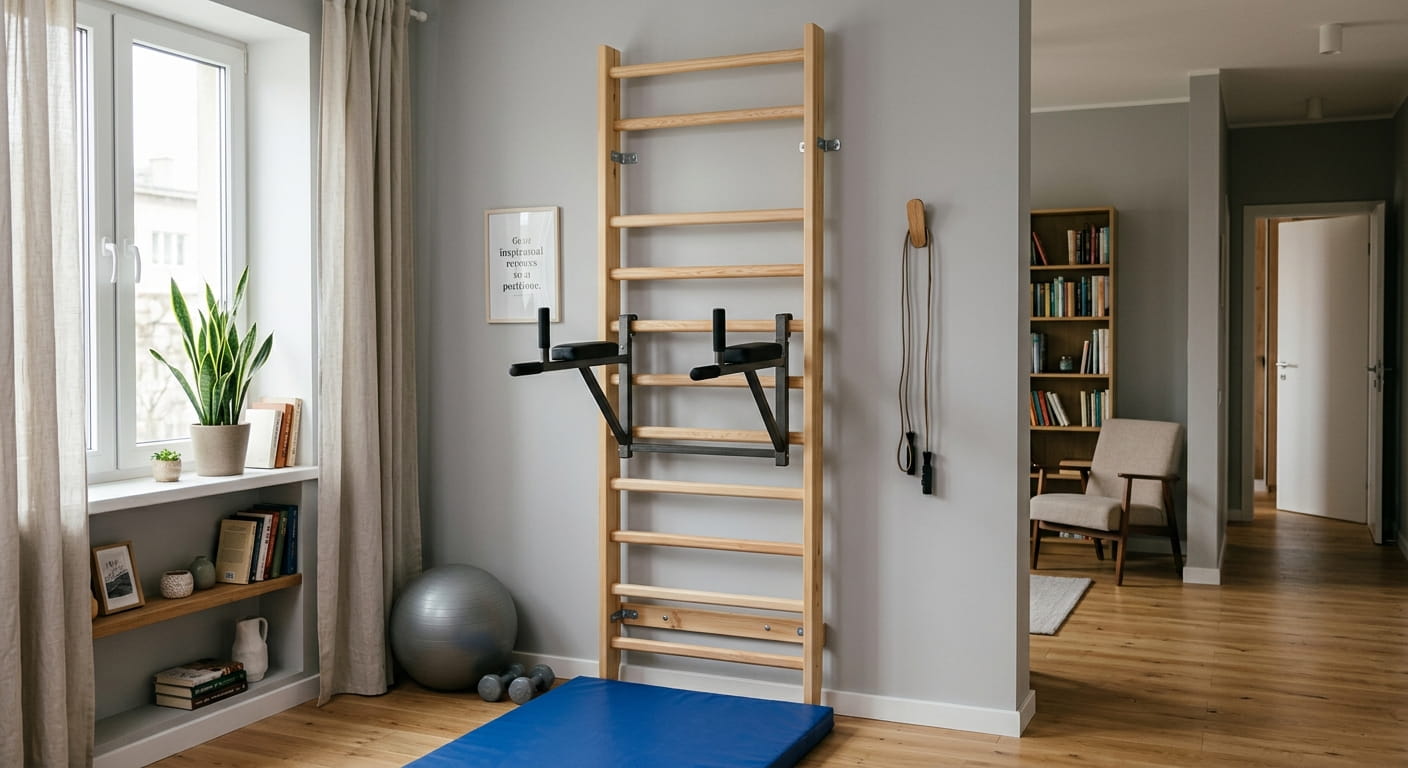
Load and materials: what the pull-up bar on wall bars withstands
The standard load for most models is 120–150 kg, which is enough for an adult of average weight plus a margin for the jerk during a pull-up (with dynamic movement the load on the fixing is briefly higher than the static body weight). Reinforced models like the «Atlet» hold up to 250 kg — an option for a family with larger adults or for intensive strength training on the bar.
The load-bearing capacity of the pull-up bar is determined not only by the thickness of the bar but also by how the uprights of the wall bars are fastened to each other and to the wall. Concealed metal fixings (furniture bolts) pull the frame together so that during a pull-up the load is distributed across the whole structure rather than concentrated at a single point of the upper unit.
| Model | Bar type | Load | Price, from |
|---|---|---|---|
| «Vershina» | Built-in, fixed | 120–150 kg | from 187 |
| «Moy Turnik» | Removable, adjustable, with grips | 120–150 kg | from 218 |
| «Atlet» | Removable, adjustable + dip bars and bench | up to 250 kg | from 202 |
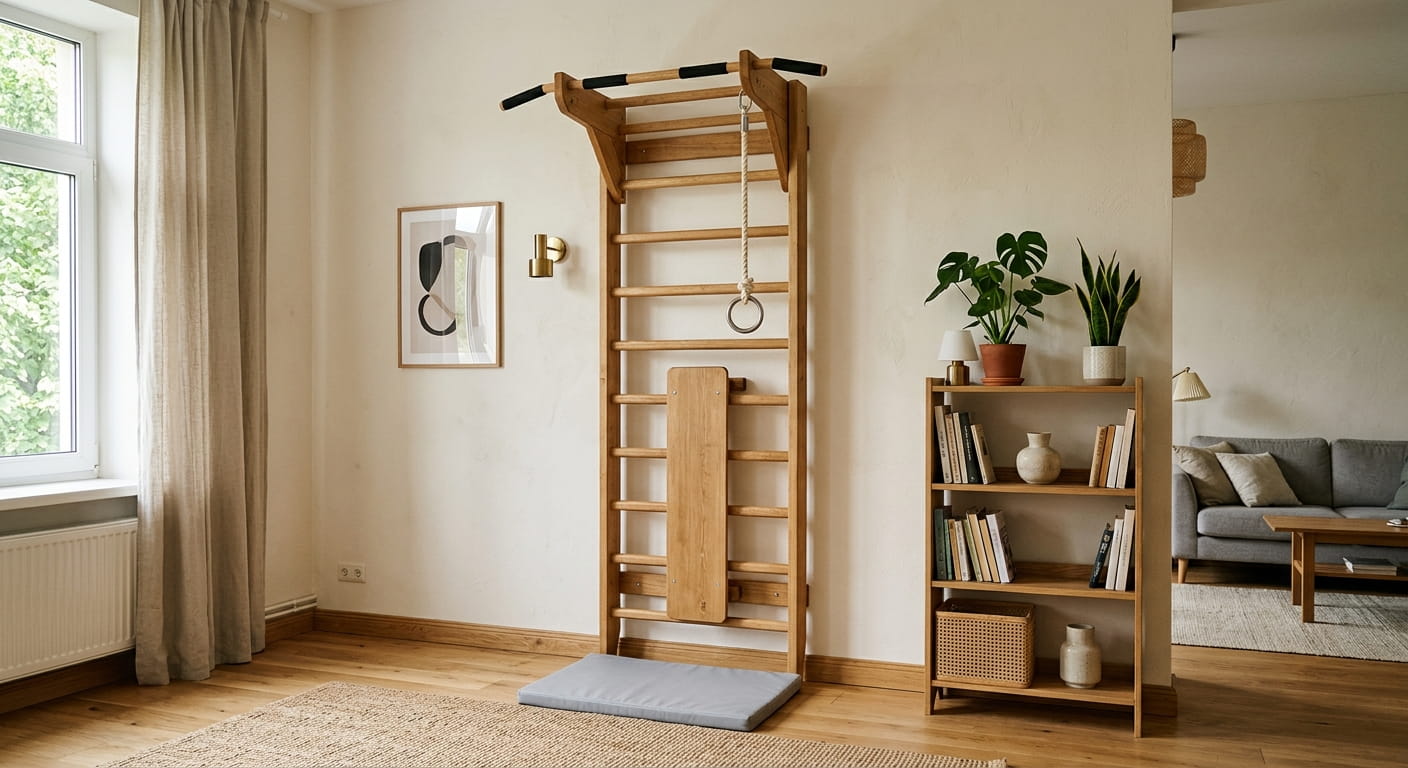
Wall bars with a pull-up bar take up little space — about 0.2 sq m of floor — but that does not remove the need to check the wall: plasterboard, aerated block without embedded parts or a thin partition will not hold an anchored fixing reliably under the dynamic load of a pull-up bar. For such walls a pressure mount is suitable, not a wall-mounted one.
Extra add-on equipment alongside the pull-up bar
Besides the pull-up bar itself, the same wall bars take a folding abs bench, gymnastic rings, a rope, a rope ladder and resistance bands — the whole set is fitted and removed without disturbing the main structure. For a child, rings and a rope ladder are often more interesting than the bar itself, while for an adult they are extra load points beyond hanging and pull-ups.
The choice of add-on equipment affects both the final price and how many people can train at once. If there is both a child and an adult in the family, it makes sense to take a model with a pull-up bar and at least one extra add-on element straight away rather than buying one part at a time over the year.
Mounting wall bars with a pull-up bar: wall-mounted, pressure, combined
Three mounting methods cover almost every situation. A wall-mounted anchored fixing is the most rigid, suited to concrete walls and solid brick; the pull-up bar in such a structure does not sway even during vigorous pull-ups. An anchored fixing cannot be used on plasterboard — the sheet simply will not hold the pull-out load from the bar.
A pressure mount (floor-to-ceiling, screw type, without drilling the wall) is the solution for rented homes and thin partitions. It requires a ceiling of 2.40 to 3.10 m and is not installed under stretch or suspended ceilings: the pressure post presses against a rigid surface rather than against film or a plasterboard lining overhead.
A combined mount is used in the top models, for example the «Atlet»: both the floor-to-ceiling bracing and an extra wall fixing point work at once. This is the most rigid of the removable solutions — exactly what you need if the pull-up bar is rated for a load of up to 250 kg and active use by several people in turn.
How to check the wall at home before buying a pull-up bar
Identifying the wall material is not hard even without special instruments: tap the surface — a dull, dense sound almost always gives away concrete or solid brick, while a ringing, light one means plasterboard or a hollow block. A small test hole tells you even more precisely: the drill goes into concrete with effort and a characteristic sound, and into a hollow material almost without resistance, with the bit sinking inward.
If the wall is in doubt, for wall bars with a pull-up bar it is safer to choose a floor-to-ceiling pressure mount straight away — it does not depend on the wall's strength and transfers the bar's load to the floor slabs above and below, bypassing the wall entirely. The only condition is a rigid ceiling of 2.40–3.10 m, without stretch fabric or suspended plasterboard structures overhead.
| Mount type | For which walls | Ceiling requirements | Bar rigidity |
|---|---|---|---|
| Wall-mounted anchored | Concrete, solid brick | Not critical | Maximum |
| Pressure (floor-to-ceiling) | Thin partitions, rented homes | 2.40–3.10 m, no stretch ceilings | High |
| Combined | Top models, e.g. «Atlet» | 2.40–3.10 m | Maximum, for loads up to 250 kg |
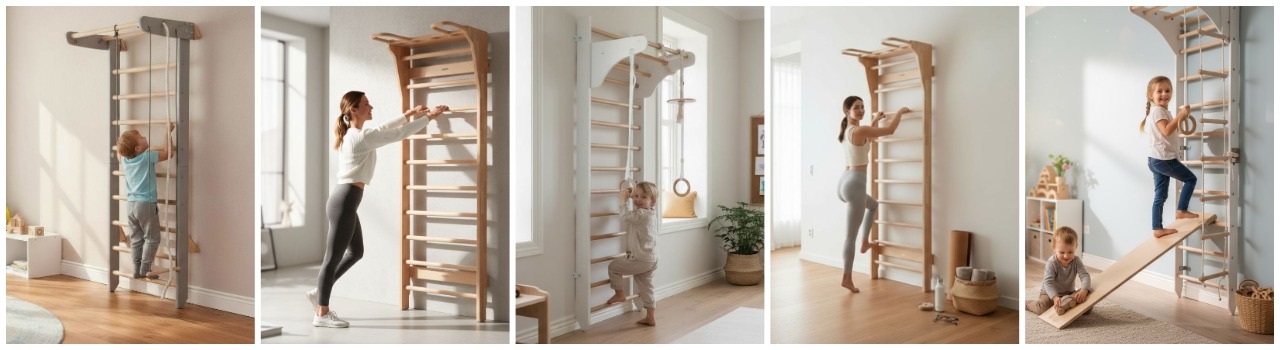
Concealed fixings
Furniture bolts do not stick out or catch clothing during pull-ups on the bar.
Wood, not metal
Laminated beam and the hard timber of the bar hold the rated load without a cold metal grip.
Assembly in 1.5–3 hours
The manual and all the fixings are already in the box; there is nothing extra to buy.
12-month warranty
The warranty also covers the add-on equipment — pull-up bar, dip bars and abs bench.
Wall bars with a pull-up bar for kids and adults in one structure
A child and an adult rarely train the same way, but a single set of wall bars with a pull-up bar can cover both tasks if the bar is removable and adjustable in height. For a schoolchild the bar is lowered so they can reach it standing on tiptoe; for an adult it is raised for a full hang with outstretched arms.
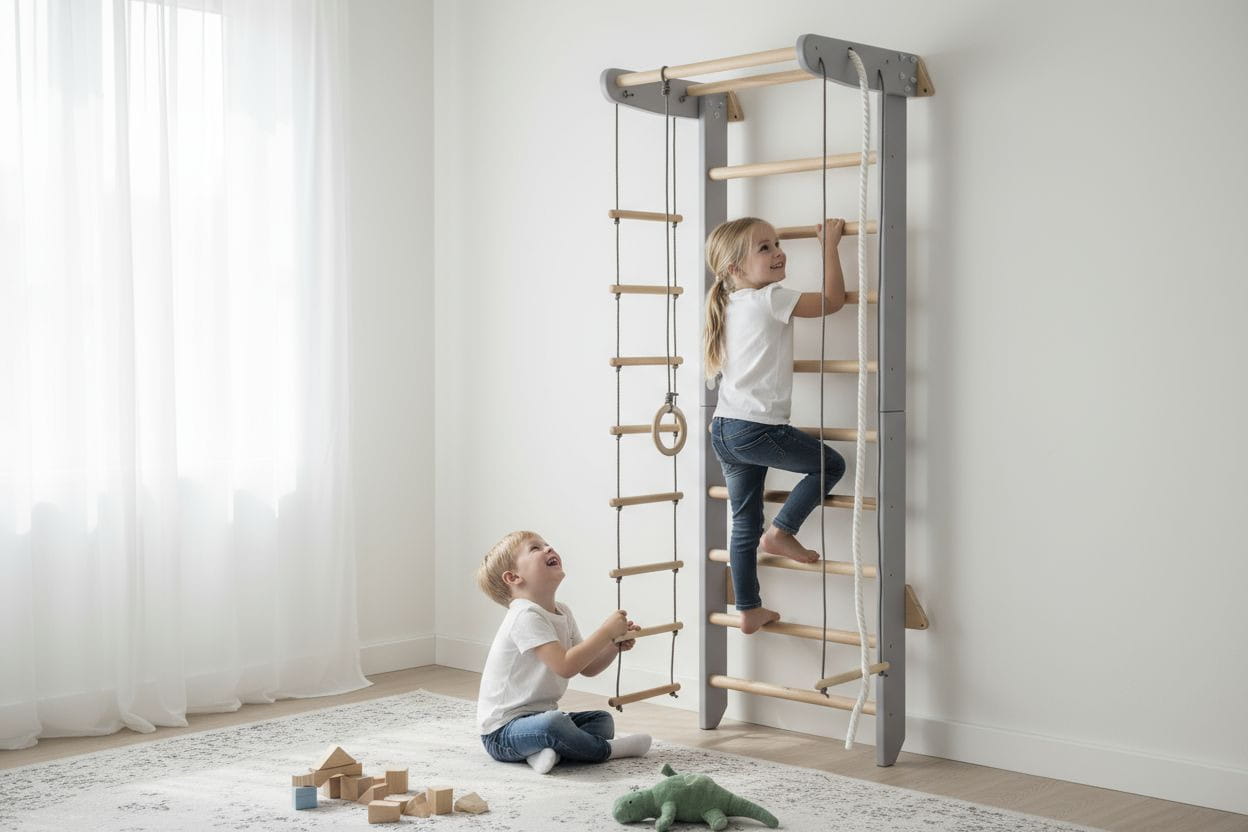
For younger children the pull-up bar is first of all a safe hang and grip strengthening, without the goal of doing ten pull-ups in a row. The bar should not be set too high for a child: if the feet cannot touch the floor or a safety mat should the grip slip, the risk of injury outweighs the benefit of training on the bar.
An adult, on the contrary, needs a bar they do not have to reach and jump up to every time — otherwise the workout becomes a nuisance and the apparatus is quickly abandoned in the corner. Hence the practical conclusion: if heights in the family differ greatly, the built-in bar of the «Vershina» will be a compromise for one person, while the adjustable unit of the «Moy Turnik» or «Atlet» is a working solution for everyone at once.
How much a home pull-up bar costs compared with gym sessions
A gym membership just for a pull-up bar and dip bars is usually justified only with regular visits several times a week over a long period. Wall bars with a pull-up bar are a one-off purchase from $187 for the «Vershina» to $218 for the «Moy Turnik», which pays for itself in the first months of regular home training, with no travel costs and no monthly membership.
The home option also wins on accessibility: you can do pull-ups on the bar in between chores, without timing it to the gym's schedule or spending an hour on the round trip. For a child it is especially noticeable — a schoolchild can hang on the bar for five minutes between lessons rather than waiting for a weekend trip to a fitness club across town.
The home solution has one drawback — the range of exercises is limited to the equipment standing in the room: pull-up bar, dip bars, bench, rings. For basic fitness and a healthy back that is enough, but for serious strength progress you will in time want to supplement the programme with a barbell or machines — then the pull-up bar on the wall bars remains a warm-up and auxiliary element rather than the only apparatus in the home.
Assembly, warranty and care of wall bars with a pull-up bar
Wall bars with a pull-up bar are assembled by yourself in 1.5–3 hours — the box contains the manual and all the fixings, including the joint for the pull-up bar if it is removable and adjustable. You will not need to buy fasteners separately or hunt for the right size of screw at the market.
The warranty on the structure is 12 months, and it covers not only the uprights and rungs but also the add-on equipment: the pull-up bar, dip bars and abs bench. The exception is natural wear of rope and textile elements such as a climbing rope or rope ladder, if they are included with a particular model.
How to care for the pull-up bar and uprights
Care is simple and needs no special chemicals: a dry or slightly damp cloth, without abrasive cleaning agents that could damage the water-based lacquer or oil finish. Every 3–6 months it is worth checking the bolt tightness — especially on the removable pull-up bar, which is taken off and repositioned more often than the uprights of the main structure.
It is recommended to place a mat under the wall bars — it is both cushioning if the grip slips off the bar and protection for the floor covering from scratches under regular load. The structure should not be placed by a radiator or in direct sunlight: constant drying can warp the wood, and the pull-up bar at the top will start to creak during pull-ups.
Typical mistakes when choosing wall bars with a pull-up bar
The first common mistake is to buy a pull-up bar from a picture alone, without putting a tape measure to your own wall. If the wall is plasterboard on a metal frame and you want a wall-mounted anchored fixing for the bar, the structure will at best work loose within a month and at worst rip the fixings out along with a chunk of wall during a sharp pull-up.
The second mistake is to buy a fixed-height pull-up bar "to grow into", "for a couple of years ahead". A child who cannot yet reach the bar standing up simply cannot train on such a bar: they have to jump, the grip slips more often and the motivation to train drops fairly quickly. For a growing child a removable adjustable pull-up bar settles the question at once and for a long time.
The third mistake is not checking the load in advance. The standard 120–150 kg covers most scenarios, but if there is someone in the family over 100 kg who plans to do weighted pull-ups, it makes more sense to look straight away at the reinforced «Atlet» with a margin up to 250 kg rather than hoping basic wall bars will hold the load with a big safety margin.
The fourth mistake is skimping on space for a mat. Wall bars with a pull-up bar take about 0.2 sq m on the floor, but the landing zone if the grip slips is wider than the structure itself. If furniture stands right under the bar or a corner of the room runs past it, the risk of a bruise from an awkward dismount is higher than it seems at the planning stage.
- Not measuring the wall before ordering an anchored fixing — check the wall material in advance.
- Taking a pull-up bar "to grow into" without adjustment — for a child this works worse than it seems.
- Not matching the user's weight to the model's load — 120–150 kg is not the same as 250 kg on the «Atlet».
- Forgetting about the mat and a clear landing zone under the wall-bars pull-up bar.
How to choose and order wall bars with a pull-up bar
The choice comes down to three questions: who will train (one adult of stable height or the whole family of varied heights), what wall is in the room (concrete and brick — for an anchored fixing; a thin partition or rented home — for a pressure mount) and what load is actually needed (the standard 120–150 kg or the reinforced 250 kg of the «Atlet»).
- Stable height, one user, a solid wall — the «Vershina» with a built-in pull-up bar.
- Varied heights in the family, adjustment needed — the «Moy Turnik» with a removable bar.
- Above-average user weight or dip bars and a bench needed in the set — the «Atlet».
- Thin walls or a rented flat — a pressure mount, ceiling from 2.40 to 3.10 m.
- Concrete or solid brick — a wall-mounted anchored fixing, maximum pull-up-bar rigidity.
Production is located in Zaslavl (Minsk District, Stroitelnaya ulitsa, 7) — our own workshop, with delivery organised throughout Belarus. If the model is needed not as a single unit but as a batch — for children's centres, gyms or under your own brand — the wholesale format applies: a minimum shipping batch from 10 units, work under a private label scheme is possible, and the products are certified to TR CU.
Lead times for wholesale orders are indicative: production takes 15–35 days, dispatch 3–5 working days after the batch is ready. Delivery to the carrier's terminal is free, and you can also collect the batch yourself from the warehouse in Zaslavl without waiting for the carrier.
For a retail order the easiest thing is to contact the manager — they will help compare the «Vershina», «Moy Turnik» and «Atlet» for your specific wall and family make-up, advise on the mount type and calculate the final cost with delivery. If the pull-up bar is not the only task and full gym-machine functionality is also needed, look at the option of a wall-bars-based exercise machine — there the bar is supplemented by block and strength units.
For those setting up an exercise corner specifically in a flat with limited floor space, the compact-installation option is covered separately on the page about wall bars for home — it goes into more detail on how to fit the structure into a small room without losing the functionality of the pull-up bar.
If active strength loading of the pull-up bar is planned — regular weighted pull-ups, a user weight near the upper limit or several adults training at once — it is worth looking at the reinforced range separately, not just at the «Atlet»: details on such models are gathered on the page about reinforced wall bars.
Expert opinion
In practice the choice between a built-in and a removable pull-up bar on wall bars is decided not by price but by the family make-up and the wall in the room. One stable user and a solid wall — take the «Vershina», it is simpler and more rigid thanks to the one-piece unit. Parents with growing children and families of varied heights are better served by the removable adjustable «Moy Turnik» pull-up bar, and those who need a serious strength load and a safety margin up to 250 kg — the «Atlet» with reinforced uprights and a combined mount.
It is also worth checking the wall before ordering: plasterboard and thin partitions do not hold an anchored fixing, and for them there is the floor-to-ceiling pressure mount with a ceiling-height requirement of 2.40–3.10 m. Assembly takes 1.5–3 hours by yourself, and the 12-month warranty covers both the wall bars themselves and the add-on pull-up bar, dip bars and bench — so the decision is usually made not from a single catalogue picture but after a conversation with the manager, who matches the model to the real room dimensions.
— Veronika Tarasevich, internet marketer, specialist in semantics and content in product niches.