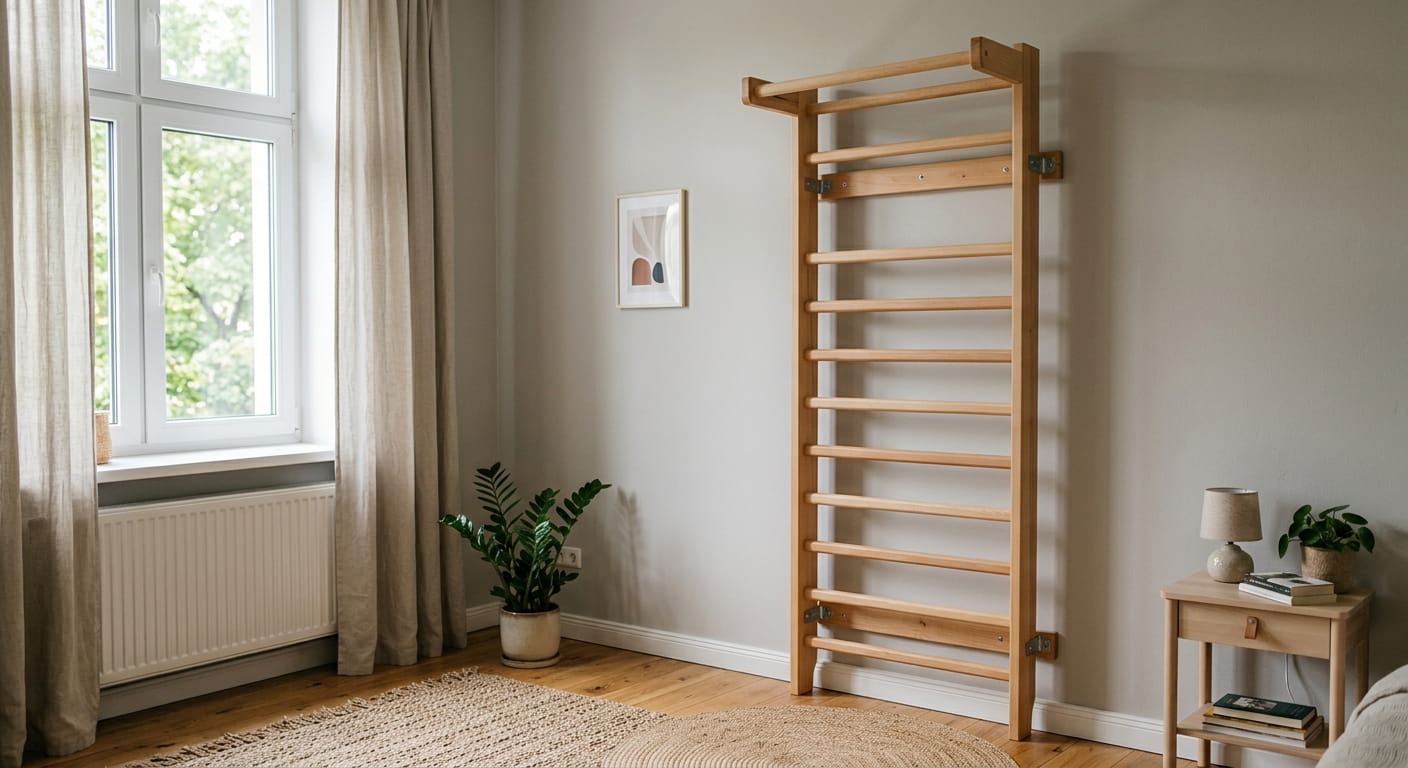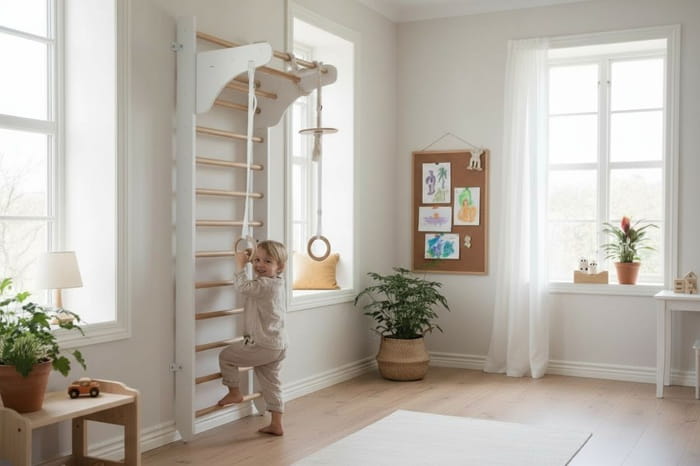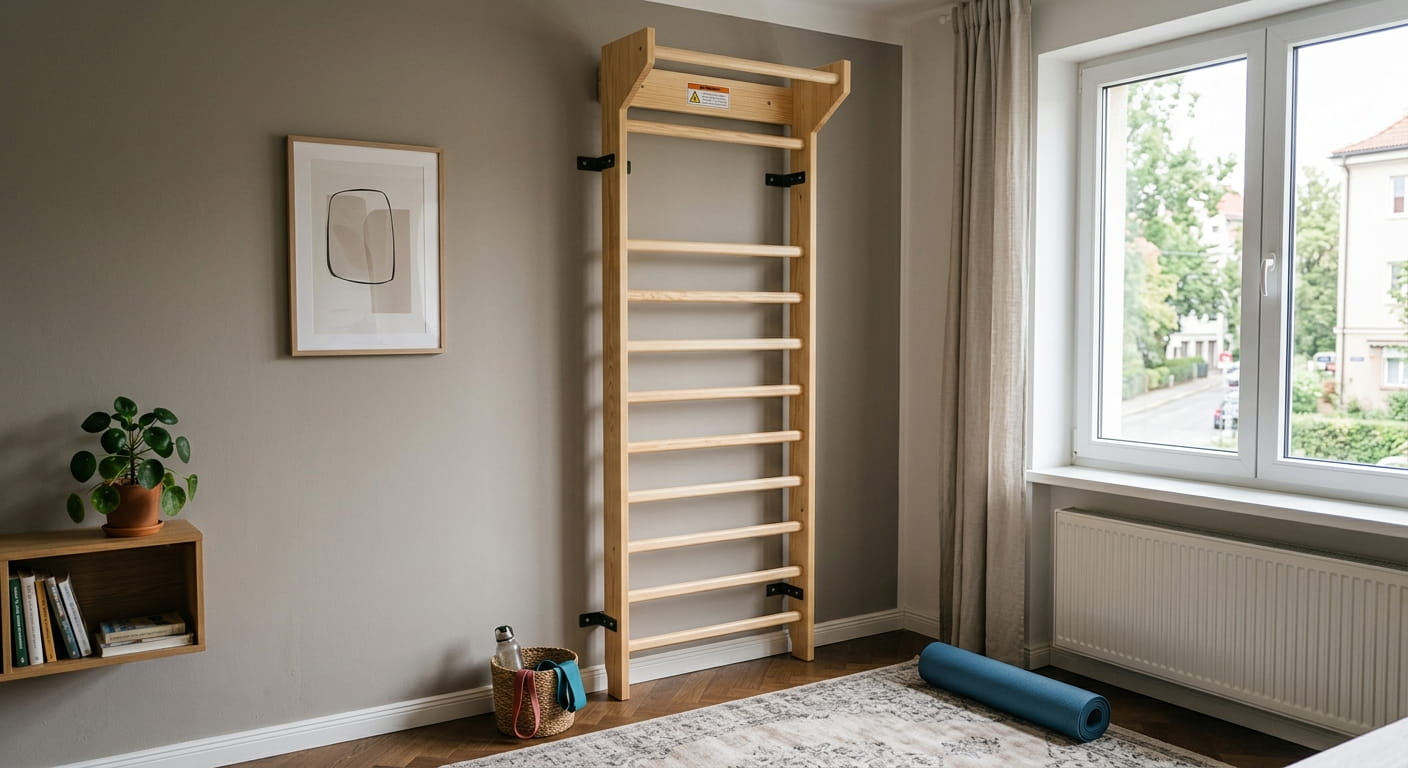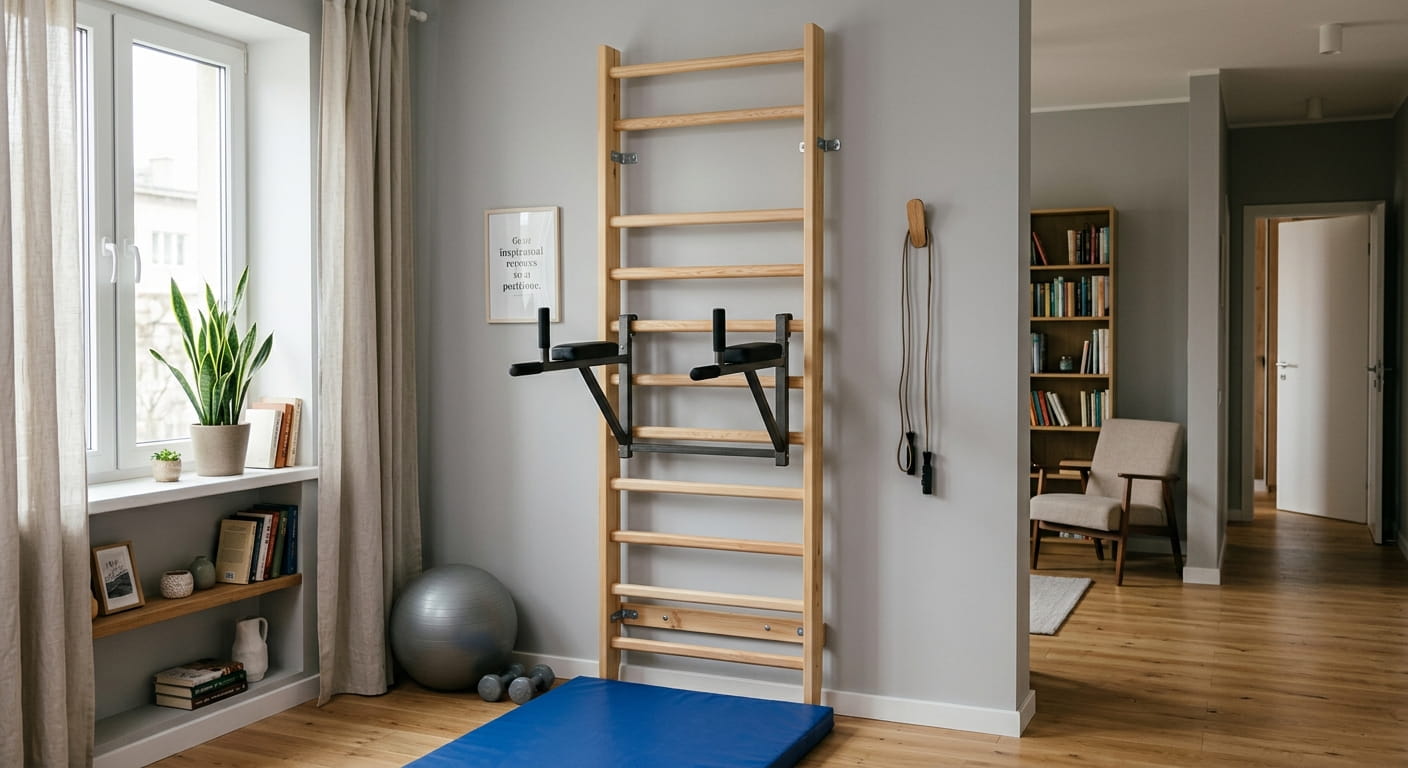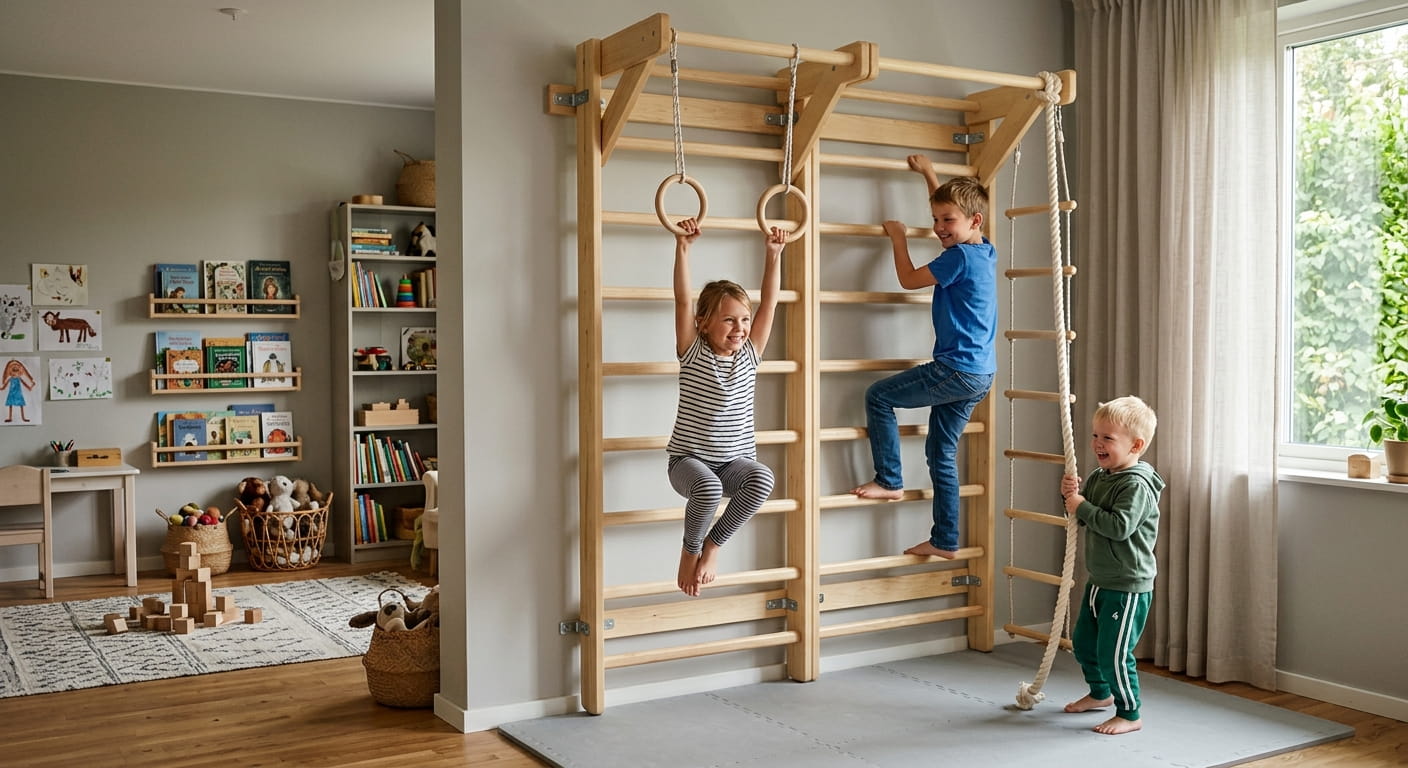
A child who gives up after five minutes of exercises yet climbs the cupboard ten times in a row to reach the sweets — a familiar picture in almost every home. Climbing wall bars channel that urge to climb into a safe direction: a plywood panel with holds is attached to the frame, the child trains grip, balance and courage, and the mats below take the impact of a slip. What follows: how such a panel is built, what it hangs on, at what age to fit it, and how to choose a model for a flat, a house or the outdoors.
Climbing wall bars: why a child needs a panel with holds
An ordinary ladder loads mainly the arms and shoulder girdle: pull-ups, hangs, climbing the rungs — all along the vertical axis, with predictable movements. A climbing wall works differently. The holds are set at random, the distance between them varies, and the direction of the grip changes too — the hand pulls up, then sideways, then holds the body weight almost on the fingertips. This is not an imitation of fitness but honest coordination work: the child decides anew each time which hand to use and where to step so as not to fall.
Courage deserves a separate mention. Not recklessness, but a calm attitude to height and the risk of falling. Children who regularly climb the holds under adult supervision with a mat below panic less on the playground, behave more confidently on the bars at school, and react more calmly if they stumble. It is the accumulated experience of "I can control my body at height", and a climbing panel on wall bars is the most accessible way to gain it at home, without enrolling in a club or driving across town.
Strength and endurance
Grip, forearms, shoulder girdle, core and back work at once — no isolated reps, simply through climbing.
Movement coordination
The asymmetric layout of the holds forces the body to recalculate its balance constantly rather than moving along a memorised path.
Courage and confidence
Controlled risk at a modest height with a mat below teaches a child to assess a situation calmly instead of fearing every climb.
Fine hand motor skills
Different hold shapes — flat, sloping, narrow — train the fingers more precisely than the uniform grip of a round rung.
There is a practical argument too: children quickly lose interest in a monotonous unit. A plain little ladder palls within a couple of months, whereas a panel with holds can be re-composed — swap some holds around, make the route harder, add a couple of holds higher up. The same frame remains, but the task is a little different each time.
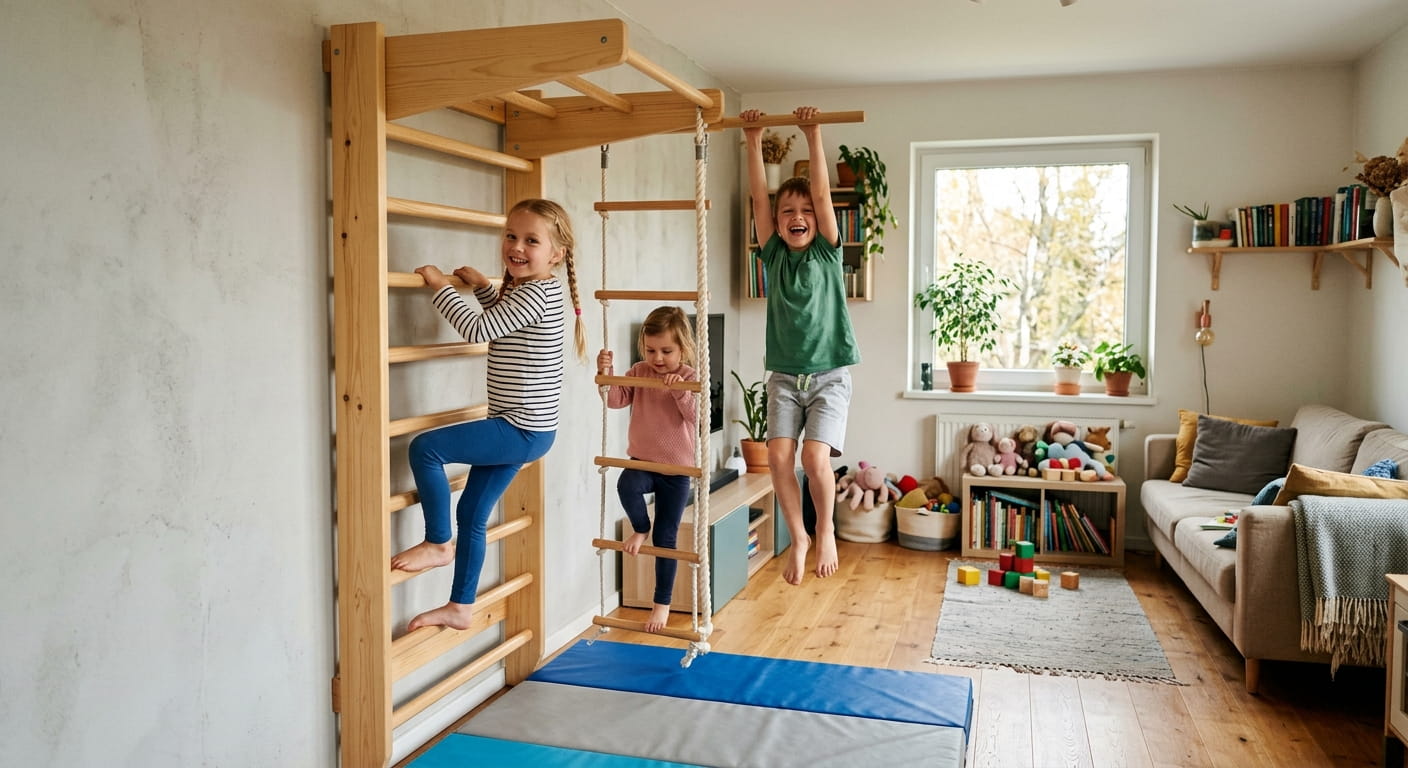
The climbing wall as a mounted element of children's wall bars
It is worth separating two different products straight away. A free-standing climbing wall is a self-contained structure, often with an inclined surface, typical of play centres and sports schools. What is meant here is a mounted or integrated panel with holds that occupies part of a span of ordinary wooden wall bars: either in place of several rungs or beside the main section on a separate board.
In terms of construction it is a flat board of moisture-resistant plywood or solid wood fixed to the same frame that carries the uprights and rungs. The holds — small shaped pads with rounded edges, comfortable to grip with the fingers or to place a foot on — are bolted to the board through T-nuts. The panel does not replace the whole set of wall bars; it is built into it as one more working element, on a par with the rungs, rings or rope.
This format is convenient for several reasons. First, the panel takes up little room — it fits within the same footprint as a standard section of wall bars, so no extra floor area is needed for it. Second, it is mounted in the same way as the whole structure: on the same frame, with the same fixings, without extra holes in the wall or ceiling. Third, the child gets climbing not as a separate attraction but as a logical continuation of an already familiar unit — the pull-up bar alongside, the rings alongside, and now the holds alongside too.
The placement of the holds is chosen in advance: some higher up for older children, some at a level a preschooler can reach. The lowest holds near the floor are usually set wider and more securely — it is from these that a child pushes off to begin the climb.

What the climbing panel for wall bars is made of
The panel board is moisture-resistant plywood from 18 mm thick or solid wood, finished the same way as the rest of the wall bars: with water-based lacquer or oil, without a harsh smell and without toxic components. The edges of the board are rounded and sanded so the child does not get hurt on an end if a hand slips accidentally.
The holds themselves are a separate matter. They are made of dense timber with a smooth but non-slip surface: no sharp ribs, no burrs, no protruding fastener heads on the working side. The fastener is countersunk flush or covered with a decorative cap. Each hold is fixed with at least one, and often two, bolts through the board — this rules out twisting under load when a child hangs their full weight on a single point.
- Holds of different sizes and shapes — from large "shelves" for beginners to narrow, trickier ledges
- No sharp corners or burrs on the working surface of any hold
- Hidden or recessed fasteners with no sharp protruding elements
- Impregnation of the board and holds without a harsh smell, resistant to damp hands and sweat
- The option to rearrange the holds as the child grows and the route becomes harder
The reliability of a hold is checked simply: it must not twist and must not wobble if you hang your full weight on it and sway gently from side to side. This check is worth repeating every few months — wood dries out and fasteners loosen over time.
Safety first: mats, height, spotting
A climbing panel is a unit with a risk of falling, and that must be treated soberly. Three things are non-negotiable here: a mat under the structure, a sensible hold height, and an adult nearby until the child has found their feet.
A mat is not a "just in case" extra but an essential part of the equipment. Even a soft floor covering like carpet does not absorb an impact the way a dedicated sports mat several centimetres thick does. The mat area should cover not only the spot beneath the panel but also the possible sideways fall zone — children rarely come off straight down; more often they are turned as they lose balance.
The height of the top holds is limited by the child's height and the ceiling height in the room: for home use the top point of the route is usually kept at a level from which a fall poses no serious risk even without an adult nearby. This does not mean the climbing wall will be "low and boring" — the route can run not only upwards but also diagonally, which in itself makes the task harder without gaining extra height.
Do not leave a small child at the panel unattended until they have learned to come down confidently, not just to go up. Falls more often happen on the way down — a hand slips when the child is feeling for the next hold with a foot without looking below.
It makes sense to go over a few simple rules with the child before the first independent climb: come down by the same holds used going up rather than jumping from height; do not push other children if a queue forms at the panel; do not climb in slippery socks or smooth shoes — barefoot or in non-slip socks the grip on the hold is noticeably better. These rules remove far more risk than a strict height limit, because the cause of a fall is most often not the height itself but a careless movement on the unit.
A separate point is the wall bars themselves as a load-bearing structure. A climbing panel creates a load not only in tension (hanging) but also in bending — a child hangs on a hold off to the side of the upright axis, creating leverage. So the fixing of the frame to the wall or ceiling must be free of play, and the frame itself must be made of timber thick enough to hold this side load without flexing.
Why holds cannot be fitted by eye, without a load calculation
The temptation to screw homemade holds straight onto ready-made wall bars yourself is understandable — it seems like just a couple of screws into plywood. In practice a factory panel differs from a home-made one precisely in the calculation: the board thickness for a given hold spacing, the depth the fasteners are set to, the grade of the wood itself. Thin plywood or a soft species of wood begins to crumble around the bolt hole over time, and a hold that held fine for six months suddenly twists under the child's weight at the worst possible moment.
Factory climbing wall bars with a climbing panel are engineered as a single system: the frame, the wall fixing, the board and the holds themselves are matched so that the load from climbing does not concentrate at one weak point. That is exactly why, when adding mounted equipment — not only a climbing panel but also rings, a rope or a pull-up bar — it is worth following the manufacturer's compatibility recommendations rather than combining elements at random.
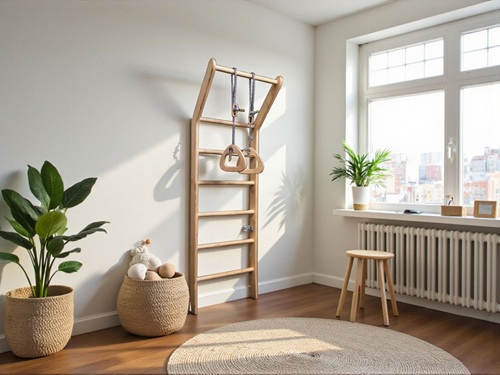
At what age to fit a climbing wall to wall bars
There is no universal "from three years and that's that" age — much depends on the particular child, but there is a general logic. Toddlers of eighteen months to two years already try to climb on things, but their holds are better set large, widely spaced and low, with constant adult supervision — essentially just another way to reach the lower rungs of the wall bars.
From three to four years a child is usually able to grip a hold deliberately and move their feet on their own — this is the age at which a climbing panel begins to work as a full training element rather than merely something to scramble on. By five to seven years the route can be made harder: shorten the distance between the comfortable holds, add narrower and sloping holds, run the line not strictly vertically but at a slant to the side.
The children's model «Maugli» is a good example of a complex designed for the age when it matters to a child not just to hang but to move actively: the rope, rings and rope ladder in this model serve the same purpose as a panel with holds — coordination and confidence in one's own body. For families specifically after a children's unit, it is useful to look in more detail at wall bars for kids — there the age-related features of the different models are covered separately.
After seven or eight years children often ask for a more "grown-up" route — with sparse holds where you have to reach and gauge the effort. Here the panel already overlaps in meaning with adult climbing: the mechanics of the grip and of shifting weight are the same, the difference being only in the difficulty of the hold layout and in the permissible load on the structure.

Climbing wall, pull-up bar, rings and rope: a climbing sports complex on one frame
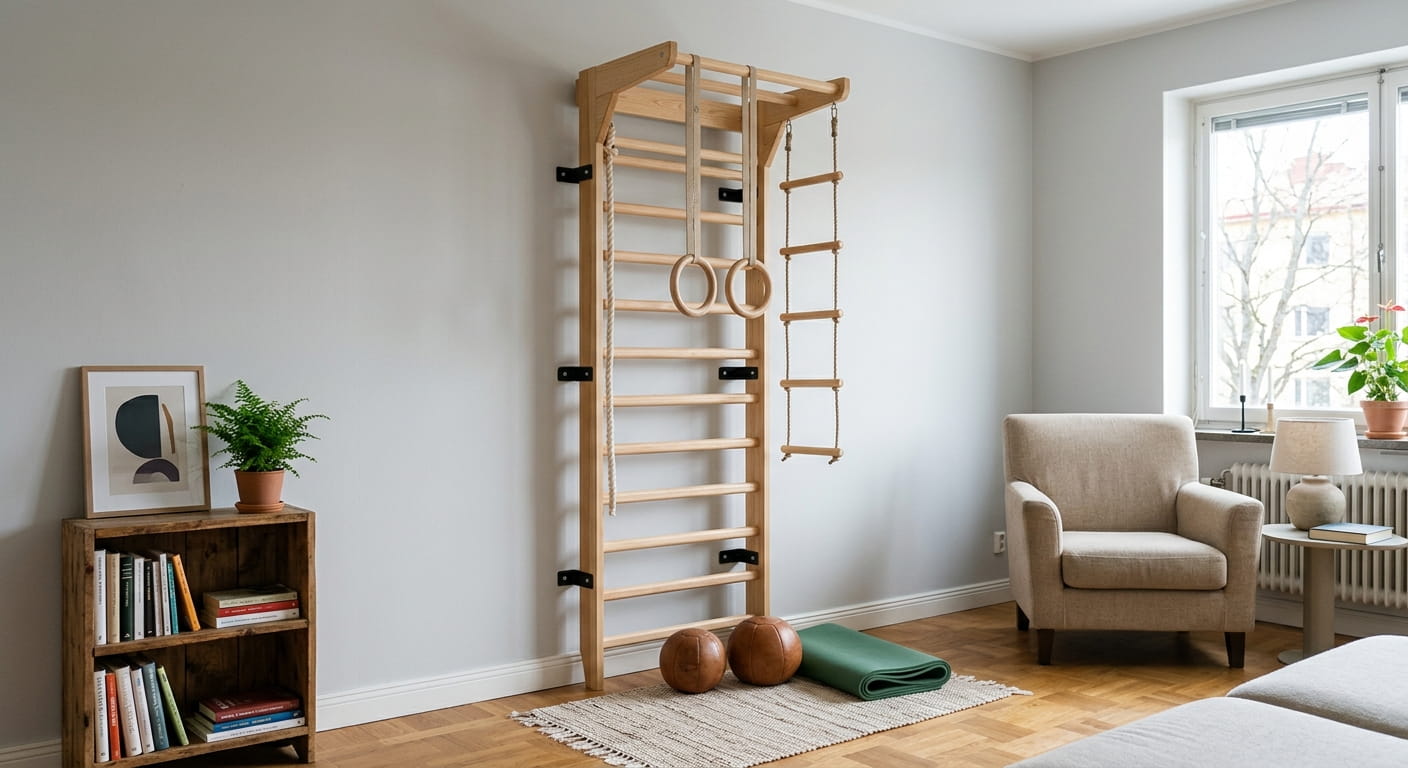
A panel with holds is rarely installed on its own — usually it is part of a wider set of mounted equipment on a single wall bars frame. The logic is simple: if a child is already climbing the holds, they enjoy alternating this with rings, a rope or pull-ups on the bar alongside. One frame — several different movements, and there is no need to give up a separate corner of the room or patch of yard for each unit.
Gymnastic rings pair well with the climbing wall precisely in the nature of the load: the holds train the grip in static and semi-dynamic work, while the rings add swing and demand stabilisation of the shoulder girdle in motion. If the plan is not just a panel but the whole set, it is worth looking in advance at what wall bars with rings look like, to understand how to place both elements on one frame without overloading a single fixing point.
A rope adds another type of grip — not on a fixed hold but on a constantly shifting support point, which is harder in terms of coordination. Monkey bars — rungs for moving by grip, hand over hand, without support on the feet — also sit logically alongside a climbing panel: both tasks require holding the body weight on the arms, only the monkey bars are horizontal while the panel is vertical or inclined. For those building a home sports complex in stages, it is worth looking ahead at the section on wall bars with a pull-up bar and monkey bars — there you can see how these elements combine on one upright without turning the structure into an overloaded "shelf stand".
Do not hang everything on one section at once: a rope, rings, a climbing panel and a pull-up bar at a single point create congestion and the risk that children will get in each other's way. It is wiser to spread the elements across different spans or alternate them by section if the unit is modular.
A separate climbing wall or a panel on wall bars: which is better value for a family
Parents often compare two scenarios: buying a separate play climbing wall or taking wall bars where part of the rungs is replaced by a climbing panel. The difference in price and in the space taken up usually settles the question in favour of the second option.
A free-standing climbing wall for the home means its own frame, its own fixing to the wall or floor, a separate area for installation and a separate mat for that very spot. A panel built into the wall bars uses the existing frame: the same upright, the same wall fixing, the same mat that already lies under the other elements. In effect, the family gets a climbing unit "thrown in" with a structure that is standing in the room anyway.
There is a substantive difference in the training itself too. On a separate climbing wall the child only climbs the holds. On climbing wall bars with such a panel, a single session can include a pull-up on the bar, a hang on the rings and a route along the holds — the body is loaded in different ways rather than by the same movement on repeat.
| Age | Route height | Type of holds |
|---|---|---|
| 1.5–3 years | Lower part of the panel, up to an adult's outstretched arm | Large, widely spaced, supervised only |
| 3–5 years | Up to the middle of the panel | Medium in size, regular step between holds |
| 5–8 years | The full panel height allowing for the ceiling | Various sizes, including narrow and sloping |
| 8 years and over | Full height, route on the diagonal | Sparse and small holds, a harder grip |
There is a flip side to the question. If a family already has wall bars without a climbing panel, buying and fitting a board with holds is usually simpler than dismantling the whole structure for a separate climbing wall. In effect one span of the frame changes, while the rest of the wall bars — the rungs, the wall fixing, the stability of the whole structure — stays as it was.
Mounting the panel: wall-anchored, pressure-mounted or combined
The climbing panel itself is not fixed separately to the wall "from the side" — it sits on the same frame as the whole set of wall bars, so the choice of mounting method for the entire structure also determines how securely the panel with holds will hold.
A wall-anchored fixing is the most rigid option. It suits concrete and solid brick walls; the frame is pulled to the wall with anchor bolts right through the masonry or concrete. This method holds the side load from the holds better than the others precisely because the frame has no play relative to the wall. This fixing must not be used on plasterboard — the sheet would simply tear out together with the anchors at the first serious load.
Floor-to-ceiling pressure mounting is a drill-free option, relevant for rented housing and thin partitions. The uprights are fixed in tension by a screw mechanism between floor and ceiling, for which a ceiling height of about 2.40–3.10 m is needed. This fixing is not used under stretch or suspended ceilings — the support point must rest on a rigid concrete slab, not on a fabric or film membrane.
Combined mounting unites both principles and is used in top models such as «Atlet» — the structure presses against floor and ceiling and is pulled to the wall at the same time, giving the maximum margin of rigidity. If a climbing panel is added to a fairly loaded frame — for instance together with rings and a rope on one section — combined or wall-anchored mounting is preferable to pressure mounting.
| Type of mounting | For which wall / room | Features |
|---|---|---|
| Wall-anchored | Concrete, solid brick | Maximum rigidity, not for plasterboard, holds side load from the holds better |
| Floor-to-ceiling pressure | Rented housing, thin walls | No drilling, needs a ceiling of 2.40–3.10 m, not for stretch ceilings |
| Combined | Top models, higher load | Wall + floor-to-ceiling at once, used in models such as «Atlet» |
The structure is assembled in one and a half to three hours, with the instructions and all the fixings already included — there is no need to buy anchors or pressure screws separately. The panel with holds is mounted on the frame the same way as the other mounted elements: through the standard holes, without drilling extra holes in the ready-made upright.
For home or outdoors: where to put the climbing wall bars
In a flat the climbing panel most often takes up part of a single section — rooms rarely allow a whole wall to be given over to climbing. Here compactness comes to the fore: the whole structure takes up about 0.2 square metres of floor space as standard, and the panel with holds is added within the same footprint without widening the installation spot.
For a private house there are more options: the panel can go in the nursery, in a separate playroom, and — if desired — part of the structure can be moved onto a veranda or into a gazebo. The outdoors calls for a separate structure with the appropriate wood treatment: weather-resistant compounds that withstand swings in humidity and temperature, rather than ordinary interior lacquer. Anyone considering the yard option should look separately at how outdoor wall bars are built — the requirements there are noticeably stricter than for indoor installation, and that concerns not only the wood impregnation but also the type of corrosion-resistant fastener.
There is a practical point often overlooked: both at home and outdoors, a climbing panel must not be placed right next to heating appliances or in direct sunlight all day long. Wood dries out and cracks faster from constant heat, and holds on a dried-out board begin to wobble over time even with sound fasteners.
Outdoors, wall bars with a climbing panel are usually used seasonally — from spring to autumn. For winter the textile and rope elements such as the rope are worth removing and storing under cover so they do not get damp and freeze. A wooden frame with the right impregnation tolerates the cold calmly, but sharp swings in temperature and humidity still wear outdoor wood faster than in a room with a stable climate — worth bearing in mind when deciding whether to put the structure in the yard or stick to an indoor version.
Load, dimensions and materials: what to look at when choosing
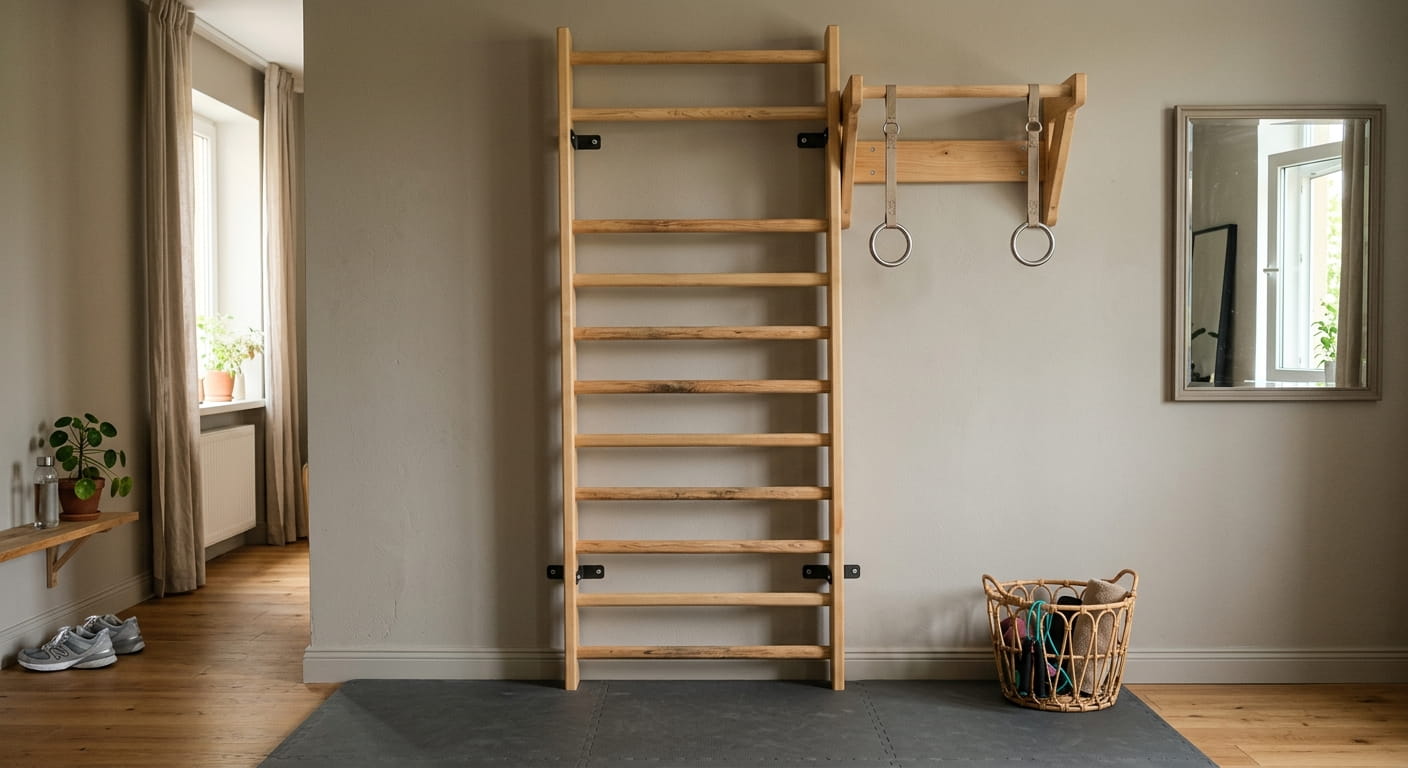
Standard wall bars are rated for a load of 120–150 kg — more than enough for children's use, including the jerk loads of climbing the holds. Reinforced models such as «Atlet» hold up to 250 kg thanks to thicker uprights, and keep that margin of strength not merely "for the future" but in case a child on the panel and an adult end up on one section at the same time — for example, spotting from below.
The uprights are of glued pine or birch timber; the rungs are made of denser, harder wood, beech or ash, to withstand the point wear of constant gripping. The board of the climbing panel is usually of moisture-resistant plywood — it "moves" less under humidity swings than a single large-section board and is less prone to cracking precisely where the holes for the hold fasteners are drilled.
The fastener throughout the structure is a hidden metal one, furniture connectors that do not protrude and do not catch clothing or skin during climbing. The same principle applies to the holds: there should be no visible fastener on the working surface.
| Model | Build | Load | Price from, $ |
|---|---|---|---|
| «Maugli» | Children's, rope / rings / rope ladder | standard 120–150 kg | from 92 |
| «Krepysh» | Basic I-shaped, narrow piers | standard 120–150 kg | from 198 |
| «Vershina» | I-shaped, built-in top pull-up bar | standard 120–150 kg | from 187 |
| «Minsk Sport» | Modular, removable attachments | standard 120–150 kg | from 174 |
| «Atlet» | Reinforced, thick uprights, dip bars and bench | up to 250 kg | from 202 |
For a climbing panel as an additional element almost any of these models will do — what matters is not the base structure itself but how rigidly it is fixed and how firmly the board with holds sits on the frame. Modular options such as «Minsk Sport» are handy in that they let you move the attachments around as the child grows and the demands change.
Care for the climbing wall and the wall bars
Caring for a climbing panel differs hardly at all from caring for the rest of the wall bars. Wipe it with a dry or slightly damp cloth, without abrasive sponges or aggressive chemicals — they destroy the wood's protective coating and make the hold surface more slippery rather than cleaner.
- Every three to six months check the tightness of all the bolts, including the fastener of each hold separately
- Keep a mat under the structure — permanently, not just "when you remember"
- Do not place the wall bars by a radiator and do not keep them in direct sunlight all day
- Check the holds for twisting and wobble by hand, rocking firmly
- Keep an eye on the condition of the rope and rope ladder separately — textile and ropes wear faster than wood
The warranty on the structure and mounted equipment, including the climbing panel, is 12 months as standard — except for the natural wear of rope and textile elements, which chafe from constant friction regardless of the quality of the original material.
It is worth checking the condition of the holds' coating separately — not the impregnation of the board overall, but specifically the working surface of the holds that a child constantly grips with palms damp from sweat. If the lacquer or oil on a hold has worn down to bare wood, the surface may become a little rougher or, conversely, slippery depending on the species of wood — in that case the hold is worth refreshing or replacing, before it works loose on its own.
How to choose and order climbing wall bars
Before ordering it is worth settling three things: the type of wall in the room (concrete or plasterboard — the mounting method depends on it), the ceiling height (important for the pressure-mounted option) and the age of the children who will use the panel — the placement and size of the holds depend on it.
Manufacture is carried out in our own workshop in Zaslavl, Minsk District; the finished structure goes into production over 15–35 days, with delivery across all of Belarus. When ordering you can check with a manager exactly how to position the holds on the board for the child's height and the ceiling height in a specific room — it is a straightforward adjustment at the configuration stage, not a separate paid option.
For those buying in batches — early-development schools, children's centres, retail chains — wholesale from 10 units is available, private-label work is possible, and all products come with certificates of conformity to the Customs Union technical regulations. Dispatch takes 3–5 working days, delivery to the carrier's terminal is free, and self-collection from the warehouse is also possible.
Checklist before buying climbing wall bars
- The wall type in the room — concrete, brick or plasterboard — determines how the frame is fixed
- Ceiling height from the floor — important if drill-free pressure mounting is planned
- The age and height of the children who will use the panel — the height and step of the holds depend on it
- The area and thickness of the mat under the whole wall bars structure, not just under the board with holds
- Compatibility of the panel with other mounted elements — rings, rope, pull-up bar — on one frame
- Certificates of conformity and a warranty on the whole set of wall bars and the mounted equipment
If the climbing panel is needed not on its own but as part of a wider set — with a pull-up bar, rings, a rope or monkey bars — it is wiser to discuss this with a manager straight away rather than buying the elements separately later. That makes it easier to calculate the load on the frame and choose a fixing that will hold the whole set at once, not just the base structure.
It is also worth remembering that a climbing panel is not a one-off "grow-into-it-forever" purchase. As the child masters the basic route, it makes sense to rearrange the holds, complicate the layout, add smaller holds. This does not require a new structure — only shifting a few bolts on the existing board, and the unit becomes interesting again for several months ahead.
In budget terms a climbing panel usually costs less than a free-standing play climbing wall of comparable size, simply because it uses the ready-made wall bars frame as its load-bearing base. A separate upright, separate mounting and a separate installation area are not needed in this case — all the functionality is added to a unit that is standing in the home anyway.
The bottom line on the format: a structure small in area that combines strength work, coordination and an element of controlled risk — something hard to get from a pull-up bar alone or rings alone. That is exactly why a panel with holds increasingly comes not as a separate purchase but as a logical addition to ordinary wooden wall bars for the home.
Expert opinion
A climbing panel should be seen not as a separate attraction but as a working element of the overall wall bars structure — it uses the same frame, the same fixing and the same maintenance principle as the other mounted units. The main thing not to economise on: the rigidity of the frame's fixing to the wall or ceiling, the reliability of each hold's fixing separately, and a mandatory mat under the structure — without these three things all the unit's other advantages lose their meaning.
For a family with children it is one of the few pieces of sports equipment that trains strength, coordination and psychological resilience to risk at the same time, while taking up the area of a single wall bars section. When choosing the model and the mounting method it is wiser to consult a manager once than to pick a configuration at random — especially if the panel is set up together with rings, a rope or a pull-up bar on one frame.
— Veronika Tarasevich, internet marketer, specialist in semantics and content in product niches.