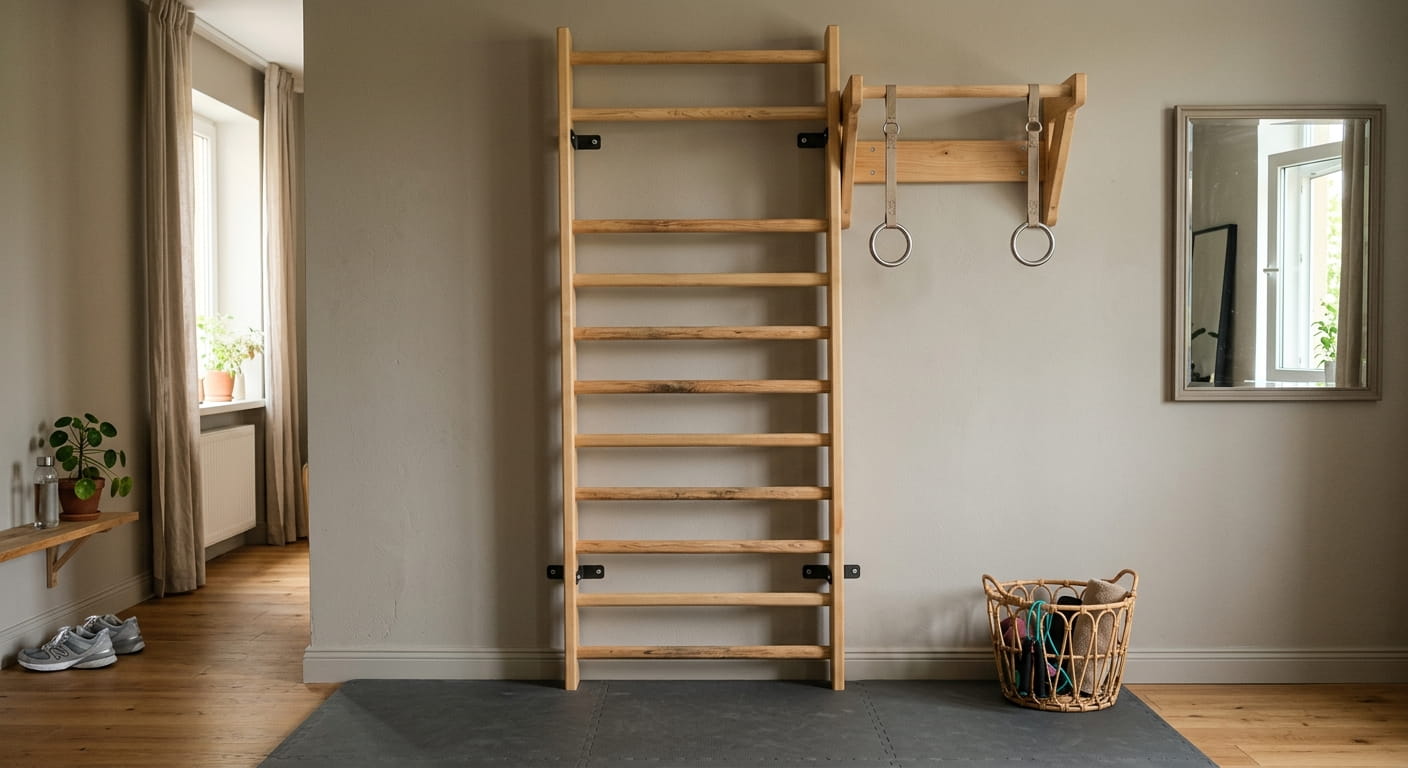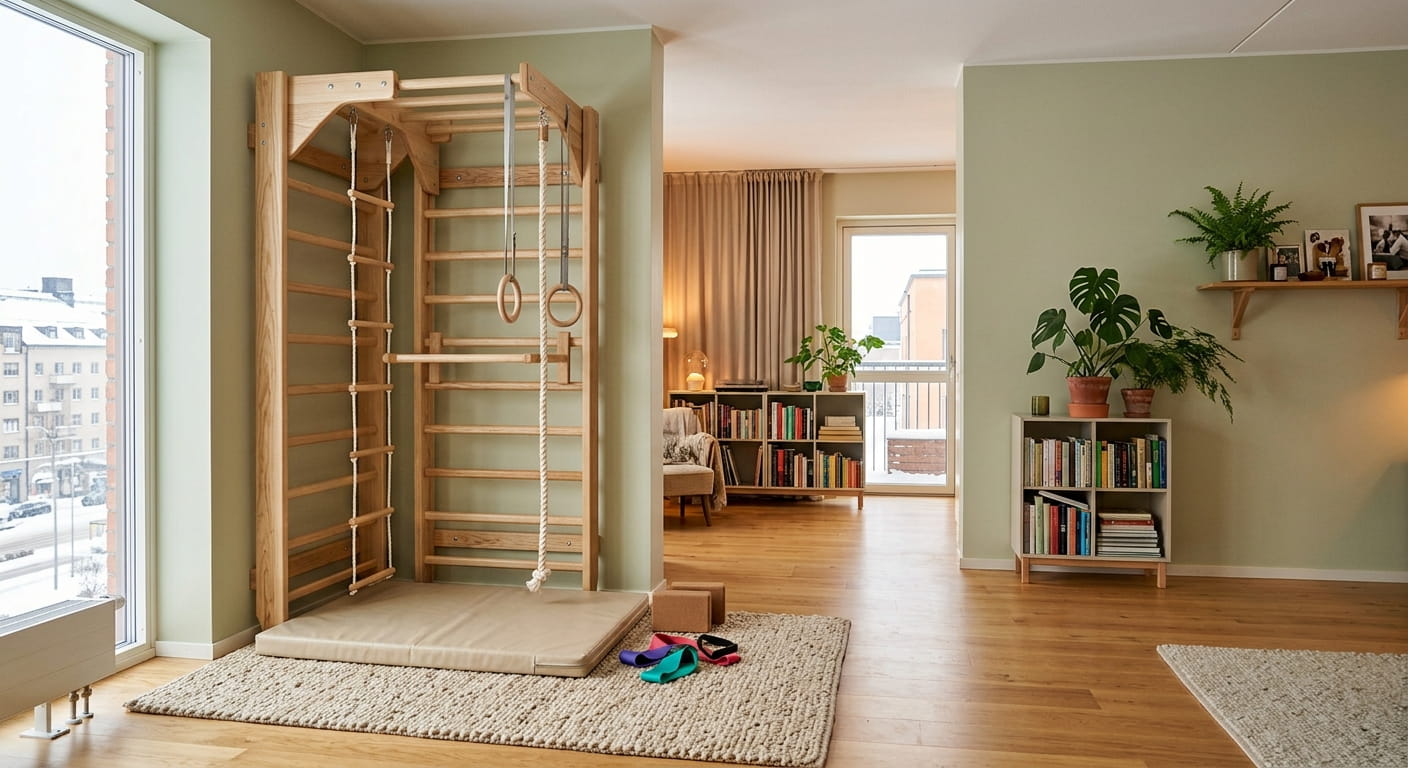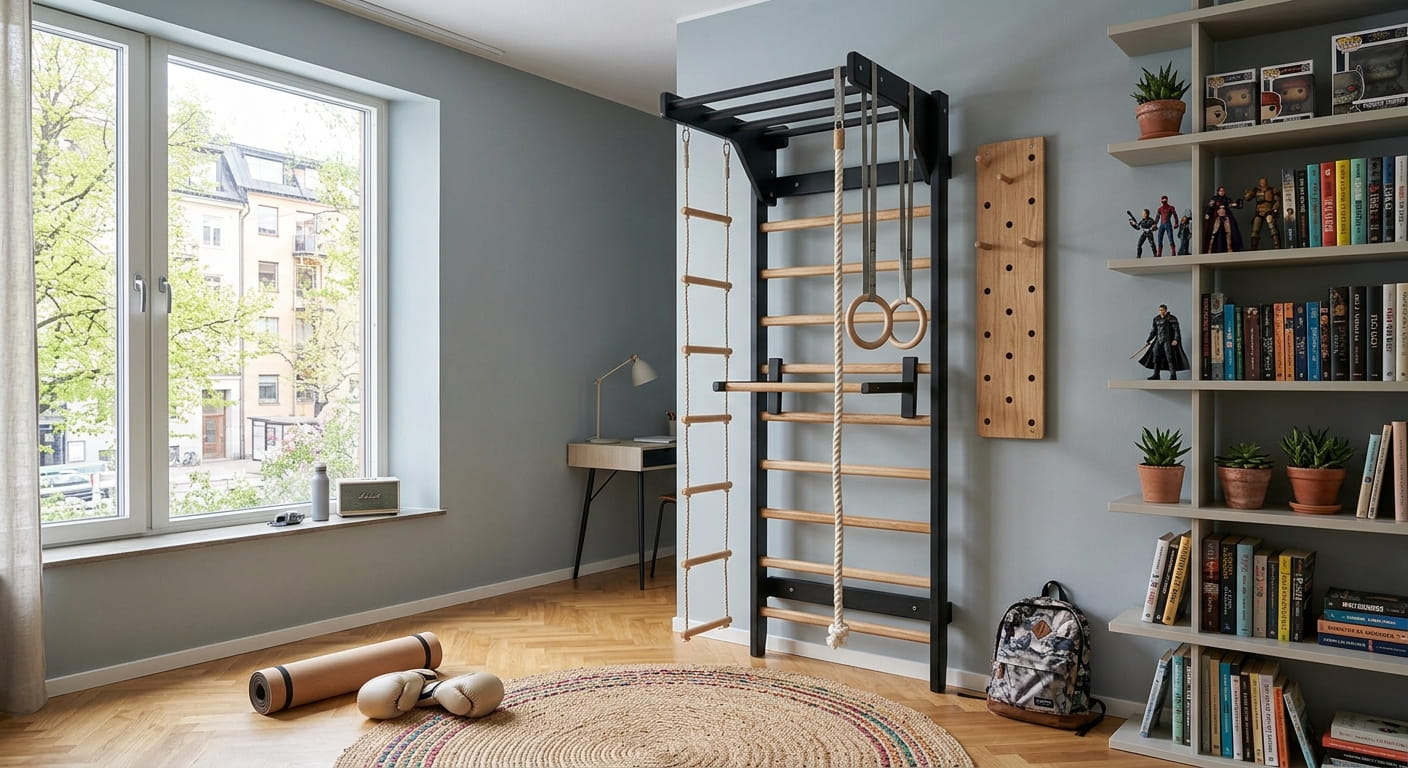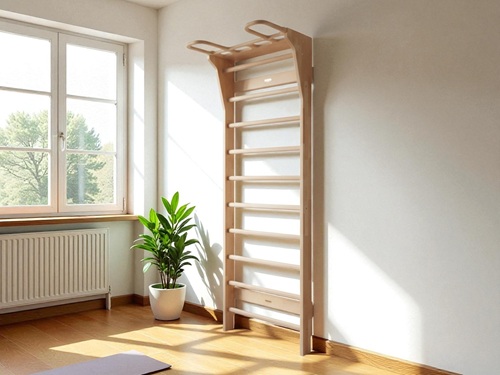
Wall bars for kids are one of those purchases that pay for themselves in the very first week: the child clambers up the rungs instead of jumping from the sofa to the armchair and back. You can set the unit up from a year and a half to two years old, as long as the rung spacing, the diameter sized for a little hand and the mat underneath have been thought through. In order, then: from what age it is safe, how to pick the size by height, which fixing suits an apartment, what makes the children's "Maugli" model with its rope and rings so good, and how to care for the wood so the unit lasts more than one season.
We make these wall bars for kids in our own workshop in Zaslavl near Minsk — uprights of glued beam, rungs of beech or ash, a water-based finish with no harsh smell and no harmful resins. We deliver throughout Belarus. Below we take each point in turn, because for a child's room details like the diameter of a rung or the type of fixing matter far more than they do in an adult bedroom.
A quick note on wording: some call the unit a children's sports corner, some simply a ladder against the wall, and some out of habit still call it wall bars for kids, even though it is really a separate range with its own height, rung spacing and add-ons. The name changes nothing about the essence — it is the same structure, the difference is only in the scale for a particular age.
From what age to install wall bars for kids
There is no single threshold here — there is the logic of a child's physical development. At a year and a half to two years a toddler is still unsteady on their feet, yet already tries to climb the sofa, a chair, a windowsill — anywhere, as long as it is higher up. A low section with wide lower rungs is safer at this age than a stool or a bookcase they will eventually scale anyway. Start with a minimal setup: two or three lower rungs, a soft mat and an adult always present.
A child under three is never left alone at the wall bars for kids, even if the height seems trivial — their coordination is not yet enough to judge grip strength on their own and let go in time when they lose balance.
A common mistake is to buy wall bars for kids "to grow into" straight away — really sized for a teenager — while the child is not yet three. The upper rungs then stand idle for years, and the lower tier has to be hemmed in with homemade bans like "not up there yet." The child breaks the rule at the first chance, because the unit is right there in front of them, tempting them to climb higher. It makes more sense to take a model with narrow rung spacing at the bottom and gradually add the extras — rope, rings — than to hold back curiosity with bans for years.
The opposite mistake is just as frequent: parents put off the purchase until school age, afraid the little one will "hurt themselves," even though low wall bars for kids with a mat underneath are objectively safer than a stool, a windowsill and the very sofa the child climbs every evening with no unit and no supervision at all.
By four or five the motor skills mature noticeably: the child now understands that a rung should be gripped with the whole hand rather than hooked with a single finger. At this age wall bars for kids turn from a cautious toy into a proper piece of apparatus — you can add a rope, rings, a rope ladder. The "Maugli" option becomes interesting here; more on it a little below.
After seven or eight the child is physically able to work almost as on an adult unit: pull-ups, hanging with straight arms, simple moves on the bars. In practice, families at this age rarely buy a second set — they add more grown-up elements to the existing one: a higher pull-up bar, parallel bars, an ab bench. The result is a single unit that grows with the child rather than turning into clutter after two seasons.
Compared with buying a separate pull-up bar, parallel bars and a mat one by one, investing in a whole set of wall bars for kids is almost always better value and more practical: a single set of uprights already combines the ladder, the mounting points for the add-ons and space for the mat, whereas scattered pieces take up more wall and each needs its own fixing.
What worries parents when choosing wall bars for kids
The first doubt is nearly always about the rope: isn't it dangerous to let a child climb a rope without a spotter? In practice the rope on a children's model is fixed at the same height as the rest of the add-ons, and a mat lies under the unit — the risk is no higher than climbing the ordinary rungs, except that the load on the arms is a little greater, which is rather a plus for developing grip.
The second doubt is whether the child will tire of the unit within a month. A lot depends on the add-ons here: the same wooden ladder-wall with a fixed set of rungs does indeed pall faster than a set where you can swap the rings for a rope, and the rope for a rope ladder. Interchangeable add-ons solve the interest problem better than buying a second, more complex model.
The third is whether the wall bars for kids have to take up a whole wall of the room. They do not: the unit physically occupies about 0.2 sq m of floor and fits within a standard pier of wall. Some models are made specifically for narrow piers — the "Krepysh" from the range for adult users is built on the same compact principle.
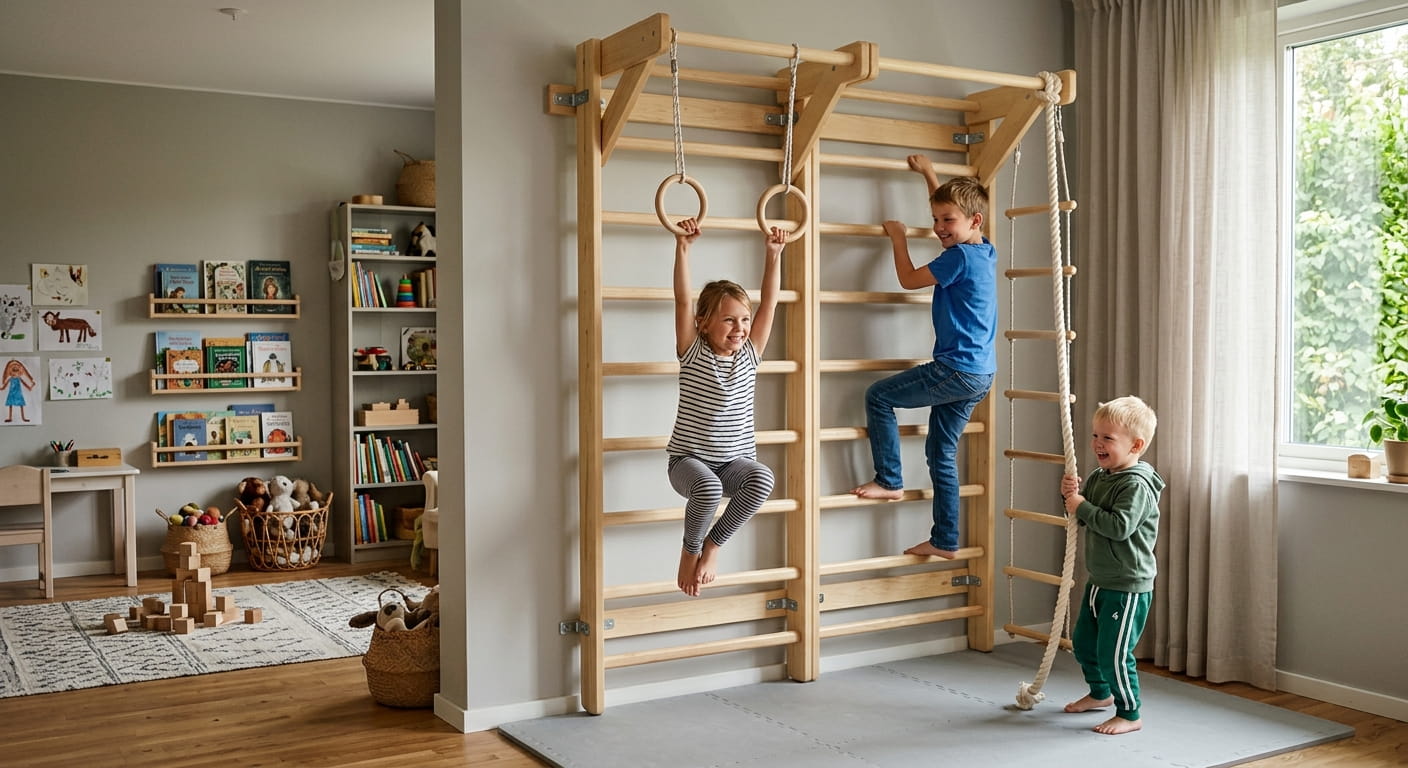
Sizing wall bars for kids: choosing by height
The calculation is simple: the unit should let the child reach the top rung with at least a little to spare, not force them up on tiptoe. Wall bars for kids that are too tall are useless for a three-year-old — the top stays out of reach for another couple of years. Ones too low for an eight-year-old become cramped and dull within a single season, and the unit simply stops being used.
| Child's age | Average height | Wall bars height | Add-ons to include |
|---|---|---|---|
| 1.5–3 years | 90–100 cm | up to 150 cm, 3–4 lower rungs | mat, low run of rungs |
| 4–6 years | 105–120 cm | 200–230 cm | rope, rings, rope ladder |
| 7–9 years | 125–140 cm | 230–260 cm, full height | lower pull-up bar, parallel bars |
| 10 years and up | 140 cm and up | full adult wall bars | pull-up bar, parallel bars, ab bench |
A small margin in height is fine: wall bars for kids chosen "one age step ahead" last longer and will not need replacing within a year. But a margin of two steps at once — a full-size unit for a three-year-old, say — means the upper part stands idle for years while the wall bars for kids visually crowd a small room with their bulk.
On some models the add-ons can be moved up and down — handy in a child's room, where the child grows faster than the furniture changes. On the "Minsk Sport," for instance, the add-ons are removable and adjustable: raise the pull-up bar a few centimetres and the unit fits the child's height again, without buying a whole new set.
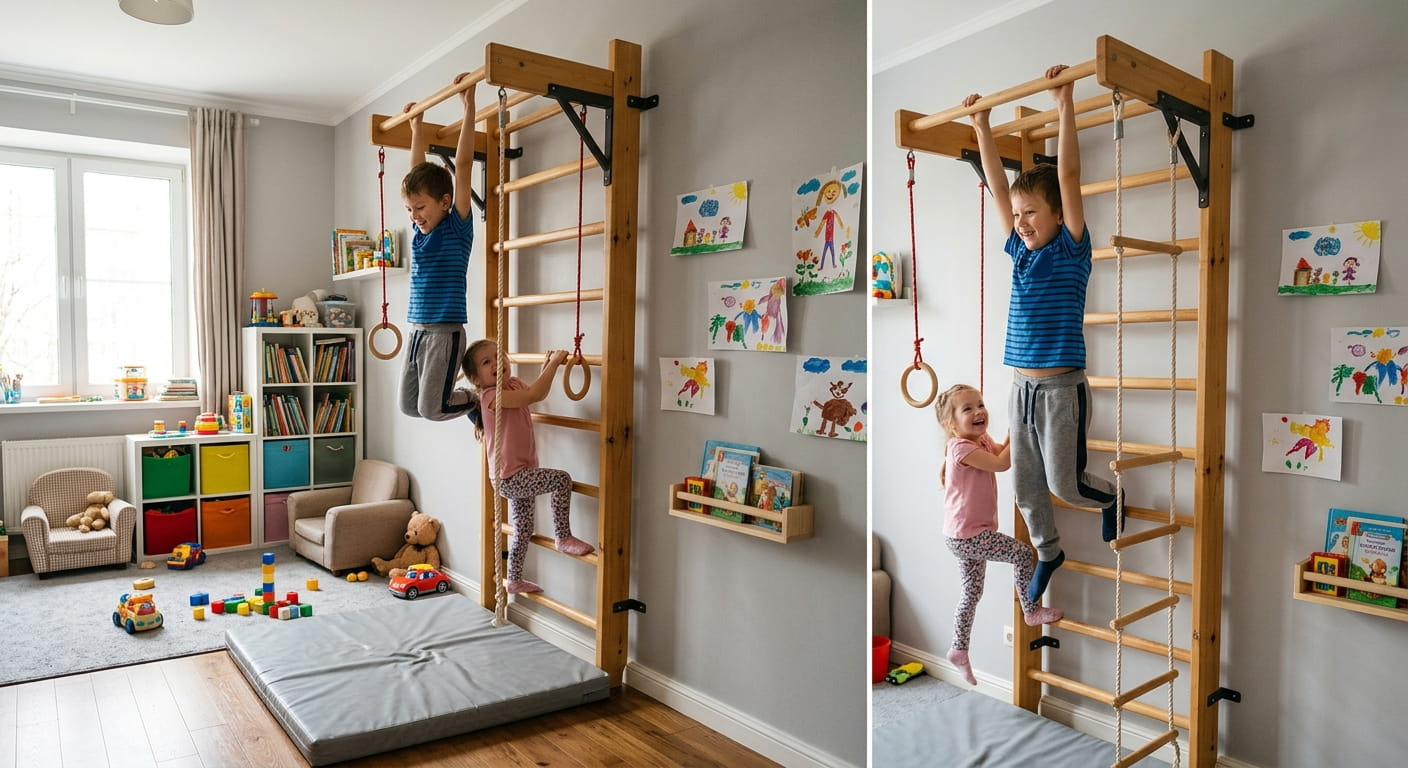
Safety: rung spacing, mats and a chemical-free finish
For a child's room the safety rules are stricter than for an adult unit, and rightly so: a child has less grip strength, shorter arms and legs, and less experience in judging their own movement. That gives four concrete requirements to look at when choosing.
Rung spacing to match the age
On children's models the distance between rungs is made smaller than on adult ones — so the child's foot reaches the next step without the risk of slipping off or overstretching.
Diameter sized for a small hand
A beech or ash rung is turned to a rounded profile so a little hand wraps fully around it, rather than sliding with the fingers over a flat or overly thick surface.
Hypoallergenic finish
The lacquers and oils are water-based, certified, with no harsh smell or toxic resins. For a child's room, where little hands grip the wood every day, this is not an option but a requirement.
Concealed fixings
The metal ties are sunk into the beam — no protruding bolts that a child could catch their clothes on, scratch themselves against or knock into during lively play.
The mat under wall bars for kids is not an extra but a part of safety. Even with careful coaching, falls happen, and a soft floor covering cuts the risk of bruising many times over, especially while the child is still learning to judge height.
For the first couple of weeks it makes sense to introduce simple rules for using the unit and to say them aloud every time: climb one at a time, without shoes — socks or bare feet grip a rung better than a slippery sole — and do not jump down from a height but climb back down the rungs. Children quickly learn the ritual if the adult never breaks it "just this once."
A separate question is the choice of finish by colour. A clear lacquer or oil brings out the grain of the wood and does not hide scuffs the way a coloured enamel does. For children's wall bars the colour is more a matter of taste and of matching the rest of the room's furniture than of safety: the hypoallergenic property is equally ensured by clear and by tinted water-based finishes, as long as both are certified.
The uprights are glued beam of softwood or birch, the rungs beech or ash: the timber is dense, does not crumble under load and gives no splinters during lively daily use — which matters far more in a child's room than in an adult bedroom or study.
Every part goes through a visual check in the workshop before assembly — cracks, knots on the working surface of a rung and uneven sanding are not allowed on a children's model, even if the material is sound in terms of strength. A child grips a rung more often and for longer than an adult, so a perfectly smooth surface here is not a matter of looks but part of that same safety discussed above.
One more point that is sometimes overlooked: the distance from the outer rungs to the wall and to neighbouring furniture. Wall bars for kids should stand so that a child who stumbles does not catch a corner of the adjacent shelving unit or the windowsill — there needs to be at least a little clear space on either side of the unit, rather than a tight fit between two cabinets.

The benefits of wall bars for kids: posture, feet, coordination
Parents rarely buy the unit for abstract benefit — more often it is a specific request from a paediatrician or orthopaedist: improve posture, strengthen the foot, burn off surplus energy before bed. Let us go through, point by point, what regular work on the rungs really gives.
Preventing posture problems
Regular hangs and pull-ups load the back symmetrically and take the strain off the spine — simple, clear prevention of a stoop and scoliosis during a child's growth spurt.
Preventing flat feet
Climbing barefoot over rounded rungs makes the muscles of the foot work almost as much as special exercises on an orthopaedic mat, only the child finds it fun rather than a chore.
Coordination and balance
Every climb to a new height trains the vestibular system and spatial thinking: where to place a foot, how to switch the grip, how to keep balance.
Burning off energy at home
A practical benefit people write about less often: fewer evening squabbles, calmer bedtimes, an easier switch of attention from a cartoon to something more active.
In practice it looks simple: children who already have the unit at home complain of boredom less often in the evenings and agree to exercise more readily — switching attention from a tablet to a rope turns out easier than it sounds. If you want to focus specifically on the rings as a separate element, there are dedicated wall bars with rings, where the rings are the main add-on rather than an afterthought.
Wall bars for kids at home are handy in that they do not depend on the weather or a club's timetable. An outdoor playground is good in summer, but in winter or the rain the child sits at home without moving, and ferrying a little one to a sports club twice a week is beyond many families' schedules. Wall bars for kids close that gap: five minutes of climbing before school or after lessons need no packing, no journey and no waiting for a coach.
There is a flip side — a playground does not have to be maintained by you, while a home unit needs occasional attention: a wipe-down, a check of the fixings, a refresh of the mat. But these are one-off tasks of a few minutes a season, not a constant burden, and most parents quickly fold them into their usual housework.
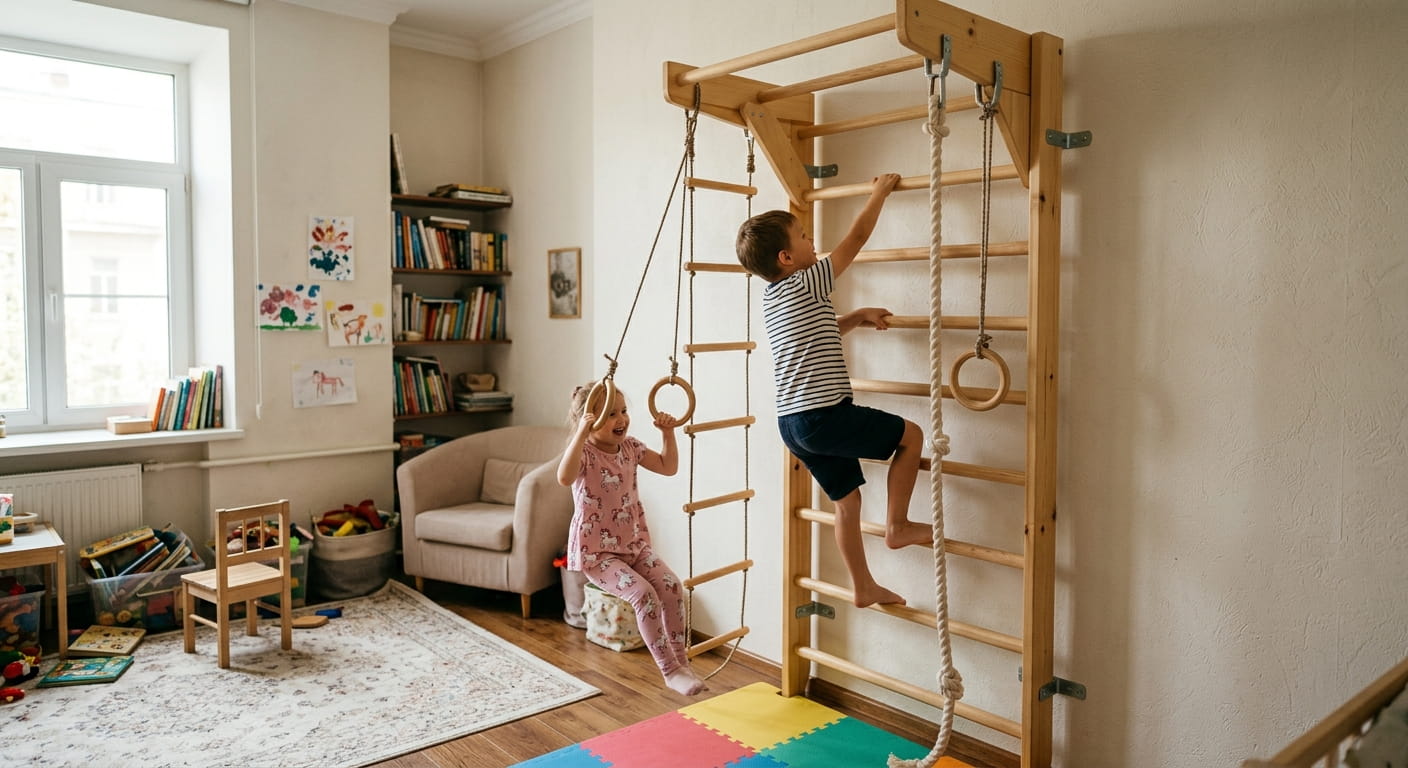
The "Maugli" model: rope, rings, rope ladder
"Maugli" is a basic set of children's wall bars from $92: a straight ladder with classic rungs plus a hanging kit — climbing rope, gymnastic rings and a rope ladder. The dimensions and load are sized for a child's height and weight, not scaled down from an adult range. Price: from $92.
Like the other models, "Maugli" is built from glued beam and hardwoods and coated with the same hypoallergenic water-based finish. The fixings are concealed — metal ties are sunk into the beam, nothing sticks out or catches clothing during lively play. The kit includes instructions and all the fixings; assembly takes from one and a half to three hours. The warranty is 12 months, including the add-ons, except for natural wear of the ropes and textile elements.
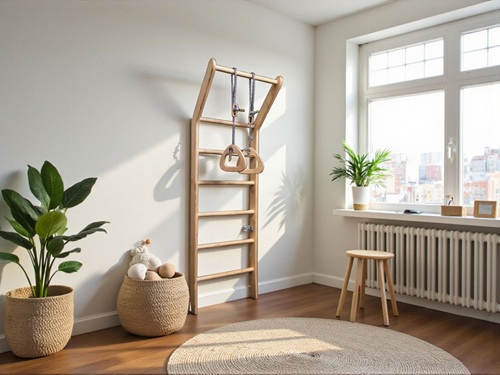
The logic is simple: a child's room is almost always smaller than an adult's, and a full-size unit with parallel bars and a bench simply will not fit or looks excessive in it. "Maugli" takes up as much floor as the other models — about 0.2 sq m — but in height and grip it is sized for a child, not for a six-foot-tall adult man.
The uprights on "Maugli," as in the rest of the range, are made of glued beam — pine or birch. Pine is lighter and a touch cheaper to produce, birch is denser and holds its shape better in high indoor humidity — for instance if the room faces the sunny side and is aired often in winter with temperature swings. The choice of species for a given home project is driven by the load calculation and the design, not by production whims — both options go through the same preparation and get the same hypoallergenic coating.
| Model | Type | Load | Feature for a child's room | Price from |
|---|---|---|---|---|
| "Maugli" | Children's: rope/rings/ladder | 120–150 kg | Fully sized to a child's height and grip | from 92 |
| "Minsk Sport" | Modular, adjustable add-ons | 120–150 kg | Add-ons move up and down — grows with the child | from 174 |
| "Krepysh" | I-shaped, narrow piers | 120–150 kg | Compact, suits a tight child's room | from 198 |
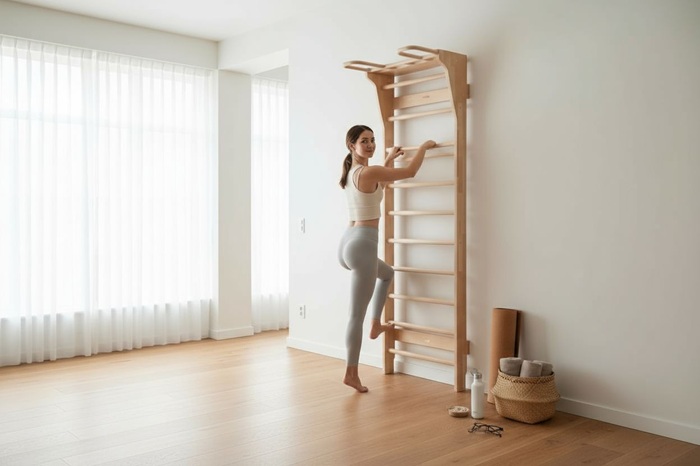
Wall bars for kids in the room's interior
A sports corner does not have to clash with the interior in bright plastic parts — a wooden unit in a light finish sits calmly within a Scandinavian style, and one tinted to match the furniture blends in against a wardrobe no worse than a shelving unit. Wood works in its favour here: it does not "shout" in colour the way typical outdoor metal structures brought into an apartment do.
There are two workable placements. The first is against a blind wall with no windows or radiators, so the sun and heating do not dry the wood unevenly. The second is in a corner of the room, if the type of fixing allows: a corner placement saves free floor for other games and furniture, and the wall bars for kids read visually as part of the room rather than a standalone machine.
Near the climbing zone it is worth clearing away furniture with sharp corners and not placing the unit right up against a bed or a desk — free space for landing is needed not only under the rungs but to the sides too, especially if the kit includes swinging elements such as a rope or rings.
The mat under the unit can be matched to the colour of the floor or the rug — the maker does not tie the family to a standard grey covering, and the safety function does not depend on the shade.
A comparison with ready-made play corners from the shop usually comes out in favour of the wooden unit: plastic home sets are more often designed for a couple of years of active use, whereas wooden wall bars, cared for properly, serve both the older and the younger child in the family and then often move house with them.
Add-ons for children: rings, rope, ladder
The base of the unit is the uprights and rungs, but the character of a children's set is defined by the add-ons. Rings teach the child to spread weight across both arms and hold the body straight. The rope is a story of its own: climbing it is harder than it looks, and it is one of the most honest grip and arm-strength workouts for a school-age child. A rope ladder is softer than a rigid one, springs a little and sways — extra coordination work that the rigid rungs do not give.
For older children, closer to seven or nine years, a removable pull-up bar at a suitable height and low parallel bars are added to the mix — the same principle as in adult models with bars, only adapted to a smaller stature. If there is an age gap between children in the family, it is handier to fit a model with several mounting points for the add-ons — then the older one swings on the rings while the younger masters the lower rungs.
Resistance bands are usually left for a more grown-up stage — around ten or eleven, when the child already works with resistance consciously and understands the technique rather than just tugging rubber out of curiosity. Before that age the rope, rings and pull-ups on the rung already provide the main load, which is enough to keep the back and arm muscles toned without special strength apparatus.
The advantage of the gradual add-on approach is that the wooden ladder-wall stays the same piece of furniture in the room for years — only what is hung on it changes. The child is not upset by a change of surroundings every couple of years, and the parents do not have to dismantle one unit and mount another at the same point on the wall.
When the child grows up and classic rungs with rings are no longer enough, the logical next step is often a unit with a full pull-up bar and monkey bars — it is worth looking at wall bars with a pull-up bar and monkey bars, already designed for a more grown-up load and long traverses along the rungs.
Fixing wall bars for kids in an apartment
The type of fixing is chosen not by preference but by the walls and ceiling of the particular room — here the material matters more than taste. Wall-mounted, or anchor, fixing is the most rigid of all, but it needs a structural wall: concrete or solid brick. You must never fix it to plasterboard under any circumstances — the partition simply will not bear the load from an active child.
Pressure mounting works on a floor-to-ceiling, screw-tensioned system, with no drilling of the walls — an option for rented housing or thin partition walls not designed for anchors. It has its own requirement: the ceiling height must be in the 2.40–3.10 m range. And an important ban: such a fixing is not used under stretch or suspended ceilings — the structure would push not against a rigid slab but against a decorative sheet, and a reliable hold would not be achieved.
| Type of fixing | Where it suits | Requirements | When to choose it for a child's room |
|---|---|---|---|
| Wall-mounted (anchor) | Concrete, solid brick | Not for plasterboard | Own house or apartment with structural walls — maximum rigidity |
| Pressure-mounted (floor-to-ceiling) | Rented home, thin partitions | Ceiling 2.40–3.10 m; not under stretch or suspended ceilings | Renting, or wanting to move the unit when relocating |
| Combined | Top reinforced models | Combines a wall-mounted and a pressure-mounted part | Active children and teenagers with a higher load on the unit |
If the apartment is rented and you would rather not drill the wall, the pressure-mounted version comes down and moves house with the family — more convenient than it first seems, because it leaves no marks on the walls and needs no repeated structural mounting. For more on installation options in your own home, see the wall bars for home page — that breakdown suits families with children and adult users alike.
In a typical panel or block apartment the load-bearing walls are usually concrete, while the internal partitions are often made of hollow brick or plasterboard on a frame — impossible to tell apart by eye until you start drilling. So before buying it is worth having at least a rough idea of the wall material in the child's room: anchor fixing of the wall bars for kids needs a genuinely structural pier, not a decorative partition between rooms.
The assembly instructions assume a DIY install, and the fixings in the kit suit standard walls. But if the wall material is in doubt — an old building, an unusual layout, a room zoned off with plasterboard — it is wiser to consult a fitter once than to move an anchor fixing to another spot later.
Assembly, warranty and care for children's wall bars
The unit goes together quickly — from one and a half to three hours, depending on the model and the set of add-ons. The kit includes instructions and all the fixings, with nothing to buy separately. The whole unit, including the add-ons, carries a 12-month warranty — the exception is fair and logical: natural wear of the ropes and textile elements such as the rope or ladder is not covered, because it depends on how intensively they are used, not on the quality of the build.
- Wipe with a dry or slightly damp cloth, without abrasive sponges or aggressive chemicals.
- Check the bolt tension every 3–6 months — especially if the child swings actively on the rings or rope.
- Keep the mat under the wall bars for kids permanently, rather than getting it out "for the occasion."
- Do not place the unit in direct sunlight or next to a radiator — changes in humidity and temperature can dry the wood out.
A separate practical point: the pressure-mounted structure must not go under a stretch ceiling — we mentioned this above, but will repeat it on its own — this is one of the most common mistakes when choosing a fixing yourself, and it is easier to head off in advance than to redo the install later.
Wood reacts to humidity and temperature more than it first seems. Near a radiator the air is drier, the beam may shrink slightly and lose tightness at the joints, while under direct sun on a windowsill it fades and changes shade unevenly — one side of an upright darker than the other. That is exactly why wall bars for kids are placed away from heating appliances and not right up against a south-facing window, even if the room's dimensions suggest that spot.
Checking the bolt tension every 3–6 months takes under ten minutes, but it is precisely what separates a unit that stands flawlessly for five years from one that develops slight play in a rung joint after a season. Children swing on the rope and rings more vigorously than adults, and the fixings at those points should be checked more often than the rest.
How to choose and order wall bars for kids
Boiled down to a short checklist before ordering, it goes like this: first the child's age and height — they set the height and rung spacing. Next the wall material and ceiling height — they determine the type of fixing. Then the size of the room, to see whether a model with parallel bars and a bench will fit or a compact option like "Maugli" or "Krepysh" is better. And only at the end the add-ons: rope, rings, ladder, a removable pull-up bar.
It is worth settling the budget question straight away too: the children's "Maugli" range is cheaper than adult models with bars and a bench, and there is no sense in overpaying for features the child does not yet need. You can always add to the add-ons or move to a more grown-up unit later, when the child has genuinely grown into it in height, rather than in advance "just in case."
When the child grows up and wants something more complex than vertical rungs, it makes sense to look toward models with holds and texture for climbing — for instance a wall bars climbing wall, which adds real wall-climbing to the classic unit, often more interesting to schoolchildren than plain rungs.
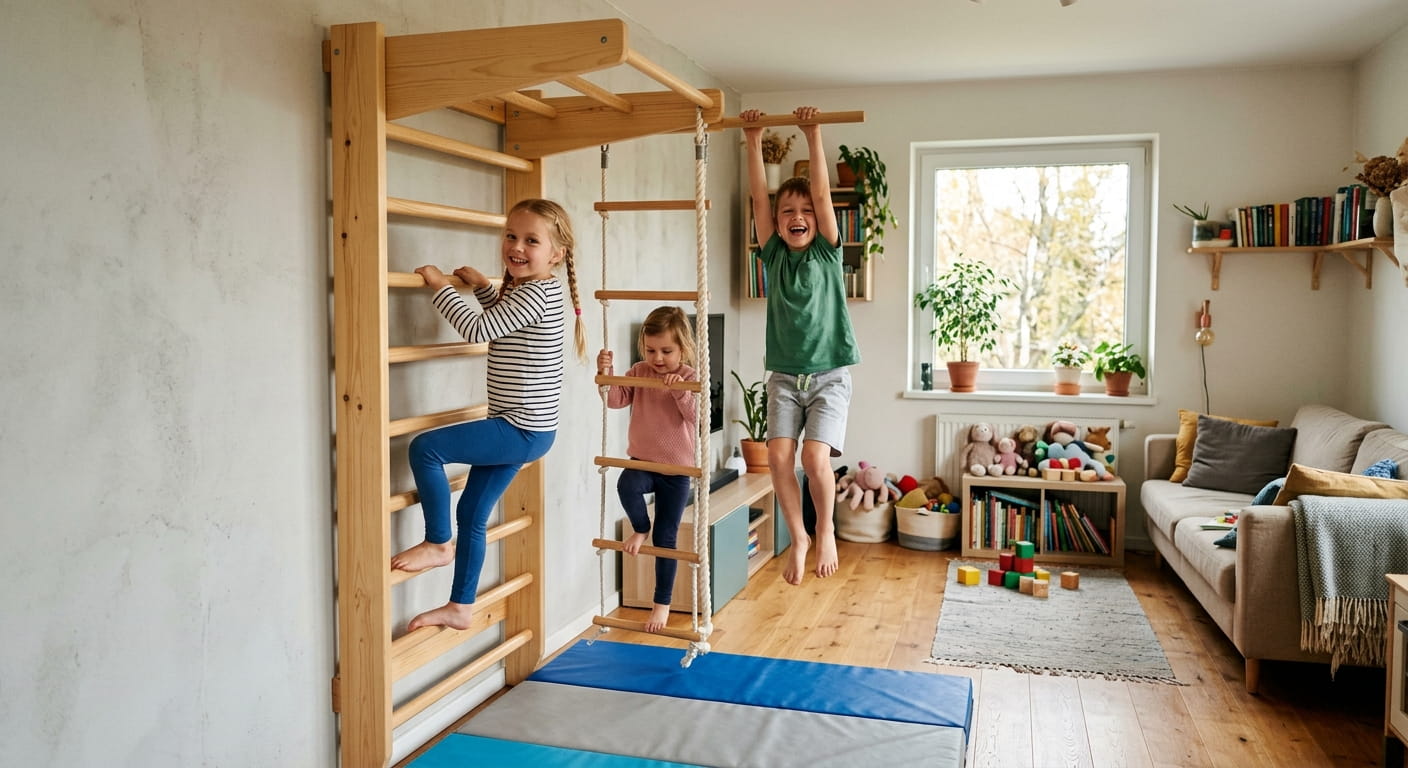
If there is more than one child in the family — close in age or a few years apart — the choice gets trickier, but not critically. A practical option is to take a model where the add-ons can be moved up and down, and simply change the position of the pull-up bar or rings as the younger one grows, rather than buying a separate unit for each. For two active children it helps to allow a slightly wider spacing between the uprights from the start, so they do not jostle elbows while climbing together.
If one child is clearly drawn to strength elements while the other prefers just to climb and hang, there is no need to argue over the one right model — the set of add-ons can be combined to suit both: rings for one, rope and rope ladder for the other, while the wall bars themselves stay the shared load-bearing structure for the whole family, parents included, if the model is rated for a load of 120 kg and up.
For wholesale buyers — nurseries, clubs, shops — there are separate terms: a minimum batch from 10 units, the option of your own brand, certificates of conformity, dispatch within 3–5 working days from stock and production of a new batch in 15–35 days. But for a family choosing a single set of wall bars for a child's apartment or house, the process is simpler: contact a manager, discuss the child's age and the room's parameters, and get a ready recommendation on model and fixing.

Putting together a unit that will last more than a year works out if you do not skimp on three things: the quality of the timber in the rungs, a fixing thought through for the particular wall, and a sensible margin in height. The rest — ropes, rings, the colour of the finish — is a matter of a family's taste and budget, not a question of safety.
The overall picture is simple: wall bars for kids are not a one-off buy for a single season but a piece of furniture that changes its role along with the child. First it is a support for the first confident steps and climbs, then a unit for ropes and rings, and by school age almost a full sports corner with a pull-up bar and parallel bars. That is exactly why it makes sense to think through the fixing and the height margin at the outset, rather than re-choosing a model every couple of years.
Expert opinion
In short: wall bars for kids pay off when they are chosen for a particular child rather than "to grow into in one click" — with a margin in height, but without losing the safety of the rung spacing and the grip. The difference between a good purchase and a unit that stands untouched after six months usually comes down to three things — the right fixing for the type of walls, a sensible choice of add-ons for the age, and the simple habit of checking the bolt tension once a season.
One thing to keep in mind separately: the "Maugli" model solves the task for junior and middle school age better than a pared-down adult range, and after seven or eight years it is easier to add more grown-up elements to the same unit than to buy a second from scratch. This approach saves both the family's budget and the space in the room.
— Veronika Tarasevich, internet marketer, specialist in semantics and content for product niches.